Steve had a 4 GPM pressure washer, but when he hooked it up to a 100-foot 1/4-inch hose, the pressure at the wand felt weak. By the time he was halfway through his driveway, it was taking twice as long as it should. The problem wasn’t his pump or his nozzle — it was the hose. When he switched to a 1/2 inch pressure washer hose, he got nearly all of his pressure back at the end of that run. That single change cut his cleaning time in half.
A 1 2 inch pressure washer hose (also written as 1/2″ ID hose) is a high-flow pressure washer hose with a 1/2-inch inner diameter. For higher-GPM machines, especially 4 GPM and above or long hose runs over 100 feet, a 1/2 inch pressure washer hose is often the difference between full power at the wand and a frustrating loss of pressure. This guide explains when you need 1/2-inch hose, how it compares to smaller diameters, pressure loss, and what to look for when buying one.
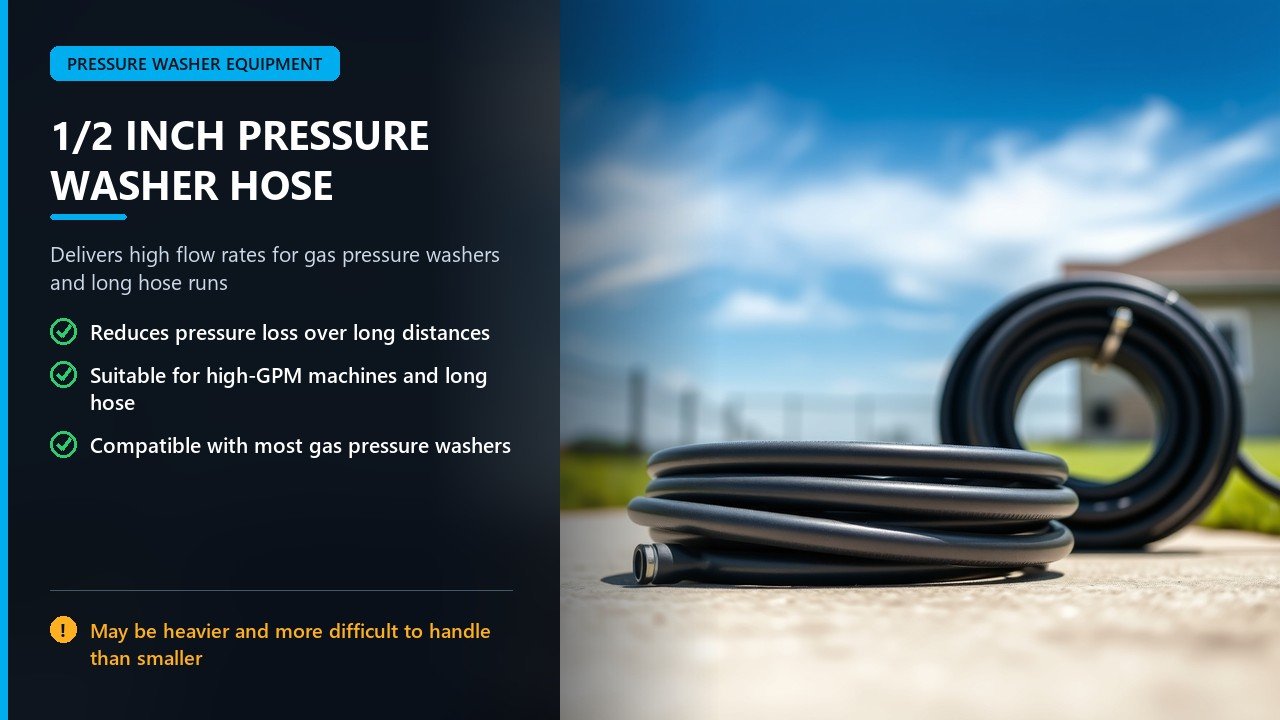
What Is a 1/2 Inch Pressure Washer Hose?
The “1/2 inch” refers to the inner diameter (ID) of the hose, not the outer diameter. A 1 2 inch pressure washer hose has a much larger bore than 1/4-inch or 5/16-inch hoses, so it can move more water with less resistance. That lower restriction means less friction loss over distance, which is critical for high-flow machines. If your pressure washer puts out 4 GPM or more, or you need to run 100+ feet of hose, stepping up to 1/2-inch is usually the right call.
These hoses are built for higher flow, not necessarily higher PSI. Most 1/2 inch pressure washer hoses are rated for 3000–4000 PSI, which matches most gas pressure washers. The key benefit is volume: they let the pump deliver its rated GPM to the wand without choking it down the line.
Why Hose Diameter Matters
Water moving through a hose creates friction against the inner wall. The smaller the diameter, the more friction per gallon. With high-GPM machines, that friction adds up fast and robs you of pressure at the gun. A 1/2 inch pressure washer hose has over twice the cross-sectional area of a 1/4-inch hose, so water flows much easier. That means more of your pump’s pressure actually reaches the nozzle.
The difference is huge on long runs. For example, a 4 GPM machine through 100 feet of 1/4-inch hose can lose 500+ PSI to friction. The same 4 GPM through 100 feet of 1/2-inch hose loses only about 25–50 PSI. That is the difference between a weak spray and full cleaning power.
| Hose ID | Typical For | Friction Loss @ 4 GPM / 100 ft | Notes |
|---|---|---|---|
| 1/4 inch | Electric, 1.5–2.5 GPM | ~500–560 PSI | Too restrictive for 4+ GPM |
| 5/16 inch | 2.5–3.5 GPM, short runs | ~170 PSI | Better than 1/4″, but still loses a lot at 4 GPM |
| 3/8 inch | 3–4 GPM, up to ~150 ft | ~45–50 PSI | Industry standard for many commercial rigs |
| 1/2 inch | 4–8+ GPM, 100+ ft runs | ~20–25 PSI | Minimal loss, best for high flow |
When Do You Need a 1/2 Inch Pressure Washer Hose?
You should consider a 1 2 inch pressure washer hose if your machine is 4 GPM or higher, especially if you run hose lengths of 100 feet or more. It is also a smart upgrade if you use a surface cleaner with a high-GPM machine, run multiple lances, or notice pressure drop at the end of your current hose. For machines under 3 GPM and runs under 75 feet, 3/8-inch is usually plenty. For very high-flow rigs (6–8+ GPM), 1/2-inch is often the minimum to keep performance where it should be.
A good rule of thumb: if flow is king for your work (big concrete, fleet washing, production jobs), go to 1/2-inch. If you mostly do small jobs with a 2–3 GPM washer, stick to 3/8-inch to save weight and cost.
PSI Rating and Hose Construction
A 1/2 inch pressure washer hose still needs the right PSI rating. Look for hoses rated at least 3000 PSI, and ideally 3500–4000 PSI for gas machines. Burst ratings are usually 4–5x the working pressure, but you should always match working PSI to your washer. Construction matters too: look for high-tensile wire braiding, abrasion-resistant outer cover, and solid fittings.
Non-marking outer covers are great if you drag the hose across concrete, decks, or finished surfaces. Some hoses come with bend restrictors at the ends to reduce kinking and extend life. Quick-connect fittings are convenient, but threaded M22 or 3/8″ NPT fittings are common — just make sure they match your gun, reel, and pump.
Weight and Handling
The tradeoff for less pressure loss is weight. A 1 2 inch pressure washer hose is heavier and stiffer than a 3/8-inch hose, especially when filled with water and stretched to 100+ feet. That extra weight can wear you out faster if you are dragging it all day. Many pros solve this by running 1/2-inch from the reel to a shorter 3/8-inch whip at the gun — you keep most of the flow benefit while keeping the end lighter and more maneuverable.
If you rarely go past 75 feet, 3/8-inch is usually easier to handle. If you regularly run 150 feet for big jobs, the productivity gain from 1/2-inch almost always outweighs the extra weight.
Fittings, Length, and Compatibility
Pay close attention to fittings. Common setups use M22 connectors (14mm or 15mm), 3/8″ quick-connect, or 3/8″ NPT. Make sure both ends match your equipment. Also consider hose length: buying a longer hose is tempting, but longer runs mean more friction even with 1/2-inch. Buy only as much length as you actually need.
If you have a hose reel, check its capacity for 1/2-inch hose. A 1/2 inch pressure washer hose is bulkier than 3/8-inch and takes more room on the reel. Some reels are rated for 3/8-inch only and will not handle 1/2-inch without binding.
Pros and Cons of a 1/2 Inch Pressure Washer Hose
Pros: Minimal pressure loss on long runs and high-GPM machines, restores full cleaning power, better for surface cleaners and production work, reduces pump strain from excessive restriction, ideal for 4–8+ GPM rigs.
Cons: Heavier and less flexible, bulkier on reels, more expensive than 3/8-inch, overkill for low-GPM electric washers and short runs.
Who Should Buy One
A 1 2 inch pressure washer hose is the right choice for contractors, commercial cleaners, or serious DIYers running 4 GPM or higher with 100+ foot runs. It is also great for anyone using a large surface cleaner on a high-flow machine. If you have a 2–3 GPM electric or light gas washer and run 50–75 feet, a 3/8-inch hose is more than enough and much easier to handle.
Final Thoughts
Hose diameter is the most overlooked factor in getting full power to the wand. For high-flow machines and long runs, a 1/2 inch pressure washer hose is worth every penny. It slashes friction loss, keeps your pressure where it belongs, and makes big jobs faster and less frustrating. Match the hose to your GPM and typical run length, and you will feel the difference the first time you pull the trigger.