 <h1>A Best Power Washer Accessories Guide: The Add-Ons That Earn Their Keep</h1>
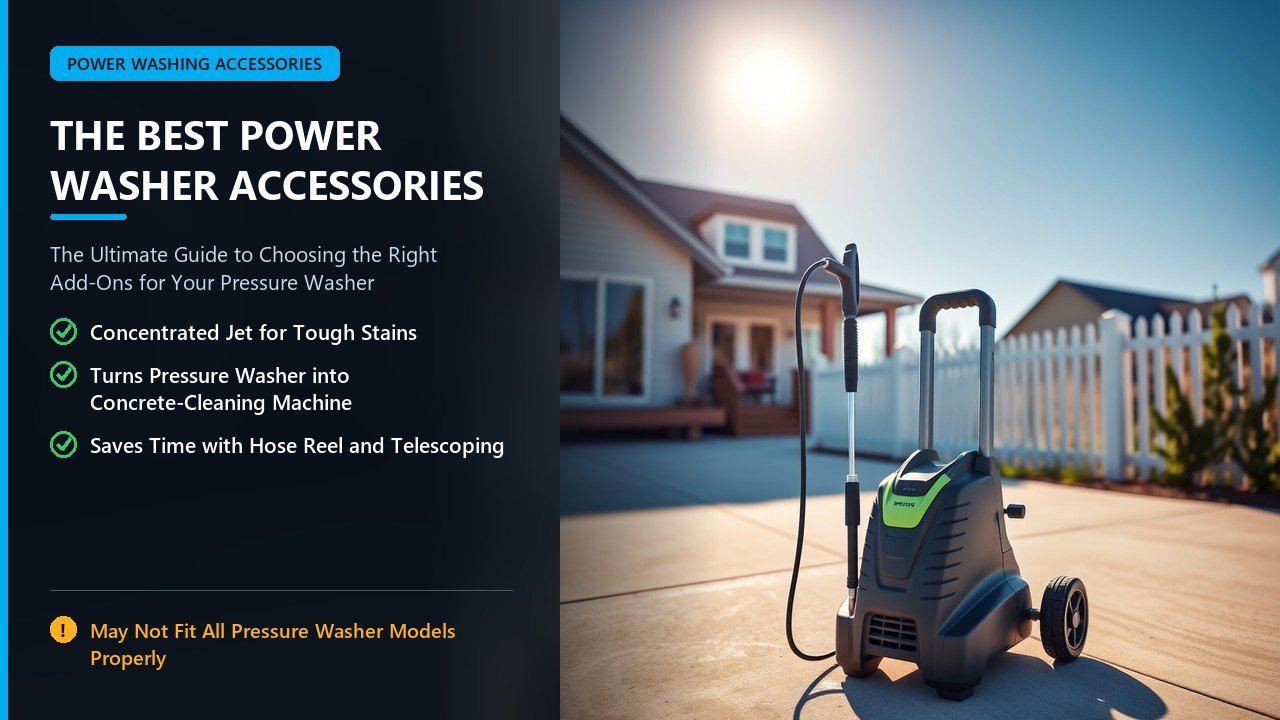
<p>"<strong>Best power washer accessories</strong>" can mean a hundred different things depending on who you ask, because the right add-on changes with the machine and the job. A surface cleaner is the accessory that turns your pressure washer into a concrete-cleaning machine. A turbo nozzle concentrates the jet for stains that laugh at a wide fan. A hose reel ends the tangle that eats half your working time. And a telescoping wand lets you clean gutters and second-story siding from the ground.</p>
<p>This guide sorts the genuinely useful add-ons from the filler, explains what each one does, how to choose the right size for your specific pressure washer, and where the money goes farthest and where it gets wasted. If you own a gas machine in the 3,000 PSI class or an electric unit around 1.5 GPM, the accessories below are ranked by how much they change your real-world results per dollar spent.</p>
<div style="border-left: 4px solid #0d6efd; background: #f0f7ff; padding: 14px 18px; margin: 18px 0; border-radius: 4px;">
<p style="margin: 0;"><strong>Quick Note:</strong> The best power washer accessories are rated to your machine's pressure and flow, use the same fitting standard on your gun and wand, and solve one specific job. Match those three things and a mid-priced accessory beats a flashy mismatch every time.</p>
</div>
<h2><strong>What Makes an Accessory "Best" for Your Machine</strong></h2>
<p>A dozen lists call one surface cleaner the "best," and another dozen pick a different one. The truth is that every accessory in this guide has a right size and a wrong size for your machine — and the "best" is the one rated to match.</p>
<p>The three things that decide compatibility are pressure rating, flow rating, and fitting standard. Pressure is simply the maximum PSI the part can handle; flow is the maximum GPM it is designed for. A surface cleaner rated for 4,000 PSI that needs 4 GPM to spin properly will feel weak on a 2.5 GPM machine, while a gun rated at 5,000 PSI on a 2,000 PSI electric unit is overkill but harmless. The fitting standard matters most of all, because almost every consumer gun and lance in North America uses a 1/4-inch quick connect, while many European and current electric brands use M22 threaded fittings or proprietary bayonet mounts. Measure your own connections before buying, as shown in our <a href="https://turboclean.tech/hose-fittings-for-pressure-washer-how-to-build-a-leak-free-connection/">pressure washer hose fittings guide</a>.</p>
<p>Finally, decide what you actually clean. The best power washer accessories for a homeowner who only does the driveway are different from the kit a restoration shop needs. The table below is the honest shortlist, ranked by how often each accessory solves a job that is painful without it.</p>
<p>A reasonable rule of thumb for most households is to spend roughly ten to twenty percent of the price of the machine on accessories in the first season, then add as jobs demand. That budget buys the tier of parts above but skips the impulse purchases. If a job comes along three times a year, the accessory for it earns its keep; if it has never come along, no bargain price changes that.</p>
<table style="border-collapse: collapse; width: 100%; margin: 16px 0; font-size: 14px;">
<thead>
<tr style="background-color: #f8f9fa;">
<th style="border: 1px solid #6c757d; padding: 10px; text-align: left;">Accessory</th>
<th style="border: 1px solid #6c757d; padding: 10px; text-align: left;">Solves This Job</th>
<th style="border: 1px solid #6c757d; padding: 10px; text-align: left;">Best For</th>
<th style="border: 1px solid #6c757d; padding: 10px; text-align: left;">Typical Price</th>
</tr>
</thead>
<tbody>
<tr><td style="border: 1px solid #6c757d; padding: 10px;">Surface cleaner</td><td style="border: 1px solid #6c757d; padding: 10px;">Driveways, patios, sidewalks</td><td style="border: 1px solid #6c757d; padding: 10px;">Flatwork in half the time</td><td style="border: 1px solid #6c757d; padding: 10px;">$80 to $250</td></tr>
<tr><td style="border: 1px solid #6c757d; padding: 10px;">Turbo nozzle</td><td style="border: 1px solid #6c757d; padding: 10px;">Stubborn oil and grime spots</td><td style="border: 1px solid #6c757d; padding: 10px;">Stains, concrete, concrete driveways</td><td style="border: 1px solid #6c757d; padding: 10px;">$20 to $40</td></tr>
<tr><td style="border: 1px solid #6c757d; padding: 10px;">Telescoping wand</td><td style="border: 1px solid #6c757d; padding: 10px;">Second-story siding, gutters, eaves</td><td style="border: 1px solid #6c757d; padding: 10px;">Reach without a ladder</td><td style="border: 1px solid #6c757d; padding: 10px;">$40 to $100</td></tr>
<tr><td style="border: 1px solid #6c757d; padding: 10px;">Trigger gun</td><td style="border: 1px solid #6c757d; padding: 10px;">Loose, leaking, or awkward control</td><td style="border: 1px solid #6c757d; padding: 10px;">Comfort and trigger lock</td><td style="border: 1px solid #6c757d; padding: 10px;">$30 to $90</td></tr>
<tr><td style="border: 1px solid #6c757d; padding: 10px;">Hose reel</td><td style="border: 1px solid #6c757d; padding: 10px;">Tangled high-pressure hose</td><td style="border: 1px solid #6c757d; padding: 10px;">Setup and teardown speed</td><td style="border: 1px solid #6c757d; padding: 10px;">$60 to $200</td></tr>
<tr><td style="border: 1px solid #6c757d; padding: 10px;">Foam cannon</td><td style="border: 1px solid #6c757d; padding: 10px;">Car washing and soap dwell</td><td style="border: 1px solid #6c757d; padding: 10px;">Detergent coverage</td><td style="border: 1px solid #6c757d; padding: 10px;">$20 to $60</td></tr>
<tr><td style="border: 1px solid #6c757d; padding: 10px;">Nozzle kit</td><td style="border: 1px solid #6c757d; padding: 10px;">Missing or worn tips</td><td style="border: 1px solid #6c757d; padding: 10px;">All-purpose backup</td><td style="border: 1px solid #6c757d; padding: 10px;">$15 to $40</td></tr>
<tr><td style="border: 1px solid #6c757d; padding: 10px;">Gutter kit</td><td style="border: 1px solid #6c757d; padding: 10px;">Clogged or muddy gutters</td><td style="border: 1px solid #6c757d; padding: 10px;">Gutter cleaning from the ground</td><td style="border: 1px solid #6c757d; padding: 10px;">$20 to $60</td></tr>
</tbody>
</table>
<h2><strong>Surface Cleaner: The Biggest Time-Saver</strong></h2>
<p>If only one accessory ever makes its way onto your pressure washer, a surface cleaner is the one. A rotating two-nozzle head spins under a shroud that traps splash, scrubbing a clean strip roughly the width of the unit with zero streaks and near-zero overspray. The same driveway that took an hour of fan-pattern passes takes a quarter of the time with a 16-inch model.</p>
<p>Sizing is where most mistakes happen. A 16-inch stainless unit is the sweet spot for gas machines in the 3,000 to 3,600 PSI range. Smaller 12-inch units suit smaller engines but crawl. Larger 18 to 21-inch units cut faster but need serious flow to spin, so check the manufacturer's minimum GPM. On electric machines, a 12-inch unit keeps the pump happy. Stainless steel bodies and sealed bearings cost more than plastic but survive years of abrasive cleaning; our <a href="https://turboclean.tech/surface-cleaner-for-a-pressure-washer-how-to-choose-and-use-one/">surface cleaner buying and use guide</a> walks through the sizes and the technique, and our <a href="https://turboclean.tech/pressure-washer-attachments-surface-cleaner-the-tool-that-cuts-cleaning-time-in-half/">attachments write-up</a> covers the practical difference on a real patio.</p>
<p>Notable sellers here include the SIMPSON universal models rated up to 4,500 PSI, the SurfaceMaxx stainless range in 14 to 21-inch sizes, and the Westinghouse 16.5-inch units that bundle with hose and fitting options. Buy the widest head your machine can spin, and buy stainless unless budget forces plastic.</p>
<h2><strong>Turbo Nozzle: Pinpoint Power in a Wide Swath</strong></h2>
<p>A turbo nozzle — also called a rotary or pulsating nozzle — takes the pinprick power of a zero-degree tip and spins it in a cone, so you get cutting force across a wider area instead of one dangerous dotted line. It is the accessory that finally shifts caked-on oil, brake dust, mildew shadows, and barnacles that a 25-degree fan merely wets down.</p>
<p>Because the zero-degree core of the stream is involved, a turbo nozzle deserves respect: it can cut into concrete or wood if you hold the pattern in one place. Keep it moving, keep it off softwood and caulk, and never let a pet or child in line with it. Ratings matter, too — pick a nozzle rated for your machine's PSI (most universals cover up to 4,000 or so). Big names include the SIMPSON universal turbo nozzle, AR Blue Clean rotary nozzles, and the classic brass-bodied turbos from Westinghouse.</p>
<p>Our <a href="https://turboclean.tech/a-pressure-washer-turbo-nozzle-packs-pinpoint-power-into-a-wide-swath/">turbo nozzle guide</a> explains the rotary-versus-fixed decision, and our <a href="https://turboclean.tech/pressure-washer-nozzle-guide-pick-the-right-tip-for-every-job/">overall nozzle guide</a> lines the turbo up against the fixed color-coded tips it competes with.</p>
<h2><strong>Telescoping and Extension Wands: Reach Without a Ladder</strong></h2>
<p>Ladders and pressure washers do not mix. A telescoping wand extends your reach several feet over your head, cleaning gutters, soffits, second-story siding, and roof edges with both feet on the ground. It is the rare accessory that is partly a safety device, and for two-story houses it is worth its weight before the first burst of a ladder.</p>
<p>Two flavors exist. A rigid extension wand clicks between the gun and the lance to add reach on flat ground or low walls, cheap and simple. A telescoping wand pushes or locks out with an internal collar for variable reach and often carries its own trigger so your pressure stays on while you aim. Check the collapsed length against your vehicle, the extended length against your eave height, and the rated PSI against your gun. Our <a href="https://turboclean.tech/a-power-washer-telescoping-extension-wand-reaches-the-second-story-without-a-ladder/">telescoping wand guide</a> covers measurement tricks and ours on <a href="https://turboclean.tech/gutter-cleaning-with-a-pressure-washer-step-by-step-and-attachments/">gutter cleaning with a pressure washer</a> shows the full gutter workflow.</p>
<h2><strong>Trigger Gun: The Part Your Hand Learns to Love</strong></h2>
<p>The factory gun is the most uncomfortable part of many budget machines, with stiff triggers, a clumsy grip, and quick connects that leak after a season. A quality aftermarket trigger gun with an ergonomic handle, an indexed rotating collar, and a proper locking trigger makes every job easier and safer. This is pure "feel" hardware, so holding one in a store tells you more than any spec sheet.</p>
<p>Beyond comfort, a better gun pays off in slower fatigue across a big driveway job and in safer handling when you pause to reposition. A gun with a trigger lock lets you rest without letting water idle through the pump, and a swivel collar lets the hose trail naturally instead of fighting your wrist. For review-heavy buyers, note the ergonomic differences between "pistol" and "staff" style guns — the former is precise, the latter suits long wands at height, and many pros keep both.</p>
<p>Buy for your fitting standard (1/4-inch quick connect is the norm), confirm the PSI rating, and look for a gun that stores your nozzles. Mid-range guns from SIMPSON, Mi-T-M, and SurfaceMaxx are rated to 4,000 to 5,000 PSI and accept any quick-connect tip. Our <a href="https://turboclean.tech/a-power-washer-trigger-gun-how-to-choose-fit-and-upgrade-one/">trigger gun guide</a> covers fitting and upgrading, and our <a href="https://turboclean.tech/pressure-washer-guns-and-wands-work-as-one-system-that-decides-how-every-job-feels/">gun-and-wand overview</a> explains why the two work as one system.</p>
<h2><strong>Hose Reel: The Tangle Cure</strong></h2>
<p>Half the frustration of pressure washing is the hose: it kinks, twists, snags corners, and lies in a wet coil waiting to trip you. A hose reel mounted on the frame or a wall holds 50 to 100 feet of high-pressure hose and winds it back in seconds, protecting the hose from sunlight and kink damage while it stores.</p>
<p>Two types dominate the market. A cart-mounted or wall-mounted manual reel is simple, cheap, and reliable, while a spring-driven rewind reel pulls the hose in by itself and costs more. Match the reel's hose rating to your machine and buy a reel rated at or above your machine's PSI. Our <a href="https://turboclean.tech/hose-reel-for-a-pressure-washer-how-to-add-one-to-your-machine/">how to add a hose reel</a> guide and the <a href="https://turboclean.tech/best-hose-reel-for-a-pressure-washer-picks-by-job-not-by-price/">best hose reels by job</a> article handle the full decision, from mounting height to hose-swivel quality.</p>
<h2><strong>Foam Cannon and Soap Systems: Detergent Done Right</strong></h2>
<p>Detergent is the half of pressure washing that does the actual dissolving; the pressure just rinses it away. A foam cannon attaches to the end of the lance, sucks chemical from a draw tube, and lays a thick, clinging foam that dwells on paint, siding, and grime while you work a neighbouring panel. The abrasive-free foam is gentle enough for car paint and makes wash-and-wax routines genuinely enjoyable.</p>
<p>Match the cannon to your flow, not just your PSI — a large orifice cannon on a small electric machine overwhelms the pump with foam instead of pressure. For an adjustable, jerry-built approach, an upstream detergent injector mounted before the gun does similar work with any nozzle. Brands like SurfaceMaxx and Simpson sell foam cannons rated up to 4,000 PSI, and the Westinghouse foam cannon bundles with their accessories kit. Extra detergents and soaps are worth planning too; our <a href="https://turboclean.tech/pressure-washer-bottle-the-complete-2026-guide-to-soap-and-detergent/">soap and detergent guide</a> explains how your tank or injector delivers them.</p>
<h2><strong>Nozzle Kit: The Cheap Backup That Prevents Bad Days</strong></h2>
<p>A full color-coded nozzle kit costs less than one tank of gas for your washer and covers the most common failure on an older machine: a worn, clogged, or missing tip. Abrasive water slowly erodes nozzle orifices, and a tired tip sprays weak or wide with no obvious symptom. Swapping in a fresh set restores pressure instantly.</p>
<p>Buy a kit that matches the size and thread of your existing tips — most universals use a 1/4-inch quick connect with a standard color code (white for 40 degrees, green 25, yellow 15, red 0, black for soap). Our <a href="https://turboclean.tech/pressure-washer-nozzle-color-code-know-which-tip-to-use-every-time/">nozzle color code guide</a> teaches the chart in thirty seconds, and our <a href="https://turboclean.tech/jet-nozzle-for-pressure-washer-pick-the-right-tip-for-every-surface/">jet nozzle guide</a> matches tips to surfaces.</p>
<h2><strong>Hoses and Fittings: The Quiet Unsung Upgrades</strong></h2>
<p>Everyone upgrades the visible bits and ignores the workhorses: the high-pressure hose and the garden hose feeding it. A longer, kink-resistant high-pressure hose extends reach and keeps pressure steady, and a matched set of brass quick connects and garden hose fittings removes the wobble and weep that steal pressure at every joint.</p>
<p>If you run an electric machine, an <a href="https://turboclean.tech/an-electric-power-washer-hose-that-resists-kinks-changes-everything/">electric-friendly kink-resistant hose</a> changes the feel of the job. Gas users benefit from our <a href="https://turboclean.tech/a-3-8-inch-pressure-washer-hose-is-the-standard-high-flow-choice/">3/8-inch standard hose explainer</a>, and the garden side is covered in our <a href="https://turboclean.tech/a-pressure-washer-garden-hose-set-up-right-keeps-your-machine-fed-and-strong/">garden hose setup guide</a>. Fittings, couplings, and the whole leak-free connection picture live in our <a href="https://turboclean.tech/hose-fittings-for-pressure-washer-how-to-build-a-leak-free-connection/">hose fittings guide</a> and our <a href="https://turboclean.tech/pressure-washer-coupling-join-hoses-and-kill-the-twist/">coupling guide</a>.</p>
<h2><strong>Gutter Kit: A Ladder-Free Safety Move</strong></h2>
<p>A dedicated gutter-cleaning attachment shoots a pressurised column of water through 90-degree elbow(s) so you stand on the ground and flush leaves, silt, and muck out of rain gutters. It is cheap, dumb, and enormously useful, and it keeps you off a ladder for the most dangerous chore around a house.</p>
<p>Good kits use a solid feed through the elbow (so the flow does not kink), a trigger pass-through, and a tip with enough punch to pry suctioned sludge loose. Our <a href="https://turboclean.tech/gutter-cleaning-with-a-pressure-washer-step-by-step-and-attachments/">gutter cleaning guide</a> walks the whole process from ladder-free to finish and discusses what real gutter rigs are rated for.</p>
<h2><strong>Which Accessories Are Honestly Overrated</strong></h2>
<p>Equal time for the ones that sound great and disappoint. Shockingly cheap "universal accessory kits" that bundle six nozzles, a brush, and a broom for a few dollars are usually built around the wrong fitting standard or plastic parts that crack. Rotating car-wash brushes agitate paint if you press too hard on grit. "Undercarriage cleaners" with a tiny orifice need serious flow and are a near miss for most homeowners. And any accessory that advertises infinite pressure without a rating is a fake.</p>
<p>The honest advice: buy from known brands (SIMPSON, Mi-T-M, Westinghouse, SurfaceMaxx, AR Blue Clean), match the rating, and ignore anything presented with a price too good to be true. Cheap quick connects leak at 3,500 PSI and give the good ones a bad name, which is why the cheap all-in-one kits wind up in a drawer.</p>
<p>When you see a bargain bundle, do the arithmetic on the useful pieces before you celebrate the deal. A kit priced at twice a good surface cleaner alone usually ships the surface cleaner you least want, plus fittings you cannot use. The accessory market rewards buyers who name the job first and shop second.</p>
<div style="border-left: 4px solid #198754; background: #f0fff4; padding: 14px 18px; margin: 18px 0; border-radius: 4px;">
<p style="margin: 0;"><strong>Buying Order Recommendation:</strong> Surface cleaner first, then a turbo nozzle, then a hose reel or trolley, then a telescoping wand, then foam cannon and nozzle kit. That order attacks the biggest time losses cheapest first.</p>
</div>
<h2><strong>Common Mistakes When Buying Accessories</strong></h2>
<ul>
<li><strong>Buying the biggest surface cleaner instead of the right one.</strong> A 21-inch unit on a 2.5 GPM machine spins slowly and leaves streaks; size for your machine's flow, not your ego.</li>
<li><strong>Ignoring the fitting standard.</strong> M22 threaded parts rarely adapt cleanly to 1/4-inch quick-connect guns. Confirm your weapon before checkout.</li>
<li><strong>Overbuying PSI.</strong> A 5,000 PSI reel on a 2,000 PSI electric unit wastes money and adds weight; buy "at or just above" your machine's rating.</li>
<li><strong>Trusting unrated plastic.</strong> Watch the word "unrated" or missing ratings on metal-to-plastic connectors; the burst risk is real.</li>
<li><strong>Skipping the detergent step.</strong> The best accessory money in cleaning is often chemical, not hardware. If you hate foaming, you are leaving half the result on the table.</li>
</ul>
<h2><strong>What Electric and Gas Machines Need Differently</strong></h2>
<p>The same accessory fitted to an electric machine and a gas machine behaves completely differently, because the two classes have different pressure and flow curves. Electric units typically run 1,600 to 2,000 PSI at around 1.4 to 1.8 GPM, while gas engines pressurize 2,800 to 4,000 PSI with two to four times the flow. Flow is what spins a surface cleaner, feeds a foam cannon, and keeps a turbo nozzle's pattern alive.</p>
<table style="border-collapse: collapse; width: 100%; margin: 16px 0; font-size: 14px;">
<thead>
<tr style="background-color: #f8f9fa;">
<th style="border: 1px solid #6c757d; padding: 10px; text-align: left;">Accessory</th>
<th style="border: 1px solid #6c757d; padding: 10px; text-align: left;">Electric Machines</th>
<th style="border: 1px solid #6c757d; padding: 10px; text-align: left;">Gas Machines</th>
</tr>
</thead>
<tbody>
<tr><td style="border: 1px solid #6c757d; padding: 10px;">Surface cleaner</td><td style="border: 1px solid #6c757d; padding: 10px;">Stick to 12-inch heads; big discs stall</td><td style="border: 1px solid #6c757d; padding: 10px;">14 to 21-inch heads shine</td></tr>
<tr><td style="border: 1px solid #6c757d; padding: 10px;">Turbo nozzle</td><td style="border: 1px solid #6c757d; padding: 10px;">Smaller orifice; work in slow sweeps</td><td style="border: 1px solid #6c757d; padding: 10px;">Full-size pattern melts grime</td></tr>
<tr><td style="border: 1px solid #6c757d; padding: 10px;">Foam cannon</td><td style="border: 1px solid #6c757d; padding: 10px;">Pick a small orifice; lose pressure fast otherwise</td><td style="border: 1px solid #6c757d; padding: 10px;">Standard orifice with rich foam</td></tr>
<tr><td style="border: 1px solid #6c757d; padding: 10px;">Telescoping wand</td><td style="border: 1px solid #6c757d; padding: 10px;">Great for gutters at arm's length</td><td style="border: 1px solid #6c757d; padding: 10px;">Reaches eaves comfortably</td></tr>
<tr><td style="border: 1px solid #6c757d; padding: 10px;">Hose reel</td><td style="border: 1px solid #6c757d; padding: 10px;">Lightweight reel fits the machine</td><td style="border: 1px solid #6c757d; padding: 10px;">Wall or cart-mounted 100-ft setups</td></tr>
</tbody>
</table>
<p>The practical rule is simple: flow-hungry accessories (surface cleaners, foam cannons, water brooms, undercarriage washers) favor gas machines; pressure-sensitive ones (turbo nozzles, 15-degree jets) work on both but need gentle technique on electrics. If you own an electric unit and are considering a surface cleaner, read the manufacturer's minimum flow before purchasing — it is the spec that makes or breaks the purchase.</p>
<h2><strong>Accessory Sets Versus Buying Pieces Individually</strong></h2>
<p>Retailers love to package "complete accessory kits" that promise a gun, five nozzles, a surface cleaner, a brush, and a foam cannon for one tempting price. Some of those kits are legitimate bundles of decent parts; most are a loss-leader mix where one star item drags three pieces of plastic filler along with it.</p>
<p>The smarter move for most owners is to buy the two or three accessories that matter individually, from brands with ratings you can verify. If a set is genuinely cheaper than its parts, count the cost of the useful bits before you feel clever. In practice, quality replacement nozzles and a good trigger gun are the parts most worth buying as spares, while surface cleaners and reels are best chosen to your machine rather than grabbed from a bundle.</p>
<p>One exception is the quick-connect fitting family: a matched set of brass quick connects and adapters is cheap, useful, and nearly impossible to overspend on, because every future accessory will attach through them. Keep a small kit of O-rings and a spare quick connect in the box, and you will never white-knuckle a leak at height.</p>
<h2><strong>Maintaining Your Accessories</strong></h2>
<p>Accessories wear out quietly and drag results down before you notice. Abrasive grit in the water erodes nozzle orifices, so pressure drops even though the pump still reads fine. O-rings dry out and crack, and quick connects begin to weep. The fix is a five-minute annual routine: flush tips with the needle tool after gritty work, keep a small stock of O-rings in the right sizes, wax or oil brass threads, and store surface cleaners upside down so their bearings shed water between uses.</p>
<p>Watch your high-pressure hose for the first sign of a bulge or a soft spot; a failing hose is the accessory most likely to fail dramatically, and our <a href="https://turboclean.tech/pressure-washer-high-pressure-hose-choose-one-that-lasts/">high-pressure hose buying guide</a> explains the ratings that keep yours intact. A little care extends every accessory several seasons, which is precisely how the "best" list stays affordable.</p>
<h2><strong>Frequently Asked Questions</strong></h2>
<p><strong>What is the difference between a turbo nozzle and a surface cleaner?</strong> A turbo nozzle concentrates one zero-degree stream into a spinning cone for cutting powerful stains in a small band, while a surface cleaner spins two wide tips under a shroud to scrub a broad flat area evenly with far less splash.</p>
<p><strong>Can I use a surface cleaner on a deck or fence?</strong> Only on flat, durable boarding if the machine and head are gentle. Wood is soft enough to be gouged by the rotating tips, and screws and nails catch the edges. Concrete and stone are the sweet spot.</p>
<p><strong>Do I need a hose reel if I wash occasionally?</strong> A wall-mounted reel is still worth it: it protects the hose from kinks and sunlight, keeps the garage tidy, and makes every session ten minutes shorter. Occasional users notice it more, not less.</p>
<p><strong>What is the single best power washer accessory?</strong> For gas machines, a stainless surface cleaner in the right width. For every machine, a turbo nozzle for tough spots and a good trigger gun for comfort.</p>
<p><strong>Do accessories work on any pressure washer?</strong> They work when the fitting matches and the rating covers your machine's pressure and flow. Check quick connect or M22, max PSI, and minimum GPM before buying.</p>
<p><strong>Is a foam cannon worth it?</strong> Yes, if you wash vehicles or want detergent to actually dwell. Match the orifice to your flow or you lose pressure.</p>
<p><strong>Can I use a turbo nozzle on soft surfaces?</strong> Not really; the zero-degree core can gouge softwood and tear siding. Reserve it for concrete, metal, and tough stains.</p>
<p><strong>Why does my pressure washer leak at the connections with a new accessory?</strong> Either the quick connects are cheap or the threads are mismatched. Brass fittings with the right standard solve it — see our coupling guide above.</p>
<p><strong>How much do worthwhile accessories cost?</strong> Budget roughly $20 to $40 for a turbo nozzle, $80 to $250 for a good surface cleaner, $60 to $200 for a reel, and $40 to $100 for a telescoping wand. Anything far cheaper in these categories is usually plastic junk.</p>
<h2><strong>Final Thoughts</strong></h2>
<p>The best power washer accessories are the ones matched to your machine and aimed at the jobs you actually do. Start with the time-eating chore — usually flatwork — and let a surface cleaner earn its price in one weekend. Add a turbo nozzle for stains, a reel for your sanity, and a telescoping wand before you climb a ladder with a wand in your hand. On a small electric rig, keep expectations realistic: surface cleaners stay at 12 inches and foam cannons need a small orifice, but a turbo nozzle and a good gun still transform daily use.</p>
<p>Buy rated, buy stainless where water meets metal, buy the fitting your gun already wears, and skip the five-dollar miracle kits. Do that and every accessory in this guide pays for itself in saved time, better results, and the reduced risk of working at shoulder height on a ladder. The machine gets the credit; the right accessories do the work. Start with one or two, prove them against your own jobs, and build the kit as the chores arrive — that way you buy exactly what you will use.</p>