Pressure Washer Water Tank: Sizes, Buffer Tanks, and How to Set One Up
A pressure washer water tank changes what a pressure washer can do. Without one, the machine is chained to a garden tap and runs dry the moment you move out of reach. With one, the washer carries its own supply, feeds the pump at a steady rate, and lets you work where there is no plumbing at all. But tanks come in many sizes and two different purposes, and choosing the wrong one wastes money or starves the pump. This guide explains the types of water tanks for pressure washers, how buffer tanks protect the pump, how to size a tank to your machine, and how to plumb and mount one safely.
The short version: A pressure washer water tank is either a buffer tank, which holds a small reserve and keeps the pump fed through a float valve so it never starves or cavitates, or a supply tank, which carries the water you will use when there is no tap. Size it to your flow rate and job, remember that water weighs 8.34 pounds per gallon, and feed the pump by gravity through a large, unrestricted hose. Match the tank, fittings, and mounting to the weight and the flow, and it becomes the heart of a mobile setup.
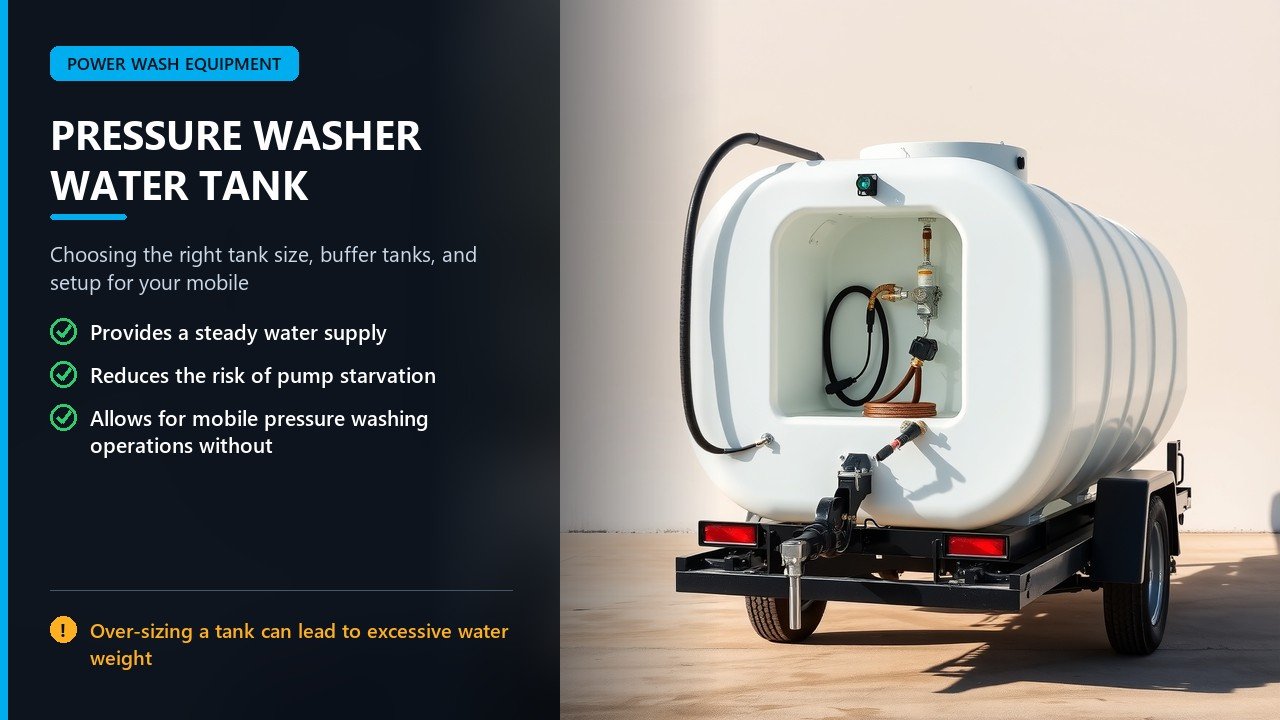
Why a Pressure Washer Needs a Water Tank
A pressure washer pump moves far more water than a garden hose can deliver on demand. A tap that supplies 4 or 5 gallons per minute at household pressure is fine for a small electric unit, but a gas washer drawing 4 GPM or more can outrun the plumbing, especially when several taps or a long hose add resistance. The pump then runs short of water, cavitates, and damages its valves and seals. A tank breaks that dependency by storing water and releasing it to the pump on demand.
The second reason is mobility. Professional pressure washing happens on driveways, rooftops, parking lots, and job sites where no tap exists. A tank on a trailer or truck carries the supply with you, turning a fixed pressure washer into a mobile rig. For a homeowner far from an outdoor tap, even a modest portable tank means the washer runs anywhere on the property. In both cases the tank exists because the pump needs water the plumbing cannot always give.
Buffer Tanks vs Supply Tanks
These two get confused constantly, and the difference matters. A buffer tank is a small reservoir that sits between a water source and the pump, usually kept full by a float valve connected to a garden hose or tap. It does not supply the whole job; it supplies the pump, smoothing out the peaks and making sure the inlet never runs dry. It is a protection device as much as a storage device.
A supply tank is the water you actually plan to use, often 100 to 500 gallons on a mobile rig, filled at the start of the job and drained by the end. Some setups use both: a large supply tank feeds a smaller buffer tank, and the buffer protects the pump while the supply lasts. If you have a reliable tap and only need to protect the pump, a buffer tank is enough. If you work off-grid, you need a supply tank, and often a buffer between it and the pump.
How a Buffer Tank Works
A buffer tank, sometimes called a float tank, works on a simple principle. Water enters the tank through a float valve that opens when the level drops and closes when it rises, exactly like the ballcock in a toilet. The pump draws from the tank through a large outlet near the bottom, and as long as the float keeps up with the pump’s demand, the tank stays full and the pump never sees air. When the pump momentarily pulls more than the tap supplies, the buffer makes up the difference.
The buffer also absorbs the surge that happens every time the trigger is released and the unloader valve diverts flow. Without a buffer, that surplus has nowhere to go but back through the pump, returning hot and agitated. With one, the tank gives the system a calm reservoir. The King of Pressure Wash guide to buffer tanks covers the setup and the sizing in detail, and it is worth reading before you plumb one.
Supply Tanks for Mobile Pressure Washing
When no tap is available, the supply tank is the whole water source, and its size decides how long you can work before refilling. Rigs commonly run 100, 200, 325, or 525-gallon tanks, with 200 gallons a popular middle ground for a truck or trailer setup. At 4 GPM, 200 gallons gives roughly 50 minutes of continuous spraying, less once you account for the trigger being released, so the real working time is often longer in practice.
Tank makers sell this range clearly. MPWSR lists poly tanks from 7 to 525 gallons, including 100-gallon vertical and horizontal designs, 200-gallon commercial tanks, and 325 and 525-gallon models for large operations. Dirt Killer’s water and chemical tank range runs from 50-gallon vertical tanks to 525-gallon leg tanks, with the plumbing accessories to match. Purpose-built mobile machines take the same approach, and the Hilltip Jet-it mobile pressure washer pairs baffled tanks from 500 litres upward with a water level sensor that stops the engine before the water runs out. Choose the size by the job and the flow, not by what fits the trailer until weight is considered.
Sizing a Tank to Your Flow and Job
Start with the pump. Note its flow in gallons per minute, then decide how many minutes of spray you need between refills. A 4 GPM pump on a 100-gallon tank has 25 minutes of pure spray time; a 5.5 GPM pump on the same tank has under 20. That is the theoretical maximum, and because you are rarely holding the trigger continuously, the practical figure is higher. A buffer tank, by contrast, is sized only to cover the gap between the tap and the pump, so a smaller tank, often 30 to 100 gallons, is plenty.
Then match the tank to the job. A homeowner washing one car and a driveway needs a few dozen gallons, or simply a buffer. A contractor doing fleet washing all day needs hundreds of gallons or a refill plan. Mobile hot-water trailers built for on-site cleaning can carry 200 to 330 gallons, as Karcher’s trailer lineup shows in its TRK-6000 and TRK-3500 specification sheet. Bigger is not automatically better, because every gallon adds weight and takes room on the rig.
Water Weight and Mounting
Water weighs 8.34 pounds per gallon, and that number should govern every mounting decision. A 100-gallon tank holds 834 pounds of water before you add the tank, the pump, the engine, and the frame. A 200-gallon tank holds nearly 1,700 pounds. A 525-gallon leg tank holds more than 4,300 pounds. Mount that much moving weight on a weak floor or a light trailer and something will fail, often dangerously.
Tanks must be secured with straps or bands rated for the load, bolted to a solid frame, and placed to keep the rig balanced. Makers sell stainless straps and heavy tank bands for exactly this purpose, and trailers are rated by gross vehicle weight for the same reason. Fill the tank before you finalise weight and balance, and never exceed the trailer’s or vehicle’s rating. A full tank on the highway is a dynamic load, and sloshing makes it worse.
Gravity Feed and Pump Supply
Most pressure washer pumps are fed by gravity, not by pressure. The tank outlet sits above the pump inlet, and water flows down into the pump under its own weight. For that to work, the feed line must be large and unrestricted. A common rule in the trade is to use an oversized input hose with no sharp bends, so the pump can pull freely. Restrict the feed and a pump that normally works perfectly will cavitate even with a full tank above it.
This is why the plumbing between tank and pump deserves as much attention as the tank itself. Use a short, wide, smooth-bore hose or pipe, keep it free of kinks, and mount the tank high enough to give a real gravity head. Makers of buffer-tank plumbing kits sell crush-proof hose for exactly this reason. If a direct-drive pump is unhappy on gravity feed, the fix is usually a bigger, straighter feed line, not a booster pump, which most advice warns against. A solid buffer tank plumbing walkthrough shows the same gravity-fed layout that keeps a pump happy.
Float Valves and Automatic Fill
A buffer tank’s float valve is what lets it run unattended. Connect a garden hose to the float assembly, and the valve keeps the tank topped up without you watching the level. When the water drops, the float falls and opens the valve; when it rises, the float shuts it off. Sizing the float matters: a valve too small for your pump’s GPM will not keep up, and the buffer will slowly empty. High-flow float assemblies exist precisely for high-draw machines.
On a supply tank, a float valve can also refill from a tap while you work, but only if the tap can out-deliver the pump, which it often cannot. More commonly, supply tanks use a fill kit and a large fill hose to top up between jobs, or a separate transfer pump. Whichever route you take, install a filter on the inlet so grit never reaches the pump, and check the float and valve regularly, because a stuck float is a quiet way to overflow or starve a tank.
Fittings, Bulkheads, and Filters
The hardware that makes a tank useful is humble but critical. A bulkhead fitting seals the outlet through the tank wall, and a uniseal is a common rubber seal for exactly that job, available in sizes from a quarter inch to an inch or more. A large drain valve lets you empty the tank quickly, an access port lets you clean inside, and an inlet filter keeps debris out of the pump. These small parts decide whether the setup works or leaks.
Match every fitting to the flow and the pressure. The pump feed wants a large outlet, often an inch or more, while a soap or chemical line can be smaller. Use a vented lid so the tank can breathe as it fills and drains, and a filter that is easy to clean. Well-chosen plumbing turns a plastic tank into a reliable water system, and cheap or undersized fittings undo the whole point of storing water in the first place.
Tank Materials and Construction
Pressure washer tanks are almost always made from high-density polyethylene or linear polyethylene, chosen for toughness, chemical resistance, and freedom from rust. Some are seamless and rotationally moulded for strength; some are rectangular for tight spaces, and some are slim vertical designs that fit behind a truck cab. Wall thickness varies, and thicker walls resist the bulging and cracking that come with repeated filling and transport.
Trailer tanks add features that matter on the road. Karcher’s trailer tanks include a 12-inch access port, a large drain valve, a float valve, and a mesh inlet filter, held in a steel cage with safety chains. Look for moulded-in baffles or add baffles to control sloshing, a secure lid, and reinforced mounting points. The goal is a tank that survives being filled, driven, and emptied for years without splitting a seam.
Baffles and Sloshing
A partly full tank on a moving vehicle is a load of water trying to shift with every turn and stop. Baffles, internal walls that divide the tank into sections, break up that motion and stop the water from surging to one end. Some tanks include baffles; others can have them added. On a trailer or truck rig, baffles are not a nicety, they are what keeps the load stable and the vehicle predictable at speed.
Baffles also reduce the stress on the tank walls, because the water is not slamming from side to side with every movement. For a stationary buffer tank, baffles barely matter, since the water sits still. But for any tank that travels, insist on baffling or add it, and keep the tank as full or as empty as practical when moving rather than half full, which is the worst case for sloshing.
Portable Tanks for Homeowners
Homeowners rarely need a 200-gallon rig, but a small portable tank solves a real problem. A compact tank on a cart or a drum-style buffer lets a homeowner wash a car or a patio away from the garden tap, or protect a pump that struggles to draw from a long hose. Small tanks of 30 to 55 gallons, or even a simple drum, are enough to make an electric or small gas washer self-sufficient for a short job.
For these setups, weight and simplicity rule. A 50-gallon tank holds over 400 pounds of water, so it needs a stable base and a cart that can take the load. Keep the plumbing simple, use a gravity feed to the pump, and add a garden-hose fill. Our guide to the portable water tank pressure washer setup walks through the homeowner version in more detail if that is your case.
Maintaining a Water Tank
Maintenance is mostly about keeping water clean and the hardware sound. Rinse the tank periodically to prevent algae and sediment from building up, especially if water sits in it between jobs. Check the float valve, bulkhead, and drain for leaks, and clean the inlet filter so the flow never drops. In cold weather, drain the tank and lines completely, because trapped water freezes, expands, and cracks tanks and fittings.
Inspect straps and bands for rust or fraying, and confirm the mounting is still tight, since vibration loosens hardware over time. Test the gravity feed under load by watching the pump inlet for air or sputtering. A tank that is clean, sealed, and well fed will outlast several pumps. A neglected one leaks, grows algae, and slowly starves the pump it was bought to protect.
Common Mistakes to Avoid
The first mistake is undersizing the feed to the pump. A small or kinked feed line will starve a pump even with a full tank overhead, causing the cavitation the tank was meant to prevent. The second is confusing a buffer tank with a supply tank and expecting a 30-gallon buffer to run a two-hour job. The third is ignoring weight, then discovering too late that a full tank overloads a trailer or a floor.
The fourth mistake is skipping baffles on a travelling tank, which makes the load unstable and stresses the walls. The fifth is leaving water in the tank in freezing weather. Avoid these and a water tank becomes one of the most reliable parts of the rig. Most tank problems trace back to plumbing and sizing, not the tank itself, so get those right first.
Tank vs Direct Feed: Which to Choose
Not every pressure washer needs a tank, so it is worth deciding deliberately. A direct feed, where the pump draws straight from a tap, is simplest and cheapest, and it works well when the water source is reliable and close and the machine is modest. A small electric washer fed by a good outdoor tap may never need a tank at all, and adding one would just be extra weight and plumbing.
A tank earns its place when the supply is weak, distant, or nonexistent. If your tap struggles to feed a 4 GPM gas washer, a buffer tank protects the pump and often fixes the problem outright. If you work mobile or far from plumbing, a supply tank is essential. The decision comes down to whether the water source can keep up with the pump and whether you need to carry water with you. If either answer is no, a tank pays for itself quickly.
Some owners run both in series: a large supply tank feeds a buffer tank through a float valve, and the buffer feeds the pump. This is the most robust arrangement for a professional rig, because the buffer smooths the draw from the supply tank and the float keeps the buffer full. For a homeowner, a single small tank is usually enough, and stacking two only adds complexity without benefit.
Filling and Draining a Tank
Filling is usually straightforward, but how you fill shapes the setup. From a tap, a garden-hose fill kit with a float valve lets the tank top itself up while you work, if the tap can out-supply the pump. From a hydrant or another tank, you may need a transfer pump or a large fill hose and gravity, filling from above. Keep an eye on the level with a sight gauge or a float indicator so you are never caught short mid-job.
Draining matters just as much, and not only at the end of a job. A drain valve at the lowest point lets you empty the tank fully so sediment and stale water do not accumulate, and so nothing freezes in winter. Trailer and commercial tanks come with a large drain valve for exactly this reason. Drain after use when the tank will sit, tilt the rig so water runs to the outlet, and leave the valve open in freezing weather to avoid a cracked seam.
Tank Accessories Worth Buying
A tank is only as good as the parts around it, and a few accessories make a real difference. A float valve is essential on any buffer tank. A bulkhead fitting and a uniseal let you plumb the outlet cleanly and leak-free. A mesh inlet filter keeps grit out of the pump. A vented lid lets the tank breathe as it fills and empties, and a sight gauge tells you how much water remains at a glance. Stainless straps or heavy bands hold the tank securely.
Beyond the basics, a drain line kit speeds emptying, and a fill kit makes topping up simple. Chemical and soap tanks are separate small tanks for detergent, often 7 to 25 gallons, plumbed to a downstream injector rather than the pump inlet. Keep supply water and chemicals in separate tanks and separate lines, so a mistake never sends detergent through the pump. Buying these accessories alongside the tank saves a second order later and ensures they fit.
Hot Water and Tank Selection
If your pressure washer heats water, the tank choice barely changes, but the temperature of the water in it can rise, particularly on a recirculating system where warm water returns during trigger release. Polyethylene tanks are generally rated for water well within these ranges, but check the manufacturer’s temperature limit before you fill a tank with hot water, and never exceed it. Most tanks are rated for ambient or moderately warm water, not for near-boiling liquid.
The hotter consideration is the return line. When the trigger is released, the unloader diverts water, and on some hot-water setups that warm water returns to the tank and gradually raises its temperature. A buffer tank absorbs this and gives the hot water somewhere to settle, which is another reason hot-water rigs run one. If you run hot water, size the buffer generously and confirm the tank’s temperature rating, so the convenience of heat does not shorten the tank’s life.
FAQ
What is a buffer tank on a pressure washer? A buffer tank is a small reservoir between the water source and the pump, kept full by a float valve. It protects the pump from running dry or cavitating when the supply cannot keep up with demand.
How big a water tank do I need for pressure washing? Size by flow and job. Divide your pump’s GPM into the tank capacity for minutes of spray, then add margin. A buffer only needs to cover the gap; a supply tank must hold the water for the whole job.
Does a pressure washer tank need a pump to feed it? No. Most pressure washer pumps draw by gravity from the tank. Use a large, straight, unrestricted feed line so the pump is not starved, and avoid booster pumps unless a specialist recommends one.
Can I use a plastic barrel as a water tank? A clean, food-grade barrel can work as a small supply tank with the right fittings, drain, and filter. Make sure it is stable, sealed, and vented, and that the feed to the pump is wide enough for the flow.
How heavy is a full water tank? Water weighs 8.34 pounds per gallon, so a 100-gallon tank holds about 834 pounds of water before the tank and equipment. Always check the mounting and the vehicle’s weight rating before filling.
Final Thoughts
A pressure washer water tank is one of the simplest upgrades with one of the biggest effects, because it frees the machine from the tap and protects the pump from the supply problems that wear it out. Decide first whether you need a buffer tank, a supply tank, or both, then size it to your flow and your job, and treat the feed line and the mounting as seriously as the tank itself.
Get the plumbing, weight, and baffling right, keep the water clean and the tank drained in winter, and the tank will quietly do its job for years. Whether you are protecting a homeowner pump with a small buffer or running a full mobile rig off hundreds of gallons, the same priorities apply: match it, mount it, and feed it properly.