Pressure Washer Connector Hose: The Short Whip That Joins Your Setup
A pressure washer connector hose, often called a whip hose or jumper hose, is the short section that bridges the gap between components that do not quite meet. It runs a few feet at most, yet it solves a very practical problem: the distance between your pump outlet and a hose reel, or between a heater coil and an outlet, or between the machine and the length of hose you actually pull around the job. Without it, you either stretch a long hose where a short one belongs or leave a connection dangling.
This guide explains what a pressure washer connector hose is, where it belongs, how to size and choose one, and how it differs from the full-length hose you use at the wand. For the fittings that join it, our hose connector guide covers matching the ends.
What a Connector Hose Actually Is
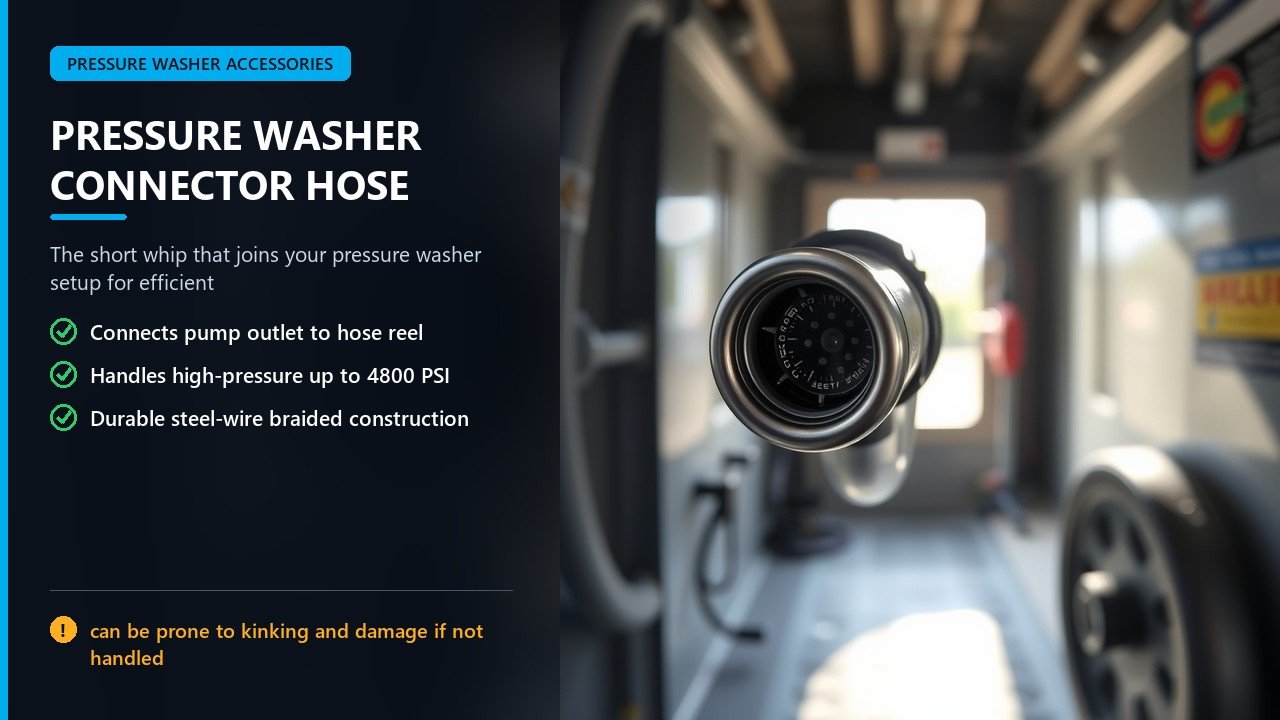
A connector hose is a short, high-pressure hose built to link two fixed points in a pressure washing system. It is not meant for washing; it never leaves the machine. Typical lengths run from two to eight feet, with two, three, and five feet being the most common. It is a dedicated jumper, and its whole job is to carry full pump pressure across a short distance without leaking or kinking.
Because it lives inside the machine, a connector hose is often steel-wire braided for strength and abrasion resistance, with a rubber or polymer jacket. It needs to handle the machine’s full working pressure, often 4,000 to 4,800 PSI on commercial units, plus a large burst margin. A cheap length of garden hose or a light pressure hose will fail quickly in this role, so the part matters more than its small size suggests. Our jumper hose guide goes deeper.
Where Connector Hoses Go
The most common use is pump to reel: the pump outlet sits low on the machine while the reel is mounted higher or on a cart, and a short jumper hose connects the two. Other jobs include linking an unloader or pump bypass line, joining a pump to a heater coil, and connecting a heater coil to the outlet. In self-serve car wash bays and pump rooms, several connector hoses may be needed to route water from the pump to the final outlet.
Connector hoses also serve as replacements for the short hose on a surface cleaner, which sees constant flexing and fails sooner than a full-length hose. Anywhere a fixed connection needs a little slack or a change in direction, a short whip hose is the right part. The rule of thumb is simple: if the run is measured in feet and stays on the machine, you want a connector hose, not a washing hose.
Common Connector Hose Specifications
| Spec | Typical Value |
|---|---|
| Length | 2, 3, 5, or 8 ft |
| Inside diameter | 3/8 in (common) |
| Working pressure | 4,000 to 4,800 PSI |
| Burst pressure | About 16,000 PSI |
| Flow range | 2.5 to 5 GPM |
| Temperature | 140 to 248 F (hot water rated) |
| Ends | 3/8 in NPT male, often one swivel |
| Construction | Steel-wire braided, rubber jacket |
The swivel end is worth noting. One end of a whip hose is often a swivel fitting, which spins freely so you can thread it onto a reel or pump without twisting the hose itself. That single feature prevents the kinks and strain that come from fighting a stiff braided hose into position. If you are buying a connector hose, a swivel end is a big usability win. A product like this YAMATIC 3/8 inch whip hose shows the anti-kink swivel design.
Sizing a Connector Hose
Length is the first decision, and shorter is almost always better as long as it reaches. A connector hose adds a little pressure loss, and a long one adds more, so keep it as short as the layout allows while leaving enough slack to avoid strain at the fittings. Two to three feet suits a tight pump-to-reel gap; five feet gives more room for routing around a cart; eight feet is for longer internal runs.
The inside diameter should match the rest of your system so it does not become a bottleneck. On a 4 GPM machine, a 3/8 inch connector hose carries the flow with only a minor pressure drop over a few feet, so it is the standard choice. Stepping up to 1/2 inch on a long or high-pressure run reduces loss further, but for the short jump most setups need, 3/8 inch is ideal.
Pressure rating must meet or exceed the machine. A connector hose sees full pump pressure, so its working rating should be at least your pump’s rated PSI, and its burst rating is a safety margin on top. Never fit a connector hose rated below your machine’s output, and prefer one rated for hot water if your machine heats water.
Connector Hose Versus Adapters
A connector hose and an adapter solve different problems, and mixing them up wastes money and creates leaks. An adapter is a rigid fitting that changes one connection type to another, such as M22 to quick connect, or garden hose thread to a pump inlet. It does not add length or flexibility. A connector hose adds a short run of flexible hose, and its ends are usually the type your machine already uses.
In practice, you often use both together. A jumper hose links the pump to the reel, and an adapter may convert the pump outlet to the thread the jumper needs. If your pump outlet is M22 and the reel takes 3/8 inch quick connect, you might use a jumper hose with the right ends, or a short hose plus an adapter, depending on what fits. Our guide to adapters and to hose fittings explains the options.
The key is to identify the thread on each side before buying. A connector hose with the wrong ends cannot be made to fit without adapters, and stacking adapters adds leak points. Matching the hose ends to your existing fittings is cleaner and more reliable.
Why Use a Connector Hose at All
The alternative to a connector hose is running a full-length washing hose straight from the pump, which is clumsy on a reel-equipped machine. The reel is meant to hold and pay out the long working hose, and its inlet usually faces a short distance from the pump. A connector hose fills that distance neatly, so the reel can do its job and the machine stays tidy. It also lets you service or replace the reel without disturbing the main hose.
On machines with multiple components, such as a pump, heater coil, and reel, connector hoses act as flexible links between rigid parts. They absorb vibration and minor misalignment that a solid pipe or rigid fitting could not, reducing stress on the components. That flexibility is a real durability benefit, not just a convenience. Our guide to couplings shows how the parts work together.
Complete kits make the job easier. A brand such as AR Blue Clean sells a jumper hose kit that connects an electric washer with an M22 fitting to a 3/8 inch hose reel, so you get the right hose and ends in one package. Other makers offer hose connector kits with the quick connects you need, like this Husqvarna connector kit. Buying a matched kit removes the guesswork of matching ends.
Common Connector Hose Mistakes
The most common mistake is using the wrong hose for the job, such as a light garden hose or a low-pressure hose where a rated jumper is required. Such a hose can burst under full pump pressure and cause injury. The second is choosing ends that do not match, which forces a chain of adapters that leaks. The third is going too long, adding pressure loss and creating a hose that can kink or catch.
Another mistake is ignoring the temperature rating on hot water machines, where a cold-only jumper can fail early. Finally, some users overtighten the connections, crushing the fittings or damaging the seal, which causes a leak that looks like a hose defect. Hand-tight plus a quarter turn, with a fresh O-ring or seal where required, is usually enough.
Quick Connect Versus Threaded Ends
Connector hoses come with either threaded ends, quick connect ends, or a mix. Threaded ends, usually 3/8 inch NPT male, screw directly into a pump outlet or reel inlet and hold with a wrench-tight seal. Quick connect ends snap into a matching coupler and release with a pull, which speeds up assembly and lets you swap components fast. Many whip hoses include both threaded ends and quick connect adapters, so you can choose.
For a permanent internal connection, threaded ends are compact and secure. For a setup you take apart often, quick connects save time and reduce wear on the threads. The trade-off is that every quick connect adds an O-ring seal that can wear or leak, while a threaded joint relies on the thread and a sealant or washer. On hot water machines, a high-temperature O-ring or seal is essential either way.
The key is consistency. If the pump outlet is quick connect, a quick connect jumper hose is simplest; if it is threaded, a threaded hose avoids an adapter. Mixing the two means an adapter somewhere, which adds a leak point. Decide based on what the machine already has, and keep the chain of connections short. Our adapter guide covers the crossover fittings.
Connector Hoses for Reels
Hose reels are the most common home for a connector hose. The reel holds the long working hose and pays it out at the wand, while its inlet sits close to the pump. A short jumper hose bridges that inlet to the pump outlet, so the reel does the storage and the jumper does the linking. This keeps the long hose on the reel instead of trailing across the machine.
A reel connector hose usually has a swivel end so it can attach to the reel’s rotating inlet without twisting. It is sized to the reel’s inlet thread, often 3/8 inch NPT or quick connect. Because the reel can hold a hundred feet or more of hose, the jumper only carries water a few feet, so its pressure loss is tiny. Getting the ends right is the main concern. Our guide to matching a reel with hose covers the pairing.
When buying a reel, check whether it includes a jumper hose or needs one. Some come ready to bolt on with the connector included, while others leave it to you. A matched reel kit, with the jumper and fittings supplied, saves a trip and prevents the frustration of a reel that will not connect. Our reel add-on guide walks through the install.
Hot Water and Heater Coil Connectors
Hot water pressure washers route water from the pump into a heater coil and then out to the outlet, and connector hoses link those stages. These jumpers must be rated for high temperature, because the water leaving the coil can be far hotter than a cold water machine ever sees. A cold-only hose used here will soften, bulge, or burst, so the temperature rating matters as much as the pressure rating.
Hot water connector hoses are typically rated for roughly 140 to 248 degrees Fahrenheit, with steel-wire braid and a heat-resistant jacket. The braid gives burst strength while the jacket protects the inner tube. When replacing one on a hot water machine, always match or exceed the original temperature and pressure ratings. Our guide to hose fittings covers the connection types.
Because heater coils are rigid and the pump may vibrate, the flexible jumper between them absorbs movement that a solid pipe could not. This is exactly why manufacturers use short hoses rather than hard plumbing in these spots. Treat the heater-to-outlet jumper as a wear part and inspect it for stiffness or cracking, replacing it before it fails under pressure.
Pump Room and Car Wash Bay Use
In commercial settings, such as self-serve car wash bays and pump rooms, connector hoses link pumps, unloaders, heaters, and outlets in tight quarters. Multiple short jumpers may route water through a compact equipment cluster where rigid piping would be impossible to align. The flexibility of the hoses lets technicians assemble and service the system without precise pipe fitting.
These environments are hard on hoses: constant pressure, cycling, and sometimes hot water. That makes the quality of each connector hose important, because a single failed jumper takes a bay out of service. Commercial operators keep spares on hand and inspect the jumpers as part of routine maintenance. Our jumper hose guide covers durable options.
The same principle applies to a busy mobile detailing rig or a wash trailer, where space is tight and vibration is constant. Short, well-rated connector hoses handle the job better than long hoses looped into place, and they are quick to replace when they wear. In any packed system, the connector hose is the flexible joint that keeps the machine serviceable.
Installing and Sealing a Connector Hose
Installing a connector hose is straightforward but fussy about sealing. Start by identifying each end: which thread or coupler meets the pump, and which meets the reel or heater. Hand-thread the connector onto the fitting until snug, then tighten about a quarter turn more with a wrench if it is threaded. Do not overtighten, because crushing a fitting or seal causes leaks rather than preventing them.
For threaded connections, use a fresh seal or O-ring where the design calls for one, and thread sealant only on threads that seal by the thread itself. Quick connect ends rely on their internal O-ring, so keep that O-ring clean and lubricated with a little silicone grease to help it seat and last. A dry or damaged O-ring is the usual cause of a drip at a quick connect joint. Our guide to matching hose connectors covers the details.
After assembly, pressurize the system and check every joint while the pump runs. A small weep at first can sometimes seat itself, but a steady drip means the seal, thread, or fit is wrong. Fix it before the job, because a connector under full pressure will only make a small leak worse. A few minutes of checking saves a soaked workspace later.
Troubleshooting Connector Hose Leaks
| Symptom | Likely Cause |
|---|---|
| Drip at a threaded joint | Loose fitting or missing seal |
| Leak at a quick connect | Worn or dirty O-ring |
| Weeping along the hose | Damaged jacket or inner tube |
| Bulge in the hose | Hose under-rated or aged |
| Kink that stops flow | Hose too long or wrong bend radius |
| Sudden pressure loss | Failed hose or blown seal |
A bulge or a soft spot in the jacket is a warning sign, not a cosmetic flaw; the hose is failing and should be replaced before it bursts. Weeping along the length means the inner tube is compromised. For leaks at the joints, replace the O-ring or seal first, then recheck the tightness. Most connector hose problems are seal issues rather than the hose itself. Our fitting leak guide covers the fixes.
Maintaining Connector Hoses
Connector hoses last longer with simple care. Check the O-rings and seals periodically and replace them when they harden or crack. Inspect the jacket for abrasion, cuts, or bulges, especially where the hose bends near a fitting. Keep the hose free of sharp edges and hot surfaces, and avoid sharp bends that stress the braid and inner tube.
When you store the machine, protect the connector hose from freezing along with the rest of the water system, because trapped ice can split it just as it splits a pump. If the hose has a swivel, spin it to check it moves freely and lubricate the seal. Treating a connector hose as a wear part, with occasional inspection and ready spares, keeps a machine reliable. Our coupling guide covers the related hardware.
The reward is small: a connector hose is inexpensive and easy to swap. Recognizing that it wears, and keeping a spare, prevents a tiny part from ending a workday. That is the whole idea of maintenance on a pressure washing system, where the failure of a two-foot hose can stop a two-thousand-dollar machine.
Connector Hoses Versus Quick Connect Kits
Many owners first meet the connector hose through a quick connect kit, a bag of brass fittings that converts a garden hose, a pump inlet, and accessories to click-on connections. Kits like these Westinghouse quick connects include the garden hose adapter, the pump inlet fitting, and couplers for guns and accessories. They solve the connection problem with rigid fittings, while a connector hose solves it with a short length of flexible hose.
The two work together. A kit might convert your pump outlet to a quick connect, and a connector hose with a quick connect end then snaps onto it and runs to the reel. If your goal is only to switch connections quickly, a kit is enough; if you also need to bridge a gap or add flexibility, you want a connector hose. Understanding which problem you have keeps you from buying the wrong part.
For a reel-equipped machine, the natural combination is a quick connect kit at the pump plus a swivel-ended jumper hose to the reel. That gives fast assembly and a clean, flexible link. For a simple machine with no reel, a short jumper may not be needed at all, and a kit alone handles the hose and gun connections. Match the solution to the setup.
When You Do Not Need a Connector Hose
Not every machine needs a connector hose. A basic pressure washer with a gun, wand, and single high-pressure hose connects pump to hose to gun directly, with no reel or heater to bridge. In that case, adding a jumper would only add a needless joint and leak point. The connector hose earns its place when there is a component to link, not as an automatic upgrade.
If your machine has a hose reel, a heater coil, or a compact multi-part layout, a connector hose is genuinely useful. If it does not, spend the money on a better main hose or a quality nozzle instead. Recognizing when a part is unnecessary is as valuable as knowing when it helps, and it keeps your system simple and leak-free.
When you do need one, buy it once and buy it right: correct length, correct diameter, correct ends, and a pressure and temperature rating at or above the machine. A well-chosen connector hose is essentially invisible in daily use, which is exactly what you want from a humble part whose only job is to join two points quietly and reliably. Our reel and hose matching guide helps you plan the whole setup.
Frequently Asked Questions
What is a pressure washer connector hose used for? It is a short whip or jumper hose that links components on the machine, most often the pump to a hose reel, or a pump to a heater coil and outlet. It is not used for washing.
How long should a connector hose be? As short as reaches, usually 2 to 5 feet. Keep it short to minimize pressure loss and avoid kinking, with just enough slack to prevent strain at the fittings.
What size connector hose do I need? For most machines, 3/8 inch is standard and handles 2.5 to 5 GPM well. Match the ends to your pump and reel, and pick a pressure rating at or above your machine’s PSI.
Can I use a regular pressure washer hose instead? You can, but a long hose is clumsy on the machine and unnecessary. A dedicated connector hose is short, flexible, and easier to route, and it keeps the working hose on the reel.
Do connector hoses work with hot water? Yes, if the hose is rated for it. Hot water models are rated for roughly 140 to 248 F, so check the spec before using one on a heated machine.
Does a connector hose reduce pressure? It adds a small loss based on length and diameter. Over a few feet at 3/8 inch, the loss is minor, which is another reason to keep it short.
The Bottom Line
A pressure washer connector hose is a small part that makes a big difference in how a machine is put together. It bridges the short distance between pump, reel, and heater, keeps the working hose where it belongs, and absorbs the vibration and misalignment that would otherwise stress rigid fittings. Choose the right length, the right diameter, and ends that match, and a rated jumper will serve quietly for a long time.
Do not overlook it because it is short. In a pressure washing system, the connection is only as strong as its weakest hose, and the connector hose is often that weak point when owners grab the wrong part. Match it properly, keep it short and rated, and your setup stays leak-free from pump to wand.