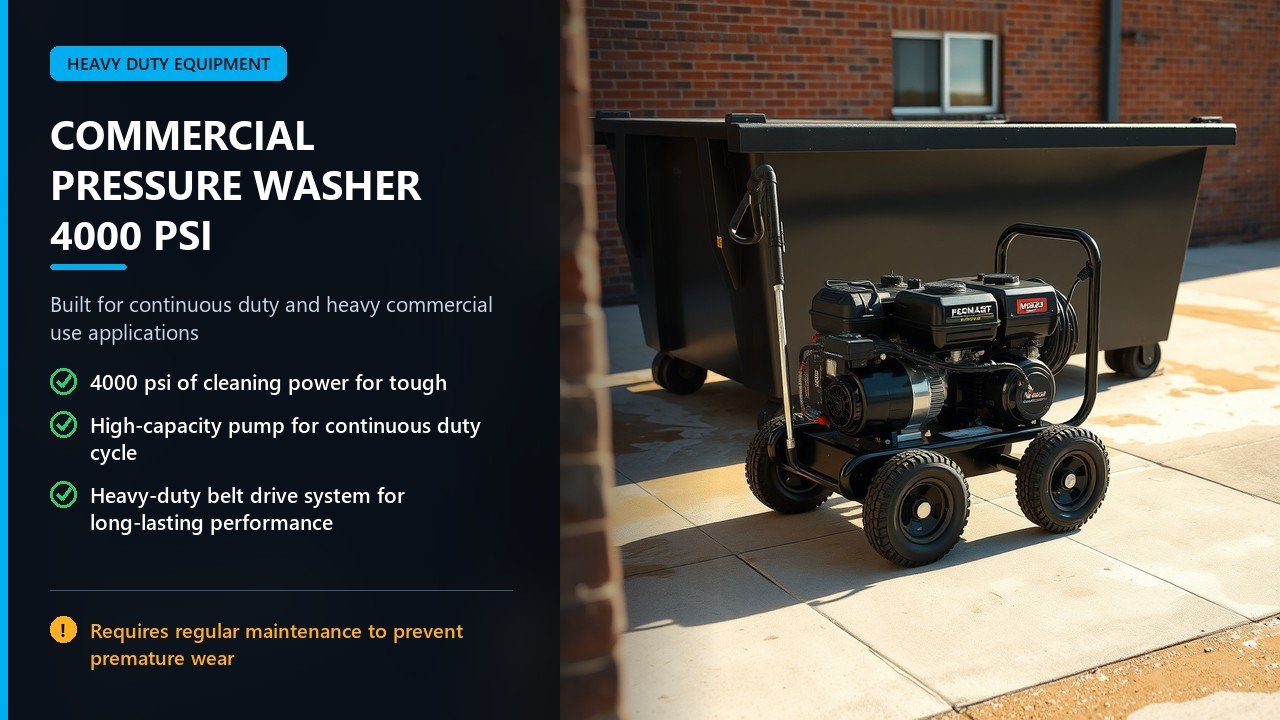
There is a quiet difference between a machine that survives a busy week and one that quits halfway through Tuesday. Cleaning professionals learn it the hard way, usually after a residential-grade unit dies on a commercial job for the third time. The machine that keeps up is built for continuous duty, not occasional weekends. When you see a crew pull a heavy, belt-driven unit off a trailer, start it once, and run it for six hours without a hiccup, that is a commercial pressure washer 4000 psi doing exactly what it was engineered to do. This guide explains what separates a true commercial machine from an overgrown homeowner model, and how to choose one you will not regret.
What “Commercial” Actually Means
The word commercial gets thrown around loosely in marketing, but in pressure washing it has a specific meaning. A commercial machine is designed for a high duty cycle, meaning it can run for hours at a time, day after day, without overheating or wearing out prematurely. That design goal drives every choice inside it: the pump, the drive system, the engine, the frame, and the components. A residential machine is built to a price and a light-use pattern. A commercial machine is built to a workload and a lifespan.
Duty cycle is the core idea. A residential washer might run twenty or thirty minutes at a stretch before cooling. A commercial unit runs continuously for as long as you have water and fuel. For a homeowner, that rarely matters. For a business that bills by the hour, downtime is lost revenue, and a machine that cannot run all day is a liability.
The Pump: The Heart of a Commercial Washer
Nothing defines a commercial pressure washer like its pump. Residential units often use axial cam pumps that are cheap, compact, and disposable. Commercial units use triplex plunger pumps with ceramic or solid plungers, heavy bearings, and rebuildable designs. Brands like CAT and General Pump set the standard because their pumps tolerate high pressure and continuous use and can be rebuilt instead of replaced.
| Feature | Residential Pump | Commercial Pump |
|---|---|---|
| Type | Axial cam | Triplex plunger |
| Plungers | Usually none (wobble plate) | Ceramic or solid |
| Duty cycle | Intermittent | Continuous |
| Repairable | Rarely | Yes, with rebuild kits |
| Oil change | Usually non-serviceable | Serviceable reservoir |
When you shop, read the pump spec before you read anything else. A 4,000 PSI rating on a cheap axial pump machine is a short-lived promise. The same rating on a triplex pump is a long-term tool.
Drive Systems: Belt Drive vs Direct Drive
Direct drive bolts the pump to the engine crankshaft and spins it at full engine speed. It is simple, compact, and cheaper, but it transfers engine heat and vibration straight into the pump. Belt drive uses pulleys and belts to run the pump at a lower, more efficient speed, cushioning shock loads and reducing heat. For commercial work, belt drive is the standard because it dramatically extends pump life and runs smoother and quieter.
The trade-off is size and maintenance. Belt drives need periodic belt inspection and adjustment, and they occupy more space. But the reliability gain is worth it for anyone running a machine professionally. If you plan to run a 4,000 PSI machine for hours a day, belt drive is the professional choice.
The 4000 PSI / 4 GPM Sweet Spot
Four thousand PSI paired with roughly four gallons per minute is a recognized sweet spot for commercial cleaning. The pressure handles tough surfaces, and the flow provides the coverage speed professionals need to make money. Flow matters as much as pressure: a machine at 4,000 PSI and 4 GPM cleans far faster than one at 4,000 PSI and 2.5 GPM, because cleaning is ultimately about moving water across the surface.
| Rating | What It Delivers | Typical Jobs |
|---|---|---|
| 4,000 PSI | Power to strip heavy soil | Concrete, paint prep, heavy grime |
| 4.0 GPM | Speed and coverage | Fleets, lots, large surfaces |
| Belt drive | Smooth, cool, long life | Production cleaning |
| Triplex pump | Continuous duty | All-day commercial work |
Cold vs Hot for Commercial Work
Many commercial 4,000 PSI machines are cold-water units, which cover a huge range of jobs: concrete, siding, fleet rinse-down, and general grime. But if your commercial work involves grease, oil, kitchens, or sanitation, you need heat, and that means a hot-water unit with a diesel, propane, or natural gas burner. Hot commercial washers cost substantially more, but for grease-heavy contracts they are not optional. Assess your actual workload: if a meaningful share of your jobs involves grease, invest in heat.
Applications for a 4000 PSI Commercial Machine
Commercial concrete and lots. Parking lots, sidewalks, and drive-throughs need the power and speed a 4 GPM machine provides.
Fleet washing. Trucks, vans, buses, and equipment clean faster with high flow and consistent pressure.
Property management. Dumpster pads, building exteriors, and common areas demand reliability under contract deadlines.
Construction and paint prep. Removing dirt, loose coating, and residue before new finishes is a core commercial task.
Municipal and industrial. Equipment, structures, and facilities cleaning where uptime and safety are priorities.
Buying Considerations That Matter
Look beyond PSI. Confirm the pump brand and whether it is rebuildable. Check the drive type and the engine quality; a commercial machine often uses a Honda or similar industrial engine. Inspect the frame, because a commercial unit gets dragged, bounced, and loaded repeatedly. Wheels, handle, and axle should be heavy duty. Verify whether the unit is portable, skid mounted, or trailer ready, and whether it includes a thermal relief valve, an unloader, and a chemical injector. Confirm that rebuild kits and parts are available for the pump and the engine, because serviceability is what keeps a commercial machine working for years.
Think about how it will move. A skid-mount slides into a truck bed or trailer, a portable rolls on wheels, and a trailer unit stays rigged for quick deployment. Choosing the right mount for your workflow matters as much as the machine itself. A complete commercial pressure washing setup includes the reel, hose, gun, and surface cleaner that make the machine productive from day one.
Maintenance on a Commercial Schedule
A commercial machine earns its keep only if you maintain it like one. Change the pump oil on a fixed interval; on a machine running daily, that may be monthly rather than yearly. Check and change the engine oil on schedule. Inspect belts for wear and tension. Clean the inlet filter frequently. Check the unloader and thermal relief valve. On hot units, descale the coil based on water hardness and service the burner and fuel system. Keep spare o-rings, nozzles, and a rebuild kit on hand so a minor failure never becomes a lost day.
Follow a disciplined maintenance and winterizing schedule and a commercial washer can deliver many thousands of working hours before it needs major service.
Common Mistakes to Avoid
Buying a residential unit for commercial work. The fastest way to lose money to downtime. The duty cycle will not hold up.
Ignoring pump quality. A great engine on a cheap pump is still a short-lived machine.
Choosing direct drive to save money. For daily professional use, belt drive pays for itself in pump life.
Skipping pump oil changes. On a working machine, this interval is measured in weeks, not years.
Undersizing flow. Chasing PSI without enough GPM slows every job. Balance the two.
Neglecting the water supply. A commercial machine needs a strong, steady feed, or a tank and feed pump. Starving it destroys the pump.
Frequently Asked Questions
Is 4000 PSI enough for commercial work? For most cleaning contracts, yes, especially when paired with 4 GPM and the right attachments. Some industrial jobs need more, but 4,000 PSI covers the bulk of commercial cleaning.
What is the difference between commercial and industrial? Commercial is built for full workdays; industrial is built for even heavier, often fixed, continuous operation.
Should I buy cold or hot? Cold for concrete, siding, and rinse-down. Hot if grease, oil, or sanitation are part of your work.
How long does a commercial pressure washer last? With proper maintenance, many years of heavy service, often outlasting several residential machines.
Belt drive or direct drive? Belt drive is the professional preference for continuous use. Direct drive suits lighter or budget-focused work.
Final Thoughts
A commercial pressure washer 4000 psi is an investment in uptime. It is built to run all day, day after day, and to be rebuilt rather than thrown away. Choose a triplex pump over an axial cam, prefer belt drive for heavy use, balance pressure with flow, match hot or cold to your workload, and keep the machine on a disciplined maintenance schedule. Do that and this machine will not just clean surfaces, it will protect the business that depends on it.
Equipment that never quits is the foundation of a cleaning business. Build yours on dependable commercial pressure washing equipment and stop losing jobs to breakdowns.