Two stories up, the second-floor siding had turned a dull grey, and the homeowner knew it needed cleaning. He also knew he was not climbing a ladder to stand next to a high-pressure stream. Instead of risking it, he screwed a wand extension onto his spray gun, extended the pole, and cleaned the entire upper wall with both feet planted firmly on the ground. The difference between a dangerous, wobbly job and a safe, controlled one was a single accessory: a wand extension. Pressure washer wand extensions turn a ground-level machine into a tool that reaches where you cannot safely go, and they are one of the most practical upgrades in pressure washing. This guide explains the types, the fittings, the real limits, and how to use them safely.
A wand extension is not a complicated device, but choosing the right one — and understanding what it can and cannot do — saves time, money, and risk. From short rigid extenders to long telescoping poles, each variety solves a specific reach problem. This guide walks through them all.
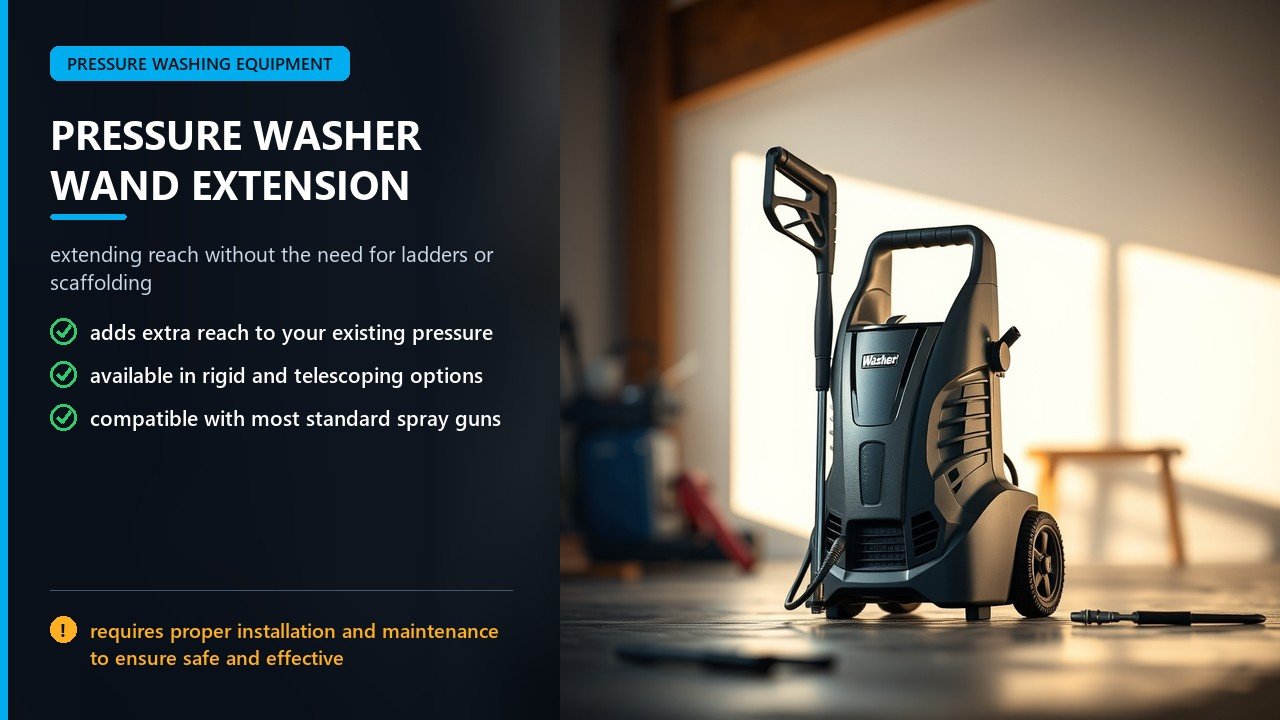
What Is a Wand Extension?
A pressure washer wand extension is an accessory that inserts between the spray gun and the nozzle to add reach. It differs from a complete replacement wand in that it extends the working length of your existing setup rather than replacing it.
There are two broad categories:
Rigid extension wands. A straight, stiff tube, usually six to twenty-four inches long, that threads or clicks into your gun and accepts a nozzle at the tip. A rigid extender gives you a fixed amount of extra reach while keeping the wand predictable and stable.
Telescoping wand extensions. A pole that extends and retracts, often from around six feet to eighteen feet or more, with a high-pressure hose routed through the inside to the tip. These add dramatic reach, letting you clean high walls and gutters from the ground.
Both share one purpose: to put distance between your body and the spray point, or between your feet and a ladder. The rigid extender extends your normal working reach by a little; the telescoping pole rewrites the rules entirely.
Rigid Extension Wands
Rigid extension wands are the simple, affordable way to gain a foot or two of reach. They are straight tubes with a fitting on one end to connect to the gun and a nozzle socket on the other. Common lengths run from about six inches to two feet.
A rigid extender is ideal for jobs where you need slightly more distance and want to keep full control: cleaning the top of a fence, reaching over a wide ledge, cleaning the upper rim of a pool, or washing the roof of a tall vehicle or RV. Because the extension stays rigid, it does not flex or wander, so precision stays high and fatigue stays low.
Many rigid extensions are made of stainless steel or brass for durability and use standard quick-connect fittings, making them easy to add and remove. Some are angled at the tip to reach under ledges or into wheel wells. A rigid extension is a low-cost accessory that quietly makes dozens of jobs easier.
Telescoping Wand Extensions
Telescoping wand extensions are the heavy hitters of reach. A pole that extends and retracts, with a high-pressure hose running through the interior to a fitting at the tip, lets you clean surfaces two or even three stories up without a ladder.
The advantages are obvious: no ladders, no balancing acts, and a safer cleaning position. Second-story siding, gutters, soffits, roofs, and tall commercial walls all become ground-level jobs. For house washing especially, a telescoping extension turns an intimidating task into a manageable one.
But a telescoping extension is not a simple longer tube, and it demands respect. The assembly is heavier and creates more leverage, so kickback and fatigue grow with length. The poles flex when pressure engages and releases, which is why they must be kept at least ten feet from power lines at all times. And reaching the full length requires enough pressure and flow to push water through the entire pole and still deliver useful cleaning power at the tip.
Most telescoping extensions need a 3/8-inch high-pressure hose connection, and many come with both a 3/8-inch quick-connect plug and an M22 adapter so they fit different setups. Before buying, confirm the connection path, the pressure rating (commonly around 4,000 PSI), and that your machine produces enough flow to feed the full length.
| Type | Typical Length | Best For | Trade-offs |
|---|---|---|---|
| Short rigid extender | 6–24 in | Fences, ledges, vehicles | Little added reach |
| Long rigid extender | 2–4 ft | Gutters, second-story edges | Heavier, still limited |
| Telescoping extension | 6–18 ft+ | High siding, roofs, large walls | Heavy, flexes, needs flow |
Fittings and Compatibility
Every wand extension has two connections that must match your equipment: the gun-side connection and the nozzle-side outlet. Getting these right is the entire compatibility question.
On the gun side, most extensions accept a common fitting — an M22 thread or a 1/4-inch or 3/8-inch quick-connect plug. Some are sold with adapters to fit multiple setups. Remember the M22 subtlety: a 14mm stem is standard on gas machines, while many electric machines use a 15mm stem, and mismatched sizes leak. Telescoping extensions often use a 3/8-inch quick connect to handle higher flow.
On the nozzle side, most extensions end in a 1/4-inch quick-connect socket, so your existing spray tips and many accessories click right on. Some use a threaded mount instead. Confirm which one your nozzles and accessories need before buying.
If your machine uses a proprietary gun-and-wand assembly, you may need an adapter to convert to a standard fitting before an extension will attach. Once converted, your reach options open up considerably.
How Much Reach Do You Actually Get?
When buying an extension, it is easy to overestimate the reach you gain. The extension length adds to your wand length, but your usable reach also depends on how you hold the tool and how far you stand from the wall.
If you have a standard 24-inch wand and add a 3-foot extension, your working length grows to roughly 5 feet, but your actual reach overhead is less than that because you hold the gun at chest height, not directly overhead. A telescoping pole rated at 18 feet reaches high walls, but you lose some of that length to the angle at which you hold it. Realistic expectations keep you from buying an extension that is longer and heavier than you need.
The other factor is pressure loss. Every foot of extension adds friction, and the longer and narrower the extension, the more pressure you lose at the nozzle. That is why a short rigid extension costs almost nothing in performance while a very long extension can noticeably soften the stream. Match the extension length to the job, and choose a large enough internal bore to limit the loss.
Choosing the Right Extension
The clearest way to choose is to start with the job and work backward.
Fences, ledges, and vehicle roofs. A short rigid extender of six to eighteen inches adds a comfortable margin without making the tool unwieldy.
Gutters and second-story edges. A longer rigid extender or a light telescoping pole reaches these spots while keeping good control.
Full house siding and roofs. A telescoping extension of sufficient length is the only practical ground-level option, and it needs a machine with enough flow to feed it.
Under-ledges and wheel wells. An angled rigid extender reaches awkward spots that a straight tube cannot.
| Job | Recommended Extension | Key Consideration |
|---|---|---|
| Fences and vehicle roofs | Short rigid extender | Keeps control and precision |
| Gutters and eaves | Long rigid or light telescoping | Reach without losing control |
| High siding and roofs | Telescoping extension | Machine flow and safety |
| Under-ledges | Angled rigid extender | Access to awkward angles |
Safety With Extensions
Extensions, especially telescoping ones, introduce safety considerations that do not exist with a standard wand.
Power lines. Telescoping poles flex when pressure engages and releases, so they can move unpredictably. Keep them at least ten feet from power lines at all times, because contact with a live line can be fatal.
Stable footing. Never extend a pole while standing on an unstable surface. Plant your feet, keep your balance, and avoid reaching beyond a position you can hold steadily.
Depressurize before changing parts. Turn off the machine and relieve pressure before adding, removing, or adjusting an extension or nozzle. A pressurized fitting that pops loose is a projectile.
Control the kickback. Longer extensions magnify the reactive force of the stream. Grip firmly with both hands and be ready for the push when you squeeze the trigger.
Watch the surface. From a distance, it is easy to underestimate the pressure reaching the wall. High pressure can damage siding, strip paint, and force water behind cladding, so test on a small area first.
Maintenance and Storage
Extensions are simple but benefit from care. Rinse and dry them after use, especially after chemicals. Inspect the fittings and o-rings at both ends, because a worn o-ring is the usual cause of a drip. Check telescoping poles for smooth operation, clean any grit from the sliding sections, and store them collapsed and dry to prevent corrosion and binding. Never store a wet extension in freezing conditions, because residual water can crack fittings. Handle the pole carefully to avoid bending it, since a bent telescoping section will not slide properly and will leak.
Extension vs Full Wand vs Telescoping Pole
Three tools solve reach problems, and understanding the differences helps you buy the right one.
An extension inserts between your existing gun and nozzle to add length without replacing anything. It is the cheapest and most flexible option, and it lets you keep the gun you already like.
A replacement wand is a complete new wand, often a longer rigid tube, that replaces the wand you have. It gains reach by making the whole wand longer, but it does not let you shorten back to your original length for close work.
A telescoping pole is a dedicated long-reach tool with a hose routed through the interior. It delivers the greatest reach but is the heaviest and most specialized, and it needs a machine capable of feeding its full length.
The practical choice often combines several of these. Many owners keep their standard wand for everyday close work, add a short rigid extension for occasional extra reach, and use a telescoping pole only for high surfaces. Buying for flexibility usually beats buying one heavy tool that is awkward for small jobs.
| Tool | Adds Reach By | Replaces the Wand? | Best For |
|---|---|---|---|
| Extension | Inserting into the setup | No | Adjustable, occasional extra reach |
| Replacement wand | Being longer overall | Yes | A permanent longer wand |
| Telescoping pole | Extending to many feet | Yes, as a system | High siding, roofs, large walls |
Accessories You Can Add to an Extension
The outlet end of most extensions is a standard 1/4-inch quick connect, which means your existing accessories click right on. That opens up a range of tasks you can perform from the end of the pole.
Spray tips. The standard set of 0, 15, 25, and 40-degree tips fits most extensions, letting you match the spray pattern to the surface even at the end of a long reach.
Foam cannons. A foam cannon mounted on an extension lets you apply detergent to high surfaces without climbing, useful for house washing and large walls.
Surface cleaners. A surface cleaner attaches to a gun or wand and spins two jets under a housing to clean flat surfaces evenly. Some setups let you feed one through an extension, though surface cleaners are usually used at shorter distances for control.
Gutter cleaners and jet nozzles. Specialty attachments reach into gutters and downspouts to flush debris, often more easily with the reach of an extension.
Angled adapters. A small angled adapter at the tip changes the spray direction, letting you clean under eaves, into wheel wells, or behind obstacles from a distance.
How to Install an Extension
Adding an extension takes only a moment when the fittings match. Follow these steps for a safe, leak-free connection.
Step 1 — Shut down and relieve pressure. Turn off the machine and squeeze the trigger to release all pressure before changing any part. This is a safety step, not a suggestion.
Step 2 — Remove the nozzle or accessory. Take the current nozzle off the wand tip so the extension can attach to the outlet.
Step 3 — Connect the extension to the gun or wand. Thread or click the extension’s inlet onto the gun or wand outlet, matching the fitting. If a threaded joint is involved, wrap the male threads with a couple of turns of thread tape.
Step 4 — Attach the nozzle or accessory. Click your nozzle or accessory onto the extension’s outlet socket.
Step 5 — Test at low risk. Turn the water on, then the machine, and check the connections for leaks before starting real work. A drip usually means a worn o-ring or a loose fitting, not a need for more torque.
Soft Washing From a Pole
When you gain the reach to clean high surfaces, the temptation is to blast them at full pressure. Resist it. Most exterior surfaces — siding, painted wood, fascia — are far better served by soft washing: low pressure combined with a cleaning solution that does the work, rather than high pressure that can force water behind cladding and strip finishes.
A wand extension is ideal for soft washing because it lets you apply detergent to high areas from the ground and then rinse with a gentle, wide fan tip at reduced pressure. Using a downstream chemical injector, you can draw detergent through the machine and apply it from the end of the pole, then switch to a rinse tip and wash it away. This approach cleans thoroughly without the risks of high pressure on delicate surfaces.
The key is to match the pressure to the surface, not to the tool’s maximum. At the end of a long pole, you actually lose some pressure to friction, which works in your favor for delicate surfaces. Use a wide fan tip, keep a sensible distance, and let dwell time and detergent do the heavy lifting.
Common Mistakes to Avoid
Buying more length than you need. Extra length adds weight, reduces control, and costs pressure. Choose the shortest extension that reaches the job.
Ignoring the M22 14mm versus 15mm difference. It is a top cause of leaks at the gun connection. Confirm the size before buying.
Using an extension without checking flow. A long telescoping pole needs enough flow from the machine to deliver pressure at the tip. Confirm before you buy.
Skipping the pressure rating check. Match the extension’s pressure rating to your machine, or it can fail under load.
Reaching near power lines. Keep telescoping extensions well clear of overhead lines at all times.
Changing parts under pressure. Always relieve pressure before adding or removing an extension.
Overextending your stance. Reaching too far makes the tool unstable and the cleaning uneven. Reposition rather than overreach.
Frequently Asked Questions
What is a pressure washer wand extension? An accessory that fits between the spray gun and the nozzle to add reach. Rigid extenders add a foot or two, while telescoping extensions add many feet for high work.
Does a wand extension reduce pressure? Slightly. Every added foot of length adds friction, and longer or narrower extensions lose more pressure at the nozzle. Choose the shortest extension that reaches your target.
Will a wand extension fit my pressure washer? It fits if the gun-side and nozzle-side connections match your equipment. Most use M22 threads or quick connects, but sizes and subtypes vary, so verify both ends.
Can I use a wand extension with any machine? A telescoping extension usually needs a 3/8-inch hose connection and enough flow to push water the full length. Confirm the connection path and ratings before buying.
Are telescoping extensions safe? Yes when used correctly. Keep them away from power lines, work from stable footing, control the kickback, and relieve pressure before changing accessories.
How long should my extension be? Match it to the job. Use a short rigid extender for a little extra reach, and a telescoping extension only for genuine high work like second-story siding and roofs.
Do I need an adapter for an extension? Sometimes. If your machine uses a proprietary fitting, you may need an adapter to convert to M22 or quick connect before an extension will attach.
Can I attach a foam cannon to an extension? Yes, if the extension ends in the quick-connect size your foam cannon uses. This lets you apply detergent to high surfaces from the ground, which is useful for house washing and large walls.
How many extensions can I stack? You can stack more than one rigid extender, but every added section costs pressure and makes the wand heavier and harder to control. Use the fewest sections that reach the job.
Why Reach Changes the Whole Job
It is worth pausing on why reach matters so much. On many properties, the hardest surfaces to clean are the highest ones, and the traditional answer — a ladder — is slow, awkward, and genuinely dangerous when combined with a high-pressure stream. Any tool that removes the ladder from the equation is not just a convenience; it is a safety upgrade.
Reach also changes the pace of work. A job that once required repositioning a ladder dozens of times becomes a continuous walk along the wall, with the extension doing the climbing. For house washing especially, where large wall areas must be covered evenly, that difference in efficiency is dramatic. A good extension turns a two-person, ladder-heavy task into a single, steady pass from the ground.
Final Thoughts
Pressure washer wand extensions are among the most practical accessories you can own, turning unsafe ladder work into safe, controlled ground-level cleaning. A short rigid extender adds a comfortable margin for fences and vehicles, while a telescoping extension opens up second-story siding, gutters, and roofs. Each has a job, and each has limits — extra length adds weight and costs a little pressure, so choose the shortest extension that solves your reach problem.
Match the connections to your machine, confirm the pressure and flow match, respect the safety rules around power lines and stability, and maintain the fittings and o-rings. Do those things and an extension becomes an extension of your reach, not a new set of problems. Keep your setup modular — a standard wand for close work, a short rigid extender for a little more reach, and a telescoping pole for the highest surfaces — and you will always have the right tool within arm’s reach. Explore dependable pressure washer wands, extension accessories, and fittings to clean higher, safer, and faster.