Anyone who has wrestled with threaded pressure washer fittings knows the frustration. You want to switch from a soap nozzle to a rinse tip, or move the hose from one machine to another, and you are stuck twisting fittings with a wrench while water drips everywhere. Then you discover quick connect fittings, and the whole experience changes. A quick connect pressure washer setup lets you attach and release nozzles, hoses, and accessories in a second, without tools and without wrestling with threads. This guide explains how quick connects work, what sizes and types exist, how to convert your machine, and how to keep the system leak-free.
Quick connects are one of the cheapest and most transformative upgrades you can make to a pressure washer. They reduce setup time, protect your fittings from wear, and make every accessory easier to use. But they also introduce a few details that trip people up, especially the M22 sizes and thread standards. Get those right and your pressure washer becomes far more pleasant to use.
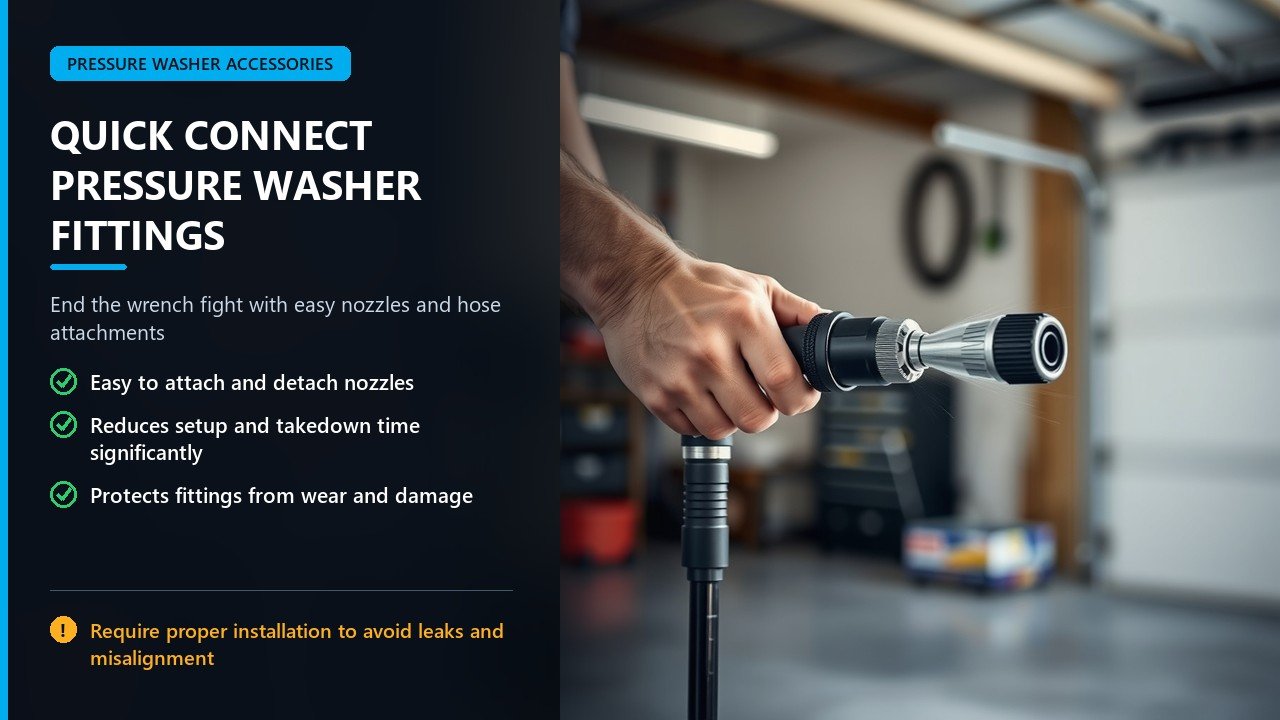
What Quick Connect Fittings Are
A quick connect, also called a quick coupler or quick disconnect, is a two-part fitting that joins two hoses or tools with a simple push and click instead of threads. The system has two halves: a plug (or nipple) and a socket (or coupler). The plug slides into the socket, a ring of ball bearings locks it in place, and a spring-loaded collar releases it when you pull the ring back.
On a pressure washer, the round-tip nozzles are actually quick connect plugs. The wand has a quick connect socket at its tip, so nozzles click in and out. Quick connects extend beyond nozzles too: you can add them between the gun and wand, between the hose and gun, and between the hose and pump outlet, so every connection releases by hand.
The main advantage is speed and convenience. Changing accessories takes a second instead of a minute, and you never strip a threaded fitting by overtightening. For anyone who cleans often, quick connects are the single most useful accessory upgrade.
Types and Sizes of Quick Connects
Quick connects for pressure washers come in several standard sizes and thread types, and matching them correctly is essential.
1/4-inch quick connect. The most common size, used for spray nozzles and many accessories. It is the standard for nozzle tips and light accessories on most machines.
3/8-inch quick connect. Larger and used for higher flow, common on commercial machines, telescoping wands, and large hoses. It moves more water, which matters for high-flow systems.
1/2-inch quick connect. Used on some larger machines and surface cleaners for maximum flow. Less common on homeowner equipment.
M22 threaded fittings. These are the screw-thread connections on many guns and hoses. Quick connect adapters convert M22 threads to quick connect so you can join those parts to a quick connect system. M22 comes in two common sizes, 14mm and 15mm, and this distinction matters enormously.
| Fitting | Typical Use | Notes |
|---|---|---|
| 1/4-inch quick connect | Nozzles, light accessories | Most common on home machines |
| 3/8-inch quick connect | Hoses, wands, heavy flow | Standard on gas/pro machines |
| M22 14mm | Inlet/outlet on many gas machines | Also called 14mm stem |
| M22 15mm | Inlet/outlet on many electric machines | Also called 15mm stem |
The M22 14mm vs 15mm Trap
No detail trips up more pressure washer owners than the M22 thread size. M22 is a 22mm thread, but it comes in two variants that differ only slightly in the shape of the mating surface. The 14mm version uses a flatter seat, while the 15mm version (often called 15mm stem) uses a more tapered seat. They connect to different styles of machine ports.
The problem is that a 14mm fitting may thread onto a 15mm port but will not seal properly, so it drips under pressure. The reverse is also true. Because the difference is only about a millimeter and the fittings look almost identical, people buy the wrong one constantly and then blame a “defective” part for the leak.
The fix is straightforward. Identify which type your machine uses before buying. If you are unsure, you can buy adapter kits that include both, or measure carefully. If you have a set of calipers, the difference is measurable. If you do not, note that most gas pressure washers use 14mm fittings at the gun and pump, while many electric machines use 15mm.
When you convert a machine to quick connects, this is the size you must get right. Once converted with the correct adapters, the quick connect itself is foolproof, and you never wrestle with the M22 threads again.
How to Convert a Pressure Washer to Quick Connects
Converting your machine to quick connects is a simple project that takes minutes and improves every future session.
Step 1 — Identify all connections. Trace your setup: pump outlet to hose, hose to gun, gun to wand, and wand tip to nozzle. Note the fitting type at each point. Most gun-to-wand and nozzle connections are already quick connect.
Step 2 — Determine the thread sizes. For the threaded joints, identify whether they are M22 14mm or 15mm. This is the critical step.
Step 3 — Buy a conversion kit. Kits typically include an M22-to-quick-connect adapter for the pump outlet, one for the gun inlet, and sometimes a hose end adapter. Match the kit to your thread size.
Step 4 — Install the adapters. Thread the adapters onto the ports. Wrap male threads with a couple of turns of thread seal tape, then tighten firmly by hand plus a quarter turn with a wrench. Do not overtighten.
Step 5 — Connect and test. Push the quick connect plugs into their sockets, turn on the water, and check for leaks. A drip usually means a loose adapter or a worn o-ring.
| Location | Common Fitting | Conversion Part |
|---|---|---|
| Pump outlet | M22 14mm or 15mm | M22 to quick connect |
| Hose to gun | M22 or quick connect | M22/QC adapter |
| Gun to wand | Quick connect | Already quick connect |
| Wand to nozzle | Quick connect | Already quick connect |
Why Quick Connects Improve Every Job
Once installed, quick connects deliver benefits on every use.
Speed. Switching nozzles or swapping accessories takes a second. No wrenches, no twisting, no drips.
Protection. Repeatedly threading and unthreading metal fittings wears the threads and can strip them. Quick connects eliminate that wear, because the threaded joint is set once and left alone.
Versatility. With quick connects at multiple points, your machine accepts a wide range of accessories — surface cleaners, foam cannons, extension wands, turbo nozzles, and more — without special adapters for each.
Convenience. You can move the gun from one hose to another, or move the whole machine into position, without draining and rethreading. Setup and teardown become quick and clean.
Fewer leaks. A properly seated quick connect with a healthy o-ring seals reliably. Once the threaded adapters are set, the frequent-wear joints are the quick connects, which are easy to maintain.
Troubleshooting Quick Connect Leaks
Quick connects are reliable, but when they leak, the cause is usually simple.
Worn or missing o-ring. The most common cause. The o-ring inside the socket seals the plug. When it hardens, cracks, or disappears, the joint drips. Replace it with a matching o-ring.
Mismatched M22 size. If a threaded adapter leaks under pressure, it is likely the wrong 14mm or 15mm type. Swap to the correct size.
Loose adapter. A threaded adapter that was not tightened enough will drip. Tighten it firmly, with thread tape on the male threads.
Dirty quick connect. Grit in the collar can prevent the coupler from locking fully, leaving a gap that leaks. Rinse and clean the fitting.
Worn plug. A heavily used plug can wear where the bearings grip. If cleaning and new o-rings do not stop the drip, replace the plug.
Maintaining Quick Connect Fittings
Quick connects are durable, but a little care keeps them sealing for years.
Inspect o-rings regularly. Check the o-ring in each socket every few uses. Replace any that look flattened, cracked, or hardened.
Keep them clean. Rinse grit out of the collars and plugs after use. Debris is the main cause of a coupler that sticks or fails to lock.
Do not force a connection. If a plug will not slide in, clean the parts rather than hammering it. Forcing damages the bearings and seats.
Use stainless or brass fittings. Better-grade quick connects resist corrosion and last far longer than cheap plated ones.
Store dry and clean. Drained, clean fittings avoid corrosion and freezing damage. Do not leave water in the system in freezing weather.
Quick Connect vs Threaded Fittings
It helps to understand what quick connects replace and why they are worth it.
Threaded fittings (usually M22) join two parts by screwing them together. They seal well when tight, but they must be re-tightened every time you change an accessory, they wear with repeated use, and they are slow to connect and disconnect. Over time, threads can cross-thread or strip, and thread tape must be reapplied.
Quick connects join two parts with a push and a click. They seal with an o-ring, release in a second, and do not wear out the same way, because the threaded joint is set once and left alone. The trade-off is that the o-ring is a wear item and must occasionally be replaced.
The practical approach is a hybrid: use threaded adapters once to convert each machine port to quick connect, then use quick connects for everything you change regularly — nozzles, wands, guns, hoses, and accessories. You pay the threaded connection only once per port, and enjoy quick connects forever after. It is the best of both worlds: the reliability of a threaded seal where it matters, and the speed of a quick connect everywhere else.
| Attribute | Threaded (M22) | Quick Connect |
|---|---|---|
| Connection speed | Slow, needs wrench | Fast, one second |
| Tool required | Yes | No |
| Wear over time | Threads wear and strip | Only the o-ring wears |
| Thread tape | Needed | Not needed on the coupling |
| Best role | Set-once permanent joints | Frequently changed connections |
Where to Add Quick Connects
You can introduce quick connects at several points in a pressure washer setup, each with its own benefit.
At the nozzle. This is usually already a quick connect on most wands, letting nozzles click in and out. If your wand tip is threaded, a quick connect adapter modernizes it instantly.
Between the gun and the wand. This lets you swap between a short wand, an extension, or a turbo nozzle without tools. It is one of the most useful places to add a quick connect.
Between the hose and the gun. A quick connect here lets you detach the gun quickly for storage or swap hoses in seconds.
At the pump outlet. Adding a quick connect where the hose meets the pump lets you attach or remove the hose without a wrench, which speeds setup and teardown.
At accessory ports. Adding quick connects to a foam cannon, surface cleaner, or water broom lets you move them between machines and store them cleanly.
Choosing Quality Quick Connects
Not all quick connects are equal, and the cheap ones cause most of the problems people associate with the technology.
Material. Brass and stainless steel are the best choices. Brass resists corrosion and seals well; stainless steel is tougher and ideal for high pressure or marine use. Avoid cheap plated zinc fittings, which corrode and fail quickly.
Pressure rating. Buy fittings rated to at least your machine’s maximum pressure, and preferably higher. A fitting rated below your machine’s output can fail under load, which is a safety risk.
O-ring quality. Most seals are Buna-N (nitrile), which handles water and detergents well. Silicone o-rings tolerate temperature extremes better. Good o-rings are the difference between a dry joint and a chronic drip.
Manufacturing tolerance. Well-made couplers lock firmly with no play. Cheap ones fit loosely, leak, and pop off under pressure. Spending a little more on quality fittings saves frustration.
Compatibility. Standard quick connects are cross-compatible by size, so a quality plug generally fits any quality socket of the same size. Stick to one reliable brand where you can.
| Feature | Best Choice | Why |
|---|---|---|
| Material | Brass or stainless steel | Corrosion resistance |
| Pressure rating | At or above machine output | Safety and durability |
| O-ring | Buna-N or silicone | Reliable sealing |
| Tolerance | Snug, no play | Prevents leaks and pop-offs |
Using Quick Connects With Common Accessories
The real payoff of a quick connect setup is how easily it handles the whole family of pressure washer accessories.
Nozzles. The classic use. Color-coded tips click in and out as you move from a narrow cutting jet to a wide rinse fan.
Foam cannons. A foam cannon with a quick connect plug attaches to your wand in a second, so you can switch between foaming and rinsing quickly.
Surface cleaners. Attaching a surface cleaner to a quick connect gun means you can alternate between a spinning floor cleaner and a hand wand without tools.
Extension wands. With a quick connect between the gun and wand, adding or removing an extension takes a second, perfect for switching between ground-level and high-reach work.
Turbo nozzles. A turbo nozzle’s rotating jet cleans faster on hard surfaces; a quick connect lets you swap it in for tough jobs and out for delicate ones.
Water brooms and undercarriage cleaners. Specialty tools with quick connect plugs attach to your existing gun, expanding what the machine can do without new hoses or fittings.
Quick Connect Kit Options
Conversion kits make upgrading easy by bundling the adapters you need. Choosing the right kit depends on your machine and what you want to convert.
Basic nozzle kits. Include a wand tip adapter that turns a threaded wand into a quick connect for nozzles. This is the simplest, cheapest upgrade and often the first one people make.
Gun and hose kits. Include M22-to-quick-connect adapters for the pump outlet and gun inlet, letting you connect and disconnect the hose by hand. These kits usually specify a thread size, so buy the 14mm or 15mm version that matches your machine.
Full conversion kits. Cover the pump outlet, gun inlet, and sometimes the wand, giving you quick connects at every joint. They are the most convenient choice for a complete upgrade.
Adapter combo sets. Include both 14mm and 15mm adapters so you are covered regardless of your machine’s thread size. These are a smart buy if you are unsure which size you have or own multiple machines.
Whatever kit you choose, check that it includes fittings rated above your machine’s pressure and made from brass or stainless steel. A cheap kit with plated fittings undermines the whole point of the upgrade.
Common Mistakes to Avoid
Buying the wrong M22 size. The 14mm versus 15mm mix-up causes most leaks. Confirm your size before buying.
Skipping thread tape. Threaded adapters need thread seal tape on the male threads to seal reliably.
Overtightening adapters. Excessive torque can crack fittings or distort seats. Snug plus a quarter turn is enough.
Ignoring worn o-rings. A drippy quick connect is usually just a tired o-ring, not a failed fitting.
Mixing brands carelessly. Quick connects are generally cross-compatible by size, but cheap, out-of-spec parts can fit poorly. Buy quality.
Leaving water in over winter. Freezing water cracks fittings and seals. Drain everything in cold weather.
Frequently Asked Questions
Are pressure washer quick connects universal? By size and type they are largely standardized and cross-compatible, but sizes vary and cheap parts may fit loosely. Match the size and buy quality.
What size quick connect do pressure washers use? Nozzles and light accessories commonly use 1/4-inch, while hoses and heavy-duty wands often use 3/8-inch. Threaded ports are usually M22.
How do I know if my fitting is M22 14mm or 15mm? The difference is about a millimeter in the seat shape. Measure with calipers if unsure, buy a kit that includes both, or note that most gas machines use 14mm and many electric machines use 15mm.
Do quick connects reduce pressure? Minimally. Well-made quick connects add little restriction, and the convenience far outweighs any tiny pressure loss.
Can I mix brass and stainless quick connects? Yes. Mixing metals at a joint is generally fine for pressure washer use, and both resist corrosion well.
Why does my quick connect keep popping off? Usually a worn plug or a dirty collar that prevents full locking. Clean the fitting and, if needed, replace the plug.
Can I add a quick connect to an electric pressure washer? Yes. Buy adapters that match your machine’s thread size — often 15mm for electric units — and convert the threaded joints.
How often should I replace quick connect o-rings? Replace any o-ring that looks flattened, cracked, or hardened. Checking every few sessions and keeping spares on hand is enough for regular use.
Will quick connects fit my foam cannon or surface cleaner? If the accessory ends in a 1/4-inch quick connect plug and your gun has a matching socket, yes. Most modern accessories use standard 1/4-inch connections.
Final Thoughts
A quick connect pressure washer setup turns a fiddly, wrench-heavy machine into a fast, friendly tool. Nozzles click in and out, hoses disconnect by hand, and accessories swap in seconds. The system is simple: a plug and a socket that lock with a push and release with a pull.
The one detail that demands attention is the M22 thread size. Get the 14mm or 15mm right, add thread tape to the threaded adapters, keep spare o-rings on hand, and clean the fittings after use. Do that, and quick connects deliver years of effortless, leak-free convenience on every job. Converting is one of the best small investments you can make for your pressure washer.
It is also worth keeping a small quick connect kit on hand for maintenance: spare o-rings in the sizes your fittings use, a spare plug or two, and a small roll of thread seal tape. These tiny parts cost almost nothing and turn a leaky joint or a stuck coupler into a two-minute fix instead of a lost afternoon. When you own the fittings, you own the problems they solve, and you solve them fast.
Finally, think of quick connects as the foundation of a modular pressure washer system. Once the machine’s ports are converted, every accessory in the same size family becomes interchangeable. You can build a personal kit — a short wand, an extension, a foam cannon, a surface cleaner, a turbo nozzle — that all click onto the same gun. That flexibility is what makes quick connects feel less like an accessory and more like an upgrade to the whole machine. It is a small change that quietly improves every single job you do. Once installed, you will wonder how you ever tolerated threaded fittings at all.