A commercial cleaner learned this the hard way. On a big driveway job, his pressure washer hose burst two hours in, soaking the customer’s wall and stopping the work cold. The hose was a cheap big-box replacement rated far below what his machine produced. The pump was fine; the hose simply was not built for commercial duty. A commercial pressure washer hose is not just a longer or thicker version of a home hose. It is engineered for continuous use, high pressure, high flow, and the abuse of daily professional work. This guide explains what makes a hose commercial-grade, how to read its ratings, and how to choose one that survives the job.
When a hose fails on a commercial job, it costs far more than the hose itself. It means lost time, a soaked site, a wet customer, and potentially an injury. Choosing the right hose is therefore not an afterthought; it is a core piece of professional equipment. Understanding construction, ratings, and sizing is how you avoid a failure that could have been prevented.
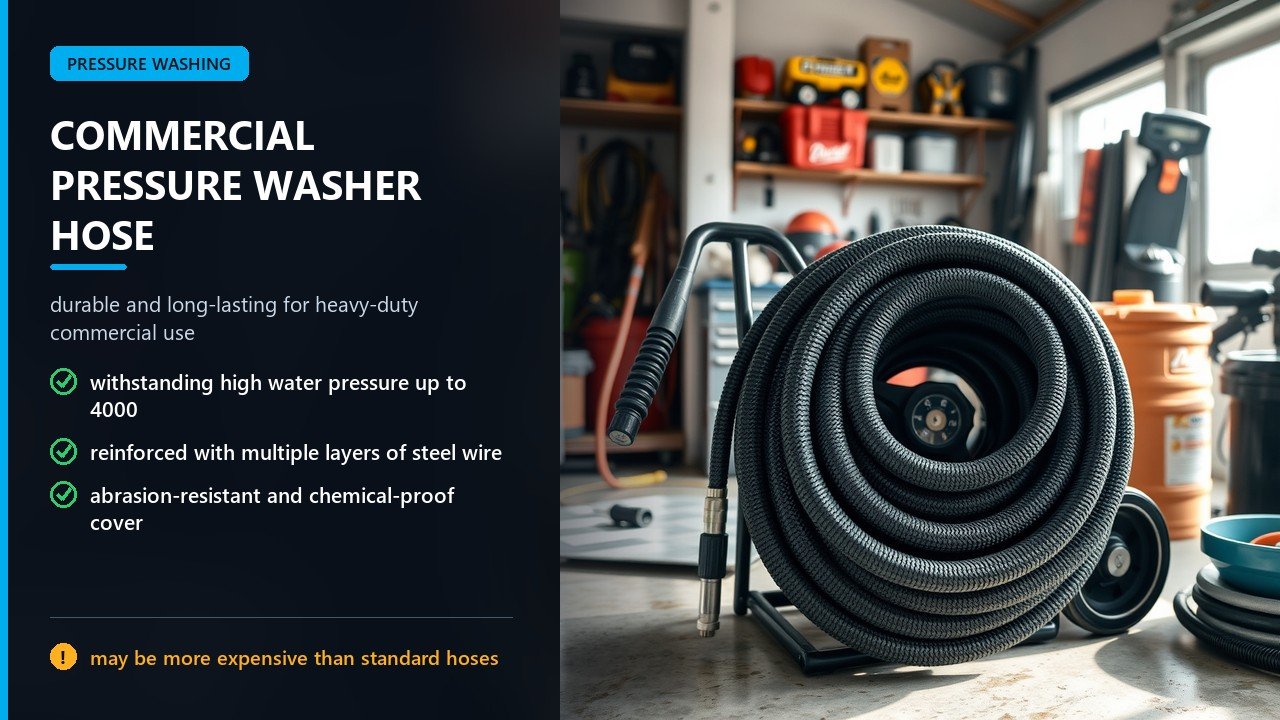
What Makes a Hose Commercial-Grade
A commercial pressure washer hose differs from a consumer hose in several important ways.
Higher pressure rating. Commercial machines produce more pressure, so commercial hoses are rated for the pressures and surges those machines create, with a safety margin above the working pressure.
Reinforcement. Commercial hoses use stronger reinforcement layers, often one or two layers of high-tensile steel wire braid, to contain high pressure without expanding or bursting.
Durable cover. The outer cover resists abrasion, oil, chemicals, weather, and UV exposure, because commercial hoses are dragged across concrete and left in the sun.
Consistent flow. A commercial hose maintains its internal diameter under pressure so flow stays high, which matters for productivity and for feeding downstream accessories.
Reliable fittings. Commercial hoses have properly crimped, high-pressure fittings that do not leak or blow off under load.
The difference is not cosmetic. A consumer hose used commercially wears out fast, while a commercial hose is built to take the daily punishment that professional work delivers.
Hose Construction Explained
Every pressure washer hose has three layers, and understanding them explains why quality varies so much.
Inner tube. The inner layer carries the water. A quality tube is smooth to minimize friction and pressure loss, and is compatible with water, detergents, and commonly used chemicals.
Reinforcement. The middle layer contains the pressure. It is made of one or more braids of steel wire or synthetic fiber. More and stronger braids mean higher pressure capacity and less expansion under load.
Outer cover. The outer layer protects the reinforcement from abrasion, weather, oil, and chemicals. A tough cover determines how well the hose survives being dragged and left outside.
Cheap hoses cut corners on each layer: a thin tube, a single weak braid, and a thin cover. Commercial hoses invest in all three, which is why they last far longer and hold their ratings over years of use.
Single vs Double Wire Braid
One of the clearest indicators of a hose’s capability is how many braids reinforce it.
Single braid hoses have one layer of steel wire braid. They suit moderate pressures and are common on lighter commercial and heavy home machines. They are more flexible and lighter than double-braid hoses.
Double braid hoses have two layers of wire braid, giving much higher pressure capacity and less expansion under load. They are the standard for high-pressure commercial work and for machines producing serious pressure.
Synthetic (fiber) braid. Some hoses use high-strength synthetic yarn instead of steel. These can be lighter and more flexible, and some are rated for high pressure, but steel braid remains the standard for the toughest commercial duty.
The braid count is a direct indicator of pressure capacity and durability. If you need to know whether a hose can handle commercial pressure, count the braids and check the rating.
| Reinforcement | Pressure Capacity | Typical Use |
|---|---|---|
| Single braid | Moderate | Light commercial, home |
| Double braid | High | Commercial, high pressure |
| Synthetic braid | Varies | Specialty, light and flexible |
Materials: Rubber vs Thermoplastic
Pressure washer hoses are made from two main families of materials, each with strengths.
Rubber hoses are flexible, durable, and resistant to kinking and abrasion. They tolerate cold well and handle high pressure reliably. Their downsides are weight and, for some formulations, susceptibility to certain chemicals and oils, though quality commercial rubber hoses resist these.
Thermoplastic (PVC, polyurethane, hybrid) hoses are lighter and often more affordable. They resist chemicals and oils well and come in bright colors. Their weaknesses are stiffness in cold weather and, for cheaper versions, less resistance to kinking and abrasion.
Hybrid hoses combine a thermoplastic cover with a rubber or blended core, aiming for the best of both: lighter than all-rubber, tougher than cheap PVC, and good chemical resistance.
For commercial work, the choice depends on the job. All-rubber hoses suit cold weather and heavy abrasion. Hybrid hoses offer a good balance of weight and durability. Cheap PVC hoses are best avoided for serious commercial use because they stiffen in cold and wear quickly.
| Material | Strength | Weakness |
|---|---|---|
| Rubber | Durable, cold-tolerant, flexible | Heavier |
| Thermoplastic/PVC | Light, chemical-resistant, cheap | Stiff in cold, less abrasion-resistant |
| Hybrid | Balanced weight and durability | Middle-ground performance |
Reading Pressure Ratings
The most critical number on a commercial hose is its pressure rating, and it comes with an important companion figure.
Working pressure is the pressure the hose is designed to handle continuously. It must be at or above your machine’s maximum pressure.
Burst pressure is the pressure at which the hose fails. It is typically several times the working pressure, providing a safety margin. A higher burst-to-working ratio means more safety.
Safety factor. Commercial hoses usually have a safety factor of at least two to four times the working pressure. This margin protects against pressure spikes, surges, and wear over time.
Temperature rating. Hoses also have a temperature limit. Exceeding it softens the materials and reduces the pressure rating, so hot-water applications need hoses rated for high temperatures.
Never use a hose whose working pressure is below your machine’s output, even briefly. Pressure spikes can exceed the rated level, and a hose that is over pressured is a genuine hazard. Buy a hose rated comfortably above your machine’s maximum, and check the temperature rating if you use hot water.
Sizing for Flow and Reach
Hose internal diameter controls flow, and length controls reach and pressure loss. Both matter immensely for commercial work.
3/8-inch hose is the most common commercial size. It balances flow and weight and suits most gas machines. Its larger bore moves more water than thin consumer hoses, maintaining pressure and flow.
1/2-inch hose moves more flow and is used on high-volume machines, but it is heavier and less flexible.
1/4-inch hose is common on light home machines. It restricts flow and is generally too small for serious commercial pressure and flow.
Length also matters. Longer hoses lose more pressure to friction, and a hose that is too long can starve the machine or reduce performance at the tip. The common advice is to use the shortest hose that reaches the work, and to avoid daisy-chaining multiple hoses, which multiplies pressure loss and failure points. A 50-foot hose is a practical standard, with longer runs handled by moving the machine rather than extending endlessly.
| Hose ID | Flow | Typical Use |
|---|---|---|
| 1/4 inch | Low | Light home machines |
| 3/8 inch | Good | Most commercial gas machines |
| 1/2 inch | High | High-volume commercial use |
Fittings and Couplings
A hose is only as good as its end fittings, and commercial hoses demand reliable ones.
Crimped fittings. Factory-crimped fittings are permanently attached by a machine and are the most reliable for high pressure. Commercial hoses almost always use crimped fittings.
Reusable fittings. These screw onto a prepared hose end and can be replaced in the field. They are convenient for repairs but require care to install correctly and are typically rated lower than crimped fittings.
Quick connect ends. Many commercial hoses end in quick connect plugs or sockets, allowing fast connection to guns and pumps. Confirm the size (often 3/8) matches your system.
M22 threaded ends. Some hoses use M22 threads, which require matching 14mm or 15mm adapters. Mismatched M22 sizes are a common source of leaks.
Strain relief. A good hose has a protective sleeve or strain relief where the fitting meets the hose, because that junction flexes most and is prone to failure.
When buying, prioritize crimped, high-pressure fittings rated above your machine’s pressure, with the correct end type for your gun and pump. The fittings are where most failures occur, so quality here is essential.
Maintenance and Storage
A commercial hose lasts far longer with basic care between jobs.
Coil without kinks. Coil the hose in large, even loops, avoiding tight kinks that damage the reinforcement. A hose reel helps keep coils consistent.
Do not drag over sharp edges. Dragging a hose across broken concrete or sharp metal cuts the cover, exposing the reinforcement. Route hoses away from sharp edges.
Protect from vehicles. Do not let vehicles run over a hose, which can crush the reinforcement and cause a weak spot.
Drain and store dry. Drain water before storage, especially in freezing weather, to prevent internal freezing that cracks the hose.
Inspect regularly. Check for bulges, cuts, or worn spots, particularly near the fittings. Replace a damaged hose rather than risking a burst.
Keep out of harsh sun when stored. UV degrades the cover over time, so store hoses under cover when possible.
Hot Water vs Cold Water Hoses
Commercial cleaning often involves hot water, which changes the hose requirements significantly.
Cold water hoses are rated for ambient water temperatures only. They are the standard for most pressure washing and are perfectly adequate for cold-water machines.
Hot water hoses are rated for elevated temperatures, often up to 200 degrees Fahrenheit or more. They use materials and construction that tolerate heat without softening, expanding, or losing pressure capacity.
The mistake to avoid is running hot water through a cold-water hose. Heat softens the inner tube and reinforcement, reducing the pressure rating and risking a burst. If your commercial machine heats water, you need a hose explicitly rated for the temperatures it produces.
Hot water also demands attention to the fittings, which must be rated for the temperature, and to the cover, which must resist the heat without cracking. For steam or very high-temperature applications, special hoses are required. Always check the temperature rating against your machine’s hot-water output.
| Hose Type | Temperature Range | Use |
|---|---|---|
| Cold water | Ambient / cold | Most pressure washing |
| Hot water | Elevated, often 200F+ | Hot-water commercial cleaning |
Why Hose Length and Diameter Matter
The reason length and diameter are so important comes down to friction and pressure loss inside the hose.
As water moves through a hose, it rubs against the inner walls. That friction costs pressure, and the loss grows with both length and the amount of water flowing. A narrow hose has more wall surface relative to its volume, so it loses more pressure. A long hose compounds the loss over distance.
This is why a high-flow commercial machine can feel strong with a short 3/8-inch hose and weak at the end of a long, narrow one. The pump is doing its job, but the hose is eating the pressure. Flow also drops, so cleaning slows and accessory performance suffers.
The practical rules follow directly. Use the widest practical diameter for your machine, typically 3/8-inch for commercial gas machines. Use the shortest length that reaches the job. Never chain hoses to extend reach, because each added section multiplies friction and adds a failure point. Move the machine closer instead.
Matching the Hose to Machine and Accessories
A commercial hose has to fit every part of the system, not just the machine.
Match the pressure rating to the machine’s maximum, with margin. A commercial machine’s pressure spikes make this non-negotiable.
Match the flow capacity to the machine’s GPM. A hose too small in diameter will throttle a high-flow pump.
Match the end fittings to your gun, pump, and any inline accessories. Commercial systems often use 3/8-inch quick connects and M22 threads, so confirm the size and type.
Consider inline accessories. If you use a downstream chemical injector, a filter, or a surface cleaner, ensure the hose feeds them adequately and that the connections match.
Check temperature compatibility if you run hot water or steam.
When all these match, the hose becomes invisible; water flows from pump to nozzle without bottlenecks or leaks. When any one mismatches, the hose stands out as a problem, either starving the machine or leaking under pressure.
Hose Reels and Management
For commercial work, how you store and deploy the hose is as important as the hose itself.
Hose reels keep a hose coiled neatly, prevent kinks, and allow fast deployment and retrieval. A good reel saves time on every job and extends hose life by avoiding kinks and tangles.
Reel mounting. Reels can mount on the machine, a cart, a wall, or a vehicle. Choose based on how you work and where the machine lives.
Swivel fittings. A reel with a swivel fitting lets the hose rotate as it spools, reducing strain at the connection point, which is where hoses often fail.
Proper coiling. Without a reel, coil the hose in large, even loops, over-under style, avoiding tight kinks. Store coiled, not in a tangled heap.
Protection. Keep hoses off the ground when stored, and away from sharp objects and heat sources. A covered storage area limits UV damage.
Good hose management is not glamorous, but it directly affects how long a commercial hose lasts and how quickly a job can be set up and taken down. A tangled, kinked hose wastes time and damages the reinforcement.
Cost and Value
A commercial hose costs more than a consumer hose, and the difference is money well spent.
A commercial hose that lasts several seasons costs far less per job than a cheap hose replaced repeatedly. More importantly, a failure on a commercial job costs time, damages the customer’s property, and can cause injury, all of which dwarf the price difference of the hose.
The value calculation favors buying the correct hose the first time. Match the pressure rating, size, material, and fittings to the work, add a hose reel to protect it, and maintain it between jobs. That approach turns a single purchase into years of dependable service, which is exactly what commercial equipment should deliver.
For professionals, the hose is not a disposable accessory; it is a tool that must perform every day. Treating it accordingly, with the right specification and proper care, is the cheapest and safest way to keep jobs moving.
Common Mistakes to Avoid
Using a consumer hose commercially. It will fail under the pressure and wear of daily work. Buy commercial-grade.
Buying a hose rated below your machine. Pressure spikes exceed the rating and cause bursts. Match the working pressure to your machine, with margin.
Choosing a hose that is too narrow. A 1/4-inch hose chokes a high-flow commercial machine. Use 3/8 or larger as appropriate.
Running hoses too long. Excess length causes pressure loss and hurts performance. Use only what you need.
Chaining multiple hoses. Each joint adds pressure loss and another failure point. Prefer one properly sized hose.
Ignoring fittings. Cheap or mismatched fittings leak and blow off. Buy crimped, high-pressure fittings of the correct type.
Neglecting inspection. A worn hose that bursts on a job costs time and safety. Inspect regularly and replace at the first sign of damage.
Frequently Asked Questions
What size hose does a commercial pressure washer use? Most use 3/8-inch for a balance of flow and weight; high-volume machines may use 1/2-inch.
What pressure rating do I need? A working pressure at or above your machine’s maximum, with a strong burst-to-working ratio for safety. Hot-water use also requires a suitable temperature rating.
How long should a commercial hose be? Use the shortest length that reaches the job, commonly around 50 feet, and avoid chaining hoses together.
Is a steel-braided hose better? Steel braid provides high pressure capacity and durability and is standard for commercial use. More braids generally mean higher pressure capacity.
Can I use a home hose for commercial work? It is not recommended. Consumer hoses are not built for the pressure and daily wear of commercial work and fail quickly.
How do I store a commercial hose? Coil it in large loops without kinks, drain it, keep it off the ground, and store it out of harsh sun and freezing temperatures.
Why does my hose lose pressure? Likely because it is too long, too narrow, or has restrictive or leaking fittings. Check size, length, and connections.
When should I replace a hose? At the first sign of bulges, cuts, worn spots, or leaking fittings. Do not risk a burst on a job.
What is the best material for a commercial hose? All-rubber hoses excel in cold and abrasive conditions, while hybrid hoses balance weight and toughness. Cheap PVC stiffens in cold and wears quickly, so it is best avoided for serious work.
Do I need a different hose for hot water? Yes. Hot water requires a hose rated for elevated temperatures, with compatible fittings and cover. A cold-water hose can fail under heat.
Is a hose reel worth it for commercial work? Yes. A reel prevents kinks, speeds setup and packing away, and reduces strain near the fittings, which is where a hose most often fails. It pays for itself in time saved and longer hose life.
Final Thoughts
A commercial pressure washer hose is a serious piece of equipment that deserves serious attention. It carries the full flow at full pressure, job after job, across rough ground and in all weather. Its construction, pressure rating, size, and fittings determine whether it delivers reliably or fails at the worst moment.
Choose a hose rated above your machine’s pressure, sized correctly for flow, reinforced for durability, and fitted with quality crimped couplings. Use the shortest length that reaches the work, maintain it between jobs, and inspect it regularly. Do that, and your hose will be the dependable link between a capable machine and clean results, rather than the weak point that ruins a day’s work.
Remember that the hose is the one part of the system that lives closest to the abuse: dragged, coiled, sun-baked, and pressurized thousands of times. Every dollar spent on a properly rated, well-built commercial hose, and every minute spent coiling it without kinks, pays back in jobs that finish on time and customers who never see a soaking.