Most people think of a pressure washer as a motor that sprays water. In reality, it is a small, precise system of engineering that converts ordinary tap water into a powerful cleaning jet, and understanding the technology behind it changes how you choose, use, and maintain one. Pressure washer tech spans pumps, motors, valves, and control systems, each doing a specific job and each affecting how the machine performs. This guide opens the hood and explains the technology in plain terms, so you can understand what you own and choose better next time.
Pressure washers are simpler than engines or electronics, but they are not trivial. A pump that generates pressure, a motor or engine that drives it, valves that manage flow and safety, and systems that protect the machine all work together. Knowing what each part does helps you appreciate why some machines last for years while others fail quickly, and why a headline PSI number never tells the whole story.
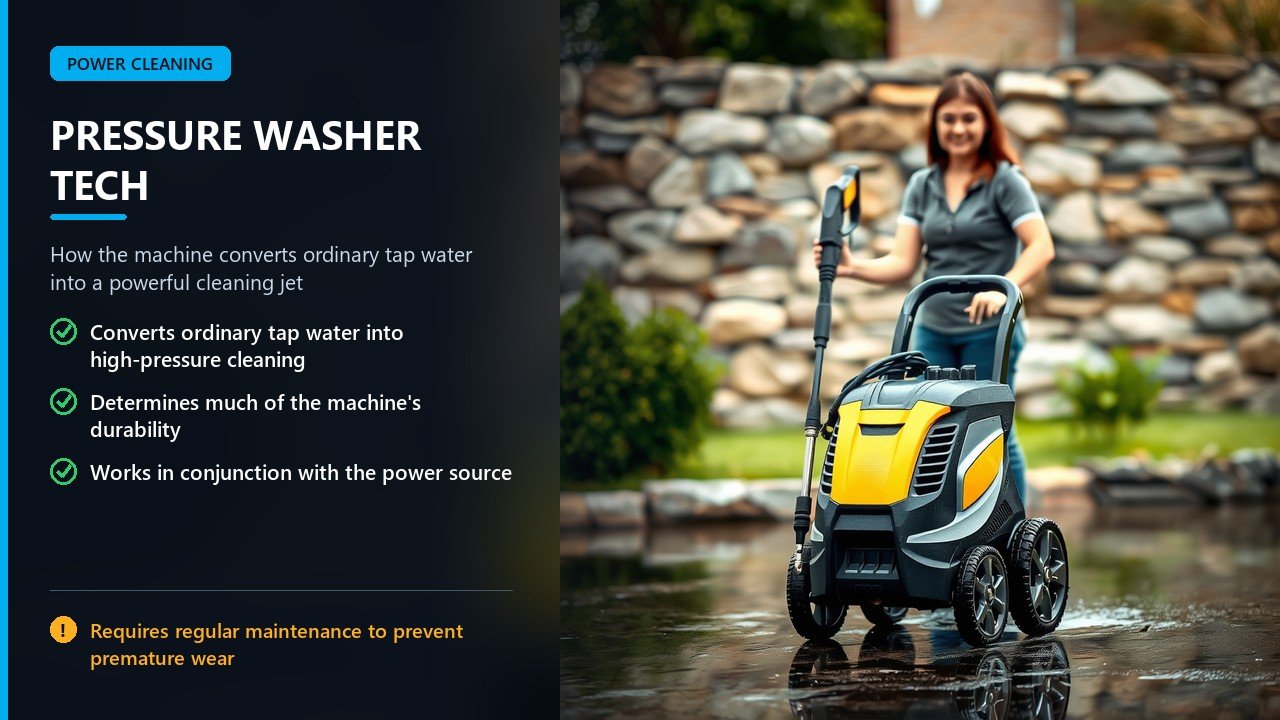
The Core: Motor and Pump
Every pressure washer is built around two central components: a power source and a pump.
The power source is either an electric motor or a gasoline engine. The motor or engine spins a shaft, and that shaft drives the pump. Electric motors are quiet and clean; engines are more powerful and portable without a cord.
The pump is the heart of the machine. It takes a flow of water at low pressure and forces it out at high pressure in a controlled stream. The pump determines much of the machine’s durability, because it endures the pressure and repetition that wear machines out.
The combination matters. A powerful motor with a cheap pump wears out fast, while a modest motor with a quality pump can last for years. This is why experienced buyers look at the pump as closely as the pressure rating.
How Pressure Is Generated
Pressure washers use positive displacement pumps, which is the key to understanding how they build pressure.
A positive displacement pump traps a fixed volume of water and forces it into the outlet, rather than simply spinning it like a fan. Because the water has nowhere to go but forward, it exits under pressure. The tighter and more forcefully the pump pushes, the higher the pressure.
The pump typically has pistons or plungers driven by a rotating cam or crankshaft. As the shaft turns, the pistons move back and forth, drawing water in on one stroke and pushing it out on the next. One-way valves ensure water only moves in the right direction, opening for intake and closing to force water out.
Because the pump moves a fixed volume per stroke, the machine’s flow rate (GPM) is set by how much water the pump displaces per minute, while the pressure is set by how forcefully it pushes against resistance. If the nozzle restricts flow, pressure rises; if the nozzle is wider, pressure drops and flow increases. This relationship is why nozzles and unloader valves matter so much.
Pump Types and Their Technology
Different pump designs suit different levels of use, and knowing them reveals a machine’s true quality.
Axial cam pumps. Common on light and home machines, these use a cam to move pistons that are not held as rigidly as in heavier pumps. They are compact, affordable, and adequate for occasional use, but they are less durable and often not rebuildable.
Triplex plunger pumps. Standard on commercial machines, these use three plungers driven by a crankshaft, with a robust design that handles high pressure and long use. They are often rebuildable, which extends the machine’s life considerably.
Wobble plate pumps. A middle design that uses a wobbling plate to move pistons. It sits between axial and triplex in durability and cost.
The technology here is about how the rotation is converted into piston movement. A cam and wobble plate are simpler; a crankshaft-driven triplex pump is more precise and durable. For heavy or commercial use, the triplex pump’s robustness and rebuildability make it the clear choice.
| Pump Type | Typical Use | Durability |
|---|---|---|
| Axial cam | Home, light use | Moderate, often sealed |
| Wobble plate | Mid-range | Moderate |
| Triplex plunger | Commercial, heavy use | High, rebuildable |
Motors, Engines, and Drive Systems
The power source and how it connects to the pump both affect performance and longevity.
Electric motors come in brushed and induction types. Brushed motors are cheaper but wear their brushes over time; induction motors are quieter, more efficient, and longer-lasting, which is why quality electric machines favor them.
Gasoline engines produce more power and run without a cord, making them suitable for heavy and remote work. They need fuel, oil, and more maintenance than electric motors.
Direct drive connects the motor or engine shaft directly to the pump, a compact and efficient arrangement common on home machines. The downside is that pump heat can reach the motor, and the fixed connection offers less flexibility.
Belt drive connects the power source to the pump with a belt, allowing the pump to run at different speeds and isolating it from engine heat and vibration. Belt drive is common on heavy-duty machines and generally extends pump life, though it adds parts to maintain.
| System | Strength | Trade-off |
|---|---|---|
| Brushed motor | Lower cost | Brushes wear out |
| Induction motor | Quiet, durable | Higher cost |
| Direct drive | Compact, efficient | Heat and wear transfer |
| Belt drive | Longer pump life | More parts, maintenance |
Valves and Safety Technology
Beyond the motor and pump, several valves and systems make a pressure washer controllable and safe.
Unloader valve. When you release the trigger, the unloader redirects water back to the pump’s inlet instead of deadheading against a closed gun. This protects the pump from the pressure spike that would otherwise occur, and it is a critical reliability feature.
Thermal relief valve. If the machine runs too long with the trigger released, water recirculating in the pump can heat up, and the thermal relief valve opens to release hot water and prevent damage.
Total stop system. Many electric machines stop the motor when the trigger is released and restart it when squeezed. This saves energy, reduces noise and wear, and is a common modern feature.
Check valves. One-way valves inside the pump ensure water flows in the correct direction, preventing backflow and maintaining pressure.
GFCI protection. Electric machines often include a ground-fault circuit interrupter, which cuts power if it detects a fault, protecting the user from electric shock in wet conditions.
Nozzles and Flow Control
The nozzle is where the machine’s technology meets the surface, and it controls pressure and flow at the point of work.
Spray angle. Nozzle tips are color-coded by spray angle, from a narrow, high-impact 0-degree jet to a wide, gentle 40-degree fan. Narrower angles concentrate the stream for more impact; wider angles spread it for gentler cleaning.
The pressure-flow relationship. Because the pump delivers a fixed flow, a smaller nozzle opening raises pressure while a larger one lowers it. Changing tips is a simple way to tune the machine to the job.
Quick connects. Most machines use quick connect tips for fast changes, a small technology that dramatically improves usability.
Turbo nozzles. A turbo nozzle spins a narrow jet in a circular pattern, combining high impact with broader coverage. It uses the same pressure and flow but applies them more aggressively.
Understanding that the nozzle controls the balance of pressure and flow helps you choose the right tip rather than forcing the machine to do something it is not set up for.
Water Inlet, Filtration, and Chemical Injection
Several supporting systems keep a pressure washer running cleanly and add capability.
Water inlet and filter. Water enters the pump through an inlet that often includes a filter to trap debris before it reaches the pump. Clean water prevents damage to valves and pistons.
Downstream injection. A chemical injector placed after the pump draws detergent into the water stream using the venturi effect. It is the most common and safest way to apply chemicals, since soap never enters the pump.
Upstream injection. Less common, this injects chemicals before the pump. It requires chemicals safe for the pump’s internal parts to avoid damage.
Onboard detergent tanks. Some machines include a tank and a selector for detergent, simplifying chemical application.
These systems extend what the machine can do and protect it, and understanding them helps you use chemicals effectively without harming the pump.
Electrical Technology in Electric Machines
Electric pressure washers add a layer of technology around the motor and its power supply.
Power supply. Home electric machines typically run on standard voltage with modest current, which limits their power. Commercial electric machines may use higher voltage and amperage to drive stronger motors and heating elements.
Motor control. Modern machines may include electronic controls that manage starting, stopping, and current draw, protecting the motor and smoothing operation.
Total stop and soft start. Some machines use soft-start technology to avoid a power surge at startup, and a total stop system to halt the motor when idle. Both reduce wear and improve efficiency.
GFCI and insulation. Because water and electricity are a dangerous combination, electric washers use insulation, waterproofing, and ground-fault protection to keep the operator safe.
The technology here is about managing electricity safely and efficiently. Better electric machines invest in better motors and protection, which shows up as quieter operation, longer life, and safer use.
Smart and Efficiency Features
Modern pressure washers increasingly include technology aimed at convenience, efficiency, and control.
Variable pressure. Some machines let you adjust pressure for different jobs, from delicate car paint to tough concrete, either mechanically or electronically. This prevents damage and improves versatility.
Energy-saving stop-start. The total stop system already mentioned is a form of efficiency technology, cutting power when the machine is idle.
Soap and nozzle selectors. Onboard dials and tanks let you switch between detergent and rinse, and between tips, without stopping.
Digital controls and displays. Some premium machines include digital readouts and controls, offering precise settings and diagnostics.
Eco and low-pressure modes. These reduce water and energy use for light cleaning, useful where conservation or delicate surfaces matter.
Not every machine needs these technologies, and they add cost. But they reflect the industry’s trend toward more controllable, efficient, and user-friendly pressure washers that adapt to a wider range of tasks.
How the Parts Work Together
It helps to follow the water and power through a machine to see how the technology integrates.
Water in. Water enters the inlet, passes through a filter, and reaches the pump at low pressure.
Power and pumping. The motor or engine spins the pump, whose pistons force water into the high-pressure outlet.
Pressure management. The unloader valve manages pressure, redirecting water when the trigger is released, and the thermal relief valve protects against overheating.
Delivery. High-pressure water travels through the hose to the gun and then the wand, where the nozzle shapes it into a spray and sets the final pressure and flow.
Chemical addition. A downstream injector can draw detergent into the stream for cleaning tasks.
Control and safety. The trigger controls flow, the total stop system controls the motor, and the GFCI protects the user.
Seeing the whole path makes the machine’s behavior predictable. When something goes wrong, you can trace the path and identify which stage is responsible, whether it is a clogged filter, a worn pump, a stuck unloader, or a wrong nozzle.
Maintaining the Technology
Each technology in a pressure washer has maintenance needs, and looking after them extends the machine’s life.
Pump oil. Serviceable pumps need their oil changed on schedule to prevent heat and wear.
Inlet filter. Clean the filter regularly so water flows freely and the pump is protected from debris.
Unloader and valves. These can seize or leak over time. If pressure behaves oddly, the unloader is a prime suspect.
Seals and o-rings. Quick connects, hoses, and pump seals wear out. Keep spares and replace them when they leak.
Electrical components. For electric machines, keep connections dry and inspect cords and the GFCI periodically.
Engine maintenance. For gas machines, change the oil, clean or replace the air filter, and service the spark plug and fuel system.
Maintenance is where the technology meets ownership. A machine with excellent technology still fails if its oil and filters are ignored, while a modest machine that is well maintained can serve for many years.
| Component | Maintenance | Interval |
|---|---|---|
| Pump oil | Change oil | Per manual, often annually |
| Inlet filter | Clean debris | Regularly |
| Seals / o-rings | Inspect and replace | When worn or leaking |
| Unloader valve | Check function | If pressure is irregular |
| Electrical / GFCI | Inspect connections | Periodically |
| Engine (gas) | Oil, filter, plug | Per manual |
Troubleshooting by Symptom
Understanding the technology makes troubleshooting far easier, because each symptom points to a specific system.
Low or no pressure. Usually a clogged inlet filter, a partially closed water supply, a worn nozzle, or air in the line. Check the water supply and filter first, then the nozzle and pump.
Pressure pulses or surges. Often air in the system, a restricted supply, or a failing unloader valve. Bleed the line, check the supply, and inspect the unloader.
Motor runs but no spray. Could be a closed trigger safety, a clogged nozzle, or a blocked line. Check the obvious restrictions first.
Machine cycles on and off rapidly. With a total stop system, this often indicates a leak in the system or a worn seal, so the pressure drops and the motor restarts repeatedly.
Pump noisy or hot. Usually low oil, worn internal parts, or a restricted supply causing cavitation. Check oil level and water supply.
Water in the oil. A sign of a failed seal allowing water into the crankcase. Stop using the machine and have it serviced to prevent further damage.
| Symptom | Likely System |
|---|---|
| Low pressure | Filter, supply, nozzle, pump |
| Pulsing / surging | Air, supply, unloader |
| No spray | Trigger, nozzle, line blockage |
| Rapid cycling | Leak, worn seal |
| Noisy / hot pump | Oil, internal wear, supply |
| Water in oil | Failed seal |
Choosing Technology That Fits
With an understanding of the technology, you can choose a machine by what is inside rather than by marketing alone.
Match the pump to the use. For occasional home jobs, an axial pump is adequate. For frequent or commercial work, choose a triplex pump for durability and rebuildability.
Match the power source to the location. Electric for quiet, indoor, and convenient use; gas for power and portability.
Match the drive to the duty. Direct drive suits light and home machines; belt drive suits heavy-duty machines that benefit from longer pump life.
Match the flow to the tasks. For cleaning speed and accessory performance, flow matters. Don’t chase PSI at the expense of GPM.
Value the protective technology. Unloaders, thermal relief valves, total stop systems, and GFCI protection may look minor, but they protect both the machine and you.
Keep maintenance in mind. A machine whose oil, filter, and parts are easy to service will last longer and cost less to own.
Choosing by the technology inside, not just the numbers on the box, is how you buy a machine that performs well and lasts, rather than one that impresses on paper and disappoints in use.
A Quick Glossary of Tech Terms
Pressure washer marketing uses technical terms freely, so a short glossary helps you read specifications with confidence.
PSI. Pounds per square inch, the measure of pressure or cleaning force.
GPM. Gallons per minute, the measure of flow or water volume delivered.
Positive displacement. The pump principle that traps and forces fixed volumes of water to create pressure.
Axial cam pump. A compact, light-duty pump design common on home machines.
Triplex plunger pump. A durable, rebuildable pump design standard on commercial machines.
Unloader valve. The valve that redirects water when the trigger is released, protecting the pump.
Total stop system. A system that stops the motor when the machine is idle and restarts it on demand.
Downstream injection. Drawing detergent into the water after the pump, using the venturi effect.
Cavitation. The damaging formation of vapor bubbles in the pump caused by an inadequate water supply.
Knowing these terms turns a confusing specification sheet into a clear picture of what a machine can do and how it is built.
Common Mistakes to Avoid
Judging only by PSI. Pressure and flow work together. A machine with high PSI and low GPM cleans slowly. Look at both numbers.
Ignoring pump type. The pump often outlasts the motor. An axial pump and a triplex pump are not equal in durability.
Running with a low water supply. Starving the pump causes cavitation, which damages it quickly. Always ensure an adequate, unobstructed water supply.
Deadheading the machine. Running with the trigger released for long periods stresses the pump, even with an unloader. Rest the machine when not spraying.
Neglecting the inlet filter. A clogged filter restricts flow and can starve the pump. Clean it regularly.
Skipping oil maintenance. Pumps with serviceable oil need changes on schedule. Neglect leads to heat and failure.
Using the wrong nozzle. A narrow tip on a delicate surface or a wide tip on a tough job wastes the machine’s capability or damages the surface.
Frequently Asked Questions
How does a pressure washer create pressure? A positive displacement pump traps water and forces it out through a restricted nozzle, converting the pump’s mechanical energy into high-pressure flow.
What is the most important part of a pressure washer? The pump, because it endures the most stress and often determines how long the machine lasts. Motor quality matters too, but the pump is usually the deciding factor in durability.
What does an unloader valve do? It redirects water when you release the trigger, preventing a damaging pressure spike against the closed gun and protecting the pump.
Why does my pressure washer stop when I release the trigger? This is likely a total stop system, which shuts off the motor to save energy and reduce wear until you squeeze the trigger again.
Are triplex pumps better than axial pumps? For heavy and commercial use, yes. Triplex pumps are more durable and often rebuildable, while axial pumps suit lighter, occasional use.
What is a turbo nozzle? A nozzle that spins a narrow jet in a circular pattern for higher impact and broader coverage, without changing the machine’s pressure or flow.
Why does nozzle size change pressure? The pump delivers a fixed flow, so a smaller nozzle opening raises pressure and a larger one lowers it. The nozzle tunes the balance of pressure and flow.
What is a total stop system? A feature that stops the motor when the trigger is released and restarts it when squeezed, saving energy and reducing wear.
What is the difference between direct drive and belt drive? Direct drive connects the motor or engine straight to the pump for a compact, efficient setup, while belt drive uses a belt to isolate the pump from heat and vibration, which often extends pump life.
Why does my machine cycle on and off quickly? Rapid cycling usually indicates a leak or worn seal causing pressure to drop, so a total stop system keeps restarting the motor. Inspect seals and connections.
How does a downstream injector work? It uses the venturi effect to draw detergent into the water stream after the pump, so chemicals never pass through the pump, protecting it.
What causes cavitation in a pressure washer pump? An inadequate or obstructed water supply lets the pump draw faster than water arrives, forming vapor bubbles that collapse and damage internal parts. Always ensure a strong, unobstructed supply.
Final Thoughts
Pressure washer technology is a study in turning water and power into controlled cleaning force. A motor or engine spins a shaft; a positive displacement pump forces water through a nozzle; valves and systems protect the pump from the spikes and heat that would destroy it. Each layer of technology exists for a reason, and understanding it reveals why some machines feel powerful and last for years while others disappoint.
The practical lessons follow directly. Look at the pump as much as the PSI, consider flow alongside pressure, ensure an adequate water supply, respect the unloader and safety systems, and maintain the oil and filter. Do that, and the technology inside your machine will reward you with reliable, effective cleaning for years, turning an ordinary garden hose into a genuinely powerful tool.