Terry had spent years cleaning concrete driveways with a wand. It worked, but the results were frustrating — no matter how carefully he moved, he always ended up with faint swirl lines and zebra stripes. Worse, it took hours to cover even a modest driveway. The first time he used a pressure washer flat surface cleaner, the difference was night and day. The entire slab came out evenly clean in a fraction of the time, with no striping at all. That single attachment turned his weekend chore into a 20-minute job.
A pressure washer flat surface cleaner is a round housing that sits directly on the surface and uses a rotating spray bar to clean a wide, even path. Instead of a fixed nozzle moving by hand, the cleaner keeps the spray at a constant distance, so every inch gets the same pressure. It is one of the most useful attachments for anyone who regularly cleans driveways, patios, walkways, or garage floors. This guide explains how it works, how to size it correctly, what to look for, and how to use it for the best results.
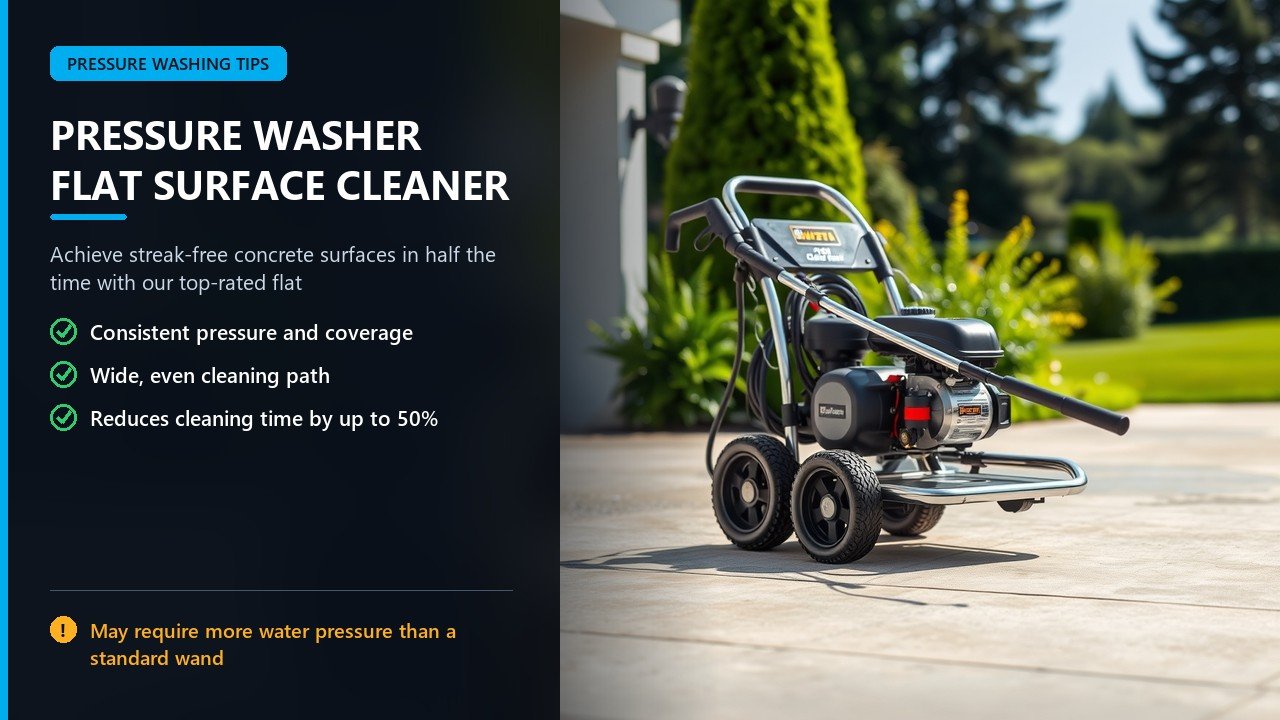
How a Pressure Washer Flat Surface Cleaner Works
Inside the round housing, two, three, or four nozzles are mounted on a spinning bar. Water pressure drives the rotation of that bar, causing the nozzles to sweep in a circle. As you walk slowly and steadily behind the unit, the rotating spray covers a wide swath with consistent coverage. The housing also contains overspray, protects nearby plants and walls from backsplash, and helps contain water on the cleaning area.
The biggest advantage is consistency. With a wand, your standoff distance constantly changes as you move and fatigue sets in — that is what causes stripes. A flat surface cleaner locks the nozzles at the perfect height, giving you a uniform clean every time. It is also much faster, especially on large, open slabs.
Choosing the Right Size for Your Pressure Washer
The most important rule for sizing a pressure washer flat surface cleaner is matching the diameter to your machine’s GPM (gallons per minute), not just PSI. A good rule of thumb is about 4 inches of cleaner width for every 1 GPM of flow. If your washer puts out 4 GPM, a 16-inch cleaner is usually a good fit. If it puts out 6 GPM, a 24-inch cleaner makes sense. If it puts out 2–3 GPM, stick to 8–12 inches.
Running an oversized cleaner on a low-GPM machine is the most common mistake. The spray bar will spin slowly or unevenly, leaving stripes and taking longer than it should. Running a small cleaner on a high-GPM machine is less of a problem, but you will waste the extra flow and clean more slowly than necessary. Always check both PSI and GPM ratings on your washer and match them to the cleaner’s specs.
| Pressure Washer GPM | Recommended Cleaner Diameter | Best Use |
|---|---|---|
| 1.5 – 2.0 | 8 – 10 inches | Small patios, tight spaces |
| 2.0 – 3.0 | 10 – 12 inches | Small driveways, walkways |
| 3.0 – 4.0 | 12 – 16 inches | Standard driveways, patios |
| 4.0 – 6.0 | 16 – 24 inches | Large driveways, commercial |
| 6.0+ | 24 – 30+ inches | High-volume commercial work |
Key Features to Look For
A quality pressure washer flat surface cleaner should last for years. Look for a stainless steel or heavy-duty aluminum housing that can take abuse without cracking. The swivel is the heart of the unit — choose one with quality bearings and seals that can handle your pressure and temperature. Nozzles should be easy to remove and replace as a matched set. Large, non-marking casters make a big difference on long jobs, reducing fatigue and helping the unit glide smoothly. Also check the hose inlet size (1/4″ vs 3/8″) to match your setup without restrictive adapters.
A good brush skirt around the bottom helps contain overspray and keeps debris from flying. For hot water pressure washers, make sure the swivel and seals are rated for hot water — cold-water-only swivels will fail quickly on hot rigs. Finally, look for models where replacement parts (nozzles, swivels, spray bars) are readily available, so you are not buying a whole new unit when one part wears out.
How to Use a Flat Surface Cleaner Correctly
Start with the right prep. Clear loose debris like leaves and rocks from the surface. Pre-treat heavy stains or organic growth with a suitable cleaner and let it dwell as directed. Connect your pressure washer flat surface cleaner to the spray wand, making sure all connections are tight. Turn on water first, then start your washer.
Walk slowly and steadily. Overlap each pass by about 2–3 inches to avoid missing any striping. Work in straight, parallel lines from one end to the other. Resist the urge to rush — moving too fast is the number one reason people still see faint lines. For edges, corners, and tight spots the round cleaner cannot reach, switch back to your wand with a fan tip. After cleaning, do a low-pressure rinse to push all loosened debris and residue off the slab.
Pros and Cons of Using a Flat Surface Cleaner
Pros: Consistently even cleaning with no stripes, much faster on large flat surfaces, reduces operator fatigue, contains overspray, easier to get professional-looking results.
Cons: Cannot clean vertical surfaces, awkward in tight corners or around obstacles, needs to be properly sized to avoid striping, adds an extra piece of equipment to haul around.
Common Mistakes to Avoid
The biggest mistake is oversizing the cleaner for your GPM. If the bar spins too slowly, you will see stripes no matter how slow you walk. Another mistake is walking too fast — let the cleaner do the work. Skipping edge work is also common; always finish edges with a wand. Using the wrong nozzle size for your pressure/GPM will hurt performance and can stress your pump. Finally, neglecting swivel maintenance (greasing or replacing worn seals) leads to poor rotation and leaks.
Maintenance Tips
Rinse the housing thoroughly after each use to flush out grit and debris. Inspect nozzles weekly for clogs or uneven wear; replace them as a matched set if they look worn. Grease the swivel if your model has a grease fitting, or replace seals when you notice leaks. Check the brush skirt for tears and replace it if it is falling apart. Store the unit in a dry place to prevent rust and corrosion. A little maintenance keeps your pressure washer flat surface cleaner spinning smoothly for years.
Who Should Buy One
If you clean a driveway, patio, walkway, or garage floor more than once or twice a year, a flat surface cleaner is worth buying. It is especially valuable for homeowners with large concrete slabs or anyone who wants professional, streak-free results with minimal effort. For contractors, it is practically essential for flatwork jobs. If you only wash a small patio or vehicles, a wand is usually enough — but once you use a flat surface cleaner, you will probably never go back.
Final Thoughts
A pressure washer flat surface cleaner takes the frustration out of cleaning concrete and other flat surfaces. By keeping nozzles at a constant distance and covering a wide path, it delivers even, stripe-free results in a fraction of the time. The key to success is proper sizing: match the diameter to your GPM, walk slowly with overlap, and use your wand for edges. Do that, and you will get showroom-clean concrete with far less work.