An adjustable nozzle pressure washer tip is the simplest upgrade that makes a machine feel twice as capable. Instead of swapping color coded tips for every surface, you twist one collar and go from a gentle fan to a focused jet in an instant. Used well, it saves time, cuts clutter, and prevents the surface damage that comes from using the wrong tip by accident.
This guide explains how adjustable nozzles work, how they compare with fixed tip sets, which spray patterns suit which jobs, how to match fitment, and how to care for the tip so it stays accurate for years.
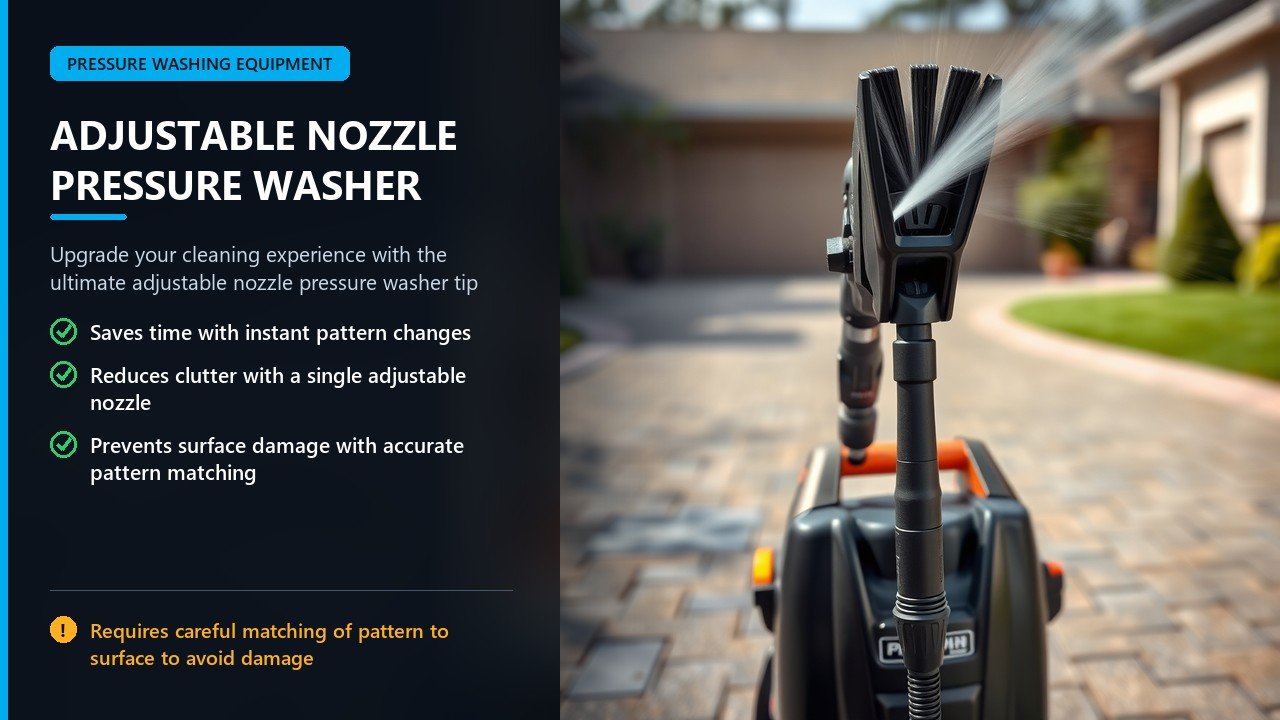
What an Adjustable Nozzle Pressure Washer Tip Does
A pressure washer nozzle is the final control point in the whole machine. It shapes the water into a pattern, and that pattern decides how hard the spray hits a surface.
It replaces a stack of tips. Most pressure washers ship with several colored tips, each fixed at a single angle. An adjustable nozzle, sometimes called a variable nozzle or adjustable spray nozzle, does the work of all of them by rotating through the range on one fitting.
It changes the pattern, not the pressure. The pump still makes the same pressure and flow. What changes is how that water is concentrated. A wide fan spreads the force, while a narrow stream focuses it, and that alone changes how aggressive the spray feels.
It speeds up a job. Cleaning a car might need a wide rinse, a medium wash, and a narrow spot blast. With fixed tips that means three swaps, but with an adjustable nozzle it is a simple twist. Over a whole property those seconds add up.
It reduces lost parts. Fixed tips get dropped in grass, left on the deck, or lost in the truck. One adjustable nozzle that stays on the wand is a lot harder to misplace, which makes it one of the most useful pressure washer accessories you can buy.
It fits the way most people actually clean. Homeowners rarely plan their patterns in advance. They wash, notice a stubborn patch, and want more force right now. The twist action matches that reality perfectly.
For anyone tired of hunting for the right colored tip, the adjustable pressure washer nozzle is one of the most practical accessories you can own.
It pays for itself quickly. A single quality adjustable nozzle often costs less than replacing a full set of lost tips, and it removes the hesitation that comes with not being sure which tip to use. That confidence alone makes every cleaning job faster and more consistent, because you spend your energy cleaning rather than deciding.
It teaches you patterns by feel. Twisting through the range lets you feel how the fan opens and closes, and that hands on feedback makes you better at judging which width each surface needs. That judgment matters far more than any single tip, and it stays with you on every job you take on.
How Adjustable Nozzles Work
The mechanism is simple, and understanding it helps you use the tool well.
An internal cone shifts. Inside the nozzle, turning the collar moves a shaped insert that changes the opening. A wider opening spreads the water into a fan, and a narrower one squeezes it into a pencil stream.
The change is mechanical and repeatable. Because the nozzle is machined to tight tolerances, the same position gives the same pattern every time. Twist to the mark and you get a predictable result, which matters when consistency keeps a surface even.
Higher pressure gives a tighter stream. At a given pump pressure, narrowing the opening concentrates the force. That is why the narrowest setting feels the most aggressive and the widest feels the gentlest.
Flow stays roughly the same. A well designed adjustable nozzle passes similar flow across positions, so you do not lose rinsing power when you narrow the pattern. Cheap versions can choke flow, which is one reason quality matters.
Fitment is standardised. Most adjustable nozzles use a quick connect fitting, often a quarter inch quick connect, so they snap onto a standard wand. Confirm the connection type before buying to avoid adapters.
Some are handle mounted. A few wands integrate an adjustable nozzle at the grip, letting you change the pattern with a thumb. These are convenient but add weight and complexity, and they are harder to service than a simple screw on tip.
None of this is complicated, but knowing what happens inside explains why the twist action works, why the narrow setting hits harder, and why a well made nozzle behaves far better than a bargain one.
The water does the work. Because the pattern concentrates the same flow, a narrow setting cuts through grime without you pressing harder. Letting the stream do the work is gentler on the surface and far easier on your arms over a long day.
Quality shows in the finish. A well machined nozzle keeps a clean edge on the fan, so the clean is even across its width. A cheap one sprays a ragged pattern that leaves stripes and streaks, which means redoing work you should have finished the first time.
Adjustable vs Fixed Nozzle Sets
Both have a place, and the best setup often uses a little of each. Knowing the main pressure washer nozzle types makes the choice far easier.
| Type | Strength | Weakness |
|---|---|---|
| Adjustable nozzle | One tip, all patterns, fast swaps | Less precise than fixed tips |
| Fixed tip set | Exact, repeatable patterns | Loose tips, manual swaps |
| Turbo nozzle | Extra bite on hard surfaces | Too aggressive for soft materials |
Adjustable wins on convenience. One fitting covers every everyday pattern, so there is nothing to lose and nothing to swap. For a homeowner who cleans many surfaces, this is usually the better daily choice.
Fixed tips win on precision. A fixed tip gives an exact, known angle every time, which matters on delicate work where a small difference in spread changes the risk. Professionals often keep a full pressure washer nozzle set for this reason.
They work well together. Many operators run an adjustable nozzle on the wand for general work and keep a couple of fixed tips, plus a turbo and a soap nozzle, in the kit for specific jobs.
The honest answer is that an adjustable nozzle handles ninety percent of residential cleaning, while a small set of fixed tips covers the rest. Own both and you are never stuck.
Cost is closer than it looks. A good adjustable nozzle often costs about the same as a set of fixed tips, and it cannot be lost one piece at a time. Over a season the adjustable route frequently works out cheaper as well as simpler, which is why so many people switch and never go back.
Some jobs still want a fixed tip. Delicate trim, soft wood, and precise spot work reward the known angle of a fixed tip. Keeping the common angles on hand costs very little and removes any compromise on the trickiest surfaces, while the adjustable tip handles everything else.
Build the kit around your work. If you mostly clean one type of surface, a single adjustable tip may be all you need. If you handle a bit of everything, a small set in a pouch covers every job without clutter.
Spray Patterns and Degrees Explained
Nozzle angles are usually described in degrees, and the number tells you how wide the fan is. A simple pressure washer nozzle chart turns those numbers into a quick reference, so you always know which tip suits the job.
The 0 degree nozzle is a straight jet. This is the most concentrated and most aggressive pattern, good for blasting rust or stripping stubborn spots but risky on any soft surface.
The 15 degree nozzle makes a focused fan. Strong and fairly narrow, it strips tough grime from concrete and hard surfaces while covering a little more area than a jet.
The 25 degree nozzle makes a general purpose fan. This is the all rounder most people reach for, strong enough for cleaning yet wide enough to be reasonably safe on many surfaces.
The 40 degree nozzle makes a gentle fan. A wide spread that is safe for siding, decking, and vehicles, and comfortable for rinsing large areas quickly.
Soap and low pressure settings add width. A soap nozzle spreads detergent at low pressure, and adjustable tips mimic this by opening wide so the chemical can dwell before the rinse.
The adjustable twist covers the range. A good adjustable nozzle sweeps from a tight jet to a wide fan, letting you dial in the degree you need without swapping tips.
Once you know what the degrees mean, choosing a pattern stops being guesswork. Match the width to the surface and the job is both faster and safer.
Wider equals safer. The larger the angle, the more the force is spread and the softer the spray lands on the surface. When in doubt, choose the wider setting and only tighten it when the dirt refuses to move. This single habit prevents most accidental damage.
Distance matters as much as angle. Standing further back turns even a strong pattern into a gentle one, while moving closer concentrates the same spray. Combine a sensible angle with sensible distance and you gain control without losing cleaning power.
Test on a hidden spot. On an unfamiliar surface, spray a small out of the way patch first. A few seconds of testing tells you exactly how the material reacts before you commit to the whole area.
Let the number guide you. Think of the degree as a measure of how widely the force is shared, and the right choice becomes obvious for each job.
Matching Pattern to Surface
Pattern choice is where damage and disappointment are either prevented or invited.
Concrete and driveways. A fifteen to twenty five degree fan works well, ideally through a surface cleaner for even results. Keep the tip moving and do not dwell in one spot.
Wood and decks. Use a wide forty degree fan and stay back from the surface. Wood fibers lift easily, so a wide, gentle pattern protects the finish.
Siding and fences. A wide fan at a downward angle cleans safely. Work top to bottom so dirt runs below the area you have already cleaned.
Vehicles and paint. A wide fan, and plenty of distance, keeps paint safe. Many people wash cars comfortably with the gentlest setting and a foam step.
Gutters and tight spots. A narrower fan adds reach and force for the front of a gutter without needing to climb.
Furniture and grills. A medium to wide fan lifts grime from metal and plastic safely, while a jet could strip paint or bend thin material.
Start wide and move in only if the dirt resists. That single habit prevents more damage than any other technique.
Brick and stone. A medium fan cleans masonry well, but mortar joints are soft and can erode under a narrow jet. Keep the angle wide and the stream moving to protect the joints between the units.
Roofs and shingles. These are among the most delicate surfaces of all and often need no pressure at all. Many pros soft wash them with a wide, low pressure pattern rather than blasting, because a jet can strip granules and void a warranty.
Pool decks and patios. Hard flat surfaces take a medium fan and a steady pass. A surface cleaner covers them faster and more evenly, leaving the adjustable tip for edges, steps, and stubborn stains.
Gutters and downspouts. A narrow fan reaches into the channel and flushes debris, but keep the stream gentle so you do not push water behind the fascia. Work along the run rather than straight up into it.
Match the tool to the surface every time. The right pattern is not about power, it is about control, and control is what keeps the clean even and the surface safe.
Quick Connect and Fitment
Buying the wrong connector is the most common frustration with accessories, so check the fitting first.
Know your connection type. Many pressure washer wands and nozzles use a quarter inch quick connect, so a quick connect nozzle snaps straight on, but some machines use threaded fittings, bayonet fittings, or brand specific connectors. Match what your wand already uses.
Match the pressure rating. A nozzle rated below your machine’s pressure can deform or fail. Choose one rated at or above your pump’s output and the hose rating.
Watch the flow rating. A nozzle sized for a small machine can restrict a larger pump, reducing performance. Match the nozzle to the flow your machine produces.
Adapters when needed. If your fitting is unusual, a quality adapter solves it, but every extra joint is another place to leak. Prefer a nozzle that fits directly.
Check the seat and o ring. A clean, intact o ring is what stops leaks. Inspect it when you buy and keep spares on hand.
Test for leaks on assembly. A quick pressure test shows instantly whether the fitment is correct before you rely on it on a customer’s property.
Getting fitment right takes a minute and saves hours of dripping, sputtering, and returning parts. Match the connector, the pressure, and the flow, and the nozzle simply works.
O ring condition decides leaks. Most drips at the nozzle trace back to a worn or missing o ring, not a faulty tip. Keeping a handful of spares in the truck turns a frustrating leak into a ten second fix.
One standard saves time. If every accessory on your wand uses the same connector, you never hunt for an adapter mid job. Standardising the fittings across your kit is one of the cheapest ways to speed up your workflow.
Seat the nozzle fully. A quick connect that is only partly seated leaks and can pop off under pressure. Push until it clicks, then give a gentle tug to confirm it is locked before you start.
Read the label before you buy. Pressure and flow ratings are printed on quality nozzles for a reason. Matching them to your machine is the difference between the right tool and a wasted purchase.
Turbo, Soap, and Specialty Nozzles
Beyond the adjustable tip, a few specialty nozzles make specific jobs far easier and are worth knowing.
Turbo nozzles rotate. A turbo nozzle spins a zero degree jet in a small circle, combining the bite of a jet with the coverage of a fan. It is excellent on concrete and hard surfaces, but too aggressive for wood, paint, or vehicles.
Soap nozzles spray wide and low. They apply detergent at low pressure so it can dwell and break down grime before you rinse. A dedicated soap nozzle is almost always better than trying to foam on a high pressure setting.
Surface cleaner nozzles. These are built into a spinning bar under a housing, giving even, stripe free results on flat concrete. They are not hand held tips but deserve a place in the kit for driveways.
Rotary and pencil nozzles. A pencil jet concentrates force for the toughest spots, while rotary designs add a spinning action for surface work.
Downstream injector tips. These pull detergent into the stream after the pump, so chemicals never pass through it, protecting seals while still applying cleaner.
A small collection of specialty tips turns one washer into a machine that can handle concrete, cars, siding, and stubborn stains without compromises.
Keep them labeled. A small labeled pouch or a color coded holder stops you grabbing the wrong specialty tip under pressure. Sixty seconds of organization at the start saves minutes of doubt on every job.
Match the tip to the mess. Grease, mold, and heavy soil each respond to different approaches and often different chemicals. Having the right specialty tip on hand lets you adapt instead of forcing one pattern to do everything.
Do not overinvest at the start. A soap tip, a turbo, and an adjustable nozzle cover the vast majority of residential work. Add the rarer specialty tips only when a specific job clearly calls for them.
Choosing the Best Pressure Washer Nozzle
When you buy, a few details separate pressure washer tips that last for years from ones that fail in a season.
Favor metal over plastic. A stainless steel insert inside a durable housing resists wear and holds its pattern far longer than an all plastic tip that erodes quickly.
Check the seals and o rings. Quality rubber or nitrile o rings seat well and resist chemicals. Cheap seals leak and need constant replacement.
Match pressure and flow ratings. Confirm the nozzle is rated for your machine’s pressure and passes the flow it needs. An under rated tip is a safety risk, not a bargain.
Look for smooth adjustment. A good adjustable nozzle turns cleanly through its range without sticking or feeling loose. Gritty or sloppy action means short life.
Choose the right connector. Standardise on the fitting your other accessories use so everything swaps easily.
Buy a set, not just one. Even if you rely on an adjustable tip, a pressure washer nozzle set with a soap, turbo, and a couple of fixed tips covers every job and gives you options.
The best pressure washer nozzle is not the most expensive, but the one that matches your fittings, resists wear, and keeps a clean, even pattern. Buy once, keep it clean, and it will outlast several cheap replacements.
Weigh the convenience. A cheap nozzle that sprays unevenly costs you time redoing work. Paying a little more for one that holds a clean pattern is usually the cheaper choice once your time is counted.
Check the warranty. A maker willing to stand behind the tip for a reasonable period is telling you it expects the part to last. A warranty is no substitute for quality, but it signals confidence.
Buy from a known source. Counterfeit tips are common, and they fail early or spray badly. Buying from a reputable seller avoids the disappointment of a part that never performed to its rating.
Read honest reviews. Look for comments about longevity and pattern quality rather than just price. The tips people keep buying again tend to be the ones that quietly do their job for years.
Care and Maintenance
A nozzle is a precision part, and a little care keeps it accurate.
Rinse after every use. Detergent and grit left inside can dry and clog the opening. A quick flush with clean water keeps the pattern true.
Clear blockages gently. If a tip clogs, soak it and clear it with a soft tool, never a hard metal pick that can scratch the insert and ruin the pattern.
Inspect o rings. Replace worn or flattened rings before they leak. Spares cost very little and save a job.
Store tips clean and dry. Keep them in a small case or pouch so they are not lost or damaged. A dedicated spot for each tip keeps the kit organized.
Do not overtighten. Hand snug is enough for threaded connections. Over tightening crushes seals and cracks housings.
Watch for drips. A leaking nozzle connection signals a bad seal or a worn fitting. Fix it early rather than losing pressure and wasting water.
These habits take seconds and keep the spray even, which is exactly what makes cleaning fast and safe. A neglected nozzle slowly loses its pattern and quietly wastes the power your machine produces.
Flush before you store. Run clean water through the nozzle at the end of a job so no detergent dries inside the opening. A dry residue film is one of the most common causes of a clogged tip.
Watch for a fading pattern. When a tip starts spraying a ragged or lopsided fan, it is usually worn or partly blocked. Nozzle replacement or a good cleaning restores the even clean and protects the surface.
Keep a spare ready. Nozzles are small and cheap, so carrying a spare means a worn tip never ends a job early. A minute to swap beats an afternoon of uneven results and unhappy customers.
Protect the tip when moving. Dropping a wand nozzle first on concrete can nick the insert and ruin the pattern. Setting the wand down carefully is a habit that quietly extends the life of every tip.
Clean the whole water path. A clean tip cannot compensate for a dirty filter or a gritty supply. Keeping the inlet strainer clean protects the nozzle and the pump at the same time.
Common Mistakes to Avoid
Most pressure washing damage and frustration trace back to a few avoidable tip mistakes.
Using a jet on soft surfaces. A zero degree stream scars wood, strips paint, and etches trim. On anything soft, start with a wide fan.
Holding the tip too close. Even a gentle pattern cuts when you hold it inches from the surface. Distance is part of pressure control.
Mixing up loose tips. Grabbing the wrong colored tip happens easily under pressure. An adjustable nozzle removes that risk entirely.
Buying an under rated nozzle. A tip not rated for your machine can fail dangerously. Check the ratings before you use it.
Ignoring clogged tips. A partially blocked nozzle sprays a distorted pattern that cleans unevenly and can damage surfaces. Clean it and restore the flow.
Foaming on high pressure. Detergent applied through a high pressure nozzle is wasted and can harm finishes. Use a soap setting and let it dwell.
Forgetting the rinse. Dried detergent leaves streaks. Rinse thoroughly with clean water before moving on.
Avoid these and the tip does its job quietly, letting the machine clean faster with less risk of an expensive mistake.
Working too close. Holding the wand inches from the surface makes even a wide fan aggressive. Back off and let the pattern and the distance do the work, and the surface stays intact.
Skipping the test patch. Every unfamiliar surface deserves a quick trial in a hidden spot. A few seconds of testing prevents a permanent mark that no amount of rinsing will remove.
Using the jet to rinse. A narrow stream is for stubborn spots, not for rinsing. A wide fan covers more area with less risk and finishes the job faster.
Neglecting the o ring. A worn ring leaks, drops pressure, and wastes water. Replacing it takes seconds and restores the performance you thought the nozzle had lost.
Rushing the pass. Moving too fast leaves stripes, and moving too slowly eats into the surface. A steady, overlapping pass gives the even finish that looks professional every time.
Slow down and stay even. Most tip mistakes come from hurrying, so a slower, steadier hand prevents most of the damage people blame on the machine.
Frequently Asked Questions
Is an adjustable nozzle as good as a full tip set? For everyday cleaning, yes. It covers every common pattern on one fitting. For very precise work, a few fixed tips still add precision and are worth keeping.
Does an adjustable nozzle change the pressure? It changes the pattern, not the pump’s pressure. Narrowing the opening concentrates the force, so the spray feels stronger, but the machine’s output stays the same.
What fitting do pressure washer nozzles use? Many use a quarter inch quick connect, but some machines use threaded or brand specific connections. Check your wand before buying.
Can I use an adjustable nozzle on a car? Yes, on a wide setting with good distance. Start gentle and only narrow the pattern if a spot truly needs it.
Can I use an adjustable nozzle on a concrete driveway? Yes, but for large areas a surface cleaner gives faster, more even results. A medium fan on the adjustable tip works for spot cleaning.
Will an adjustable nozzle damage my car paint? Not if you use a wide setting and keep a sensible distance. Paint is soft, so treat it like wood and start gentle before deciding whether any spot needs a tighter fan.
How long does a good adjustable nozzle last? With clean water and occasional o ring changes, a quality tip can last for years. Cheap ones may wear within a season, which is why the metal insert and seals matter so much.
Can I leave the nozzle on the wand? Yes, and many people do for convenience. Simply rinse it after use so detergent and grit do not dry inside the opening and clog the tip.
Do I still need a soap nozzle? If you apply detergent, yes. A wide adjustable pattern is not the same as a low pressure soap setting, so a dedicated soap tip gives a better, safer chemical application.
Will it fit my pressure washer? If your wand uses a standard quick connect, most adjustable nozzles will fit directly. For unusual or brand specific fittings, a matching adapter solves it in seconds.
Final Thoughts
An adjustable nozzle pressure washer tip is one of the smallest purchases that makes the biggest day to day difference. It turns a drawer of loose tips into one reliable fitting, speeds up every job, and reduces the chance of grabbing the wrong pattern and damaging a surface.
Start wide, move in slowly, and let the pattern do the work. Keep the tip clean, match the fitment to your wand, and add a soap or turbo nozzle for the jobs that need them. Do that and your pressure washer nozzle stops being an afterthought and becomes the control that makes every other part of the machine easier to use.
Whether you clean driveways, decks, siding, or cars, the right tip is the difference between fighting the tool and finishing the job. Choose well, care for it, and the adjustable nozzle will earn its place on your wand for years.
Start simple and stay consistent. The nozzle rewards a calm, methodical approach more than raw force. Begin wide, overlap your passes, and only tighten the pattern when a stubborn spot genuinely calls for it, and the surface will show the difference.
Treat the tip as a tool, not an accessory. It controls how every other part of your machine performs. A sharp, clean nozzle makes the pump, the wand, and the hose all feel more capable than they would with a worn tip.
Replace before it fails. A nozzle is cheap insurance for expensive surfaces. When the pattern turns ragged, swap in a fresh tip rather than risk an expensive mistake on a customer’s property.
Control the pattern and you control the outcome. That one idea turns an ordinary pressure washer into a tool that handles delicate paint and tough concrete with equal confidence.
Keep learning your surfaces. Every job teaches you a little more about how water behaves on wood, stone, paint, and metal, and that growing skill is what separates a careful cleaner from a careless one.
Good tools, used well, make good work. The adjustable nozzle is proof that a small, thoughtful upgrade can lift the standard of everything you do with it.