Shop owners, boat yards, and detailers often have a compressor humming in the corner but no electrical outlet near the work. That is exactly the situation where an air powered pressure washer earns its place. Instead of an electric motor or a gas engine, these tools use compressed air to pressurize water — no cord, no fuel, no exhaust, and no risk of electricity meeting a wet floor. For the right user, that is a small revolution; for the wrong user, it is a disappointing purchase.
This guide explains what an air-powered (pneumatic) pressure washer actually is, how it works, what pressure and flow it can realistically deliver, when it makes sense compared with electric and gas machines, and how to buy, use, and maintain one. If you are weighing compressed air against the mainstream options, you will leave with a clear, practical answer.
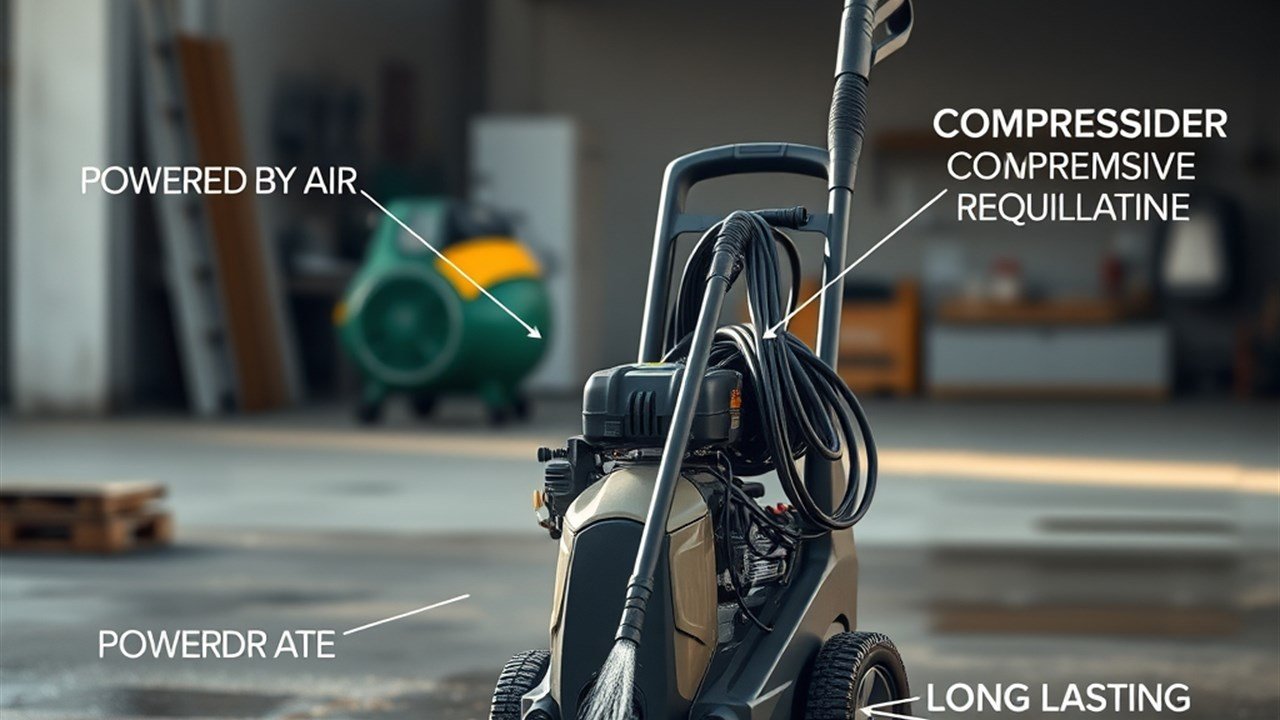
What Is an Air Powered Pressure Washer?
An air powered pressure washer is a cleaning device that uses compressed air — supplied by an ordinary shop air compressor — to create a pressurized water stream. There are two common designs:
- Air-driven pump units: A pneumatic motor or air cylinder drives a water pump, which then pushes water at pressure. These behave most like a conventional pressure washer but are powered by air instead of electricity or fuel.
- Air-over-water (tank) units: Compressed air pressurizes a sealed water tank, and the pressurized water is released through a nozzle. Simple and effective, with no pump to service, but limited by tank size.
A third device often confused with these is the air-and-water “wet sandblaster” or siphon attachment, which uses a venturi effect to draw water and abrasive into an air stream. That is a different tool with a different job, and it is worth knowing the difference before you buy.
How It Works: The Physics in Plain Language
Air compressors store energy as compressed air. Release that air through a regulator into a water system and you convert air pressure into water pressure. In a pneumatic pump design, the air pushes a piston or drives a rotary motor that moves a water pump, which then pushes water through a nozzle. In a tank design, the same air simply pushes directly on the surface of the water in a sealed vessel — a design known as a pressure pot or pneumatic sprayer.
The end result is a water jet strong enough for many cleaning tasks, produced without any electrical or combustion power at the point of use. The trade-off is that the energy has to come from a compressor, and the compressor’s capacity (measured in CFM — cubic feet per minute) sets the ceiling on how much water pressure and flow you can sustain.
Quick Note: The single most important number for an air powered pressure washer is your compressor’s CFM at working pressure, not its tank size or peak PSI. A large tank with a small pump runs out of air quickly; sustained cleaning depends on continuous CFM.
How Much Pressure Can It Really Deliver?
This is where expectations must be set honestly. Pneumatic water cleaning is generally lower in pressure and flow than electric or gas pressure washers:
| Machine Type | Typical PSI | Typical Flow | Best For |
|---|---|---|---|
| Air-powered (pneumatic) | 100–1,000 | Low–moderate | Light cleaning, rinsing, workshop parts |
| Electric (household) | 1,300–2,000 | 1.2–1.6 GPM | Cars, patio, light siding |
| Electric (220V) | 2,500–3,000 | 2.5–3.0 GPM | Driveways, professional indoor |
| Gas | 2,700–4,000 | 2.4–4.0 GPM | Heavy/commercial work |
Some industrial pneumatic water pumps reach higher figures, but they require large, expensive compressors. For a typical home or small shop compressor, an air-powered water cleaner is a light-to-medium tool — useful for rinsing, degreasing parts, cleaning engine bays, and delicate jobs where you want control rather than raw force.
Short Note: If your plan is to clean a concrete driveway with an air powered washer, you will be disappointed. If your plan is to rinse a motorcycle engine, degrease machine parts, or clean a boat deck without dragging a cord around, you will likely love it.
Air Powered vs Electric vs Gas: An Honest Comparison
| Factor | Air-Powered | Electric | Gas |
|---|---|---|---|
| Power source | Compressed air | Electricity | Gasoline |
| Max pressure | Low–moderate | Moderate–high | High |
| Needs a compressor | Yes | No | No |
| Electricity near water | None — safest | Present (GFCI needed) | None |
| Exhaust / fumes | None at use point | None | Yes |
| Portability | Limited by air hose | Limited by power cord | Fully mobile |
| Maintenance | Simpler (no engine) | Pump care | Engine + pump |
The pattern is clear: air-powered units win on safety, simplicity, and indoor suitability — and lose on outright cleaning power. They are a complement to, not a replacement for, a conventional pressure washer.
Where an Air Powered Pressure Washer Shines
Because the tool is naturally gentler and cord-free, it fits specific jobs beautifully. The best real-world uses:
- Auto and motorcycle detailing: Rinsing wheels, engine bays, and undercarriages without a power cord snaking across a wet driveway. The control is excellent for delicate parts.
- Workshop and machine cleaning: Degreasing tools, parts, and benches where compressed air already drives other tools. Cleaning fluid mixed into the water stream makes this a natural fit.
- Marine and boat uses: Rinsing decks, hulls, and equipment in yards where power is scarce. With the right setup, salt can be flushed with fresh water without electrical risk.
- HVAC and coil cleaning: Gentle, metered water flow is desirable for delicate fin coils, where a conventional pressure washer can fold the fins.
- Agricultural and farm spot work: Rinsing small equipment and tools in the field at low risk.
- Confined or wet spaces: Where running a cord means a shock hazard, compressed air through a hose is the safer path.
Quick Note: The recurring theme is “controlled cleaning in places where cords and engines do not belong.” Buy an air-powered washer for those spaces, and keep a conventional pressure washer for the heavy jobs.
The Compressor Requirement: The Make-or-Break Detail
Your pressure washer is only as good as the air feeding it. Before buying any pneumatic water cleaner, check the manufacturer’s required CFM at a given PSI and compare it with your compressor’s continuous output:
| Compressor Size | Typical CFM @ 90 PSI | Suitable For |
|---|---|---|
| Small portable (pancake) | ~3–5 CFM | Very light rinsing only; frequent pauses |
| Mid workshop (20-gal) | ~6–10 CFM | Moderate cleaning, parts washing |
| Large shop (60-gal+) | ~12–20+ CFM | Sustained cleaning and multiple tools |
Key rules:
- Match CFM, not tank size. A big tank only buys short bursts. Continuous work needs a compressor whose pump keeps up.
- Account for pressure drop. Long, narrow air hoses lose pressure. Use a short, large-diameter hose from compressor to washer for best results.
- Drain moisture. Compressed air carries water and oil aerosol. A filter/regulator (and ideally a dryer) keeps contaminants out of the water stream and off the surface you are cleaning.
- Use a regulator. Set the pressure to the tool’s spec; over-pressurizing wastes air and can damage the unit.
Short Note: If your compressor cycles on constantly and the washer’s stream sputters, you are air-starved. Step up compressor capacity or accept that the tool is a rinse aid, not a pressure washer.
Types of Air-Powered Water Cleaning Tools
Within the category, several distinct tools exist, and knowing them prevents a wrong purchase:
| Tool | How It Works | Best For |
|---|---|---|
| Pneumatic engine cleaner / spray gun | Air-driven siphon or venturi draws water/solvent | Engine bays, parts, dissolving grime |
| Pressure pot / pneumatic sprayer | Air pressurizes a sealed tank of water/chemical | Even chemical application, rinsing |
| Air-driven water pump | Pneumatic motor drives a pump | Continuous washing with good supply |
| Air/water wet media blaster | Air + water + abrasive slurry | Stripping, rust removal (aggressive) |
The first two are the closest thing most people mean by “air powered pressure washer.” The wet media blaster is a different animal entirely — powerful and destructive if misused.
Pros and Cons at a Glance
| Pros | Cons |
|---|---|
| No cord or fuel at the use point | Requires a capable air compressor |
| Inherently safer — no electricity near water | Lower PSI and flow than electric/gas |
| Simple, few moving parts to maintain | Tank tools run out; pump tools need CFM |
| Gentle control for delicate parts | Not suitable for heavy concrete/moss jobs |
| Uses infrastructure you may already own | Air hose limits range |
How to Choose an Air Powered Pressure Washer
Use this checklist to avoid a mismatched purchase:
- Define the job, not the dream. If you are cleaning parts, engines, or doing touch-up rinsing, an air-powered unit fits. If it is driveways and siding, buy electric or gas instead (see our guide on whether 3000 PSI is right and the 4000 PSI professional class).
- Check your compressor first. Note your continuous CFM at the working pressure the tool requires. If you cannot match it, the tool will underperform.
- Pick the right tool type. Siphon/spray gun for engine cleaning, pressure pot for even chemical/rinsing, air-driven pump for sustained washing.
- Verify pressure and flow ratings. Confirm the tool’s PSI and flow honestly match your expectations and your compressor.
- Insist on quality seals and brass fittings. Cheap seals fail fast under air pressure; brass resists corrosion and lasts.
- Plan for filtration. A filter/regulator protects both the tool and the surface from oily, watery air.
- Check chemical compatibility. Some tools handle solvents; others are water-only. Match to the cleaners you will actually use.
Quick Note: The most common mistake is buying the tool before checking compressor CFM. Do it in the other order — compressor capacity decides whether the tool is a joy or a frustration.
Practical Tips for Best Results
- Use a short, fat air hose. Pressure loss over a long, thin hose is severe; keep the run short and the diameter generous.
- Regulate and dry your air. Set pressure to spec and fit a filter/dryer to keep oil and water out of the stream.
- Pre-treat heavy grime. Because flow is limited, let a degreaser or detergent dwell before rinsing. Chemistry does the work the pressure cannot.
- Work top to bottom. Let gravity help; it reduces passes and water use.
- Keep the nozzle at a sensible distance. Air-powered streams lose force fast with distance; find the sweet spot where cleaning works without over-wetting.
- Protect sensitive areas. Cover electrical connections, intakes, and electronics before washing engines or machinery.
- Mind the mixer. If the tool blends air and water, adjust the ratio; too much air can atomize chemicals into mist you may inhale.
Safety Considerations
Even lower-pressure streams and compressed air carry real hazards. Keep these in mind:
- Compressed air is not a toy. Never point an air jet at skin — air can be forced into the body and cause serious injury. Never use compressed air to clean clothing or your body.
- Eye and skin protection. Safety glasses and gloves guard against spray, debris, and chemical mist.
- Chemical safety. Read labels; never mix cleaning chemicals; ensure ventilation when using solvents or atomized products.
- No electricity near water — but be mindful anyway. The point of air power is avoiding cords in wet areas, but keep the compressor itself dry and on a protected circuit.
- Secure hoses and fittings. A whipping, disconnected air hose is dangerous; check couplers and use safety clips.
- Ventilation. Engine cleaning and solvent use produce fumes; work outdoors or in ventilated spaces.
For general safety guidance covering pressure streams and wash-water handling, the OSHA pressure washing resources and the University of North Carolina EHS guidance are reliable references.
Maintenance: Keeping It Simple and Long-Lasting
One advantage of air-powered tools is their mechanical simplicity. Maintenance is minimal but still worthwhile:
- Drain the compressor tank regularly. Moisture is the enemy of both the compressor and the tool; drain the tank after each use.
- Service the air filter/regulator. Replace or clean filter elements so clean, dry air reaches the tool.
- Lubricate where specified. Some pneumatic motors need a few drops of air-tool oil; follow the manual. Others are sealed and need none.
- Rinse the water side. After using detergents, flush the water path with clean water to prevent clogging.
- Inspect seals and hoses. Replace worn o-rings and cracked hoses promptly — leaks waste air and reduce performance.
- Store dry. Drain water from the tool and lines before storage, especially in freezing weather.
Short Note: The U.S. Department of Energy’s maintenance guidance for water equipment applies here too: a few scheduled minutes of preventive care prevents most avoidable failures.
Air Powered vs the Alternatives: A Quick Decision Guide
| Your Situation | Best Choice |
|---|---|
| Clean parts/engines, avoid cords, own a big compressor | Air powered |
| Driveways, patios, moss, heavy grime | Electric or gas |
| Occasional car washing at home | Electric (120V) |
| Indoor commercial, quiet, fixed | 220V electric (wall-mounted options) |
| Grease-heavy indoor commercial | Heated electric (hot water guide) |
| Remote sites, no power, no compressor | Gas |
Common Questions
Can an air powered pressure washer clean a driveway?
Not effectively. Its pressure and flow are far below what concrete needs. Use an electric or gas unit for that job.
Does it need electricity?
The washer itself does not — but the air compressor does (or a gas compressor). The benefit is that electricity stays away from the wet work area.
What size compressor do I need?
It depends on the tool’s CFM requirement. Light rinsing tools work with small compressors; sustained cleaning needs a compressor matching the tool’s continuous CFM at the required PSI.
Is it good for car washing?
For rinsing and gentle cleaning, yes, especially wheels, engine bays, and undercarriages. For removing heavy road film, a conventional washer is faster.
Can I use chemicals with it?
Many models can, provided the materials are chemical-compatible. Always check the tool’s rating, and never mix cleaning chemicals.
Is it safer than electric?
Regarding electrocution risk near water, yes. But compressed air and chemical sprays have their own hazards, so protective gear still matters.
Conclusion
An air powered pressure washer is a specialized but genuinely useful tool. It is not a replacement for a conventional pressure washer — it cannot match the pressure and flow needed for large, heavy jobs like driveways and thick moss. What it does offer is cord-free, fuel-free, inherently safer cleaning that runs off the compressor many workshops already own, making it ideal for parts washing, engine bays, delicate equipment, boats, and any wet environment where dragging electricity is unwise.
Buy it for the right reasons and match it to a compressor with adequate continuous CFM, and it becomes a convenient, low-maintenance companion to the tools you already have. Buy it expecting to replace a full-pressure washer, and you will be disappointed. Understand where it fits — controlled, safe, targeted cleaning — and it will quietly earn its keep for years.
Quick Note: The golden rule for air-powered cleaning: compressor CFM decides the experience. Match it before you buy, and everything else falls into place.