Some of the dirtiest places on a vehicle or a house are the ones a straight wand can never reach. Think about the inside of a wheel well, the underside of a car after a salty winter, the gap under roof eaves, or the top of a fence rail. You can aim a standard nozzle at those spots, but the water just glances off, because the wand cannot get the right angle. That is the exact problem an angle nozzle for pressure washer setups is designed to solve. It bends the spray path so you can hit awkward, hidden surfaces without contorting yourself or the wand.
Angled nozzles are a small, inexpensive accessory with an outsized impact on what your pressure washer can do. But the term “angle nozzle” can mean two different things, and knowing which one you need saves confusion. This guide explains both types, how they differ from ordinary spray-angle tips, the jobs they handle best, how to choose one that fits your machine, and how to use and maintain them safely.
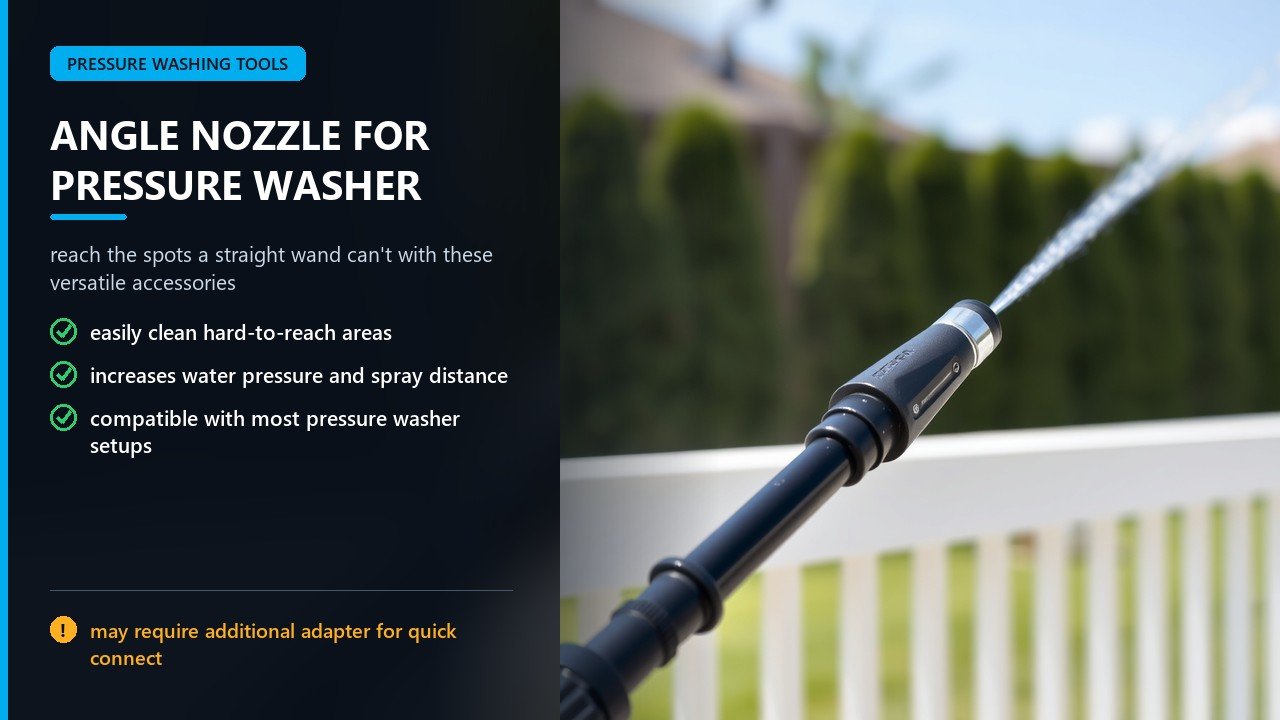
“Angle Nozzle” Can Mean Two Things
Before buying, get clear on terminology, because retailers use these words loosely.
- Spray angle nozzles: Standard tips that fan water at a specific angle, such as 0, 15, 25, or 40 degrees. This is what color-coded nozzle sets are all about.
- Angled or bent nozzles: Tips physically bent at an angle, usually around 90 degrees, so the spray shoots sideways or at a right angle to the wand.
Most of the time, when someone searches for an “angle nozzle,” they want the second type: the bent tip that reaches around corners and under objects. That is our main focus, though we will also cover spray angles so you understand the whole picture.
Type 1: Angled and Bent Nozzles
An angled nozzle bends the spray roughly 90 degrees relative to the wand. Instead of shooting straight ahead, the water comes out sideways, which lets you clean the underside of things while holding the wand at a comfortable, safe angle.
Common uses:
- Undercarriage cleaning. Blasting road salt, mud, and grime off the underside of vehicles.
- Wheel wells and fenders. Reaching the curved interior surfaces that a straight tip misses.
- Roof eaves and soffits. Cleaning under overhangs from below.
- Fence rails and deck undersides. Getting beneath horizontal surfaces.
- Equipment and machinery. Reaching into tight, angled spaces.
Because the spray turns a corner, angled nozzles are ideal for undercarriage and hard-to-reach work. Some are fixed at a single angle, while others swivel or pivot for more flexibility.
Type 2: Spray Angle Nozzles
These are the familiar color-coded tips. The angle here describes how wide the spray fans out, which controls both force and coverage.
| Color | Spray Angle | Force | Typical Use |
|---|---|---|---|
| Red | 0 degrees | Highest | Isolated tough spots, use with extreme care |
| Yellow | 15 degrees | High | Concrete, heavy cleaning |
| Green | 25 degrees | Moderate | General cleaning |
| White | 40 degrees | Lower | Delicate surfaces, vehicles, siding |
| Black | Low pressure | Lowest | Applying detergent |
The narrower the angle, the more concentrated and forceful the spray. Whether you need a bent tip or a specific spray angle depends entirely on what you are cleaning. Often, the ideal solution is a bent nozzle combined with a moderate spray angle for control.
What Angled Nozzles Are Best For
Vehicle undercarriage and wheel wells
This is the flagship use case. Road salt and winter grime cause rust, and the underside of a car is nearly impossible to clean with a straight wand. An angled nozzle lets you spray up and into the wheel wells and along the undercarriage from a safe, upright position.
Eaves, soffits, and overhangs
Cleaning under the roofline of a house means spraying upward at an odd angle. A bent nozzle makes it far easier to reach and clean these areas that collect cobwebs, dirt, and mildew.
Fences, railings, and deck edges
Horizontal surfaces have undersides that hold grime. An angled tip reaches beneath them without you having to crouch or angle the whole wand awkwardly.
Machinery and tight spaces
Equipment with recessed or angled components benefits from a nozzle that can shoot sideways into gaps a straight tip cannot clean.
Angled Nozzle vs Angled Wand
Another way to solve the reach problem is an angled or pivoting wand, which changes the angle of the entire lance rather than just the tip. Each approach has merits.
| Solution | How It Works | Best For |
|---|---|---|
| Angled nozzle | Bent tip shoots spray sideways | Undercarriage, wheel wells, tight spots |
| Angled/pivoting wand | The whole lance adjusts its angle | Varied angles, ergonomic control |
| Undercarriage cleaner | Dedicated multi-nozzle attachment | Fast, even vehicle underside cleaning |
Many users combine options. An angled nozzle handles tight spots, while an angled wand improves comfort for a range of tasks. For frequent undercarriage cleaning, a dedicated undercarriage cleaner attachment is the most efficient tool of all.
How to Choose the Right Angle Nozzle
- Identify the task. Undercarriage and wheel wells favor a bent nozzle; general cleaning favors the appropriate spray angle.
- Match your connection. Confirm the nozzle uses your wand’s quick connect standard, typically 1/4 inch.
- Check the pressure rating. The nozzle must handle your machine’s PSI.
- Match the orifice size to your machine’s GPM and pressure for optimal performance.
- Consider adjustability. A pivoting or multi-angle bent nozzle offers more flexibility than a fixed one.
- Consider material. Brass or stainless nozzles last longer than plastic tips.
Quick Connect and Compatibility
Most modern nozzles use quick connect fittings that snap onto the wand. This is convenient, but compatibility matters.
- Confirm the size, typically 1/4 inch quick connect on most machines.
- Keep O-rings in good condition to prevent leaks.
- Store nozzles clean, since grit in the orifice ruins spray quality.
- Use adapters only when necessary, since each connection is a potential leak point.
Safety With Angled Nozzles
- Never point the stream at yourself, especially when spraying under a vehicle. High-pressure water can pierce skin.
- Wear eye and hand protection, since angled spray kicks up debris and can bounce back.
- Watch for overhead hazards such as electrical lines and loose materials when spraying upward.
- Test the angle on an inconspicuous area to judge force before committing to a surface.
- Keep bare skin out of the spray path, particularly with narrow-angle tips.
Cleaning and Maintenance
- Rinse the nozzle after each use, especially after detergent applications.
- Clean clogs with a nozzle tool, never a wire that can scratch the orifice.
- Inspect O-rings and replace them when worn.
- Check for damage, such as bent or cracked tips that affect spray quality.
- Store nozzles in a case or holder to keep them clean and protected.
- Replace worn tips when the orifice enlarges and performance drops.
Frequently Asked Questions
What is an angle nozzle used for?
An angled or bent nozzle shoots water sideways, letting you clean the underside of vehicles, wheel wells, eaves, and other hard-to-reach areas where a straight wand cannot get the right angle.
What is the difference between an angle nozzle and a spray angle?
An angled nozzle is physically bent to change the spray direction. A spray angle refers to how wide the nozzle fans the water, such as 0, 15, 25, or 40 degrees. They are different concepts.
Can I use an angle nozzle on my car?
Yes, and it is ideal for the undercarriage and wheel wells. Choose a moderate spray angle and keep the pressure controlled to avoid damaging underbody components.
Do angle nozzles fit all pressure washers?
They fit if they match your wand’s connection type and pressure rating. Most use quick connect fittings, but confirm compatibility before buying.
What is the best nozzle for cleaning under a car?
An angled or bent nozzle, or a dedicated undercarriage cleaner attachment, lets you spray upward and into the wheel wells efficiently and safely.
Final Thoughts
An angle nozzle for pressure washer jobs solves the reach problem that frustrates so many owners. Whether you need a bent tip for undercarriage and wheel-well cleaning, an angled wand for ergonomic control, or the right spray angle for a specific surface, matching the tool to the task makes your machine far more capable.
Confirm compatibility, match the orifice and pressure rating to your setup, use them safely, and keep them clean. With an angled nozzle in your kit, the spots that used to be impossible suddenly become easy, and your pressure washer proves itself on the jobs that used to be a headache.