The first time Maria pressure washed her whole fence, she spent more time fighting her hose than cleaning wood. It coiled into memory loops, kinked at the wand every few minutes, and stiffened as the evening cooled until it dragged like a dead snake. The machine was fine. The hose was the problem. Learning to choose the best hose for pressure washing is one of those quiet upgrades that transforms the entire experience, turning a frustrating battle into smooth, efficient work. A pressure washer is only as good as the line that delivers its water.
The hose carries high-pressure water from the pump to the gun, and every fault in it, whether a kink, a restriction, or a stiff jacket, sabotages the machine’s performance and your patience. Choosing well means matching four things to your machine and your work: the inside diameter, the length, the material, and the fittings. This guide walks through each, explains the numbers that actually matter, and ends with clear recommendations by machine class.
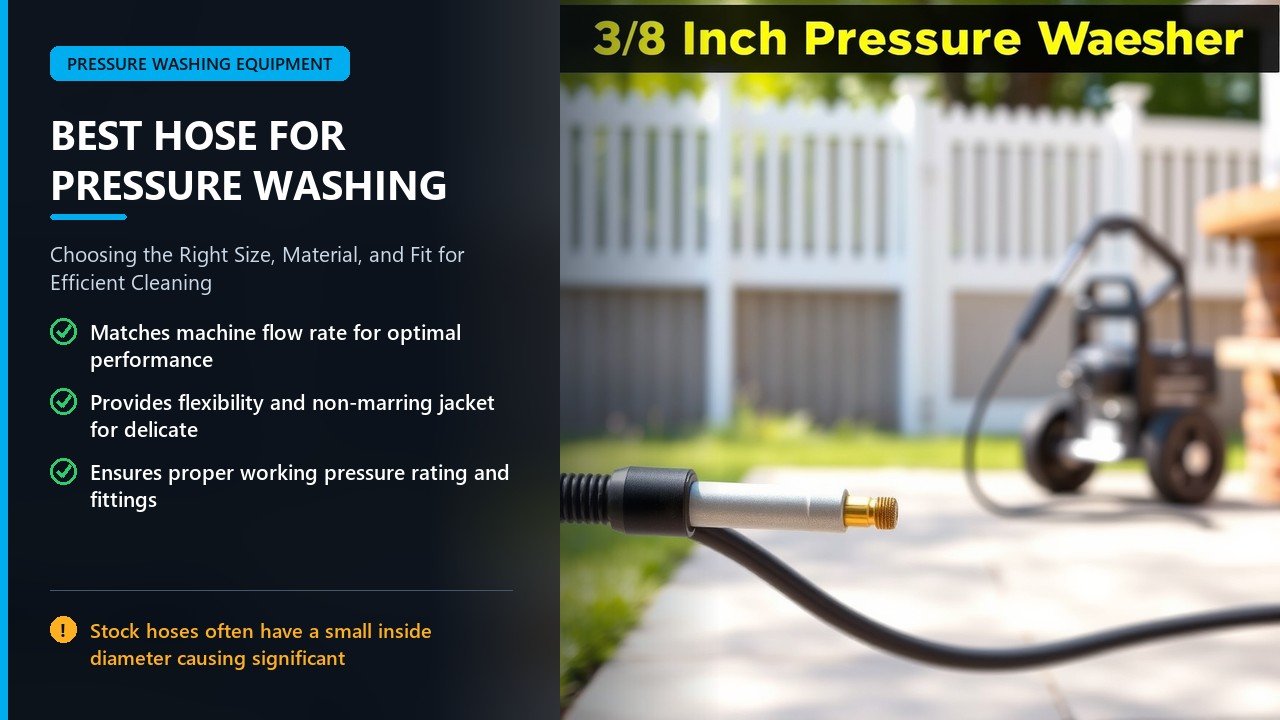
Why the Stock Hose Is the Weak Link
Almost every pressure washer, from budget electrics to mid-range gas units, ships with the cheapest hose the maker could include.
The stock hose exists to get you started. It is usually a short, stiff PVC line that meets the minimum specifications but fails on the qualities that make a hose pleasant to use. It kinks, coils into memory loops, stiffens in cold weather, and often measures only twenty to twenty-five feet, forcing you to move the machine constantly.
Kinking steals pressure and patience. A sharp kink chokes the flow and can spike pressure inside the pump, which stresses seals and reduces pump life. Even without a hard kink, a stiff hose fights your every move, and that friction adds up over a full afternoon of work.
Upgrading is the cheapest performance gain you can buy. Replacing a stock hose with a proper flexible, correctly sized one improves handling, protects the pump, and makes the machine feel more powerful, all for a modest cost. It is the single best accessory upgrade most owners can make.
What to look for. A hose that lays flat when depressurized, stays flexible in the cold, resists kinking, and carries the right volume of water for your machine. Those four qualities define a good hose more than any single specification.
Inside Diameter: The Most Important Spec
The inside diameter, the hollow space water travels through, controls how much flow reaches your gun, and getting it wrong is the mistake that costs real performance.
| Inside Diameter | Typical Flow Range | Best For |
|---|---|---|
| 1/4-inch | 1.0 to 2.0 GPM | Electric and compact gas machines |
| 5/16-inch | 2.1 to 3.0 GPM | Mid and prosumer gas machines |
| 3/8-inch | 3.5 to 5.0+ GPM | Commercial and high-flow machines |
Undersizing starves the machine. If your pump can deliver 4 GPM but your hose is 1/4-inch, the hose becomes the bottleneck and flow drops at the nozzle. You lose cleaning power that you already paid for, and the pump works harder than it should. Matching the bore to the machine’s output is essential.
Oversizing adds weight without benefit. A 3/8-inch hose on a light electric machine is heavier and clumsier than necessary and gains nothing, because the machine cannot produce the flow that a wider bore is designed to carry. Match the hose to the machine, not to a generic rule.
Friction loss over distance. All hoses lose some pressure to friction, and the loss grows with length and flow. A wider bore reduces that loss, which is why long runs and high-flow machines favor 3/8-inch. For short runs on low-flow machines, 1/4-inch is entirely adequate, as our guide to the 4 GPM pressure washer explains for high-output setups.
The simple rule. Match the hose bore to the machine’s outlet. If the outlet is 3/8-inch, run 3/8-inch. If you have a light electric with a 1/4-inch outlet, stay with 1/4-inch. The manufacturer designed the system around that size for a reason.
Length: Reach Versus Pressure Loss
Length determines how far you can work before moving the machine, but every extra foot costs a little pressure.
Match length to your projects. A fifty-foot hose handles most residential work, letting you wash a car or reach across a patio without relocating the machine. For house washing, a longer hose may be worthwhile, but only if the added reach truly saves you time.
Longer means more loss and more weight. Friction removes pressure along the hose, so a very long line reduces performance at the nozzle. Longer hoses are also heavier and harder to manage. Buy the length you need, not the longest one on the shelf.
Consider a hose reel. A reel keeps a long hose organized, prevents kinks and tangles, and speeds setup and storage. For anyone using a long hose regularly, a reel is a practical companion.
Keep runs reasonable. When you need more reach than a single hose provides, weigh the pressure loss against the convenience. In most home scenarios, a single fifty-foot hose of the correct diameter is the better choice than two coupled hoses.
Material: PVC, Rubber, or Polyurethane
The material determines how the hose feels, how long it lasts, and whether it marks surfaces.
| Material | Strengths | Trade-offs | Best For |
|---|---|---|---|
| PVC | Cheapest, light | Stiff, kinks, stiffens in cold, marks surfaces | Occasional light use |
| Rubber | Flexible, durable, handles cold and abrasion | Heavier, can leave black marks | Regular and heavy use |
| Polyurethane / hybrid | Light, flexible, often non-marring, kink-resistant | Costs more | Frequent use where weight and marking matter |
PVC is the budget baseline. It is cheap and light but stiff and prone to kinking, and it stiffens badly in cold weather. It is fine for occasional light use but frustrating for regular work.
Rubber is the durable workhorse. Rubber stays flexible in cold, resists abrasion, and withstands the demands of daily use. Its downside is weight, and the standard black rubber can leave marks on lighter surfaces unless you choose a non-marking version.
Polyurethane and hybrid polymers are the modern upgrade. These hoses combine light weight with excellent flexibility and kink resistance, and many are marketed as non-marring. They cost more but earn it for anyone who washes often or hates fighting a stiff line.
Match the material to the environment. If the hose lives on a cold truck or you drag it across rough ground daily, rubber or a hybrid is worth the cost. For a light electric machine used occasionally in mild weather, a decent PVC or hybrid hose is plenty.
Fittings and Compatibility
Even a perfect hose fails if its fittings do not match your machine and gun.
M22 is the consumer standard. Most residential machines use M22 threaded connections. There are two common sizes: M22-14mm, used on gas machines and most electric ones, and M22-15mm, found on certain electric models. Mixing them causes leaks, so confirm which your machine uses.
Quick-connect is the professional norm. Higher-end and commercial setups use 3/8-inch quick-connect fittings, which snap together for fast setup. An adapter can bridge the two systems when needed.
Never accept plastic fittings. Cheap hoses sometimes use plastic connectors that crack after a few uses. Choose brass or stainless steel fittings, which seal reliably and survive the stress of quick-connect changes.
Check both ends. A replacement hose must match the pump outlet on one end and the gun inlet on the other. When in doubt, measure or test-fit, and use adapters to bridge differences rather than forcing mismatched threads, which can strip and leak.
Pressure Ratings and Temperature
Two numbers protect your equipment and yourself, and both are printed on the hose.
Working pressure is what matters. The working pressure rating is the pressure the hose handles continuously, while burst pressure is the point of failure and should never be treated as usable margin. Choose a hose whose working pressure comfortably exceeds your machine’s output, and note that our guide to 7000 PSI pressure washers shows how high these ratings can climb.
Add headroom. A hose rated above your machine’s pressure lasts longer and tolerates spikes better. A machine running at 3,000 PSI is well served by a hose rated to 3,750 PSI or higher.
Temperature matters for hot-water machines. A cold-water hose used on a hot-water machine fails early. If you run hot water, choose a hose rated for that temperature, and always respect the hose’s stated maximum.
Read the cover. Most hoses print their working pressure, burst pressure, and temperature range on the jacket. Those printed values are the honest specifications, and they are the numbers to compare when choosing between two candidate hoses.
Recommendations by Machine Class
A quick reference makes the choice straightforward for most owners.
| Your Machine | Recommended Hose | Why |
|---|---|---|
| Compact electric, under 1.5 GPM | 25 to 50 ft, 1/4-inch, light PVC or hybrid | Low flow, easy handling |
| Full-size electric, 1.5 to 2 GPM | 50 ft, 1/4-inch, flexible or non-marring | Matches flow, easy around cars |
| Residential gas, 2 to 3 GPM | 50 ft, 1/4 or 5/16-inch, rubber or hybrid | Handles flow and muffler heat |
| Commercial gas, 3.5 GPM and up | 50 to 100 ft, 3/8-inch, steel-braided | Prevents flow restriction |
The homeowner sweet spot. For most homeowners with an electric or mid-range gas machine, a fifty-foot non-marring hose in the correct diameter, rated well above the machine’s pressure, is the ideal upgrade. It is long enough for a full house wash and flexible enough to work around obstacles.
For hard-use machines. If you run a gas machine at 3,500 PSI or higher, or work commercially, a steel-braided 3/8-inch hose is the right call. It resists abrasion and handles the pressure without complaint, and it outlasts the machine it serves.
For light electrics. A compact electric machine does fine with a light 1/4-inch hose. Spending on a heavy commercial hose here wastes money and adds unnecessary weight.
Care and Maintenance
A good hose lasts years with a little attention.
Drain before storage. Empty the hose completely after use, especially before cold weather, because trapped water freezes, expands, and damages the inner tube. Coil it loosely rather than tightly to avoid stress points.
Store out of the sun. Ultraviolet light degrades hose jackets over time. Keep hoses coiled on a reel or shelf away from direct sunlight to extend their life.
Inspect O-rings and fittings. Worn O-rings cause drips and pressure loss. Replace them at the first sign of a leak, and keep spares on hand, since they cost almost nothing and prevent mid-job frustration.
Avoid sharp edges and heat. Dragging a hose over broken concrete or against a hot muffler damages it quickly. Route the hose thoughtfully, especially around a running gas engine, which gets hot enough to melt a jacket.
Rubber Versus Polyurethane in Depth
The two premium materials deserve a closer look, because they suit different owners.
Rubber: the durable classic. Synthetic rubber hoses use a wire or textile braid for strength and a rubber cover for abrasion resistance. They stay flexible in cold weather, tolerate rough surfaces, and handle the heat that a gas engine throws off. Their drawbacks are weight and, in the standard black version, a tendency to leave marks.
Polyurethane and hybrid: the light, flexible modern option. These hoses often use a thermoplastic inner tube with a braided reinforcement and a smooth, sometimes clear outer jacket. They are lighter than rubber and very flexible, and many are marketed as kink-free and non-marring. Their disadvantage is a higher price and, in some formulations, less tolerance for extreme heat.
Steel-braided: the commercial standard. High-flow hoses often use one or two layers of steel wire braid, which gives outstanding kink resistance and pressure capacity. These are heavier and stiffer but are the right choice for machines at 3.5 GPM and up, where flow restriction and abrasion are constant concerns.
How to decide. If you wash often, in cold weather, or across rough ground, pay for rubber or steel-braided. If weight and surface marking matter most, and you clean finished surfaces such as cars or painted siding, a non-marring polyurethane or hybrid hose is the better fit. Both are enormous upgrades over the stock hose.
How to Replace or Upgrade Your Hose
Swapping a hose is a simple job, but a few steps prevent leaks and frustration.
Identify both connections first. Note the fitting at the pump outlet and at the gun inlet. If they differ, plan for an adapter. Confirm whether your machine uses M22-14mm, M22-15mm, or quick-connect, since guessing leads to leaks.
Match the diameter and rating. Choose a hose whose bore matches your machine’s flow and whose working pressure comfortably exceeds your machine’s output. When in doubt, err on the side of a higher rating and a matching or slightly larger bore.
Add quick-connects for convenience. Installing quick-disconnect fittings on the hose, gun, and machine speeds every setup and teardown. This is the same convenience covered in our guide to quick connects for a pressure washer, and it pairs perfectly with a hose upgrade.
Test for leaks. After connecting, run the machine and check every joint for drips. Tighten gently, replace any O-rings that leak, and never overtighten, which can damage threads. A leak-free system preserves pressure and protects the pump.
Store it properly from day one. Coil the new hose loosely, drain it after use, and keep it out of direct sun. Treating a good hose well is how it lasts for years.
Common Hose Mistakes
Knowing the usual pitfalls helps you avoid expensive and annoying errors.
Buying by length alone. A long hose sounds convenient until friction loss and weight make it a burden. Length is only one of several specs, and it should never override diameter and rating.
Ignoring the fitting size. A beautiful hose that will not connect is useless. Always confirm the fitting size before ordering, and keep an adapter or two on hand for surprises.
Choosing plastic fittings to save money. Plastic connectors crack under the stress of high pressure and repeated connections. Brass or stainless steel costs a little more and lasts far longer.
Using a garden hose on the pressure side. This is the most dangerous mistake. A garden hose cannot withstand pressure washer output and can burst, causing injury and damage.
Forgetting to drain before winter. Water left in a hose freezes and splits the inner tube. Draining and storing the hose properly prevents this entirely, the same winterizing habit that protects the pump and keeps your machine alive through the cold months.
Why Hose Diameter Affects Pump Life
The hose does more than deliver water. It also determines how hard the pump has to work.
A restrictive hose strains the pump. When the bore is too small for the machine’s flow, the pump pushes against back-pressure it was never designed to fight. That added resistance generates heat and stress, accelerating wear on seals, valves, and plungers. Over months of use, an undersized hose quietly shortens the pump’s life.
Correct sizing lets the pump run efficiently. A properly matched hose lets water flow freely, so the pump operates within its design parameters. That efficiency translates into steadier pressure at the nozzle, cooler running, and a longer service life, all from choosing the right diameter.
Long runs magnify the effect. The longer the hose, the more friction accumulates. A slightly restrictive hose on a short run may be fine, while the same hose on a hundred-foot run becomes a serious bottleneck. When you need length, choose a wider bore to compensate.
Surface cleaners are especially sensitive. Tools like rotary surface cleaners demand consistent flow, and a restrictive hose makes them streak and bog down. Feeding them properly through the correct hose is the difference between an even, fast clean and a frustrating, uneven one.
The takeaway. The hose is part of the hydraulic system, not just a delivery tube. Treat it as an engineered component, match it to the machine, and your pump will thank you with years of reliable service.
Frequently Asked Questions
What is the best hose for pressure washing? The best hose matches your machine: a flexible, correctly sized hose in the right diameter, rated above your machine’s pressure, with brass or steel fittings. For most homeowners, a fifty-foot non-marring hose in 1/4 or 3/8-inch, depending on flow, is the sweet spot.
Is 1/4-inch or 3/8-inch hose better? It depends on your machine’s flow. Electric machines under about 2 GPM do fine with 1/4-inch. Gas machines at 2 to 3 GPM suit 1/4 or 5/16-inch. Machines at 3.5 GPM and up need 3/8-inch to avoid restricting flow.
Does a longer pressure washer hose lose pressure? Yes. Friction removes pressure along the hose, so longer hoses reduce pressure at the nozzle. Buy the length you need rather than the longest available, and choose a wider bore for long runs.
What material is best for a pressure washer hose? Rubber is the most durable and stays flexible in cold, while polyurethane and hybrid polymers are lighter and often non-marring and kink-resistant. PVC is the cheapest but stiffest and least durable.
What does non-marring mean on a pressure washer hose? A non-marring hose has a jacket that will not leave dark streaks on concrete, siding, or finished surfaces when dragged across them, which matters for cleaner results and satisfied customers.
Can I use a pressure washer hose on a garden hose? No. The two are not interchangeable. A garden hose cannot withstand high pressure, and a pressure washer hose is not meant for unrestricted supply flow. Use each for its intended purpose.
What fittings do pressure washer hoses use? Most residential hoses use M22 threaded fittings, in 14mm or 15mm versions, while commercial setups use 3/8-inch quick-connect. Always confirm your machine’s fitting size before buying a replacement hose.
How long should a pressure washer hose be? For most home use, fifty feet is the practical sweet spot, long enough to reach around a car or across a patio without moving the machine. Go shorter for light jobs and longer only when the added reach truly saves time, since length costs pressure and weight.
Why does my pressure washer hose keep kinking? Kinking usually means the hose is stiff, too narrow, or poorly made, often a PVC stock hose. A flexible rubber, polyurethane, or hybrid hose with a kink restrictor at the fitting solves the problem and also improves handling.
Can I repair a pressure washer hose? Small issues like a bad O-ring or a loose fitting are easily fixed, but a damaged inner tube or a burst hose is not safely repairable. Replace a compromised high-pressure hose rather than risking a failure under pressure.
Final Thoughts on the Best Hose for Pressure Washing
The best hose for pressure washing is the one that fits your machine and your habits: the right diameter to carry your machine’s flow without restriction, the right length for your projects without excess pressure loss, a material that stays flexible and does not mark your surfaces, and fittings that seal without leaks. Get those right and the hose disappears into the background, doing its job quietly while you focus on the cleaning.
Maria replaced her stock hose with a fifty-foot non-marring line of the correct diameter, and the difference was immediate. No more kinks, no more fighting, no more black streaks on her fence. The machine had been fine all along; the hose had been holding it back. Choose your hose with the same care you would give the machine, and every job will go smoother, faster, and cleaner, from the first pass to the final rinse, season after season.