There is a shelf in every big-box aisle that owns a particular kind of buying moment: the gas pressure washer with an orange engine shroud and a price tag that looks like it belongs a class down. For years, that shelf has carried the Coleman PowerMate brand, and for years it has moved by the pallet load to first-time buyers and weekend warriors who want coyote power without the pro-store receipt. Marcus was one of them. He bought his Coleman on a Saturday, assembled it in the driveway, and by Sunday it had already done what the ads promised: invented a weekend’s worth of clean on a cracked driveway and a concrete pad. He has owned it for three seasons now, changed the oil twice, and swapped a plug once. And he will be the first to tell you the fine print nobody markets, starting with the pump that needs babying and the plastic fittings that want to break.
The Coleman pressure washer is a real machine with a real reputation, and the reputation is a fair one: capable, affordable, and a little rough around the edges if you do not know its quirks. Coleman is the outdoor brand famous for coolers and camping gear, and its power wash line, sold under the PowerMate label, occupies the affordable gas end of the market, offering big PSI numbers and full-featured machines at prices the pro brands charge for a third of the power. This guide gives you the honest read on what a Coleman pressure washer actually is, which models sit in the range, the quirks owners actually meet, how to make it last, and the straight answer on whether one belongs in your garage.
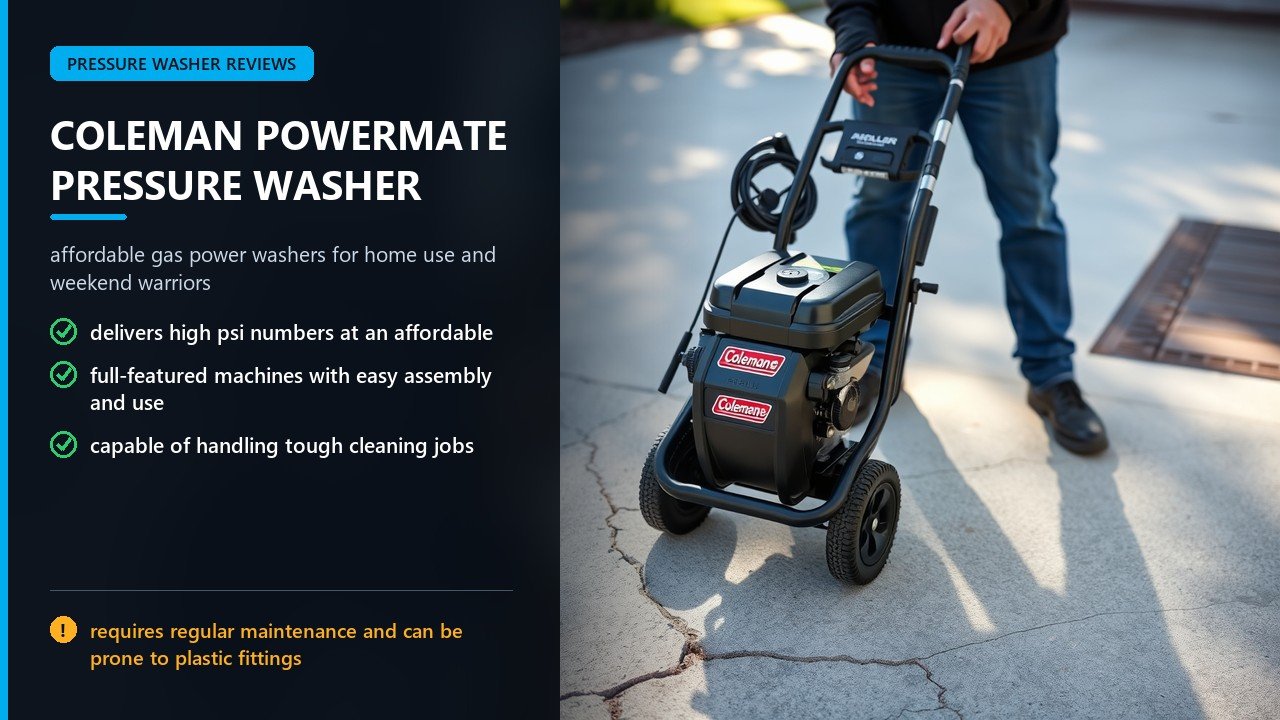
What Coleman Actually Sells
Before reviewing, know the map. Coleman’s pressure washer range is built around gas-powered machines, with a few electric options, and it clusters around the power level that conquers a normal home.
The gas core. Most Coleman machines are powered by a gas engine, styled in the brand’s distinctive gray-and-orange scheme, and rated in the 2,500 to 3,400 PSI range with flow around 2.3 to 2.6 GPM. That is the thoughtful bracket for home use: strong enough for concrete, decks, siding, and vehicles, without tipping into commercial-grade price.
Axial pumps, the entry decision. Nearly the whole line runs an axial cam pump, which is the cost-saving design used across consumer machines. Axial pumps are compact and cheap to make, deliver the promised pressure, and ask that you treat them well: run water before starting, never let it dry-run, and change the pump oil on schedule. That last part is where a lot of Coleman frustration is manufactured. Our guide to axial versus triplex pumps shows exactly what you are getting at this tier.
The electric corner. Coleman also offers plug-in electric models for car washes and light patio work, quieter and simpler, at gentle power levels. For anyone who does not want to manage an engine, the electric side is the gentler introduction to the brand.
What the brand is not. Coleman does not chase the 4 GPM commercial market. Its machines are homeowner-sized, sold by the box, backed by the outdoor lifestyle brand’s name, and priced to be somebody’s first pressure washer. Knowing that positioning is half the review, because the fair question is not “is Coleman as tough as a pro machine?” but “is Coleman the right first machine for a household budget?”
Where Coleman Wins
Start with the strengths, because at the price this is genuinely a lot of machine.
Pressure per dollar. The headline strength is the PSI-to-price ratio. A Coleman gas unit puts several thousand PSI in reach for a fraction of a pro-brand cost, and for driveway, patio, and concrete work that power genuinely does the job. Owners who buy one to clean the property report being satisfied with exactly this value, and it is the engine of the brand’s turnover.
Simple assembly, flat learning curve. The machines arrive near-ready, bolt the handle, wheel it out, attach the hose, hook the water, start the engine. Twenty minutes from box to blast is the universal experience, and the controls are the ones every web instruction video teaches. No franchise ceremony, no pro-shop intimidation.
Enough accessories in the box. Most models ship with an adjustable wand, assorted tips, a soap nozzle or bottle, and the pressure hose, enough to start real work immediately. Buyers who throw in a surface cleaner find the very same machine turns faster and cleaner on flatwork, which is the usual upgrade path.
Replacement parts and community support. Because the line sells in volume, parts like pumps, hoses, wands, and filters are easy to find, and the owner community has documented every quirk and fix. A Coleman unlike a boutique machine has a generous aftermarket and a thousand people online who have already fixed yours. Our article on whether the orange Coleman bargain is worth it sums up the value case from owner reporting.
Where Coleman Is Weak
The honest review also names the edges, and these are the reasons some owners write angry reviews and many others quietly learn to live with the machine.
The pump is the watchpoint. Axial pumps are the standard consumer choice, and they are also the part most likely to fail where owners run them dry, starve them of water, or skip the oil. A Coleman pump faces into a world of avid new owners, so pump complaints dominate the online story far more than the engineering deserves. Treated right, the pump lasts fine; treated as a fire hose that “just goes,” it dies early.
Plastic fittings and small hardware. Many connection points, hose ends, and fittings are molded plastic, and the culture has been littered with posts about cracked quick connects and snapped wand collars. A can of common sense helps: remove tools gently, store out of the sun, and order a brass fitting or two as a bully-proof spare.
Engine culture shock. The gas engine is a small-engine learning curve for owners who have only ever owned electrics. Fuel, oil levels, winterizing, air filters: the machine asks for the care a lawn mower does, and buyers who wanted plug-and-play get a lesson instead. Our guide to gas engine maintenance turns the lesson into a routine.
Not built for daily commercial use. A Coleman is a strong weekend tool and a shaky 40-hour-a-week machine. Buyers who launch a business on one find out in the busy season why the pros pay for triplex pumps and belt drives. The honest buyer keeps the Coleman for the property cleanup it nails and rents or upgrades for regular income work.
| Strengths | Weaknesses |
|---|---|
| High PSI for a sharp price | Axial pump demands care |
| Fast assembly, easy controls | Plastic fittings break when rushed |
| Ships with useful accessories | Engine maintenance is mandatory |
| Big aftermarket support | Not built for daily commercial duty |
Models Worth Knowing
The Coleman range shifts year to year, but three shapes repeat across the current line, and knowing the shape is more useful than chasing a serial number.
Compact gas models. The 2,500-ish PSI small gas units with a horizontal engine, ideal for a homeowner who wants gas power without a giant footprint. These are the machines that make a driveway disappear and still fit beside the trash cans.
Mid-range gas units. The 3,000 to 3,200 PSI tier with a bit more GPM and usually a better axle, wheel set, and accessory kit. This is the sweet-spot bracket for anyone whose list is concrete, decks, siding, and vehicles in one machine. Our companion look at the 3000 PSI bracket benchmarks what that power actually changes.
Top-end homeowner gas. The 3,400 PSI area units with the largest engines Coleman ships, positioned as the strongest home machine before the line hands off to commercial brands. Bulky, powerful, and still priced like a budget machine, which is exactly why it gets compared to the entry pro units and usually loses on pump and build, while winning on the sticker.
For the current model numbers and available stock, the manual that ships with each unit is the truth, and the spec sheet posted for your region lists the real flow and PSI pair. When comparing, weight flow as heavily as pressure; two Colemans with the same PSI and different GPM clean at different speeds even on the same driveway.
Setting One Up the Right Way
The day-one experience decides most of the owner verdict, and five minutes of correct setup prevents most early problems.
Water first, full open. Connect and open the supply fully before the engine starts. This is the single most important step on any gas machine and it is Coleman culture’s biggest lesson, because a dry axial pump is a dying axial pump. Water on, engine on, then trigger duty.
Prime the pump. Pull the trigger briefly with water flowing so the pump and lines fill and any air clears before the engine shoulders a load. Two seconds of “spitting” is the sign the machine is ready, and it prevents the dry-skid moment new owners mistake for a defect.
Use the right tip for the job. The boxed tips range from tight-cone to wide fan. Start wide on anything painted or soft, tighten only for concrete and stone, and keep a conservative distance until the surface reads correctly. Most new-owner “damage” posts are a wide surface met by a tight tip held close.
Shut down in order. At the end, close the trigger, kill the engine, and only then turn off and disconnect the water. Reverse-order shutdown can leave the pump pressurized or run it against a closed line, and the habit is cheap to build.
Maintenance That Makes a Coleman Last
The difference between “Coleman broke in a year” and “my Coleman is going strong” is not luck; it is a short maintenance list applied on schedule.
Pump oil. Change it after the break-in, then on the hours schedule in the manual. Use the specified weight, check the level before each season, and never overfill. The pump is the most expensive part and the easiest to protect.
Engine care. Check the oil, keep the air filter clean, use fresh fuel, and winterize before storage. A single season of neglect turns a fine engine into a no-start, and the fix is the ordinary care a car takes for free. Our guide to choosing engine oil answers the viscosity question in two sentences.
Water path. Flush the detergent system after chemical days, keep an inlet screen or filter on the water intake so sediment does not grind the pump, and store the machine with the lines drained. Sediment is the silent killer of axial pumps, and a few dollars of inlet protection repays itself annually.
Winter storage. Drain the pump and hoses, run the machine dry briefly in the spring guidelines, and store the pump protected from a freeze exactly as the pump freeze-saver guide describes. A machine that survived the garage all winter is a machine whose owner performed this page.
Recurring Owner Issues, Solved
Every brand has a greatest-hits list of complaints, and Coleman’s are documented, repetitive, and mostly preventable.
“It won’t start.” Fresh gasoline, correct engine oil level, choke and prime per the manual. Nine of ten no-starts are fuel, oil, or procedure, and the fix is in the manual pages most owners skip. Our troubleshooting guide for start-then-die pressure washers works through the sequence.
“It leaks from the bottom.” Then check the pump first: worn seals, a dry nipple, or a bad o-ring. Leaks at the pump’s seams are usually seal wear from missed oil changes or running dry. The repair is a seal kit and an oil change, and it is cheaper than the tears in the reviews imply.
“The wand or quick connects cracked.” Plastic fittings under stress, cold, and sun spot are the bruise points. Replace with brass, handle them gently, and store out of the sun. A $10 brass fitting ends the story.
“It surges.” The unloader and the nozzle are the usual suspects: a clogged tip, a sticky unloader valve, or supply starvation from a small feed hose. Clean the nozzle, check the feed, and the machine steadies out. Our surge and stutter guide is the playbook.
Is a Coleman Pressure Washer Right for You?
The fair verdict comes down to three profiles.
Perfect for the weekend property cleaner. If the work list is the driveway, the garage slab, the back deck, the siding, and the car, and the machine will run a few hours a month under a person who reads the manual, Coleman delivers unmatched power per dollar and years of service.
Good for the first gas machine buyer. As an entry into gas pressure washing, a Coleman teaches the whole skillset at a forgiving price: fluids, pumps, tips, winterizing. Most people learn on one and then keep it as the permanent homeowner tool.
Wrong for the daily pro. If income depends on it through a busy season, the cheaper machine’s axial pump and plastic parts do not share the reliability of triplex builds. That buyer is already shopping the next bracket, and the triplex upgrade is the honest path.
Compare the machine against a whole row, not the sticker alone, and read the spec line that matters: flow, pump type, and the warranty. Consumer-focused reviews of pressure washers lean on the same three specs for the same reasons, and the discipline protects every dollar.
Accessories That Change the Machine
The boxed machine does the whole job with its stock wand and tips, and a short list of affordable add-ons turns the same Coleman from merely capable into genuinely fast.
The surface cleaner. The single best first upgrade, already said and worth repeating. It converts the machine from a long hand sweep into a wide spinning pass, cuts a driveway job in half, and reduces the streaking and carving risk that bare manual passes invite. On a Coleman’s pressure, flatware becomes the fastest work the machine does. Our guide to professional surface cleaners shows the sizes that match mid-range gas flow.
A longer, quality hose. The stock hose is functional and short. A 50-foot quality replacement with the right fittings turns the machine from a machine you move around a driveway into a machine that stays put while the hose roams, and it costs less than most complaint sessions about handle moving. Match the rating to the PSI and keep the ends clean.
A proper soap kit. The box soap nozzle works; a dedicated foam cannon or a detergent applicator with a wider fan spreads chemical faster and more evenly on cars and soft surfaces. Detergent + pressure is the cold-water pro trick, and a good applicator is the tool that makes it routine. Our comparison of foam cannon versus soap nozzle settles which suits which job.
The brass fitting kit. A handful of brass quick connects, M22 adapters, and a spare wand collar ends the plastic-fitting saga permanently. It is the cheapest insurance the brand offers, and owners who add it spend the rest of their seasons forgetting fittings were ever an issue.
Coleman Versus the Shelf Competition
Nobody buys a pressure washer in a vacuum, and the honest comparison across the budget aisle keeps the Coleman verdict fair.
Against house-brand gas units. Store-brand gas pressure washers at the same price bracket share the same axial pump DNA and often the same engines. Coleman’s edge is the recognizable brand, the parts ecosystem, and the volume of documented owners. The house brand rarely offers that support network, which is why the extra few dollars toward Coleman is usually the better shelf pick.
Against mid-priced gas units. Brands that sit a tier up, built on more robust frames, better hoses, and better fittings, cost meaningfully more for the same pressure. For a homeowner who wants the same job done at a lower price, staying in the Coleman lane is a fair trade; for an owner who wants to treat the machine like equipment rather than an appliance, the tier above stops being a splurge.
Against electric models. Electric machines lose the gas advantage in portability and peak power, but win on quiet, simplicity, and zero fuel smell for small jobs. If the whole season’s work is a car and a patio, an electric out-handles a gas Coleman in comfort even if it loses on raw PSI. Our comparison of electric versus gas pressure washers frames the choice on usage hours, not sticker numbers.
The verdict by weight. In the budget gas aisle, Coleman is very close to the top of its class: same pumps, more community, sharper brand support. It is the price bracket’s right answer for the right buyer, and the buyer is the weekend cleaner, not the daily pro. Everything below that has already been said; choose accordingly in the aisle and sleep soundly either way.
Common Coleman Mistakes
Running the pump dry. The #1 killer. Water first, always.
Skipping the oil change. The break-in and seasonal changes are not optional; they are the pump’s life support.
Storing it with water inside. A freeze turns a working pump into a paperweight. Drain it, always.
Using a tight tip on soft surfaces. The machine can carve anything in the yard. Wide tips and distance, every time.
Rushing plastic fittings. Snapped collars are a user-speed problem. Gentle hands, brass spares, sun-shaded storage.
Never flushing the detergent system. Chemical residue eats o-rings and streaks the next job. Rinse it out after chemical days.
Frequently Asked Questions
Is Coleman a good pressure washer brand? For homeowner duty, yes: strong pressure per dollar, easy setup, deep parts support. The honest review is value-led, with pump care and plastic fittings as the trade-offs.
How much does a Coleman pressure washer cost? Typically a few hundred dollars for entry gas models, rising with PSI and features, still well under pro-brand equivalents at every step.
Where is the Coleman pump made and what type is it? The range uses axial cam pumps, the standard consumer design, valued for cost and compact size, and demanding good water habits and oil changes.
Why does my Coleman pressure washer leak from the bottom? Usually worn pump seals or o-rings, often from running dry or missed oil changes. The repair is a seal kit plus fresh oil, documented widely online.
Can I use a Coleman for commercial work? Light commercial and marketing-days, yes; daily booked income, no. Its axial pump and plastic fittings are not built for 40-hour weeks.
Does Coleman still make pressure washers? The power-washing line has continued under the Coleman PowerMate label with evolving gas and electric models; the current spec sheet for your region is the truth for available stock.
Final Thoughts on the Coleman Pressure Washer
The Coleman pressure washer earns exactly the reputation its shelf position suggests. It is a genuinely capable gas machine at a genuinely sharp price, strong enough to demolish a driveway in a weekend and simple enough to assemble in the time it takes to unbox it. It is also a consumer-grade axial pump machine whose whole story is written by its habits: water before start, oil on schedule, tips matched to surfaces, plastic handled gently, and winter drains honored.
Buy it for the property cleaning that fills a normal home’s season, read the manual it ships with, and treat the pump as the investment it is. Skip the parts of the routine, put a tight tip on a painted wall, or run it dry, and the reviews you will later write will sound like all the others. Honor the small list, add the surface cleaner and the care, and the orange machine in the corner of the garage becomes what every buyer hoped for on the countless Saturday morning of purchase day: a few hundred dollars that out-cleans the neighbors, season after season, on nothing but pressure, water, and a little respect for the machinery.