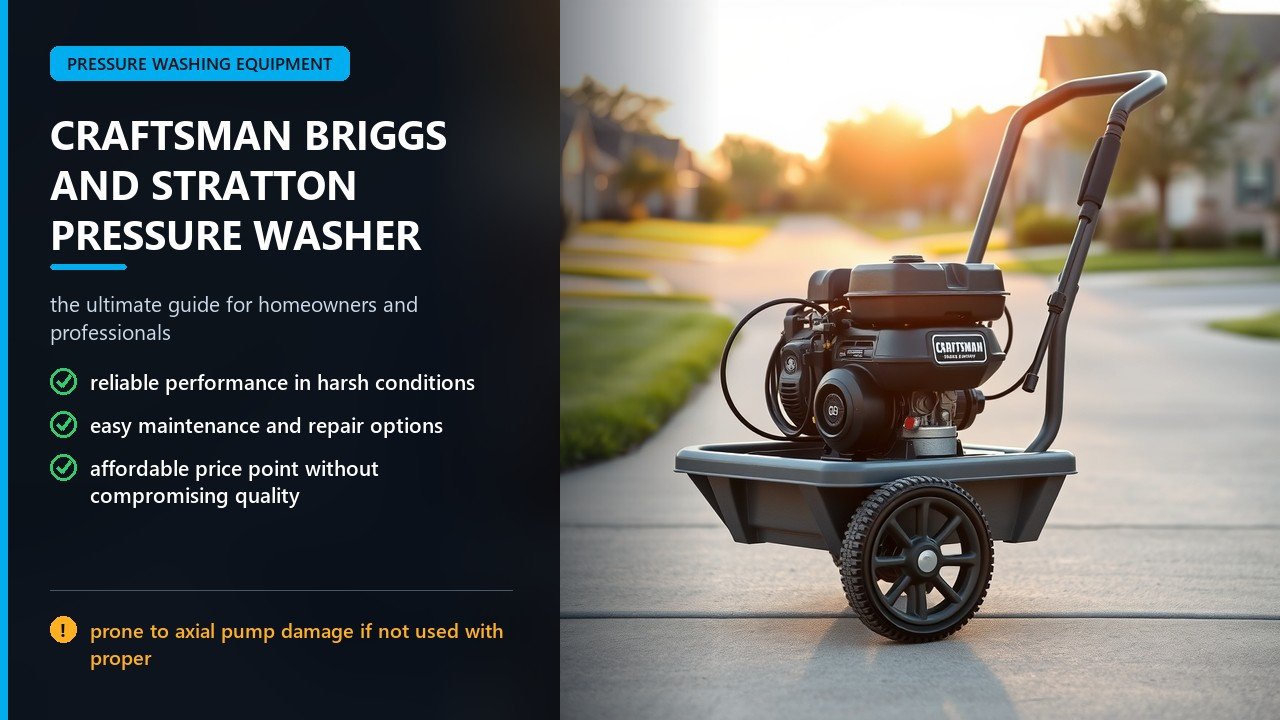
In the driveway of a house you will one day sell, there is a pressure washer that tells the story of the American gas machine. It wears a Craftsman badge on a black and gray cart, and under the hood sits a small Briggs & Stratton engine that has been the beating heart of homeowner power equipment for generations. A buyer looking at a used machine will read those two names the way a mechanic reads a nameplate: Craftsman means parts on every hardware store shelf, and Briggs & Stratton means an engine any small-engine shop can service, with a carburetor kit and a spark plug found in an afternoon. The combination is not glamorous and it is one of the safest buys in the entire budget gas category, precisely because both names mean the machine can be fixed.
The Craftsman Briggs and Stratton pressure washer is a pairing rather than a single model: Craftsman, the long-standing tool brand, builds and sells pressure washers around Briggs & Stratton gasoline engines, and the result is the classic homeowner gas machine. It has enough pressure for real concrete work, an engine with vast parts support, and a price point that keeps it accessible. It also has the trade-offs of its class: an axial pump that wants careful water habits, plastic fittings that bruise easily, and a maintenance list new owners routinely ignore. This owner’s guide covers what the pairing actually delivers, which models and power levels to expect, how to maintain a Briggs engine and the pump beneath it, what commonly goes wrong, and how to make one of these machines last a decade instead of a season.
What the Craftsman and Briggs Pairing Means
Understanding the two brands and what each contributes explains why this machine has such staying power.
Craftsman brings the machine and the sales channel. Craftsman is a heritage tool and outdoor-equipment brand, sold through major retailers, and its pressure washer line spans electric and gas machines. The Craftsman name means the frame, pump, wand, hose, and accessories carry that brand’s support and its wide retail footprint, so consumables and replacements are easy to find.
Briggs & Stratton brings the engine and the parts network. One of the largest small-engine makers in the world, Briggs & Stratton builds the gasoline engines that power a huge share of homeowner equipment, from mowers to generators to pressure washers. A Briggs engine means a carburetor, fuel system, ignition, and air filter that any small-engine technician understands in their sleep. The official Briggs & Stratton support resources cover engine models, manuals, and service for these engines directly.
The pairing is the point. Put a widely sold machine brand together with a universally recognized engine and you get a machine with a long service trail: the manual, the parts, and the know-how all exist, in stores and online, for years after purchase. That is why a used Craftsman with a Briggs engine holds value and why an owner can keep one running with basic tools. It is not the most powerful or refined machine, and it is one of the easiest to live with long term.
What This Machine Is Good At
The strengths of the pairing are unglamorous and practical, which is exactly the point for a homeowner.
Real pressure for real surfaces. These machines typically deliver enough PSI and flow to clean concrete driveways, patios, siding, and fences comfortably, which is the lion’s share of homeowner cleaning. The power is matched to the work most people actually do.
An engine you can service anywhere. The Briggs engine’s ubiquity is a genuine advantage. Spark plugs, air filters, carburetor parts, oil, and fuel system components are available at hardware stores, box stores, and online inexpensively, and repair know-how is abundant. When the engine needs attention, it does not become a specialty-order nightmare.
Parts for the whole machine. Craftsman’s retail presence means wands, hoses, nozzles, o-rings, and replacement pumps are widely stocked, and the brand’s service resources cover the machine side. This is the opposite of a boutique rig where a broken hose collar stops the whole weekend.
A familiar, forgiving price. The Craftsman name and its retail positioning keep these machines affordable, and their ease of service keeps the total cost of ownership low. For a buyer who wants gas power without a pro price, it is a sensible entry into the category. Our comparison of the Coleman machine and how it compares to the big-box field shows where the Craftsman pairing lands relative to the competition.
Model Range and Power Levels
Craftsman’s line shifts over the years, and the Briggs engines appear across a range of power levels, so it helps to know the brackets.
Entry gas machines. The smaller Craftsman gas units, often around 2,000 to 2,600 PSI with a modest GPM, built for cars, patio furniture, and light exterior cleaning. These are the least expensive way into a Briggs-powered machine and the easiest to handle.
Mid-range gas machines. The 2,800 to 3,200 PSI tier, the sweet spot for homeowners with concrete, decks, and siding on the list. This is where most Craftsman Briggs machines live, and where the pairing hits its stride: enough power for the heavy surfaces, still manageable for one person.
Upper homeowner gas machines. The 3,300 to 3,600 PSI area, with larger Briggs engines and greater flow, for bigger properties or heavier concrete work. These approach entry-commercial capability while remaining homeowner machines, and they carry the same pump-care demands as the whole line. Our look at the 3,000 PSI bracket benchmarks what that power buys.
Model numbers change with the retail seasons, so the reliable spec is the pair of numbers on the machine: its PSI and its GPM, alongside the Briggs engine model stamped on the engine itself. When comparing two Craftsman units, weight flow and engine model as heavily as pressure. The engine’s model number is the key to every part and manual you will ever need.
The Pump Underneath
The engine gets the badge and the pump does the work, and understanding the pump is essential to making the machine last.
Likely an axial pump. Most Craftsman gas pressure washers of this class use an axial cam pump, the standard consumer design that is compact and cost-effective. It delivers the rated pressure and asks for careful water habits, never running dry and receiving its oil changes on schedule.
Pump oil and its schedule. If the pump has a reservoir, it needs the specified pump oil changed after break-in and then on the manual’s interval. This is the single most neglected service on the machine and the most common cause of early pump failure. Our step-by-step guide to changing pump oil applies directly to the Craftsman’s pump.
Pump protection habits. Water on before the engine starts, no dead-heading for long periods, clean water through an inlet filter, and a winter drain. These habits decide whether the pump under the Briggs engine reaches the end of its design life or dies in its second season, and they cost nothing to build.
Maintaining the Briggs & Stratton Engine
The engine’s maintenance is the familiar small-engine routine, and the Briggs platform makes it straightforward.
Engine oil. Check the level before each use, change the oil after the break-in period, and then on the hours schedule in the manual. Most Briggs small engines on pressure washers accept a standard small-engine oil, commonly 10W-30. Our guide to 10W-30 pressure washer oil answers the grade question thoroughly.
Air filter. A clogged air filter chokes the engine and wastes fuel. Inspect and clean or replace it seasonally, or more often in dusty work. It is one of the cheapest parts on the machine and one of the most ignored.
Spark plug. A fouled or worn plug causes hard starting and rough running. Replace it on the manual’s interval, gap it to spec, and keep a spare on the shelf. On a Briggs engine, a plug is a few dollars and a two-minute job.
Fuel system. Fresh fuel matters. Old or ethanol-blended fuel left sitting varnishes and gums the carburetor, the number one cause of “it won’t start next spring.” Use fresh fuel, add a stabilizer, run the engine dry before storage, or drain the tank and bowl, per the manual. The Briggs fuel system is simple and responds well to this discipline.
Cooling and governor. Keep the cooling fins and air passages clean so the air-cooled engine breathes, and leave the governor alone unless it needs service. Dirt and debris blocking the cooling fins is a quiet cause of overheating on neglected machines. Our guide to how much maintenance a gas pressure washer needs lays out the full cadence.
| Component | Service | Interval |
|---|---|---|
| Briggs engine oil | Check / change | Before use / per manual |
| Air filter | Clean or replace | Seasonally or dusty use |
| Spark plug | Replace, gap | Per manual |
| Fuel | Fresh, stabilize, drain | Storage and seasonally |
| Pump oil | Change | Break-in, then seasonal |
Parts and Repair Advantage
The pairing’s greatest long-term value is how easily a Craftsman Briggs machine gets repaired, and that is worth spelling out.
Engine parts are everywhere. Briggs & Stratton’s engine models use widely available parts: carburetor kits, coils, recoil starters, air filters, and gaskets. Any small-engine shop can identify the engine by its model number and service it, and the owner can order matching parts online or from a local dealer. This ubiquity is the engine’s whole advantage.
Machine parts are widely stocked. Craftsman’s retail channel keeps machine-side consumables, hoses, wands, nozzles, o-rings, and often replacement pumps in stock or readily orderable. A cracked wand or a worn hose coupling does not sideline the machine for a week.
Manuals and support exist. Craftsman publishes machine manuals, and Briggs & Stratton publishes engine manuals keyed to the engine’s model number. Finding the correct oil capacity, plug gap, and fuel spec is a search away rather than a guessing game. Our guide to how the Briggs engine earns its keep expands on the service ecosystem.
Repair is economical. Because parts are cheap and common, repairing a Craftsman Briggs machine is usually worth it where repairing a boutique machine might not be. A new carburetor, an ignition coil, or a pump can be replaced for a fraction of a new machine, which stretches the pairing’s service life across many seasons.
Common Problems and Fixes
These machines develop predictable issues, and most have simple causes.
Won’t start in spring. Stale fuel and a gummed carburetor, nine times in ten. Drain and refill with fresh fuel, clean or replace the carburetor, and use stabilizer going forward. Our guide to starting and running problems walks the sequence.
Surges or hunts at idle. A dirty carburetor, a clogged fuel filter, or an air leak. Clean the fuel path and check the carburetor. The surge and stutter guide is the playbook.
Loses pressure. Usually a worn nozzle, a clogged inlet, an air leak on the suction side, or a failing pump. Check the easy causes first: nozzle, water supply, fittings, before suspecting the pump. Persistent low pressure points to pump wear, often from a missed oil change.
Leaks from the pump. Worn seals or o-rings, typically from running dry or contaminated oil. A seal kit and a fresh pump oil fill is the usual fix, and it is worth doing before the pump fails outright.
Excessive vibration or rattle. Loose mounting bolts, worn engine bushings, or pump bearing wear. Tighten the mounts, replace tired bushings, and if the pump rattles, check its oil and condition. Ignoring a rattle is how a small problem becomes a replacement.
Mistakes That Shorten the Machine’s Life
Running the pump dry. Water supply fully open before start, every time. This one habit prevents most pump deaths.
Skipping pump oil. The engine gets the attention and the pump gets forgotten. Change the pump oil too.
Leaving old fuel in it. Stale fuel ruins the carburetor and the spring start. Stabilize, drain, or run it dry for storage.
Overfilling engine oil. Extra oil foams and can damage seals. Fill to the dipstick mark.
Using a tight tip on soft surfaces. The machine can etch wood and strip paint. Match the tip to the surface.
Storing it wet and cold. Freeze damage cracks pumps and fittings. Drain the system before winter.
Ignoring the air filter and cooling fins. A clogged engine overheats and wastes fuel. Clean them seasonally, especially after dusty work.
Setting Up and the First Season
The first hours decide the machine’s habits, and a correct setup protects both the engine and the pump.
Assemble and read the manual. Attach the handle, wheels, wand, and hose per the instructions, and actually read the engine and pump sections. The manual lists the oil capacities, the fuel spec, the break-in interval, and the correct pump oil, and it is the only authority for your specific model.
Prepare the machine before the first start. Fill the engine oil to the mark, confirm the pump oil level if the pump has a reservoir, and fill the tank with fresh gasoline. Check that the water supply hose and inlet filter are connected and clear. A new machine that starts on its first pull with correct fluids runs better for its whole life.
Water on before engine on. Open the supply fully, confirm flow, and pull the trigger to clear air from the lines before starting the engine. This single step protects the pump from the dry-run that kills axial units, and it should become muscle memory on every future job.
Match the tip to the task from day one. Start with a wide fan tip on anything painted or soft and reserve the tight tip for concrete and stone at a safe distance. Learning tip discipline early prevents the etching and stripping that new owners accidentally cause. Our guide to avoiding cutting concrete and wood is the reference for safe technique.
Do the break-in service. Within the first few hours, change the engine oil and the pump oil as the manual directs. The break-in change removes the wear particles from the machine’s initial seating and is the most important service the machine will ever receive. Skipping it is the fastest way to turn a new Craftsman into a tired one.
Craftsman Briggs Versus the Field
Placing the Craftsman Briggs machine against the competition clarifies who should buy it and who should look elsewhere.
Against other big-box gas machines. Store-brand and lifestyle-brand machines at the same power level share the same axial-pump reality and similar frames. Craftsman’s edge is the combination of a Craftsman parts channel and a Briggs engine, giving it perhaps the strongest service ecosystem in the budget aisle. A buyer who values repairability should weight that heavily.
Against the Coleman-style pairing. Both classes deliver strong pressure per dollar. The comparison usually comes down to engine familiarity and parts trail: a Briggs engine’s ubiquity and the Craftsman retail network often tip the service argument toward the Craftsman. Our piece on how the Coleman machine compares to the big-box field runs the same logic in the other direction.
Against mid-tier brands. Machines a step up the price ladder use better frames, hoses, and fittings, and sometimes triplex pumps, and they last longer under hard use. For a homeowner with a modest job list, the Craftsman Briggs offers more value per dollar; for someone who intends to run the machine hard or commercially, the step up is the better investment. Our guide to triplex pump machines explains the upgrade.
Against electric machines. An electric machine is quieter, simpler, and fuel-free for small jobs, losing on portability and peak power. If the whole job list is a car and a patio, electric serves; for concrete, decks, and mobility, the gas Craftsman Briggs is the right tool. Our comparison of electric versus gas washers frames the decision by usage.
The honest verdict: within the budget gas category, the Craftsman Briggs machine is one of the safest, most serviceable choices a homeowner can make. It is not built for daily commercial duty, and it rewards the owner who respects its pump and cares for its engine. For that owner, it is close to ideal.
Frequently Asked Questions
Is a Craftsman Briggs and Stratton pressure washer good? For homeowner duty, yes. It pairs a widely supported engine with a well-stocked machine brand, delivering real cleaning power with easy parts and service access.
What oil does a Craftsman Briggs pressure washer engine use? Most Briggs small engines on these machines accept a standard small-engine oil, commonly 10W-30. Confirm the grade in your manual and change it after break-in.
How often should I change the pump oil on a Craftsman pressure washer? After the break-in period and then on the manual’s interval, typically once a season for home use. The pump is the common early failure point.
Why won’t my Craftsman pressure washer start? Usually stale fuel or a gummed carburetor after storage. Fresh fuel, a cleaned carburetor, and fuel stabilizer prevent and fix it.
Where can I get parts for a Craftsman Briggs pressure washer? Machine parts through Craftsman retailers, engine parts through Briggs & Stratton dealers and small-engine shops, both readily available online for common models.
Is a Craftsman pressure washer with a Briggs engine a good used buy? Often yes. The wide parts and service support makes it a safer used purchase than an obscure machine, as long as the pump has been maintained and the engine starts cleanly.
Final Thoughts on the Craftsman Briggs and Stratton Pressure Washer
The Craftsman Briggs and Stratton pressure washer is the definitive homeowner gas machine, and its strength is not any single dazzling spec. It is the pairing itself: a well-known machine brand meeting a universally recognized engine, producing a pressure washer that cleans concrete and siding with real authority while remaining one of the easiest machines in the category to keep running. Parts exist, manuals exist, and service know-how exists, for years after the purchase, which is a kind of reliability that spec sheets never capture.
Own it for the work it is built for, concrete, decks, siding, fences, and vehicles, and treat its two lives with equal respect. Keep fresh fuel and a clean air filter in the Briggs engine, change its oil on schedule, and give the pump beneath it the water habits and oil changes it quietly demands. Read the old pump oil, log the services, and drain the whole system before winter. Do those ordinary things, and a machine that could have been a forgotten square of hardware in the garage becomes what every buyer hopes for: the pressure washer that still fires up reliably for that first driveway of the season, backed by two of the most serviceable names in the business, doing exactly what it was bought to do for year after year.