Kevin had a plan that seemed foolproof. His pressure washer had an onboard soap tank, his garage shelf held a big bottle of blue dish soap, and he figured the soap that cut grease off a lasagna pan would make short work of the oil stains on his driveway. He poured it in, pulled the trigger, and waited for the magic. What he got was a wand full of foam, a driveway that would not stop bubbling, and a soap injector that never worked quite right again. The next weekend, when he tried to wash his truck, the machine refused to draw any soap at all. The culprit was the very product he had trusted: dish soap in a pressure washer is one of the most common and most damaging shortcuts an owner can take. This guide explains exactly why dish soap and pressure washers disagree, what it does to your machine and your surfaces, the one safe way to use it, and what you should pour into that soap tank instead.
The confusion is understandable. Dish soap is cheap, it is already in the house, and it is famous for cutting grease. But a pressure washer’s soap system was designed for a completely different kind of liquid, and everything that makes dish soap excellent in a sink makes it wrong inside a pressure washer. Let us break down the chemistry, the machinery, and the practical alternatives so you never repeat Kevin’s mistake.
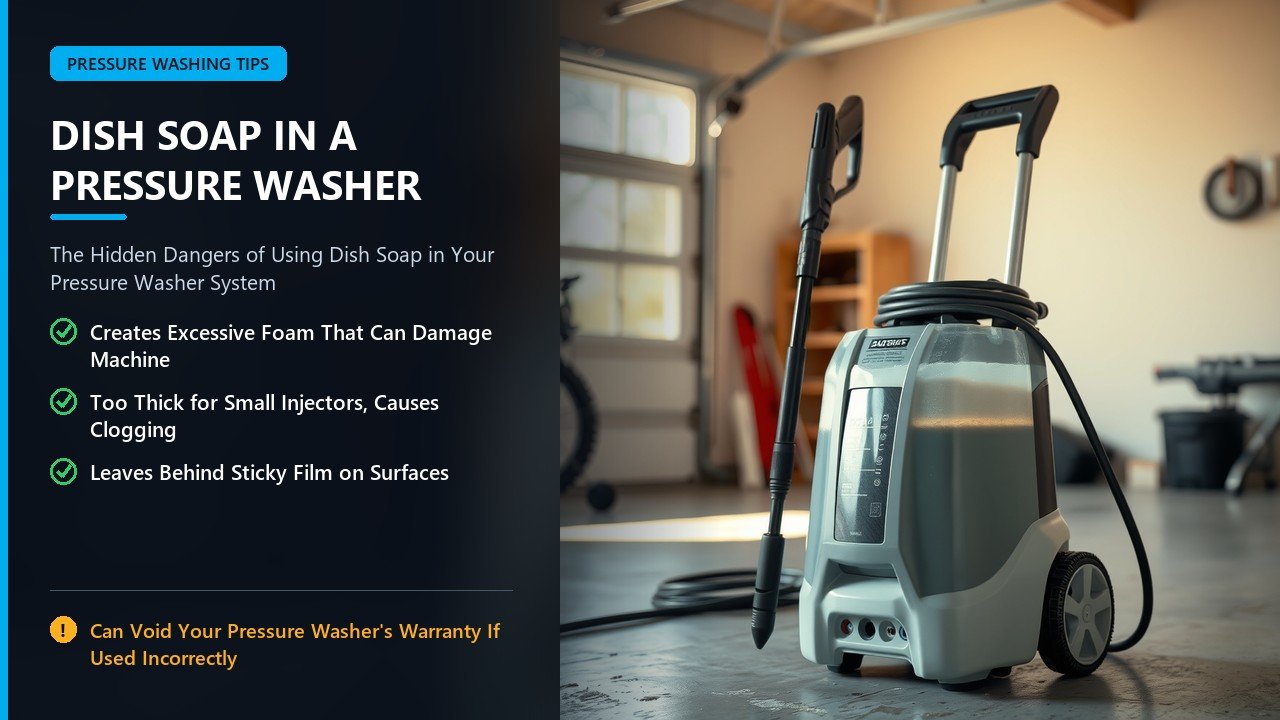
The Short Answer on Dish Soap in a Pressure Washer
Can you use dish soap in a pressure washer? Not in the machine. You should never pour standard dish soap into the detergent tank, and you should never let it run through the pump. The reasons stack up quickly: dish soap is engineered to produce mountains of stable foam, and a pressure washer’s chemical system is engineered to handle a thin, low-foaming liquid. Forcing the first into the second breaks almost every design assumption.
Where it goes wrong. The typical homeowner machine pulls detergent through a downstream injector or an onboard tank using a small passage and a Venturi effect. Dish soap is many times thicker than the detergent that passage was built to move, so it either refuses to draw at all, or it dries into a gummy plug that blocks the injector the next time you use it. Either way, your soap system stops working, and the fix is a part that was perfectly fine before you poured the wrong liquid in.
Where it is fine. There is a safe way to get the grease-cutting power of dish soap: keep it out of the machine entirely. Use it in a bucket with a brush or sponge and let the pressure washer act only as a rinse hose, or run it through a foam cannon that mixes the soap at the wand and never touches the pump. More on that later.
Why Dish Soap Fails Inside a Pressure Washer
The mismatch comes down to four properties. Understanding them explains every symptom owners report.
Foam. Dish soap exists to make suds. People associate suds with cleaning, so manufacturers load it with high-foaming surfactants. A pressure washer wants the opposite. Its soap system relies on steady liquid flow and a clean rinse, and a wand full of foam creates inconsistent flow, sputtering, and a rinse that turns into a twenty-minute battle with bubbles. The The Honest Reviewers guide calls this the most common symptom: it simply does not work the way you expect.
Viscosity. Dish soap is thick. Downstream injectors and onboard tanks meter chemical through a tiny hole or check valve, and a viscous liquid struggles to pass. The machine draws little or nothing, and the owner assumes the soap system is broken. When people thin it enough to flow, they usually overshoot and get hopeless over-foaming instead.
Residue. Dish soap leaves a film. That film dries into a sticky layer that attracts dirt, and once it dries inside the injector or siphon tube, it becomes a gel that clogs the small passages. A single use can leave enough residue to gum up the works.
Chemistry. Many dish soaps contain salt (sodium chloride) as a thickener and have a high, alkaline pH. That combination is not friendly to the aluminum and brass parts and rubber seals inside a pressure washer over repeated use. Dedicated detergents include corrosion inhibitors and are pH-balanced for equipment; dish soap has none of that.
What Dish Soap Does to Your Machine
The damage usually starts at the soap system, but on some machines it reaches deeper.
The injector and siphon tube. This is ground zero. A downstream injector is a small, precise part with a tiny orifice, a check valve, and often a mesh filter on the pickup tube. Thick dish soap and its dried residue clog all three. A common result is an injector that will not pull soap anymore, which owners mistake for a mechanical failure. The fix is usually soaking and clearing the part, but prevention is far easier.
The pump. On most consumer machines, detergent is injected after the pump, so the soap never touches it, and a single use is unlikely to cause harm. The risk rises sharply if soap is siphoned into the inlet or run through an upstream proportioner, where chemical passes through the pump itself. Heavy foam inside a pump introduces air, and air causes the same pulsing, cavitation, and seal wear you get from a starved water supply. Cavitation is not a cosmetic problem; it can destroy a pump over time.
The warranty. Most pressure washer manuals explicitly state that only pressure-washer-approved detergents should be used. Manufacturers such as Karcher and Simpson list approved products and warn that non-approved chemicals can void the warranty. Saving a few dollars on soap is a poor trade if it costs you a warranty claim on a pump.
What Dish Soap Does to Your Surfaces
The machine is not the only victim. Dish soap can also damage the very surfaces you are trying to protect.
Cars and paint. This is the worst place for dish soap. It is a degreaser, and the wax, sealant, or coating on a car’s clear coat is exactly the kind of oily film it removes. One wash will not ruin paint, but it strips the protective layer, leaving the finish bare and making dirt bond more easily next time. Detailers are unanimous that a pH-balanced car wash soap cleans just as well while leaving the wax and sealant in place.
Wood and finishes. Dish soap can leave a residue and raise grain on wood, and on decks about to be stained, any leftover film ruins the finish. Use an oxygen-based deck cleaner instead.
Leftover film. Any dish soap residue left on siding, glass, or a vehicle dries into a dull film, which is why a thorough second rinse matters. Leftover chemical attracts new dirt just as effectively as it removed the old grime, which means your surface gets dirty again faster.
Dish Soap Versus Pressure Washer Detergent
The two products are built for opposite jobs, and seeing them side by side makes the difference obvious.
| Property | Dish Soap | Pressure Washer Detergent |
|---|---|---|
| Foaming | High, stable suds | Low or controlled |
| Thickness | Thick, slow to flow | Thin, flows through the injector |
| Rinse behavior | Often leaves a film | Formulated to rinse clean |
| Salt content | Often contains salt | Usually salt-free with corrosion inhibitors |
| pH | High (alkaline), around 9 to 10 | Neutral to mildly alkaline, around 7 to 8 |
| Surface specific | One general degreaser | Car, house, deck, concrete versions |
| Manufacturer approval | Usually not approved | Yes, when labeled for pressure washers |
The cost argument is weak too. A gallon of pressure washer concentrate costs roughly ten to twenty-five dollars and covers several jobs, so the price per wash is a couple of dollars at most. Compare that to the cost of a clogged injector, a pump repair, or a car that needs re-waxing, and dish soap stops looking like a bargain.
The One Safe Way to Use Dish Soap Around a Pressure Washer
Dish soap is not useless. It is a capable hand-cleaning product, and there is an old-fashioned way to get its grease-cutting power without risking your equipment.
The bucket method. Mix a small squirt of dish soap into a couple of gallons of warm water, apply it with a soft brush, sponge, or pump sprayer, let it sit for a few minutes without drying, and then rinse with the pressure washer using a wide tip. Because the soap never enters the injector, hose, or wand, none of the clogging or warranty issues apply. This is perfect for greasy grill exteriors, plastic patio furniture, kids’ toys, garbage cans, garden tools, and resin planters, meaning small, non-painted items where a little scrubbing is part of the job anyway.
The foam cannon workaround. If you want to spray suds from your pressure washer, use a foam cannon attached at the wand. A foam cannon draws soap from its own reservoir and mixes air to create thick foam, so the dish soap never passes through the pump or the machine’s soap system. Dilute heavily, roughly one to two ounces of dish soap per quart of water in the cannon bottle, and test on a small area first. Even then, remember that dish soap still strips wax from a car, so a dedicated foam cannon car soap is the better choice for paint.
If you insist on the tank. We do not recommend it, but if you put dish soap in the machine anyway, reduce the damage: dilute it heavily first so it is thin and watery, use only the low-pressure soap nozzle so the injector can draw, never siphon it into the pump inlet, and run clean water through the soap system for a couple of minutes afterward. Check your manual first, because some manufacturers explicitly prohibit it.
How Pressure Washer Soap Systems Actually Work
Knowing how your machine applies soap explains why the right detergent matters and how to troubleshoot when nothing comes out.
The downstream injector. Most residential pressure washers inject detergent after the pump, using a small part called a downstream injector. As Powerwash.com explains, the injector works on the Venturi effect: water is pushed into a constricted section, its speed increases, and the resulting pressure drop creates a vacuum that pulls the soap in. Because the injector sits after the pump, the chemicals never touch the pump’s internals, which is why aggressive cleaners can be used safely and why the pump lasts longer.
The soap nozzle is required. A downstream injector only draws when the low-pressure soap nozzle is fitted, because it depends on the pressure drop that nozzle creates. If you put a high-pressure tip on the wand, the injector stops drawing, and the spray is just water. This is why the black 65-degree soap tip exists. Our guide to pressure washer nozzle colors covers the full set and which tip pulls soap.
The dilution happens automatically. Downstream injectors dilute whatever they draw, typically around one part chemical to ten or more parts water depending on the machine and nozzle. That is why detergents are sold as concentrates to pre-mix in the tank, and why a thick product like dish soap both resists the injector and behaves unpredictably once diluted. If your soap will not draw, the usual suspects are the wrong nozzle, a clogged pickup filter, or a soap that is simply too thick to flow.
What to Use Instead of Dish Soap
The right cleaner depends on the surface, and this is where dedicated detergents pull ahead of any one-size-fits-all household product.
| Job | Use This | Avoid |
|---|---|---|
| Car, truck, or boat | pH-neutral car wash or foam cannon soap | Dish soap, household cleaners |
| Vinyl or painted siding | House wash detergent targeting mildew | Undiluted bleach, dish soap |
| Wood deck | Oxygen-based deck cleaner | Chlorine bleach, high pressure |
| Concrete and driveways | Concrete degreaser for oil and tire marks | Dish soap through the machine |
| Patio furniture and toys | Mild soap in a bucket, then rinse | Running soap through the injector |
Why surface-specific matters. Car wash formulas are pH-balanced and wax-safe. House wash formulas target mildew, algae, and general grime on siding. Concrete and driveway formulas are stronger degreasers for oil spots and tire marks. Deck cleaners are usually oxygen-based and gentle on wood fibers. Dish soap is a single general degreaser, which is why it does a mediocre job on most of these surfaces and a damaging one on some.
Already Ran Dish Soap Through It? Do This
Do not panic. In most cases nothing has been permanently damaged, and a thorough flush fixes the problem.
Flush the soap system. Empty whatever is left in the tank or siphon bottle, rinse the container, and fill it with clean water. Fit the soap nozzle, run the machine, and let it draw plain water through the injector for two or three minutes, or until no foam comes out of the wand. This clears the passages before the residue dries.
Clear a stuck injector. If the injector stopped drawing, the dish soap probably gummed it up or clogged the pickup filter. Remove the filter screen on the end of the siphon tube and rinse it in warm water. Some injectors have a small check ball that sticks when residue dries; soaking the injector or tank outlet in warm water and gently working the ball free usually brings it back. If the machine uses a detachable soap bottle, soak the cap and pickup tube too.
Rinse the surface again. Any dish soap residue left on siding, glass, or a car will dry into a film. A second rinse with plain water now saves you a streaky finish later, and if it was a car, plan to reapply wax or sealant.
How Much Dish Soap Is Safe If You Must Use It
Sometimes the only soap in the garage is dish soap, and the job is small enough that a bucket or a foam cannon is impractical. In those narrow cases, a little knowledge reduces the risk. The safe rule is that dish soap should be diluted until it flows like water and should never be poured into the machine at full strength.
For hand cleaning, less is more. A single teaspoon in a gallon of warm water is enough for most hand-washing jobs. More soap does not clean better; it just leaves more residue to rinse away and more suds to fight. Warm water does more for grease cutting than extra soap ever will.
For a foam cannon, dilute heavily. One to two ounces of dish soap per quart of water is a common starting point, and you should test on a small, hidden area first. Even here, remember that dish soap strips wax, so it belongs on concrete, plastic, and metal, not on a waxed vehicle finish.
For the soap tank, do not risk it. There is no dilution that makes dish soap the right choice for a detergent tank. Even a thin mix leaves the film that gums injectors over time, and repeated use is what causes the permanent clogs owners blame on the machine.
Use a pump sprayer for control. If you want dish soap to dwell on a vertical surface without it running straight off, a pump sprayer filled with a weak dish soap solution gives you control that a pressure washer wand cannot. Spray it on, let it work, agitate if needed, and rinse with the pressure washer afterward.
How to Prevent Soap System Clogs Long Term
Prevention is far cheaper than repair, and a few habits keep a soap system healthy for the life of the machine.
Always flush after soap. Run clean water through the injector for a minute or two after every soap job. This single habit prevents most of the residue that clogs small passages.
Empty the tank between uses. Never leave detergent or soap sitting in a tank or siphon bottle. Whatever is left gels as it dries, and the next use draws a plug instead of liquid.
Clean the pickup filter. Most siphon tubes have a small screen that traps debris and dried product. Rinse it in warm water whenever you notice weak soap draw.
Store the machine properly. In freezing weather, drain the system so residual water does not freeze and crack components. Our guide to what oil a pressure washer uses covers related maintenance habits that extend equipment life.
Use the right nozzle for the job. Soap drawing depends on the low-pressure tip, and pressure depends on the correct high-pressure tip. Keeping the correct set on hand, as covered in our nozzle colors guide, keeps both jobs working as designed.
Common Mistakes With Soap and Pressure Washers
Most soap-system problems trace back to a few familiar errors.
Pouring undiluted dish soap into the tank. The most common mistake. It is too thick for the injector, so it either will not draw or it dries into a gummy plug.
Leaving soap in the tank between uses. Residue gels and clogs passages. Empty and flush the tank after every use.
Using a high-pressure tip with soap. The injector only draws with the low-pressure soap nozzle. A high-pressure tip stops the draw entirely.
Mixing soaps with bleach or ammonia. Never combine cleaning chemicals, which can produce toxic gases.
Expecting dish soap to strip tough stains. For real oil and grease, a dedicated concrete degreaser outperforms any dish soap, because it is engineered to break down petroleum residue rather than general kitchen grease.
Frequently Asked Questions
Can you use dish soap in a pressure washer? Not in the detergent tank or pump. It foams too much, is too thick for the injector, and leaves residue. You can use dish soap safely in a bucket or through a foam cannon that keeps it out of the machine.
Can I use Dawn dish soap in my pressure washer? It is not recommended, for the same reasons as any dish soap. Dawn is a strong degreaser that foams heavily, can clog the injector, and can strip wax from cars. Use a dedicated pressure washer detergent.
Will one use of dish soap ruin my pressure washer? On most machines the detergent is injected after the pump, so a single use is unlikely to cause lasting harm. The risk rises if soap enters the pump or is left to dry in the system. Flush thoroughly afterward.
Why won’t my pressure washer pull soap? Most injectors only draw when the low-pressure soap nozzle is fitted. Check that you are using the soap tip, that the pickup filter is clear, and that the soap is thin enough to flow. Thick products like dish soap are a very common cause.
Is dish soap safe in a foam cannon? It bypasses the pump, so it will not damage the machine, but it can still strip car wax and damage some seals. A dedicated foam cannon car soap is the better choice.
What is the difference between soap and pressure washer detergent? Dish soap is designed to foam; pressure washer detergent is low-foaming, thin, pH-balanced, and matched to surfaces like cars, siding, decks, and concrete.
Can I use laundry detergent instead? No. Like dish soap, it foams and leaves residue, and it can clog internal components. Use a detergent labeled for pressure washers.
How do I clean my soap tank after using dish soap? Empty it, rinse the container, fill it with clean water, and run clean water through the soap nozzle for two to three minutes until no foam remains.
Final Thoughts on Dish Soap in a Pressure Washer
Dish soap is one of the best cleaners in your kitchen and one of the worst things you can pour into a pressure washer. It is built to foam, and a pressure washer’s soap system is built for the opposite, so using it the convenient way leads to clogged injectors, stubborn suds, stripped wax, and warranty headaches. The safe path is simple: keep dish soap in a bucket or a foam cannon, and feed the machine a detergent designed for the job.
Kevin’s driveway did eventually come clean, but not because of the dish soap. It came clean once he bought a proper concrete degreaser, used the low-pressure soap nozzle so the injector could actually draw, let the detergent dwell, and rinsed with a wide tip. Match the cleaner to the surface, respect the machine’s design, and flush the soap system after every job. Do that, and your pressure washer’s soap system will keep working for years instead of quitting the first time you reach for the kitchen sink.