There is a moment in every pressure washing career, whether professional or serious enthusiast, when coiling hose by hand stops making sense. The hose is heavy, it is wet, it is cold, and at the end of a long job the last thing you want to do is wrestle a hundred feet of stiff line back onto a reel. That is where an electric hose reel changes the experience. A powered reel winds the hose for you at the push of a button, turning a chore into a convenience and protecting the hose in the process. For anyone running an electric hose reel pressure washer setup, that button is a small luxury that pays dividends every single job.
This guide explains electric hose reels in detail. We will cover what they are, how the motorized winding works, the benefits they deliver, how they compare with manual and industrial reels, the different types, power requirements, capacity matching, the swivel that makes them work, installation, maintenance, when they are worth the investment, and honest pros and cons. By the end, you will know whether a powered reel belongs on your rig.
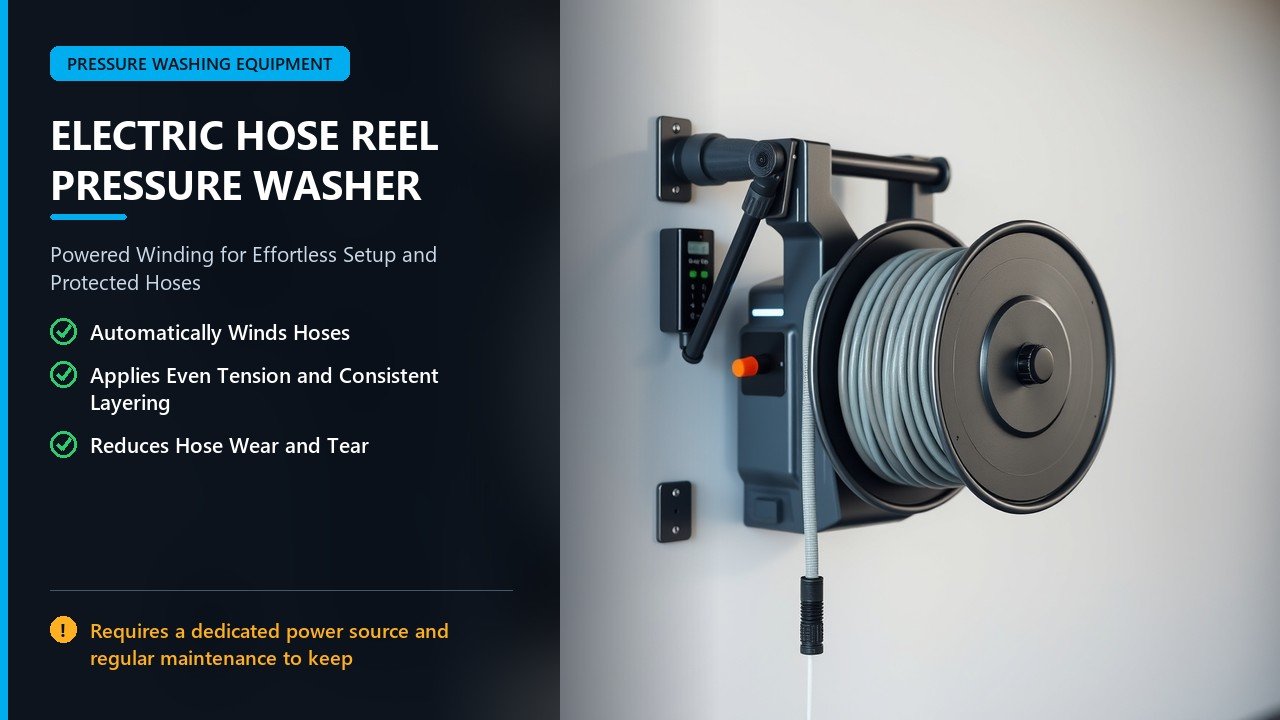
What Is an Electric Hose Reel?
An electric hose reel uses a motor to wind the hose automatically, replacing the hand crank found on manual reels. You press a button or switch, and the reel turns, layering the hose neatly onto the spool.
The comfort benefit is obvious, but the functional benefits run deeper. Powered winding applies even tension and consistent layering, which reduces the kinks, flat spots, and abrasion that shorten hose life.
How Powered Winding Works
The motor drives the spool through gears or a chain, turning the reel at a steady rate as you guide the hose onto it. Most systems let you control the speed or stop the motor as needed, and some include automatic layering that distributes the hose across the spool.
- Motor-driven spool winds the hose with little effort from the operator.
- Guided layering keeps coils even and prevents overlap that crushes the hose.
- Control options let you manage speed and stop when done.
Benefits of an Electric Reel
- Less physical effort, especially with heavy high-pressure hose.
- Time savings, since winding is fast and hands-free.
- Longer hose life, through even winding and reduced kinks.
- Better organization, keeping hose off the ground and off surfaces.
- Reduced injury risk from lifting and repetitive winding.
- Professional appearance on trailer and commercial rigs.
Manual vs Electric vs Industrial
| Type | Winding | Best For | Considerations |
|---|---|---|---|
| Manual hand crank | By hand | Occasional use, short hose | Tiring with long, heavy hose |
| Manual geared | Hand with reduction | Regular light use | Less effort, still manual |
| Electric powered | Motor driven | Frequent and commercial use | Needs power, higher cost |
| Hydraulic/air industrial | Powered, heavy duty | Fleets and industrial | Expensive, complex |
Electric reels occupy the sweet spot for serious home and light commercial use, offering powered convenience without industrial complexity.
Types of Powered Reels
- Motor-driven winding reels. The operator guides the hose while the motor winds it.
- Self-retracting reels. A spring or motor retracts the hose automatically, sometimes with a locking mechanism.
- Powered reels with auto-layering. Distribute hose evenly across the spool as it winds.
- Trailer and skid-mounted powered reels. Built into mobile commercial rigs.
Power Requirements
Electric reels need a power source, which is an important planning consideration.
- Voltage and draw vary by model, so check the electrical spec.
- Power source options include a nearby outlet, a machine-mounted supply, or a trailer’s electrical system.
- Weather protection matters for outdoor and mobile use.
- Wiring and connections must be safe and rated for the environment.
On mobile rigs, the reel often shares the trailer’s power, so confirm the electrical capacity.
Matching Capacity to Your Hose
| Hose Length and Diameter | Reel Size Needed | Notes |
|---|---|---|
| Short, thin hose | Small powered reel | Convenience, light duty |
| 100 ft, 3/8 inch | Medium powered reel | Most home and light commercial |
| 150-200 ft, 3/8 inch | Large powered reel | Big properties and commercial |
| Heavy or hot water hose | Heavy-duty powered reel | Extra strength and capacity |
Confirm the reel is rated for your exact hose length and diameter, since heavier hose takes more space and load.
The Swivel Still Matters
Even on a powered reel, the swivel is the critical component. It must handle full pressure and constant rotation without leaking.
- Pressure rating at or above your machine’s output.
- Temperature rating for hot water use.
- Machined brass or stainless construction.
- Replaceable seals for easy servicing.
- Live swivel capability to prevent hose twist.
Installation
- Mount on solid structure rated for the loaded reel and motor.
- Position for easy hose guidance and safe access.
- Connect the feed hose to the swivel inlet with quality fittings.
- Route electrical power safely, protected from moisture.
- Install a hose guide at the payout point.
- Test winding and pressure slowly before full use.
Maintenance
- Inspect the swivel and seals regularly and replace worn ones.
- Keep the motor and electrical parts dry and protected.
- Lubricate the winding mechanism per the manufacturer’s guidance.
- Check hose condition for kinks, abrasion, and bulges.
- Rinse and drain the hose after use.
- Winterize and store the whole system in freezing weather.
When Is It Worth It?
- You wind long, heavy hose regularly.
- You work alone and want to save effort and time.
- You run a business where job turnover and professionalism matter.
- You have mobile or trailer-mounted equipment.
- You want to protect an expensive hose through even winding.
Pros and Cons
Pros
- Saves effort and time.
- Protects hose through even winding.
- Improves organization and professionalism.
- Reduces physical strain and injury risk.
Cons
- Higher cost than manual reels.
- Needs power, adding a planning consideration.
- More components, so more potential failure points.
- Overkill for occasional, light use.
Frequently Asked Questions
What is an electric hose reel pressure washer setup?
It is a pressure washing system equipped with a motorized reel that winds the hose automatically, reducing effort and protecting the hose through even, consistent layering.
Are electric hose reels worth it?
For frequent users and those with long, heavy hose, yes. They save significant effort and time and extend hose life. For occasional light use, a manual reel is often sufficient.
Do electric hose reels need a power source?
Yes. They require electrical power from an outlet, machine supply, or trailer system, so plan the power source and protect the wiring from moisture.
Can an electric reel handle hot water?
Only if the reel, swivel, and seals are rated for the temperature. Check the temperature rating before using any powered reel on a hot water system.
How do I choose an electric hose reel?
Match the reel’s capacity to your hose length and diameter, choose a model with a quality serviceable swivel, confirm the power requirements, and pick the winding type that suits your work.
Final Thoughts
An electric hose reel pressure washer setup trades a bit of cost and complexity for real gains in effort, time, and hose life. Powered winding takes the burden out of coiling long, heavy hose and keeps your rig organized and professional, which is why it is standard equipment on many commercial trailers.
Match capacity to your hose, insist on a quality swivel, plan the power source, and maintain the motor and seals. If you wind hose often, an electric reel is a worthwhile upgrade. It saves your arms, protects your investment, and makes every job just a little easier.