A restaurant manager once spent an entire afternoon on a greasy commercial kitchen floor with a powerful cold-water pressure washer. The water blasted chunks of grime loose, but the stubborn layer of baked-on grease stayed put, smeared into a gray film that dried into a sticky mess. Then a cleaning contractor arrived with an electric hot pressure washer, ran 200-degree water across the same tiles, and the grease melted off in minutes like butter in a pan. Nothing about the pressure changed. The temperature did all the work. That is the entire case for hot water cleaning, and it is why electric hot washers have carved out a permanent place in kitchens, garages, and detail shops across the country.
Why Heat Changes Everything
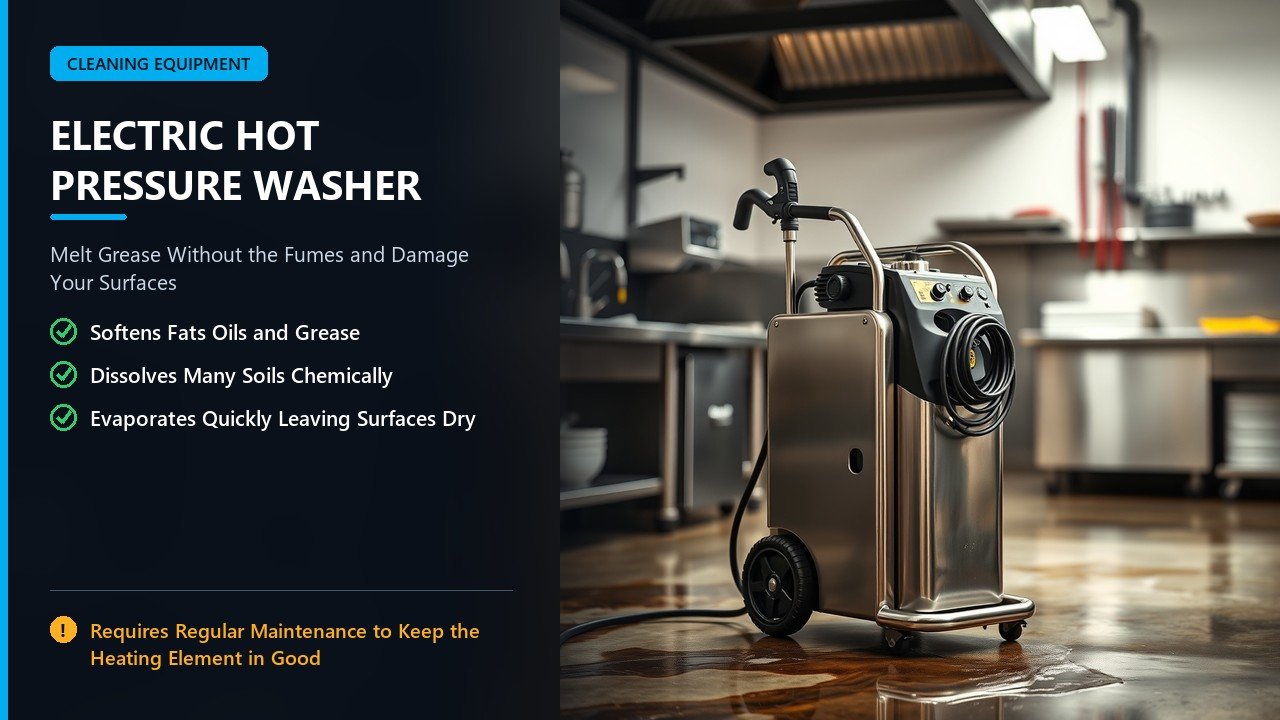
Water temperature is the quiet multiplier in pressure washing. Cold water relies almost entirely on mechanical force to break the bond between dirt and surface. Hot water does three things at once: it softens fats, oils, and grease; it dissolves many soils chemically; and it evaporates quickly, leaving surfaces nearly dry. The net effect is that hot water can clean thoroughly at lower pressure than cold water, which is gentler on surfaces and faster overall.
Industry studies have long shown that raising water temperature dramatically improves cleaning efficiency. Oil and grease that repel cold water flow away from hot water. That is why food-service regulations often call for hot-water cleaning and sanitizing. It is not marketing; it is chemistry.
How an Electric Hot Pressure Washer Actually Heats Water
Cold electric washers have no burner at all; they simply pressurize whatever temperature water you feed them. An electric hot pressure washer adds a heating system, usually an electric heating element or coil inside a heated chamber that raises the water as it flows through. Because there is no flame, there are no exhaust fumes, no diesel tank, and no propane line. That is the defining advantage of the electric design.
| Heat Source | How It Works | Best Fit |
|---|---|---|
| Electric heating element | Resistance coil heats water in a chamber | Indoor use, kitchens, detail bays |
| Diesel burner | Fuel burner heats a coil | Outdoor commercial, mobile rigs |
| Propane burner | Gas burner heats a coil | Outdoor use, remote sites |
| Natural gas burner | Building gas line fires the coil | Fixed commercial installations |
Electric heating has a real trade-off: it draws serious power. Most electric hot washers run on 240-volt circuits and pull substantial amperage, which is why they usually need a dedicated breaker. You gain an indoor-safe, fume-free machine and pay for it in electrical demand.
The Electrical Reality Nobody Mentions Enough
Before you buy any electric hot pressure washer, settle the power question. Heating water takes energy, and a 240-volt hot washer can draw 30, 40, or even 50 amps depending on its heating capacity. A household 120-volt outlet cannot support that. You need a properly sized, dedicated circuit, correct wiring gauge, and an outlet rated for the load.
| Voltage | Typical Use | What You Need |
|---|---|---|
| 120V | Cold water only, small units | Standard outlet, limited GPM |
| 240V | Hot water electric washers | Dedicated breaker, correct gauge wire |
| 240V / 3-phase | Large commercial hot units | Commercial service, electrician required |
Pressure, Flow, and Heat Working Together
An electric hot washer is only as effective as the balance of its three variables. Too much heat and too little flow means the water cools before it reaches the surface. Too little heat and you are back to cold-water cleaning with extra cost. A well-designed machine delivers a high enough flow rate to carry heat to the surface and enough pressure to lift the loosened soil.
Most electric hot washers fall in the moderate pressure range, often around 1,000 to 2,000 PSI, with flow in the 1.5 to 3 GPM range. That is plenty for grease, kitchens, vehicles, and equipment because heat does so much of the work. Do not assume you need 4,000 PSI. For greasy indoor work, 1,500 PSI with 200-degree water routinely outperforms 4,000 PSI of cold water.
Where Electric Hot Washers Win
Commercial kitchens and food service. Hoods, floors, drains, and equipment come clean with hot water and the right detergent, meeting sanitation expectations without exhaust fumes indoors.
Auto detailing. Hot water lifts traffic film, bugs, and grease from engines and wheel wells, and it speeds drying. Interior-safe when used carefully.
Fleet and shop floors. Oil and grease on concrete shop floors surrender to hot water far faster than to cold.
Hospitals and food plants. Fume-free operation and hot water for sanitation make electric the safe indoor choice.
Home garages. For serious home mechanics, an electric hot washer removes years of grime from engines and parts without a gas engine running in a closed space.
Where They Struggle
Electric hot washers are not the best choice for every job. They cost more than cold electric units and often more than diesel hot machines of similar output. Their power demand limits where they can go, since you need a capable outlet rather than just a garden hose. Many are stationary or require a generator to run on a truck. And on large outdoor concrete work, where hot water’s grease-cutting advantage matters less, a cold gas machine may be more cost-effective.
Be honest about your work. If your main job is stripping grease indoors or sanitizing, electric hot is outstanding. If your main job is washing a long driveway, a cold gas unit is more practical and cheaper to run.
Maintenance That Keeps the Heat Flowing
Hot water accelerates mineral scale. In hard-water areas, heating elements and coils build up scale that reduces efficiency and eventually blocks flow. Descaling with a mild acid solution on a regular schedule is important; how often depends on your water hardness and usage. Ignoring scale is the fastest way to kill the heating side of the machine.
Beyond descaling, follow the basics. Check the inlet filter often so debris never enters the pump. Keep the water level and quality consistent. Inspect seals and o-rings, since heat is hard on them; high-temperature rated seals are essential, and standard cold-water seals will fail early. In cold climates, winterize completely, because a heating chamber full of frozen water will crack.
A proper winterizing and maintenance routine protects both the pressure side and the heating side of the system.
Electric Hot vs Diesel Hot: A Quick Comparison
Diesel hot washers deliver more heat and power in a portable, fuel-driven package, ideal for mobile crews and outdoor work. They produce exhaust, need fuel, and cannot run indoors. Electric hot washers are fume-free, quieter, and indoor-safe, but tethered to a substantial power supply. The choice usually comes down to location: indoors leans electric, mobile and outdoors leans diesel. Many cleaning businesses own both and use each where it shines.
Common Mistakes to Avoid
Ignoring the electrical requirement. The single biggest cause of disappointment and danger. Verify the circuit before buying.
Skipping descaling. Scale quietly steals heat and flow until the machine underperforms or stops.
Using cold-water seals. Heat destroys them. Use high-temp rated components.
Running without flow. Like any pressure washer, a hot unit left deadheaded overheats and damages the pump and heater.
Expecting outdoor portability. Many electric hot units are not made to roam. Confirm the design matches your work.
Neglecting water quality. Hard water shortens heating component life. Filter and soften where possible.
Frequently Asked Questions
Do I really need hot water? For grease, oil, food residue, and sanitation, yes, it is transformative. For plain dirt and mud, cold water is often enough.
What voltage do electric hot pressure washers use? Most serious models use 240 volts and need a dedicated circuit. Small cold units use 120 volts, but they do not heat water.
Can I run one on a generator? Sometimes, if the generator is large enough to handle the starting and running draw. Matching generator capacity to the machine is essential.
How hot does the water get? Many electric hot units reach around 200 degrees F, hot enough to melt grease and sanitize.
Are they safe to use indoors? Yes, because they produce no combustion exhaust, which is their main advantage over fuel-fired hot washers.
Final Thoughts
An electric hot pressure washer is the right tool when heat, sanitation, and indoor safety matter more than raw pressure or outdoor mobility. It melts grease that cold water only smears, does it without fumes, and often cleans better at lower pressure. Buy it with your electrical service in mind, descale it on schedule, use high-temperature seals, and match it to jobs that reward heat. Do that, and you will clean faster, use less chemical, and get results that cold water simply cannot match.
Heat is the ingredient most pressure washers are missing. Add it with dependable hot water pressure washing equipment and watch the hardest cleaning tasks become routine.