A homeowner named Greg bought a replacement pressure washer hose online, waited a week for it to arrive, and then discovered it would not thread onto his spray gun. The listing had said M22, and so had his machine, but the two M22 parts refused to seal. What he did not know was that M22 comes in two internal sizes, and his machine and his new hose used different ones. A single missing millimeter cost him another week and taught him a lesson every pressure washer owner eventually learns: the high pressure water hose connector is not a trivial detail. It is the joint that decides whether your machine works or leaks.
The connector is the hardware that joins a high-pressure hose to the pump, the spray gun, the wand, and the nozzle. Get the connector right and everything flows, seals, and lasts. Get it wrong and you face leaks, lost pressure, or a fitting that blows apart under load. This guide breaks down the connector families, the sizes within them, the materials, the pressure ratings, and the practical steps for identifying and matching the fittings on your machine.
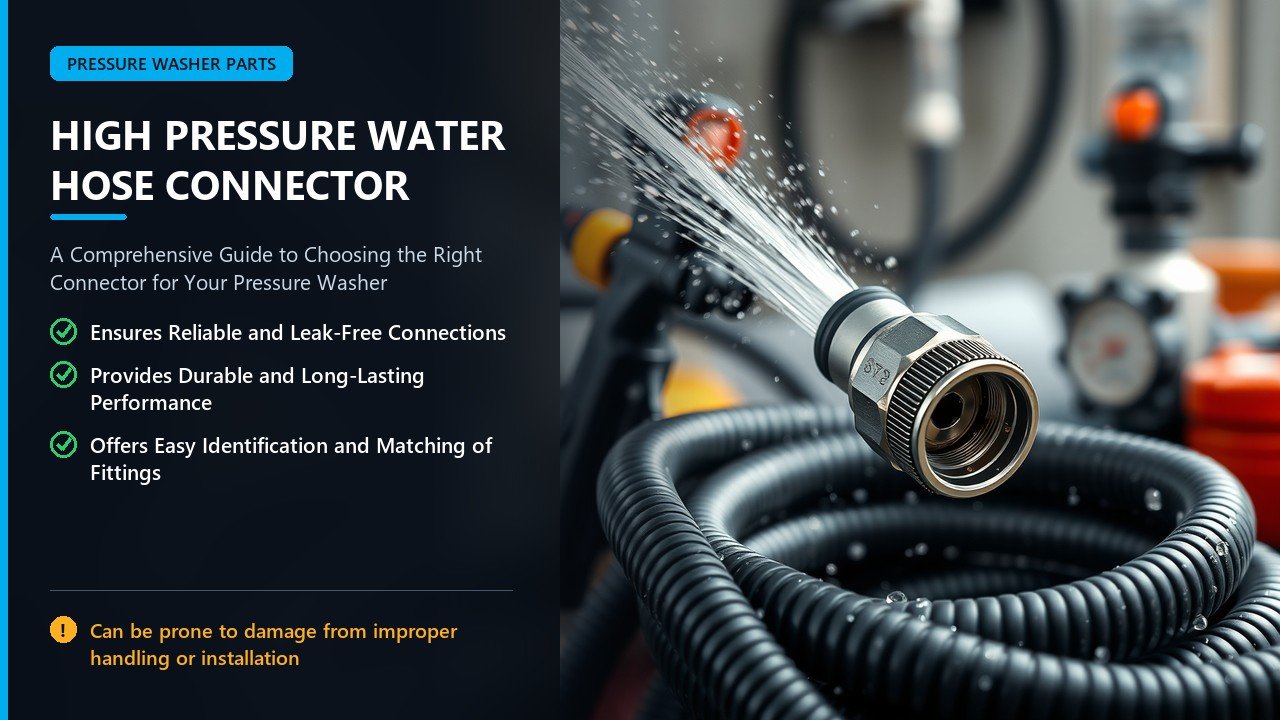
What a High Pressure Hose Connector Does
The connector is where the hose meets the rest of the system, and its job is demanding.
It joins pressurized components. A typical pressure washer has several connection points: the pump outlet, the hose’s machine end and gun end, the gun inlet, the wand inlet, and the nozzle. Each requires a connector that matches its mate exactly, sealing against hundreds or thousands of pounds of pressure.
It must seal and hold. Unlike a garden hose, a high-pressure line cannot tolerate a sloppy fit. A connector that threads only partway, or a quick-connect that clicks without truly locking, is not proof of a seal. Under pressure, a bad joint weeps, sprays, or fails outright.
It must match pressure and temperature. Every connector carries a pressure rating and often a temperature rating. A connector is only safe when its rating meets or exceeds the machine’s output. Using an underrated fitting is a common cause of coupling blowouts, which can turn a hose into a dangerous, whipping hazard.
It determines your convenience. Threaded fittings are secure but slow, while quick-connects trade a little pressure capacity for speed and convenience. Your choice of connector shapes not only how well the system seals but how quickly you can set up, swap accessories, and tear down.
The Main Connector Families
Understanding the major families is the foundation of getting the right part.
| Family | Typical Size | Common Use | Typical PSI Range |
|---|---|---|---|
| M22 threaded | 14mm or 15mm bore | Residential and prosumer machines | Up to 3,200 PSI |
| NPT pipe thread | 1/4, 3/8, 1/2 inch | Pump outlets, industrial systems | 3,000 to 6,000+ PSI |
| Quick connect | 1/4 or 3/8 inch | Hose, gun, and accessory swaps | 2,000 to 5,000 PSI |
| Garden hose thread | 3/4 inch | Water supply inlet | Low pressure supply |
M22 threaded fittings. M22 is the dominant standard on residential and light commercial pressure washers, with a 22mm outer diameter and a metric thread. The critical detail is the internal bore, which comes in 14mm and 15mm versions. They look nearly identical but will not seal against each other, so matching the bore is essential.
NPT pipe threads. NPT, or National Pipe Tapered, fittings are the standard for industrial machines and pump outlets. They seal by the taper wedging together as you tighten, with thread sealant filling any voids. Common sizes are 1/4, 3/8, and 1/2 inch, with 3/8 inch the workhorse of commercial hose connections.
Quick-connect couplers. Quick-connects use a plug and socket with a spring-loaded collar, allowing tool-free connection. The two common sizes are 1/4 inch and 3/8 inch, and they are not interchangeable. A common professional layout uses 3/8-inch quick-connects on the hose side and 1/4-inch on the wand and nozzle side.
Garden hose thread. On the supply side, machines connect to a standard garden hose via 3/4-inch garden hose thread. This is a low-pressure inlet connection and should never be confused with the high-pressure side fittings.
M22: The Two Bore Sizes That Fool Everyone
M22 threads cause more confusion than any other connector, and the reason is simple.
Same threads, different bores. M22-14 and M22-15 share the same M22 x 1.5 metric thread, so they screw together smoothly. But M22-14 has a 14mm internal bore and M22-15 has a 15mm bore, and the 1mm difference means the O-ring cannot seal. The fitting threads on, feels tight, and then leaks.
Where each appears. M22-14 is the standard on gas pressure washers and most electric machines. M22-15 appears on certain electric pressure washers and on hot water machines, which often use the larger bore for higher flow. When you buy a replacement hose or gun, confirm which bore your machine uses.
How to tell them apart. Because the threads look the same, you must measure the internal bore or check the manufacturer’s documentation. A digital caliper gives a clear answer, or you can compare against a known fitting. When in doubt, bring the original part to the store and match it directly.
The fix for a mismatch. If your machine is 15mm and your accessories are 14mm, a 15-to-14mm reducer bridges the difference. Keeping one on hand prevents the exact frustration that cost Greg a week of waiting.
NPT: The Industrial Standard
NPT fittings serve the higher-pressure end of the market and the pump connections on many machines.
Tapered threads that seal by wedging. Unlike M22, which seals at a face washer or O-ring, NPT threads seal along the threads themselves, the taper tightening as the joint is turned. This requires thread sealant, such as PTFE tape or a liquid sealant, to fill the spiral gap and complete the seal.
Common sizes and uses. A 1/4-inch NPT fitting often appears at the pump outlet on residential machines, while 3/8-inch NPT is standard for commercial hose connections and 1/2-inch for high-flow ports. Larger industrial systems may use 3/4 or 1 inch.
Watch the standards. NPT is the American standard, while BSP is the British equivalent. The two look similar but do not mesh: a 3/8-inch NPT male will bind after only a few turns in a 3/8-inch BSP female. Knowing which standard your machine uses prevents a frustrating mismatch.
Pressure ratings vary. Quality brass NPT fittings commonly rate to 3,000 or 4,000 PSI, while stainless steel can reach 6,000 PSI or more. Not every NPT fitting is rated for high pressure even if it physically fits, so check the rating rather than assuming. For extreme pressures, our guide to 7000 PSI pressure washers shows how demanding the top end becomes.
Quick-Connect Couplers Explained
Quick-connects are the modern convenience that makes pressure washing setups pleasant to live with.
Plug and socket. A quick-connect system has two halves: the plug, a male fitting, and the socket or coupler, a female fitting with a spring-loaded collar. Pushing the plug into the socket locks it; pulling the collar releases it. Inside the socket, an O-ring does the sealing.
Sizes are not universal. The two common sizes are 1/4 inch and 3/8 inch, and within a size, the coupler body diameter and locking geometry can vary between manufacturers. Cross-brand compatibility is unreliable, so match the brand or bring the original fitting to confirm a replacement.
Pressure ratings matter. Quick-connects typically rate between 2,000 and 5,000 PSI depending on size and material. An underrated coupler can blow its locking sleeve off under pressure, sending the hose whipping. Always exceed your machine’s output with margin, and prefer brass or stainless steel.
Where they belong. In a typical professional layout, 3/8-inch quick-connects join the high-pressure hose, while 1/4-inch connects serve the wand and nozzle end. Converting a threaded machine to quick-connects is one of the most popular upgrades an owner can make, as our guide to quick connects for a pressure washer explains.
Materials: Plastic, Brass, and Stainless Steel
The material of a connector determines how long it lasts and where it is safe to use.
| Material | Strengths | Weaknesses | Best For |
|---|---|---|---|
| Plastic | Cheap, lightweight, will not corrode | Fragile, low heat tolerance, cracks under load | Light cold-water use only |
| Brass | Durable, corrosion resistant, moderate cost | Heavier than plastic | Most cold-water applications |
| Stainless steel | Highest strength, heat and chemical resistant | Costs the most | Hot water, chemical, high pressure |
Plastic is a false economy on the high-pressure side. Cheap plastic fittings crack and burst under the loads a pressure washer generates, and many are not rated above 120 degrees Fahrenheit. They are acceptable for the low-pressure supply side at most, and never for hot water, where heat softens them further and causes sudden, dangerous failures.
Brass is the sensible default. It resists corrosion, holds up under pressure and weather, and costs only a little more than plastic. For most cold-water machines, brass is the right choice throughout.
Stainless steel is for the demanding jobs. When you run hot water, inject chemicals, or work in a marine or food-grade environment, stainless steel provides the strength and resistance those conditions require. It is the standard for high-pressure industrial and hot-water service.
O-rings and seals are part of the material story. Female fittings rely on rubber O-rings to seal, and these wear, crack, or fall out over time. They are the most common cause of a leak that appears out of nowhere, and replacing a cheap O-ring often restores a perfect seal. Keep spares on hand.
How to Identify Your Connector
Guessing wastes money and time, so identifying the connection is worth the effort.
Step one: shut off and release pressure. Turn off the machine and water supply, then squeeze the trigger to release residual pressure before loosening any fitting. Never work on a pressurized system.
Step two: classify the type. Determine whether each connection is threaded (M22 or NPT) or a quick-connect plug or socket. These require entirely different replacement parts, and confusing the two leads to a wrong order.
Step three: measure. Use a thread gauge or calipers to measure the outer diameter and, for M22, the internal bore. M22 measures 22mm across the outer threads but hides a 14mm or 15mm bore, while NPT sizes refer to nominal pipe size rather than the actual thread diameter.
Step four: check pressure and temperature ratings. Confirm that every part in the path can handle your machine’s pressure and water temperature. An adapter can make two shapes connect, but it cannot raise the rating of the components it joins.
Step five: compare against documentation or the original part. The most reliable method is to bring the original fitting to a knowledgeable supplier and match it physically. When a measurement does not clearly match a specification, stop and look up the exact model rather than forcing the closest fit.
Common Adapters and Their Uses
Adapters bridge the gaps between mismatched fittings, and a few are worth keeping in your kit.
M22 to quick-connect. The most popular conversion, turning a threaded machine or gun into a quick-connect system in a single step. This is what makes swapping hoses and accessories effortless.
M22 male to M22 male coupling. A straight coupling joins two female hose ends, which is how you connect two hoses to extend your reach without moving the machine.
M22 15mm to 14mm reducer. The specific fix for the bore mismatch between certain electric machines and standard accessories, saving you from a leaking joint.
NPT to quick-connect. Used to modernize industrial or commercial setups or to attach standard accessories to an NPT outlet.
Gun swivels. A swivel fitting between the gun and hose lets the hose rotate freely, reducing kinks and fatigue. It is a small, cheap addition that makes a noticeable difference on long jobs, and it pairs well with the hose advice in our guide to the best hose for pressure washing.
Troubleshooting Leaks and Poor Performance
When a connector misbehaves, the symptom points to the cause.
A leak at a joint usually means a bad seal or a mismatch. Check the O-ring or washer first, then confirm the bore and thread match. A worn O-ring is the most common culprit and the easiest fix.
Weak spray with no visible leak suggests a restriction. A kinked hose or an undersized quick-connect fitting can choke the flow, reducing performance without leaking a drop. Trace the path from pump to nozzle for anything undersized.
A quick-connect that pops apart usually has debris or a mismatched plug. Clean the socket, confirm the plug size, and make sure it is fully seated with the collar engaged. If it still releases under pressure, the coupler is likely underrated or worn.
Persistent leaks after tightening mean the seal is compromised. Replacing the fitting or the O-ring with a documented, same-system match is safer than forcing an adapter onto a mismatched connection, which merely relocates the leak risk.
Pressure and Flow: Why Connector Size Matters
A connector does more than join parts. It also affects how freely water moves and how safely the system holds together.
A small orifice restricts flow. The internal passage of a fitting must match or exceed the hose bore to preserve flow rate. A connector that is too small for the system becomes a bottleneck, dropping the flow and cleaning power even when every other part is correct. The rule is simple: never let the connector narrow the path anywhere in the system.
Undersized fittings rob cleaning power. When a fitting chokes flow, pressure rises behind it and the nozzle delivers less usable force. The machine works harder, the pump runs hotter, and the cleaning takes longer. Matching connector orifice to hose bore is a quiet but real performance factor.
Ratings protect against failure. A fitting rated below your machine’s pressure is a hazard waiting to happen. Under load, an underrated coupler can release its grip and turn a pressurized hose into a whipping line. Always choose fittings rated at or above your machine’s maximum pressure, with a little headroom for spikes and surges, because the moment of failure is often the most dangerous one.
The weakest link sets the limit. A system is only as strong as its lowest-rated component. Even one underrated fitting on a high-pressure line compromises the entire assembly. Check every connection from pump to nozzle and make sure each one can take the pressure, not just the hose and gun.
Building a Reliable Connection Kit
A small stock of spare fittings turns a stalled job into a five-minute fix.
Spare O-rings. O-rings are the cheapest and most frequently replaced seal. Buy a small assortment sized to your fittings, and you will solve the majority of sudden leaks instantly.
Quick-connect set. A quality brass or stainless quick-connect set for your machine and gun makes setup faster and reduces wear on threads. This is the upgrade most owners appreciate most, and it pairs with the ideas in our guide to quick connects for a pressure washer.
An M22 to quick-connect adapter. This single piece converts a threaded machine into a quick-connect system, and it is essential for anyone who wants to swap hoses and accessories easily.
A coupler and a reducer. A male-to-male coupler lets you join two hoses, and a 15-to-14mm reducer handles the M22 bore mismatch. Both are small, inexpensive, and prevent the exact problems that send people back to the store.
Thread sealant for NPT only. Keep a roll of PTFE tape or a tube of liquid sealant for NPT joints, but remember it belongs nowhere near M22 or quick-connect fittings.
A consistent system pays off. Once you settle on a standard, whether M22 threads or quick-connects, buy accessories that match so everything works together. Consistency reduces adapters, leaks, and the moment of doubt when a new part arrives. Our overview of pressure washer connector types helps you plan a coherent setup.
Frequently Asked Questions
What are the most common high pressure hose connectors? The most common are M22 threaded fittings, with 14mm and 15mm bores; NPT pipe threads in 1/4, 3/8, and 1/2 inch; and quick-connect couplers in 1/4 and 3/8 inch. Which one you need depends on your machine.
Is M22 the same as 3/8 inch? No. M22 is a metric threaded connection with a 22mm outer diameter, while 3/8-inch refers to a quick-connect or pipe thread size. They are different systems and need an adapter to connect.
What is the difference between M22 14mm and 15mm? Both use the same M22 thread, but the internal bore differs: 14mm on gas and most electric machines, 15mm on some electric and hot water machines. The threads fit but the seal fails, so match the bore using a caliper or the manufacturer’s spec.
Do I need thread sealant on pressure washer fittings? Only on NPT and other tapered pipe threads. M22 and quick-connect fittings seal with a washer, O-ring, or internal seal and should never have sealant applied to their threads.
Can I mix brass and stainless steel fittings? Yes. Brass and stainless steel join and seal reliably together. The concern with mixed metals is long-term galvanic corrosion in some environments, but for typical pressure washing use, mixing them is fine.
What pressure rating do I need for a hose connector? Match the connector’s rating to your machine’s output, with margin. A 3,000 PSI machine needs fittings rated at or above 3,000 PSI, and high-pressure machines call for stainless steel or heavy brass fittings rated accordingly.
Why does my quick connect keep leaking? The most likely causes are a worn or missing O-ring, debris in the socket, a mismatched plug size, or an underrated coupler. Inspect and clean the O-ring, confirm the size, and replace the coupler if it is rated below your machine’s pressure.
Can I use a garden hose fitting on a pressure washer? Only on the low-pressure supply inlet. Garden hose thread is a low-pressure connection and will not survive on the high-pressure side, where reinforced fittings are required. Never connect a garden hose between the pump and the gun.
How do I connect two high-pressure hoses together? Use a male-to-male coupling that matches your hose ends. Two M22 female hose ends join with a dual M22 male coupling, and two quick-connect hoses join with a matching coupler. Confirm the sizes match before connecting.
Final Thoughts on the High Pressure Water Hose Connector
The high pressure water hose connector is the unglamorous hardware that makes everything else work. A pressure washer is only as reliable as its connections, and a single mismatched or underrated fitting can turn a productive afternoon into a leaky, frustrating mess. By learning the families, the sizes within them, the materials, and the ratings, you gain the confidence to buy the right part the first time.
Greg learned the M22 lesson the hard way, but afterward he kept a note of every connection on his machine and a small box of spare O-rings and adapters. He never again waited a week for a part that did not fit. Do the same: identify your connections, respect the pressure ratings, use the right seal, and your high-pressure hose connector will do its quiet job for years, sealing perfectly and never giving you a reason to think about it, no matter how many jobs you run through the machine.