When it comes to commercial pressure washing, reliability is everything. Downtime costs money, and cheap engines don’t hold up to daily, all-day use. That’s why so many contractors choose a Honda industrial pressure washer. Honda engines are known for easy starting, fuel efficiency, long life, and worldwide parts availability — exactly what you need when the job can’t wait.
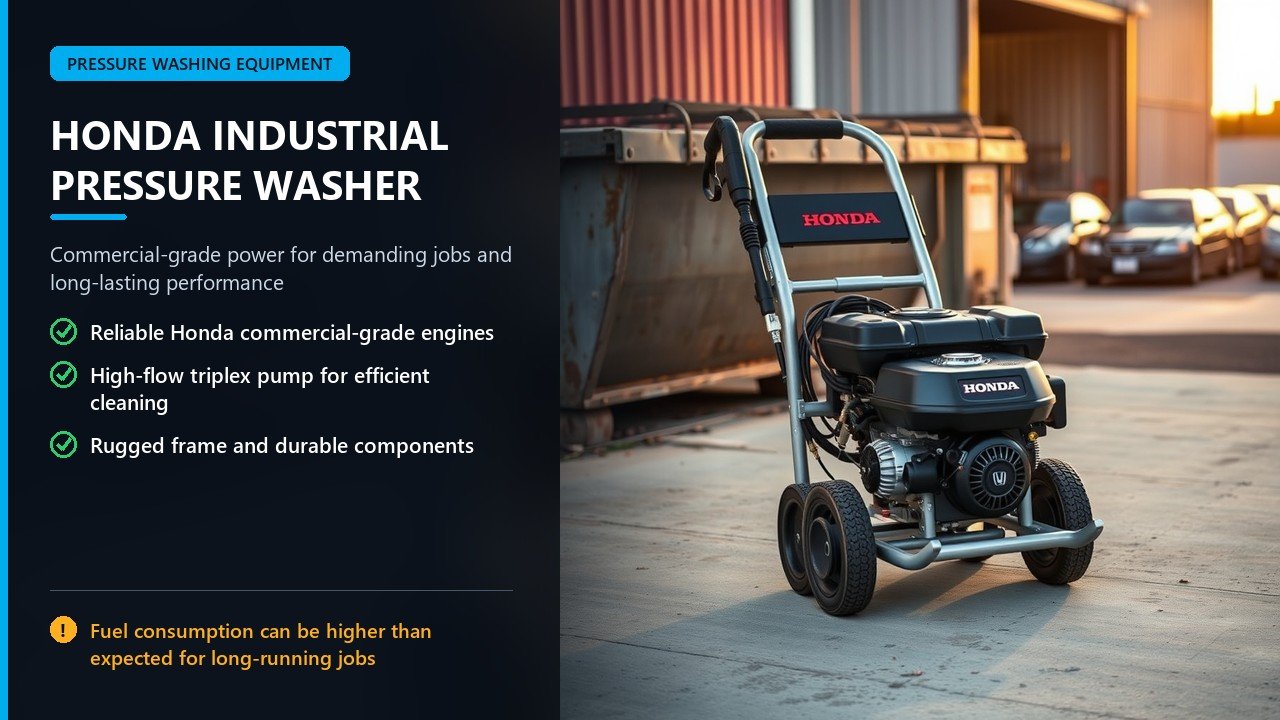
A Honda industrial pressure washer pairs a Honda commercial-grade engine (like the GX series) with a heavy-duty triplex pump, a rugged frame, and high-flow components. These rigs are built for fleet washing, parking lots, equipment cleaning, and other demanding commercial work. They’re designed to run for hours at a time and take the abuse of daily use.
This guide covers what makes Honda industrial pressure washers stand out, how to choose the right setup, key features, maintenance, and what to expect in terms of value.
Why Honda Engines for Industrial Pressure Washers?
Honda’s GX, GXR, and iGX commercial engines are built for continuous duty. They feature cast-iron cylinder sleeves, overhead valves, and robust carburetion/electronic options. They start reliably in hot or cold weather, run smooth, and sip fuel compared to many competitors. Parts are easy to find almost anywhere, which is critical when you’re on the road.
Honda also backs their commercial engines well, and many pressure washer manufacturers spec Honda engines for their top-tier industrial models for good reason: fewer headaches and longer service intervals.
What Defines an “Industrial” Setup?
An industrial rig isn’t just about PSI — it’s about flow, duty cycle, and build quality. Look for a triplex plunger pump (AR, General Pump, CAT), belt-drive or direct-drive designed for continuous use, heavy-gauge steel frame with vibration mounts, pneumatic wheels for mobility, and large-diameter hoses/fittings. Typical industrial setups run 4–15+ gpm at 3000–5000 PSI.
A true Honda industrial pressure washer will have a commercial-grade engine, not a residential model. Check the engine designation — GX commercial series is what you want for all-day work.
Choosing the Right GPM/PSI
Match to your jobs. For flatwork (parking lots, driveways), flow (GPM) is king. 6–8 gpm at 3000–3500 PSI is efficient for most contractors. For heavy equipment or grease, 4–6 gpm at 3500–4000 PSI works well. For large-scale municipal work, 10–15+ gpm is common. More flow = faster coverage with surface cleaners.
| GPM | PSI Range | Ideal Jobs |
|---|---|---|
| 4 – 5 | 3500 – 4000 | Equipment, trucks, grease |
| 6 – 8 | 3000 – 3500 | Concrete, parking, general contract work |
| 10 – 15+ | 2500 – 3500 | Large lots, industrial, municipal |
Key Features to Look For
Engine: Honda GX commercial series with electric start is ideal. Pump: Triplex plunger, rebuildable, with oil sight glass. Drive: Belt-drive runs cooler for all-day use. Frame: Powder-coated steel, low center of gravity. Mobility: 10–13″ pneumatic wheels, sturdy handles. Safety: Thermal relief valve, unloader with pressure adjustment, safety shutdowns. Accessories: High-pressure hose (50–100′), quick connects, spray gun/wand, surface cleaner compatibility.
Maintenance for Longevity
Change engine oil per Honda schedule (break-in + regular). Use Honda-recommended oil/filter. Keep air filter clean. Check pump oil level/change per pump mfr. Flush after detergents. Don’t run in bypass for hours — use thermal relief or shut down. Winterize with pump antifreeze in freezing temps. Replace nozzles when worn.
Value and ROI
A quality Honda industrial pressure washer runs $3,000–$8,000+ depending on size. Yes, more than no-name brands, but less downtime, easier repairs, and longer life usually pay off. For businesses, reliability directly impacts revenue. Parts availability alone is worth it when you’re stuck on a job.
Final Thoughts
A Honda industrial pressure washer is a workhorse built for professionals. Focus on matching GPM/PSI to your work, getting a solid triplex pump, and choosing a commercial Honda engine. With proper maintenance, it’ll deliver years of dependable service and keep you earning instead of wrenching.