For a mobile cleaning business, a trailer-mounted hot water pressure washer is a powerful workhorse, bringing high-pressure hot water to the job site. A hot water pressure washing trailer combines a hot water pressure washer, a water supply, and the equipment needed for mobile cleaning on a trailer, so a technician can drive to a location and clean without a fixed station. Hot water makes these setups especially valuable for degreasing and heavy cleaning. This guide explains the hot water pressure washing trailer, its components, benefits, setup, and what to consider when buying or building one.
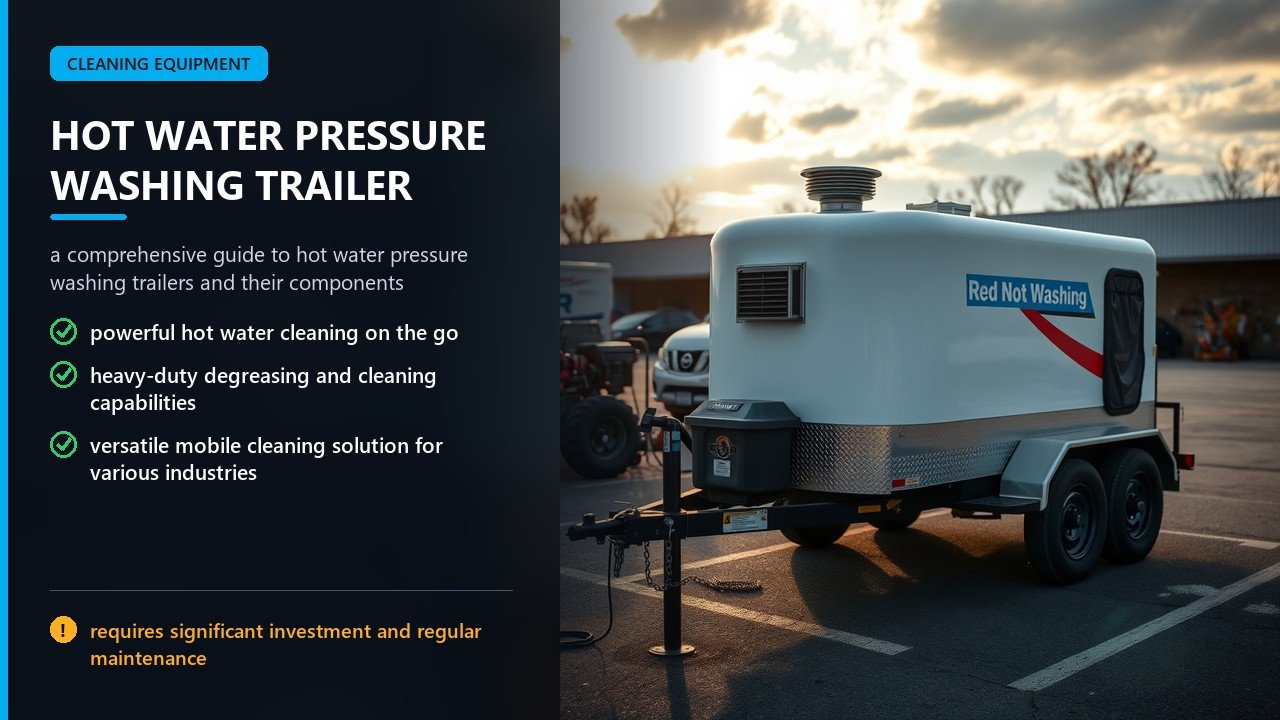
What a Hot Water Pressure Washing Trailer Is
A mobile hot water cleaning system.
A hot water pressure washing trailer is a trailer equipped with a hot water pressure washer and the supporting equipment for mobile cleaning. The trailer carries a hot water machine, which uses a pump to pressurize water and a burner to heat it, along with a water supply, often a tank, and hoses, reels, and sometimes a generator to power the setup. This lets a cleaning business bring hot water pressure washing to any location, from parking lots to job sites, without relying on a fixed water or power source.
These trailers range from simple setups with a machine and a tank to elaborate rigs with large tanks, generators, multiple reels, and surface cleaners, depending on the work. They are popular with mobile pressure washing businesses, fleet washing services, and contractors who need to clean at customer locations. By combining hot water with mobility, a trailer setup addresses the needs of mobile cleaning, providing the cleaning power of hot water wherever the work is.
Understanding what it is grounds the decision. Because it is a trailer-mounted hot water pressure washer with the equipment for mobile cleaning, it serves businesses that clean on site, and the hot water adds cleaning power. This makes it a complete mobile solution. With this understanding, the benefits and components become clear. Our guide to pressure washer components explains the parts of these setups.
Why Hot Water on a Trailer
Hot water plus mobility.
The combination of hot water and mobility is what makes these trailers valuable. Hot water cleans grease, oil, and grime far better than cold water, so a hot water trailer handles the tough soils that mobile cleaning often involves, from vehicle fleets to restaurant equipment, with less effort and fewer chemicals. Mobility lets you take that cleaning power to the customer, which is essential for a mobile business that cannot bring the work to a fixed station.
For a mobile cleaning business, a hot water trailer expands what you can offer and the jobs you can take, since you can handle degreasing, sanitizing, and heavy cleaning on site, not just light washing. This makes the trailer a business asset, enabling higher-value services and efficiency. So the combination of hot water cleaning and a mobile platform is the reason these trailers exist, and it suits businesses that clean tough soils at customer locations.
Hot water plus mobility is the core value. Because hot water cleans grease and grime far better than cold water, and because mobility lets you take it to the job, a hot water trailer suits mobile businesses that face tough soils. This makes the combination valuable for fleet, commercial, and industrial cleaning on site. With this value, the trailer can grow a cleaning business. Our guide to honda hot water pressure washer covers a popular hot water machine for these trailers.
Components of a Hot Water Pressure Washing Trailer
The setup has several parts.
A hot water pressure washing trailer typically includes the hot water pressure washer itself, with its pump and burner, and a water supply, which may be a tank carried on the trailer or a connection to the customer’s water. It includes hose reels for the high-pressure hose and often a water supply hose, along with a gun, wand, and nozzles, and frequently a surface cleaner for flat surfaces. A generator may be included to power the setup if the machine is electric or if power is needed for accessories.
Other components can include a chemical or detergent system, a water heater or burner fuel tank, storage for tools and supplies, and safety equipment. The trailer’s deck, tank, and equipment are arranged for efficient use, and the configuration depends on the business’s needs, from a compact single-machine rig to a large setup with capacity for long jobs. These components together create a self-contained mobile cleaning unit that can operate at a customer’s location.
The components make the trailer a complete system. Because the machine, water supply, reels, tools, and often a generator work together, the trailer is self-contained and ready for mobile work, and the configuration can be tailored to the business. This makes the components a key consideration. With the right components, the trailer handles the work efficiently. Our guide to pressure washer with trailer covers the setup in more detail.
| Component | Purpose |
|---|---|
| Hot water pressure washer | Provides pressurized hot water for cleaning |
| Water tank or supply | Provides water when none is available on site |
| Hose reels | Store and manage the high-pressure and supply hoses |
| Generator | Powers the setup when site power is unavailable |
| Surface cleaner and tools | Clean flat surfaces and handle various tasks |
This table lists the main components of a hot water pressure washing trailer and their purposes, from the machine and water supply to the reels, generator, and tools. Together, these parts make the trailer self-contained and capable of working on site. Understanding the components helps you plan or evaluate a trailer and ensure it has what your work requires. With the right components, the trailer is a complete mobile cleaning solution.
Water Supply and Tank
Water is often the limiting factor.
A mobile hot water pressure washing trailer needs a water supply, since many customer locations lack a suitable water source, and this usually means carrying a water tank on the trailer. Tank size determines how long the setup can run before refilling, so it should match the work: larger tanks allow longer jobs without refilling, while smaller tanks suit short jobs or locations with water access. The tank, along with a pump or the machine’s draw, supplies water to the pressure washer.
Some setups connect to the customer’s water when available, using a tank only when needed, and others rely entirely on the tank. Tank capacity, weight, and the availability of refill locations are important considerations, since water is heavy and running out mid-job is a problem. Planning the water supply, whether by sizing the tank to the work or arranging access to water, is essential for a mobile setup, and it is often the factor that limits how long the trailer can operate.
Water supply is critical for a mobile trailer. Because the setup needs water and many sites lack it, a tank sized to the work, or access to customer water, determines how long the trailer can run. This makes the water supply a key consideration. With adequate water, the trailer works efficiently on site. Our guide to water tank and pressure washer covers supplying water to these machines.
Power, Weight, and Trailer Considerations
Practical factors matter.
Power is another consideration, since the pressure washer may be gas or diesel engine driven, in which case it needs fuel, or electric, in which case it needs a power source, often a generator on the trailer. A generator adds weight and cost but makes the setup self-sufficient. The trailer’s total weight, including the machine, water, fuel, and equipment, must be within the tow vehicle’s capacity and the trailer’s rating, and weight distribution affects towing safety, so these factors must be planned.
The trailer itself should be sized and rated for the load, with a sturdy deck, proper tie-downs, and secure mounting for the equipment, and it should be roadworthy with lights, tires, and a hitch suited to the tow vehicle. Fuel storage, ventilation for the burner exhaust, and compliance with regulations for fuel and equipment matter. Considering power, weight, towing, and the trailer’s build ensures the setup is safe and practical, and these factors are as important as the cleaning equipment itself.
Practical factors determine a workable trailer. Because power, weight, towing capacity, and the trailer’s build and safety must be managed, and because these affect whether the setup is legal, safe, and effective, planning them is essential. This makes the trailer and its supporting factors a key part of the project. With these addressed, the trailer is practical and safe. Our guide to diesel high pressure washer covers machines that may power these trailers.
Applications
Where these trailers work.
Hot water pressure washing trailers serve mobile cleaning businesses in many settings. Fleet washing is a major application, where a trailer cleans trucks, vans, and equipment at a depot or site, and mobile detailing uses them for vehicle cleaning. Commercial cleaning of restaurant hoods, dumpster pads, and building exteriors suits the hot water capability, and industrial and construction cleaning of equipment and structures benefits from the power and mobility.
Because the trailer is self-contained and mobile, it can serve multiple locations, making it efficient for a business that cleans at various sites. The hot water handles grease and grime that would challenge a cold water setup, expanding the services the business can offer. Anywhere mobile cleaning faces tough soils and reliable power is needed, a hot water trailer proves its value, and it can be the backbone of a mobile pressure washing business.
Applications show the trailer’s reach. Because it brings hot water pressure washing to sites, it serves fleet washing, mobile detailing, and commercial and industrial cleaning, handling tough soils on location. This makes it a versatile asset for a mobile business. With the right trailer, a cleaning business can serve many customers efficiently. Our guide to pressure washer for mobile detailing covers a related mobile use.
Building Versus Buying
Two paths to a trailer setup.
You can buy a ready-made hot water pressure washing trailer or build one from components, and each path has merits. Buying a complete trailer means the setup is engineered and assembled as a unit, so it is ready to work, with matched components and, ideally, a warranty and support. This saves time and effort and ensures the parts work together, which suits a business that needs to start working quickly or prefers a turnkey solution.
Building a trailer lets you tailor it to your needs and budget, choosing the machine, tank, generator, and layout you want, and it can cost less if you source components carefully or already own some. The trade-off is the time and effort to design and assemble the setup, and the need to ensure the components and wiring, plumbing, and mounting are done correctly and safely. For a business with specific needs or do-it-yourself ability, building can be worthwhile, while buying suits those who want a proven, ready setup.
Building versus buying is a practical choice. Because a complete trailer is ready and engineered while a built one is customizable and potentially cheaper, the decision depends on your time, budget, and needs, and either can yield a good setup. This makes both paths valid. With the right approach, you get a trailer suited to your business. Our guide to pressure washer with trailer covers trailer-mounted setups.
Maintaining a Hot Water Trailer
Service keeps it working.
A hot water pressure washing trailer needs regular maintenance to stay reliable. Service the pressure washer per its schedule, including engine oil, air filter, and pump oil, and maintain the burner and heating coil, the fuel system, and the water pump and filters. Check the hoses, reels, gun, and nozzles for wear, and inspect the trailer itself, including tires, lights, hitch, and tie-downs, to keep it roadworthy and safe.
Protect the setup from freezing, since water in the pump, coil, and lines can freeze and cause damage, and winterize it if it is stored in the cold. Keep the trailer clean and the equipment secure, and address issues promptly to avoid breakdowns on the job. Because the trailer is a business asset that works hard, maintaining both the cleaning equipment and the trailer keeps it reliable, and it protects the investment. A well-maintained trailer serves a mobile business for years.
Maintenance protects the investment. Because the machine, burner, pump, and trailer each need service, and because freezing and neglect cause damage, regular maintenance keeps the trailer reliable and roadworthy. This makes maintenance a key part of owning a trailer setup. With proper care, the trailer performs consistently and lasts. Our guide to changing oil in pressure washer pump covers a key service task.
Costs and Business Considerations
Weigh the investment.
A hot water pressure washing trailer is a significant investment, with costs for the trailer, the hot water machine, the tank, a generator, and accessories, plus ongoing costs for fuel, water, maintenance, insurance, and the tow vehicle. These costs should be weighed against the revenue the trailer can generate by enabling mobile hot water cleaning services, which command higher value than basic washing. For a business, the trailer is a tool that expands services and reach, and the return depends on the work it enables.
Consider the market for mobile cleaning in your area, the services you can offer with hot water, and the efficiency gains of working on site, and compare the investment and operating costs with the potential revenue. Also consider regulations, insurance, and any licensing required for mobile cleaning and for fuel transport. Weighing the costs and the business opportunity helps you decide whether a hot water trailer is worthwhile, and how much to invest in the setup.
Costs and business fit shape the decision. Because a hot water trailer is a major investment with ongoing costs, and because its value lies in the mobile services it enables, weighing the costs against the business opportunity guides the choice. This makes the business case central. With the right assessment and a suitable trailer, the investment can pay off in a growing cleaning business. Our guide to pressure washer for mobile detailing covers a related service.
Frequently Asked Questions About Hot Water Pressure Washing Trailers
What is a hot water pressure washing trailer? It is a trailer-mounted setup combining a hot water pressure washer, a water supply often in a tank, hose reels, and often a generator, allowing mobile cleaning with hot water at customer locations.
Why use hot water on a trailer? Hot water cleans grease, oil, and grime far better than cold water, so a hot water trailer handles tough soils on site, expanding the services and value of a mobile cleaning business.
What components does the trailer include? A hot water pressure washer, a water tank or supply, hose reels, a gun, wand, and nozzles, often a surface cleaner and generator, and possibly a detergent system, arranged for efficient mobile use.
How big a water tank do I need? Size the tank to your work: larger tanks allow longer jobs without refilling, while smaller tanks suit short jobs or sites with water access. Water is heavy, so tank size also affects weight.
Do I need a generator? If the pressure washer or accessories need electric power and the site lacks it, a generator makes the setup self-sufficient. Engine-driven machines with diesel or gas power do not need a generator for the machine itself.
What tow vehicle do I need? A vehicle rated for the trailer’s total weight, including the machine, water, fuel, and equipment. Check the trailer’s weight rating and your vehicle’s towing capacity, and consider the load of a full water tank.
Final Verdict on Hot Water Pressure Washing Trailers
A hot water pressure washing trailer is a mobile setup combining a hot water pressure washer, a water supply, and the equipment needed to clean on site, bringing the cleaning power of hot water to any location. The combination of hot water and mobility makes it valuable for fleet, commercial, and industrial cleaning.
When choosing or building one, consider the machine’s pressure and flow, the water tank and supply, the power source and whether you need a generator, and the trailer’s weight, towing requirements, and build quality. With the right components and careful planning of water, power, and weight, a hot water pressure washing trailer becomes a self-contained, efficient cleaning system that can anchor and grow a mobile cleaning business.