If you have ever tried to move a large volume of water through a thin fitting, you know the problem. The water backs up, pressure builds behind the restriction, and the stream at the tip is weaker than the pump is capable of producing. This is exactly what happens when a high-flow pressure washer is strangled by undersized fittings. The 3/8 quick connect pressure washer setup exists to solve that. Where the common 1/4-inch quick connect suits nozzles and light accessories, the 3/8-inch size is built for flow, and for the hoses, wands, and machines that move serious water. This guide explains what 3/8 quick connects are, where they belong, and how to use them without choking or leaking your system.
Fitting size is one of the most overlooked parts of pressure washer performance. People obsess over PSI and GPM, then connect a high-flow machine to thin fittings and wonder why the result disappoints. The quick connect size matters, and 3/8-inch fittings are the answer for high-flow setups. Getting this right is the difference between a system that breathes and one that gasps, and it costs very little to fix once you know what to look for.
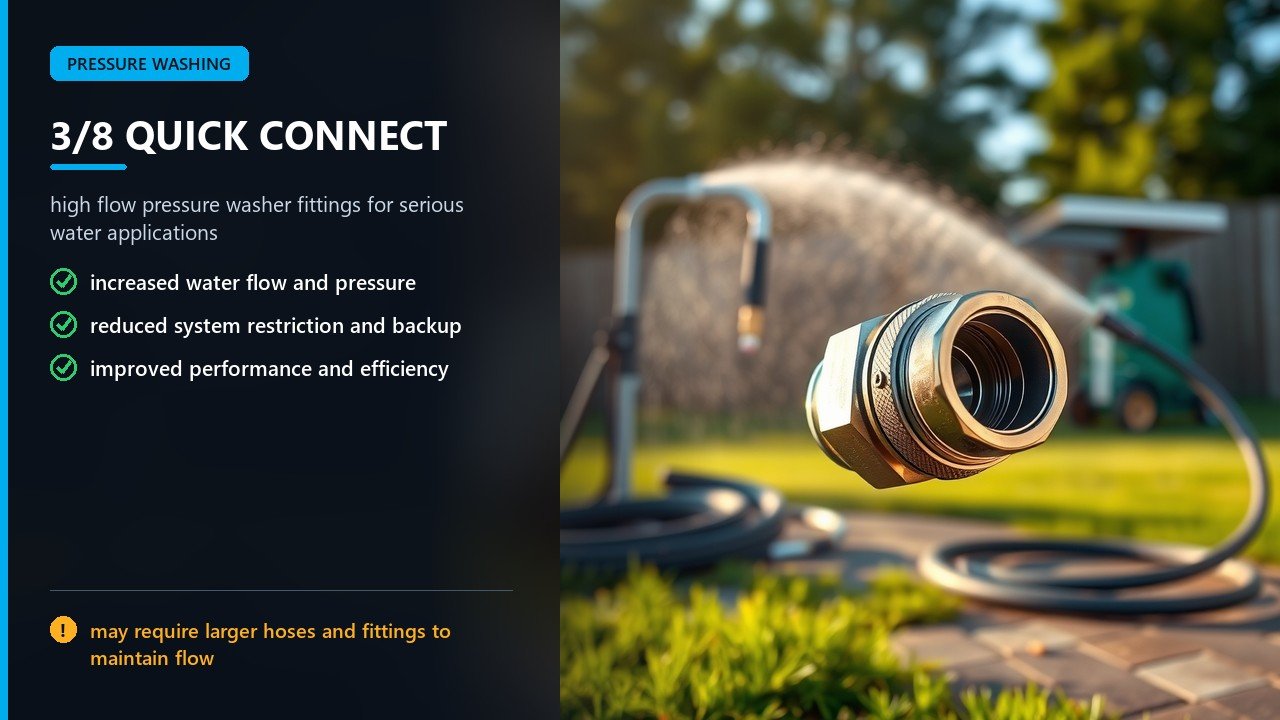
What a 3/8 Quick Connect Is
A 3/8 quick connect is a quick-coupling fitting sized for 3/8-inch connections, meaning its internal passage is larger than the 1/4-inch version. Like all quick connects, it has two halves: a plug and a socket. The plug slides into the socket, ball bearings lock it, and a spring-loaded collar releases it. The difference is scale: the 3/8 version passes noticeably more water.
This matters because fittings are channels. A narrow channel restricts flow, creating a bottleneck and dropping pressure across it. A wider channel lets water pass with less resistance. On a high-flow machine, undersized fittings are like a wide highway narrowing to one lane: everything backs up. On the same machine, 3/8-inch fittings keep the lane open and let the flow move freely.
The 3/8-inch quick connect is therefore the standard for the parts of a pressure washer that carry the most water: the high-pressure hose, the main wand, and the machine’s inlet and outlet. The 1/4-inch size typically handles the final step — the nozzle — where flow has already been shaped into a jet.
3/8 vs 1/4 Quick Connects
Both sizes have a place, and understanding the difference helps you use each correctly.
1/4-inch quick connects are the most common size on home pressure washers. They are standard for nozzle tips and light accessories. Their smaller passage is fine for a shaped nozzle jet, but it restricts flow, so it is a poor choice for a main hose on a high-flow machine.
3/8-inch quick connects are larger, with a bigger bore, and are standard on gas and professional machines. They connect high-pressure hoses, telescoping wands, guns, and pumps where flow is high. Their larger passage keeps the water moving with less pressure loss.
The practical rule is to match the fitting to the flow at that point in the system. Upstream, where the whole flow is present — pump outlet, hose, main gun — use 3/8. Downstream, at the nozzle where flow is shaped into a jet, 1/4 is normal. Mixing sizes requires adapters, and a 3/8-to-1/4 adapter at the right point lets the system step down smoothly near the tip.
| Attribute | 1/4-Inch Quick Connect | 3/8-Inch Quick Connect |
|---|---|---|
| Passage size | Smaller | Larger |
| Flow capacity | Moderate | High |
| Typical use | Nozzles, light tools | Hoses, wands, pumps |
| Common on | Home electric machines | Gas and pro machines |
| Pressure loss | Higher at high flow | Lower at high flow |
Where 3/8 Quick Connects Belong
The 3/8 size belongs wherever the full flow of the machine passes and restriction would hurt.
The high-pressure hose. The main hose carries the machine’s entire flow, so it is usually 3/8-inch inside diameter, and its end fittings are 3/8 quick connects. This is the most important place for the larger size.
The main wand. A full-length wand carries the full flow before the nozzle shapes it. The connection between the gun and the wand is often 3/8, so a 3/8 quick connect here keeps flow unrestricted.
Telescoping and long wands. Long wands add friction, and a larger bore reduces that loss. Telescoping wands commonly use 3/8 quick connects for this reason.
Guns. A high-flow gun has a 3/8 inlet where the hose attaches and often a 3/8 outlet to the wand.
Pump inlet and outlet. The machine’s high-pressure outlet carries the full flow, frequently through an M22 fitting that adapts to 3/8 quick connect.
Surface cleaners and high-flow accessories. A surface cleaner on a high-flow machine draws a large volume, so 3/8 connections keep it fed.
| Component | Typical Quick Connect | Reason |
|---|---|---|
| High-pressure hose | 3/8 | Carries full flow |
| Main / telescoping wand | 3/8 | High flow, less restriction |
| Gun inlet / outlet | 3/8 | Full flow connection |
| Pump outlet | M22 to 3/8 | Full flow at source |
| Nozzle tip | 1/4 | Shaped jet at the end |
Why 3/8 Fittings Improve Performance
Choosing 3/8 fittings where the flow is high delivers several concrete benefits.
Less pressure loss. A fitting with a larger bore creates less resistance, so more of your pump’s pressure survives to the work. This is especially important on long hoses and wands, where restriction compounds over distance.
More available flow. A high-flow pump paired with 3/8 fittings delivers its rated volume to the tip. Undersized fittings would throttle that flow and waste the machine’s capability.
Better performance on long runs. The longer the hose or wand, the more restriction matters. A 3/8 system maintains performance over distance that a 1/4 system would lose.
Cooler, happier pump. A restricted outlet means the pump works against resistance, which raises heat and wear. Wider fittings let the pump move water with less strain.
Proper match for high-flow machines. A gas machine flowing several gallons per minute needs 3/8 connections to breathe. Feeding it through narrow fittings is like running a marathon breathing through a straw.
How to Install 3/8 Quick Connects
Installing 3/8 quick connects is similar to installing any quick connect, with attention to the larger scale and the flow path.
Step 1 — Map your connections. Identify each joint: pump outlet, hose ends, gun inlet, wand socket, nozzle. Note which are threaded (usually M22) and which are already quick connect.
Step 2 — Choose the right adapters. For threaded ports, buy M22-to-3/8-quick-connect adapters of the correct thread size. For 1/4 joints you want to convert to 3/8, buy a 3/8-to-1/4 adapter.
Step 3 — Install with thread tape. Wrap male threads with thread seal tape and tighten firmly by hand plus a quarter turn. Do not overtighten.
Step 4 — Connect the components. Push plugs into sockets until they click. Confirm each is locked by giving a gentle tug.
Step 5 — Test the system. Turn on the water, then the machine, and check every joint for leaks before working. Fix drips by checking o-rings and thread tightness.
Step 6 — Step down at the nozzle. Use a 3/8-to-1/4 adapter at the wand tip if your nozzles are 1/4, so the flow necks down only at the final shaping point.
Understanding Flow Restriction
The whole case for 3/8 fittings rests on how restriction affects water flow, so it is worth understanding the mechanics.
Every fitting, hose, and wand is a channel for water. Anywhere the channel narrows, it restricts flow and drops pressure across that point. This is called pressure loss, and it grows with the amount of water being pushed through and with the narrowness of the channel. A thin fitting on a high-flow machine forces water through a bottleneck, and the pump must work harder while the tip receives less.
Pressure loss also grows with length. Over a long hose or a long wand, restriction compounds, so the effect of an undersized fitting is far worse over a hundred feet than over ten. A 3/8 system keeps the channel generous through the long run, so pressure loss stays low and the pump’s output reaches the work.
The final step, the nozzle, is where flow is intentionally shaped into a high-speed jet. That is the one place where a smaller passage is correct, because the jet needs to be concentrated. Everywhere before it, in the hose, gun, and wand, the goal is to keep the channel wide and restriction low. That is precisely what 3/8 quick connects are for.
3/8 Quick Connect Types and Configurations
Within the 3/8 family, there are several designs, each suited to a different job.
Push-to-connect (ball lock). The standard type, where you push the plug into the socket until a collar of ball bearings locks it, then pull the collar to release. Reliable and fast.
Threaded-base couplers. Quick connect sockets with a threaded base (such as M22) that screw onto a machine port, converting it to quick connect. These are the adapters that start a conversion.
Hose barbs and stub ends. Fittings that clamp or thread onto a hose and end in a quick connect plug, letting one side of the connection be a hose.
Valved couplers. Some couplers contain an internal valve that stops flow when disconnected, useful for systems where you want to prevent spills. Many pressure washer couplers are unvalved, since the machine is off during changes.
90-degree and angled adapters. These redirect the connection at an angle, useful for tight spaces or to stop a hose from kinking at the gun.
| Configuration | Function | Best Use |
|---|---|---|
| Push-to-connect coupler | Standard plug-and-socket joint | General 3/8 connections |
| Threaded-base coupler | Converts a port to quick connect | Machine and gun adaptation |
| Hose barb plug | Attaches a hose to a quick connect | Hose ends |
| Angled adapter | Redirects the joint | Tight spaces, anti-kink |
Choosing Quality 3/8 Fittings
Because 3/8 fittings sit in the high-flow, high-pressure part of the system, quality matters even more than for nozzles.
Material. Brass and stainless steel are the right choices. Brass seals well and resists corrosion; stainless is tougher and ideal for heavy or marine use. Avoid plated zinc, which corrodes and fails under high pressure.
Pressure rating. Buy fittings rated at or above your machine’s maximum output. High-flow gas machines produce strong pressure, and an under-rated fitting can fail dangerously.
Bore size. Confirm the coupler’s internal bore is appreciably larger than the 1/4 version. A “3/8” body with a narrow internal passage defeats the purpose.
O-rings. Look for quality Buna-N or silicone o-rings, and make sure replacements are available in the same size.
Locking mechanism. A well-made coupler locks firmly with no wobble. Loose fittings leak and can pop off under pressure.
Building a Complete 3/8 System
A well-planned 3/8 system has a clear flow path from pump to nozzle, wide until the final step.
Pump outlet. An M22 threaded port converts to 3/8 quick connect with an adapter. Water leaves the pump into a wide channel immediately.
High-pressure hose. A 3/8 hose carries the full flow. Its quick connect plug clicks into the pump adapter, and its other end plugs into the gun.
Gun. A gun with a 3/8 inlet receives the hose, and its 3/8 outlet feeds the wand.
Wand. A 3/8 wand carries the flow forward. For high reach, a 3/8 telescoping wand keeps the channel wide over its long length.
Nozzle step-down. At the wand tip, a 3/8-to-1/4 adapter necks the flow down to standard 1/4 nozzles, shaping the jet at the last possible moment.
Accessories. Foam cannons, surface cleaners, and turbo nozzles plug in at the gun or tip, using adapters where needed.
Maintaining 3/8 Quick Connects
Heavy-duty fittings still need care to stay leak-free and easy to use.
Check o-rings. The larger 3/8 o-rings are critical seals. Replace any that look flattened, cracked, or hardened, and keep spares of the correct size.
Keep them clean. Grit in a 3/8 collar can stop it locking. Rinse the fittings after use and wipe away debris.
Confirm locking. After connecting, tug gently to confirm the plug is locked. This quick habit prevents pop-offs under pressure.
Do not force. If a plug will not seat, clean the parts rather than forcing them, which damages the bearings.
Store dry. Drain and dry the fittings after use, especially in freezing weather, to prevent corrosion and cracked seals.
When 3/8 Is Overkill
The 3/8 size is not always the right answer. On a small electric machine, big fittings can be overkill or even awkward.
Small electric machines. A light electric pressure washer flowing under three gallons per minute does not need a 3/8 system. Its factory 1/4 or M22 connections are proportionate, and adding heavy 3/8 fittings mostly adds bulk and weight.
Short runs. Restriction compounds over length, so on a short hose and wand, the difference between 1/4 and 3/8 is small. A short, light setup is often better served by 1/4 fittings.
Nozzle connections. The nozzle is where flow is shaped into a jet, so 1/4 is correct there regardless of the rest of the system. Do not force 3/8 onto nozzles.
The key is to match the fitting size to the flow. If your machine flows modestly and your runs are short, 1/4 fittings are appropriate. If you have a high-flow gas machine driving long hoses and wands, 3/8 is the right tool. Buying oversized fittings for an undersized machine adds cost and bulk without benefit.
The Hose Matters Too
Fittings and hose work together, and a 3/8 fitting on a thin hose is only half the equation.
The hose’s internal diameter, not just the fitting size, determines flow. A 3/8-inch high-pressure hose has a larger internal bore than a 1/4-inch hose, and it must match the fittings to realize the benefit. A 3/8 fitting on a 1/4 hose still restricts the flow at the hose itself, so the fitting upgrade is wasted.
This is why a complete high-flow setup uses a 3/8 hose with 3/8 quick connect ends. The whole path — fitting, hose, fitting — stays wide, and the water moves freely from pump to gun. If you upgrade the fittings but keep a thin hose, you have widened the door but kept the hallway narrow.
Non-marking and wire-braid hoses are common in 3/8 sizes. A wire-braided 3/8 hose handles high pressure without expanding, while a non-marking cover protects surfaces it drags across. For high-reach and heavy-duty work, a good 3/8 hose is as important as the fittings on each end.
Common Mistakes to Avoid
Using 1/4 fittings on a high-flow machine. This chokes the flow and wastes the pump’s capability. Use 3/8 for hoses and main connections.
Stepping down too early. Dropping to 1/4 in the middle of the run restricts flow for the rest of the path. Step down at the nozzle, not before.
Buying the wrong thread size. M22 14mm and 15mm differ. Confirm your machine’s size before buying adapters.
Mixing cheap and quality fittings. A cheap plug in a quality socket can leak or pop off. Keep quality throughout.
Ignoring o-rings. Worn o-rings cause drips. Check and replace them regularly.
Overtightening adapters. Too much torque cracks fittings. Snug plus a quarter turn is enough.
Forcing a connection. If a plug will not seat, clean it rather than forcing it, which damages the bearings.
Frequently Asked Questions
Do I need 3/8 quick connects on a home pressure washer? If your machine is a high-flow gas unit, yes for hoses and main connections. A small electric machine with a 1/4 system may work fine as-is.
What is the difference between 1/4 and 3/8 quick connects? Primarily the internal passage size. The 3/8 version moves more water with less restriction, so it suits high-flow parts of the system.
Can I use a 3/8 quick connect on a nozzle? You can with an adapter, but nozzles are usually 1/4, which is fine because the jet is already shaped. Step down to 1/4 at the tip.
Will 3/8 fittings increase my pressure? They do not create pressure, but they reduce loss, so more of your pump’s pressure reaches the work. The benefit is most noticeable on high-flow and long-run systems.
Are 3/8 quick connects universal? Quick connects are largely cross-compatible by size, but thread adapters vary and cheap parts may fit poorly. Match the size and buy quality.
What thread size do 3/8 quick connect adapters use? Adapters commonly convert M22 threads to 3/8 quick connect. Match the M22 size to your machine, whether 14mm or 15mm.
Can I mix 3/8 and 1/4 in one system? Yes, with adapters. Keep the run wide (3/8) through the hose and wand, then step down to 1/4 at the nozzle.
How do I know which size my pressure washer uses? Check the hose and gun connections. High-flow gas machines typically use 3/8 and M22 fittings, while light electric units often use 1/4 or smaller. Confirm before buying adapters.
Do 3/8 quick connects fit a 1/4 wand? Not directly. You need a 3/8-to-1/4 adapter to bridge the two sizes, ideally placed near the nozzle so the flow stays wide through the run.
Should I convert my whole machine to 3/8? Only if it is a high-flow machine that benefits. A small electric unit does not need it, and the extra weight and cost bring little gain on short, low-flow setups.
What is the advantage of a 3/8 system over stock fittings? A 3/8 system reduces pressure loss and lets a high-flow pump deliver its rated volume to the work, which matters most on gas machines and long hose runs.
Final Thoughts
A 3/8 quick connect pressure washer setup is about letting your machine breathe. Where the full flow of the pump passes — the hose, the gun, the wand, the pump outlet — the larger 3/8 passage moves water with less restriction and preserves more of your pressure. Where the flow is shaped into a jet — the nozzle — the smaller 1/4 size is perfectly appropriate. Keeping that principle in mind makes every fitting choice simple: stay wide until the very end, then step down only at the tip where the jet is formed.
The best systems keep the run wide through the hose and wand and step down to 1/4 only at the tip. Match your adapters to the right M22 thread size, use quality brass or stainless fittings, add thread tape to threaded joints, and keep spare o-rings handy. Do all that, and your high-flow machine will deliver the performance it was built for, not the reduced performance that undersized fittings would impose. Keep the high-flow path wide and open, step down late, and every job becomes faster, cleaner, and more consistent.