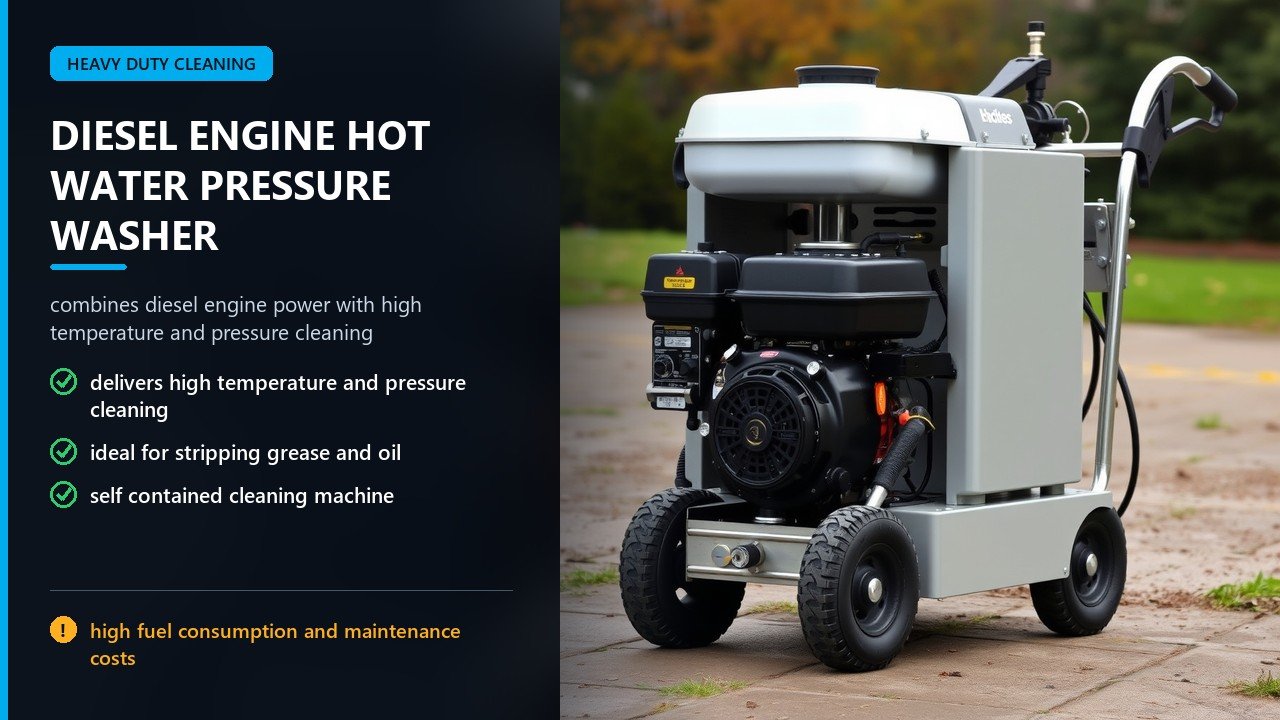
A diesel engine hot water pressure washer is the machine that cleaning professionals reach for when a cold water unit simply cannot do the job. It pairs a heavy duty diesel engine with a pump and a burner that heats the water, so it can deliver both high pressure and high temperature at the same time, in a package that can run all day on a job site without an electrical supply. This combination makes it ideal for stripping grease, oil, and grime that cold water only pushes around, from commercial kitchens and vehicle fleets to construction equipment and industrial floors. This guide explains how these machines work, what separates a good one from a poor one, how to choose the right size for your work, and how to keep it running reliably for years of demanding service.
What a Diesel Engine Hot Water Pressure Washer Is
Before comparing models, it helps to understand exactly what these machines are and what sets them apart from simpler pressure washers.
A diesel engine, a pump, and a burner. A diesel engine hot water pressure washer is a self contained cleaning machine built around three core systems. The diesel engine provides the power, driving both the high pressure pump and, on most models, the burner’s fuel pump and fan. The pump pressurises the water and pushes it through a high pressure hose to the operator. The burner, usually a diesel fired coil, heats the water as it passes through on its way to the nozzle, so the operator gets hot water at full pressure. Because the engine, pump, and burner are integrated into one unit, the machine is self sufficient: it needs only water and diesel to run, which makes it ideal for sites with no mains electricity. This combination of power and heat is what distinguishes it from a cold water pressure washer, and it is the reason these machines are found wherever grease, oil, and heavy grime must be removed quickly and thoroughly.
Where these machines are used. The combination of diesel power and hot water suits a wide range of demanding jobs. Cleaning fleets of vehicles, trucks, and heavy equipment is a classic use, because hot water cuts through road film, oil, and grease far faster than cold. Commercial kitchens, food processing plants, and restaurants rely on hot water to strip baked on grease from floors, extraction hoods, and equipment. Construction and agricultural machinery, workshop floors, bins, and industrial plant all benefit from the combination of high pressure and heat. Many of these jobs take place on sites without a convenient power supply, which is why the diesel engine matters: it allows the machine to work anywhere a water supply and fuel can be brought. For contractors and businesses that clean for a living, a diesel engine hot water pressure washer is often the machine that decides how quickly a job can be finished and how well the result holds up.
Diesel Engine and Hot Water Working Together
The real advantage of this design is how the engine and the hot water function reinforce each other on a working job.
Diesel torque and constant load. A diesel engine is well suited to driving a pressure washer because it produces strong torque at low speed and runs happily under a constant, heavy load for long periods. Unlike a petrol engine, which tends to be lighter and rev harder, a diesel engine delivers its power in a steady, unhurried way that suits the continuous demands of a pump pushing water at high pressure all day. This matters because a pressure washer works its engine hard whenever the trigger is open, and a diesel engine handles that relentless load with less stress and better fuel economy. The result is a machine that can run for hours without complaint, pulling water from a tank, pressurising it, and feeding a burner simultaneously. For anyone who cleans for a living, this durability under load is one of the strongest arguments for choosing a diesel powered machine over a petrol one.
Hot water lifting grease and grime. Heat transforms the way water cleans. Cold water relies almost entirely on pressure to blast dirt away, which works on loose material but struggles with grease, oil, and baked on residue that cling to surfaces. Hot water, by contrast, softens and dissolves fats and oils so that the pressure can lift them away far more easily, often allowing the operator to use less aggressive nozzles and lower pressure on delicate surfaces. Many cleaning chemicals also work far better in hot water, so the combination of heat and detergent can cut cleaning time dramatically. On a diesel engine hot water pressure washer, the burner raises the water to a working temperature that makes this possible, and the diesel engine ensures the heat is available whenever the machine runs. Together, power and heat turn a difficult job into a manageable one. For a business, that difference translates directly into time saved on every job and into the ability to take on work that would otherwise be turned away. When the engine and the water heater are well matched, the operator simply opens the trigger and gets both power and heat, which is exactly what makes these machines so productive in professional hands.
Heat Sources and Burner Types
Not every hot water machine heats the same way, and the choice of heat source affects running cost, convenience, and performance.
| Heat Source | Strengths | Considerations |
|---|---|---|
| Diesel burner | Strong heat, works off grid | Needs fuel and exhaust care |
| Petrol or gas burner | Cheaper fuel, easy to find | Lower heat, higher consumption |
| Electric heater | Clean, quiet, no fuel | Needs large power supply |
| Exhaust heat exchanger | Uses waste engine heat | Warm rather than hot water |
Diesel burner versus other heat sources. The diesel burner is the most common heat source on a diesel engine hot water pressure washer, and for good reason. It produces a strong, controllable flame that heats the water quickly and reaches the high temperatures that make the machine effective on grease. Because it burns the same diesel that feeds the engine on many machines, it keeps the machine independent of mains gas or electricity, so it can work anywhere. Petrol and gas burners can be cheaper to fuel in some regions, but they tend to produce less heat for the same effort and may need more careful handling. Electric heaters are clean and quiet but demand a large electrical supply that most mobile machines cannot provide. The diesel burner remains the workhorse choice, offering a strong balance of heat, independence, and practicality for professional cleaning. The burner’s reliability and the ease of its controls matter just as much as its raw output, because a machine that heats well but is awkward to run will soon frustrate the operator who depends on it every day.
Temperature rise and the coil. What matters on any hot water machine is not just the maximum temperature but the temperature rise the burner can achieve at the flow the machine produces. Water passes through a coiled tube inside the burner, where it is heated by the flame, and the size and design of that coil, together with the burner’s heat output, determine how hot the water can get at a given flow rate. A machine with a large heat input and a well designed coil can maintain high temperatures even at full flow, while a weaker burner may only reach useful heat at reduced flow. The coil must also be made from material suited to pressure and heat, and it must be kept clean internally to transfer heat efficiently. Understanding temperature rise helps buyers compare machines honestly, because a high maximum temperature figure means little if the machine cannot sustain heat while working at full pressure.
Pressure, Flow, and Cleaning Power
The cleaning ability of a hot water machine comes from the combination of pressure, flow, and heat, so all three deserve attention.
Reading the numbers together. Pressure, measured in PSI or bar, is the force of the jet, while flow, measured in litres or gallons per minute, is the volume of water delivered. Cleaning power depends on both: too little pressure and the water cannot dislodge dirt, while too little flow means the jet lacks the volume to carry dirt away and to cover ground quickly. Multiplying pressure by flow gives a useful measure of cleaning power, sometimes called cleaning units, which lets you compare machines fairly. Hot water adds a further dimension, because heat reduces the pressure needed to shift grease, so a hot water machine can sometimes out clean a more powerful cold water one. A diesel engine hot water pressure washer typically balances these factors for professional work, delivering high pressure, strong flow, and reliable heat together, and the buyer should read all these numbers together rather than fixating on any single figure.
Matching nozzles and surface cleaners. The nozzle at the end of the wand shapes the jet, and choosing the right one is essential to getting the best from the machine. A focused jet concentrates pressure for stubborn spots, while a wider fan spreads the force for faster coverage of large areas. On surfaces such as car parks, driveways, and warehouse floors, a rotary surface cleaner attachment uses the machine’s flow to clean flat areas quickly and evenly, but it must be sized to the machine’s flow, since an oversized cleaner will move too slowly and leave trails. The gun, wand, hose, and nozzle must all be rated for the pressure and flow the machine produces, and any weak component in that chain will restrict performance or fail under load. Matching the whole system to the work is what turns raw pressure and heat into efficient, consistent cleaning. It is also worth checking that the hose and fittings are rated for both the pressure and the temperature, because a component that is fine with cold water may soften or fail under heat, so the whole chain from pump to nozzle should be chosen for hot water duty.
Fuel, Tank, and Runtime
Because these machines run on diesel, fuel capacity and consumption have a direct effect on how long they can work without stopping.
Diesel consumption and tank size. A diesel engine hot water pressure washer consumes fuel both to run the engine and to fire the burner, so its fuel tank and consumption determine its runtime. Larger machines with high flow and strong heat burn more fuel per hour, while smaller units sip it. Tank size, therefore, should match the length of a typical working day or job, so that the machine does not run dry in the middle of a task. Many machines offer a combined fuel tank or separate tanks for engine and burner, and some allow the burner to draw from the same supply to simplify refuelling. Estimating fuel use from the engine’s rated consumption plus the burner’s burn rate lets an operator plan refuelling intervals and avoid downtime. For a busy contractor, a tank sized for a full shift is a practical necessity rather than a luxury. A machine that can work a full shift on one tank keeps the operator productive and the customer happy, while one that needs constant refuelling disrupts the schedule and wastes fuel in the process.
Cold weather and fuel quality. Diesel fuel behaves differently in cold weather, and this matters for machines that work outdoors in winter. In low temperatures, diesel can thicken or form wax crystals that clog filters and fuel lines, starving the engine or burner. Operators in cold climates often use winter grade diesel or add a suitable anti gelling treatment, and they keep fuel filters clean and water free. Water in the fuel is another common problem, because condensation forms inside partly filled tanks as temperatures swing, and it can damage the injection system and the burner. Draining water traps and keeping the tank reasonably full reduce this risk. Good fuel hygiene, including clean fuel, clean filters, and full tanks, keeps a diesel engine hot water pressure washer starting and running reliably whatever the weather. Small spare parts such as fuel filters and a spare nozzle are worth carrying, so that a minor problem does not bring a paying job to a halt in the middle of a cold morning far from the workshop.
The Pump and Drive Systems
The pump is the heart of a pressure washer, and the way it is driven affects performance, maintenance, and lifespan.
Pump types and ratings. Most professional machines use either a triplex plunger pump, which has three pistons and is known for durability and smooth output, or an axial pump, which is more compact and cheaper but less suited to constant heavy duty. The pump must be rated for the pressure and flow the machine delivers and, on a hot water unit, for the temperature of the water passing through it, since not all pumps tolerate heat. Pump materials matter too: ceramic plungers, stainless valves, and quality seals last longer and resist wear. The pump oil should be changed on schedule, and the correct grade is essential, because the wrong oil or neglected oil leads to premature failure of the very part that does the hardest work. A well chosen, well maintained pump is the foundation on which the machine’s reliability rests. Regular oil changes and careful attention to the pump, together with the correct grade of oil, are the simplest and cheapest way to protect the most expensive part of the machine from the wear that constant high pressure working causes.
Belt drive versus direct drive. The pump can be connected to the engine directly, through a direct drive coupling, or indirectly through a belt drive. Direct drive is compact, efficient, and inexpensive, and it suits many machines, but it spins the pump at engine speed and transmits engine vibration and heat to the pump. Belt drive isolates the pump from the engine, allows the pump to run at a slower, more forgiving speed, and makes it easier to service or replace the pump. Many heavy duty diesel engine hot water pressure washers use belt drive for exactly these reasons, accepting the slightly higher cost and the need to check belt tension in exchange for longer pump life and easier maintenance. The right choice depends on the duty the machine will see, but belt drive is common on machines built for continuous professional work. Whichever drive is chosen, the alignment and tension of the drive must be kept correct, and a worn belt or coupling should be replaced promptly to avoid damage to the pump or the engine.
Hot Water Safety and Temperature Control
Hot water under pressure demands care, and the machine should be designed and operated with safety in mind.
Safe operating temperatures. Hot water machines are capable of temperatures that can scald a person very quickly, so the operator must understand the working temperature and treat the jet with respect. Burner controls should allow the heat to be set or shut off as needed, so that cold water can be used where heat is unnecessary or unsafe, and a safety thermostat should cut the burner if the water gets too hot. The exhaust from the burner is also hot and must be kept clear of people, vehicles, and flammable material, and the machine should never be run indoors or in an enclosed space without proper ventilation, because the engine and burner produce dangerous exhaust gases. Understanding the temperature range, the burner controls, and the ventilation requirements is basic to safe operation of any diesel engine hot water pressure washer. The operator should also be trained to recognise the early signs of a problem, such as a drop in heat or an unusual smell of fuel, and to stop the machine before a fault becomes a hazard or an expensive repair.
Protecting surfaces and people. Just as importantly, the operator must protect the surfaces being cleaned and any people nearby. Hot water and high pressure together can strip paint, etch soft metals, and damage timber, seals, and decals, so the temperature and pressure should be matched to the material, and the nozzle kept a sensible distance from delicate surfaces. Protective clothing, gloves, and eye protection are wise, because hot spray can splash back off the surface. The gun’s trigger should be released when moving between areas, and the jet kept pointed away from anyone present. On sites with bystanders or traffic, a safe working area and clear communication prevent accidents. Safety on a hot water machine is a matter of respecting both the heat and the pressure, and of controlling them with the same care throughout every job. It also helps to plan the order of work so that the hottest, harshest cleaning is done first where possible, and to switch the burner off when it is no longer needed, saving fuel and reducing risk.
Water Supply and Tank Options
Because these machines are often used away from taps, how water reaches the pump is an important part of the setup.
Feed tanks and float valves. Many diesel engine hot water pressure washers are paired with a water tank carried on a trailer or skid, so the machine can work where no mains supply exists. Water from the tank feeds the pump by gravity or through a booster pump, and a float valve or level control keeps the supply steady as the tank drains. The tank size determines how long the machine can run between refills, so it should be matched to the job and to the machine’s flow. A strainer or filter on the tank outlet keeps debris out of the pump, and a means of draining and cleaning the tank prevents the build up of sediment that can damage the pump over time. A well planned water supply, whether from a tank, a tap, or a hydrant, is essential to reliable operation in the field. Where a mains supply is available, a simple float tank and hose connection can top up the tank automatically, but on remote sites the operator must monitor the level and refill before the pump draws air, which can damage it.
Hard water and pretreatment. Water quality affects both the cleaning result and the machine’s longevity. Hard water contains dissolved minerals that can scale the burner coil and the pump over time, reducing heat transfer and eventually restricting flow, so in hard water areas it pays to use a water softener or a suitable descaling routine. Sediment and grit should be filtered out before the water reaches the pump, because abrasive particles wear the pump’s seals and valves. Where the water is very hard, an inline softener or a regular descale of the coil keeps performance from drifting away. Operators who understand their water and treat it accordingly protect their investment and keep the machine working at full efficiency for far longer than those who ignore it. Filtering the water, using a softener where needed, and descaling the coil on a routine basis all protect the machine, and they usually cost far less than the repairs they prevent over the life of the equipment.
Mobile Setup and Trailers
Mobility is a major reason to choose these machines, and the way they are mounted matters to how well they work.
Mounting on a trailer or skid. A diesel engine hot water pressure washer is often mounted on a trailer or a skid so that it can be transported easily and used wherever the work is. A trailer setup carries the machine, the water tank, the hose reels, and often a supply of fuel and chemicals, making the whole cleaning rig self contained. A skid mount, by contrast, is designed to sit on a truck bed or a flat surface and can be lifted or moved as a unit. Either way, the machine should be secured against movement and vibration, protected from the weather where possible, and arranged so that the burner exhaust, the fuel filler, and the controls are all easily accessible. Careful mounting also means the operator can reach the gun, hose, and nozzles without climbing over equipment, which speeds up every job. A tidy rig, with the hose coiled, the nozzles stored, and the fuel and chemicals secure, also makes the machine safer to move and quicker to put into service when the operator arrives at the next site.
Towing, weight, and licensing. When the machine is carried on a trailer, the vehicle towing it must be capable of handling the combined weight of the trailer, the machine, the water, and the fuel, and of managing the tongue weight safely. Brakes, lights, and tyres must be in good order, and the driver should be aware of any licensing or registration rules that apply to the trailer in their area. Water is heavy, so a full tank can add a great deal of weight, and it is worth planning routes and refuelling points with that in mind. Loading the rig so that the weight is distributed correctly keeps the trailer stable on the road. Treating the trailer as a serious vehicle, rather than a box on wheels, is what keeps a mobile diesel engine hot water pressure washer working safely and efficiently. Checking the trailer before each trip, from tyre pressure to lights and coupling, takes only minutes and prevents the breakdowns and accidents that can turn a simple journey into a costly one.
Choosing the Right Machine
With so many sizes and configurations available, matching the machine to the work is the key decision.
Matching to your work. Begin by identifying what you will clean and how often, because these factors drive the specification. Light duty work such as occasional vehicle washing may suit a smaller machine, while fleet cleaning, kitchen degreasing, and industrial plant demand high flow and strong heat. Consider the surfaces involved, since delicate paintwork calls for controllable pressure and lower heat, while concrete and machinery tolerate full power. Think about the sites you visit: remote locations favour a machine with its own water tank and a generous fuel capacity, while sites with water and power may allow a simpler setup. The right balance of pressure, flow, heat, and tank capacity, matched to the jobs you actually do, will serve you far better than either an oversized machine that wastes money or an undersized one that struggles. Talking to other operators, and describing your typical jobs honestly rather than your most demanding one, helps a dealer recommend a machine that fits the bulk of your work rather than an occasional task.
Evaluating build and support. Beyond the specification, judge the machine by its build quality and the support behind it. Look at the engine, the pump, the burner, and the frame, and favour well known components that can be serviced anywhere. Check the quality of the fittings, the hose, and the gun, because weak accessories let down good machines. Most importantly, consider the availability of spare parts and service, because a machine that cannot be repaired quickly is a liability in a business that depends on it. Warranty terms, dealer support, and the reputation of the brand all matter, and reading reviews and speaking to other operators reveals how a machine behaves in real use. A well built, well supported diesel engine hot water pressure washer is an investment that pays back over years of reliable work. A machine that starts first time, holds its temperature, and keeps running through a long shift is worth far more than one that saves money on paper but costs time, fuel, and reputation in the field.
Maintenance and Longevity
Like any machine that works hard, a diesel hot water pressure washer rewards regular care with a long, dependable life.
Routine service tasks. Keeping the machine in good order means following a simple service routine. Change the engine oil and filters on schedule, and keep the air filter clean so the engine breathes freely. Change the pump oil at the intervals the manufacturer specifies, using the correct grade, and check the pump for leaks or unusual noise. Clean or replace the fuel filter to protect the injection system and the burner, and check the burner nozzle and electrodes so the flame stays clean and efficient. Inspect the coil for scale and descale it where necessary, check belts for tension and wear, and examine hoses, fittings, and the gun for damage. Attending to these tasks on a regular basis prevents small faults from becoming expensive failures and keeps the diesel engine hot water pressure washer ready for work whenever it is needed. Keeping a simple log of oil changes, filter renewals, and burner services helps track the schedule and reveals any change in how the machine runs before it becomes a breakdown.
Winterizing and storage. When the weather turns cold or the machine will stand unused, proper storage prevents costly damage. Water left inside the pump, coil, and hoses can freeze and crack them, so the machine should be drained thoroughly or protected with an antifreeze solution suitable for the purpose before storage. Fuel left in the tank for long periods can deteriorate, so a fuel stabiliser or a full tank helps, and a partly filled tank should be avoided because condensation forms inside it. Store the machine under cover where possible, and protect the battery, the burner, and the controls from the weather. Before returning the machine to service, check all fluids, inspect for leaks, and run it briefly to confirm everything works. Good seasonal care prevents the cracked coils and seized pumps that ruin an otherwise sound machine. Draining the pump, coil, and hose, protecting them from frost, and storing the machine under cover are simple habits that add years to its working life at almost no cost.
Cost, Value, and Return
These machines are a significant purchase, so it is worth understanding both the cost and the value they deliver.
Upfront cost and running cost. A diesel engine hot water pressure washer costs more to buy than a cold water or petrol machine, reflecting its engine, burner, and heavier build. Running costs include diesel for the engine and the burner, pump oil, filters, and periodic service, and these should be weighed against the work the machine makes possible. Fuel consumption rises with flow and heat, so a larger machine costs more per hour to run, though it also completes jobs faster. For a business, the relevant question is not the price alone but the cost per job and the value of the time saved. A machine that cleans faster and more thoroughly, and that can reach sites others cannot, often justifies its running cost many times over through higher productivity and better results. A machine that cleans faster, reaches remote sites, and handles grease that cold water cannot touch will usually win more work than a cheaper machine that cannot, so the running cost is best judged against the value of the jobs it makes possible.
Return on a working machine. For a cleaning contractor, the return on a diesel engine hot water pressure washer comes from the work it wins and the speed at which it completes it. Hot water cleans grease and heavy soil that cold water cannot touch, which opens up kitchen, industrial, and fleet cleaning that would otherwise be impossible or far slower. Being independent of mains power and water lets the machine reach remote sites, expanding the work that can be quoted for. Faster cleaning per job means more jobs per day, and a well maintained machine holds its value and serves for many years. Weighed this way, the machine is not simply an expense but a tool that earns its keep, and the operators who invest in a good one are usually the ones who build the busiest, most profitable cleaning businesses. A good machine, looked after well, becomes the dependable centre of a cleaning operation, and its cost is repaid not once but over many seasons of steady, profitable work.
Frequently Asked Questions
Some common questions help round out the picture for anyone considering one of these machines.
Is a diesel engine hot water pressure washer worth it for a small business? For a small cleaning business that regularly faces grease, oil, or heavy soil, it can be well worth the cost, because hot water cleans faster and reaches jobs that cold water cannot handle. The decision rests on the work you do: if hot water opens up new jobs or cuts time on existing ones, the machine earns its keep, but if your work is light, a smaller or cold water machine may be a better fit for the budget. For a small business, the sensible approach is to weigh the cost against the work you expect to win, and to choose a machine that fits your regular jobs rather than just the occasional challenging one. Buying a machine that is too large for your daily work wastes money, while one that is too small for your hardest jobs leaves you unable to quote with confidence. Many businesses start with a mid sized machine and move up as the work grows, and talking to other operators about their experience helps you judge what size is right for you.
Can I run the machine on cold water only? Yes, most machines can be run with the burner off, using cold water when heat is unnecessary or unsafe for the surface. Running cold also saves fuel and reduces wear on the burner, so it makes sense for jobs that do not need heat. The ability to switch between hot and cold water gives the operator flexibility to match the machine to each task and to protect delicate surfaces. That versatility means the machine can be used on delicate surfaces at lower heat or no heat at all, and then turned up for the heavier work where grease and oil demand it. Being able to shut the burner off also saves fuel on jobs that do not need heat and reduces wear on the burner itself. The right approach is to match the heat to the material and the soil, using the least heat that does the job well and protecting both the surface and the machine in the process.
How hot does the water get? The working temperature depends on the burner’s heat output, the coil design, and the flow rate, and most professional machines reach temperatures well above those of a domestic hot tap, hot enough to soften grease and oil quickly. The important figure is the temperature the machine can sustain at its working flow, not simply its peak. The burner can usually be adjusted or turned off as the job requires. In practice, the working temperature is what matters, and it should be set to suit the soil and the surface rather than simply set as high as possible. Very hot water is not always better, because it can damage some surfaces and increase the risk of scalding, so a measured approach is safer. The controls on a good machine make it easy to turn the heat up or down and to switch it off entirely, giving the operator real control over the cleaning process rather than a single fixed setting.
What fuel does it use? The engine runs on diesel, and on most machines the burner is also diesel fired, which keeps one fuel supply for the whole machine and lets it run off grid. Some machines use a separate burner fuel or a different heat source, so it is worth confirming the specification before buying, and using clean, appropriate fuel and keeping the filters in good order protects both the engine and the burner. Clean fuel is essential, because dirt or water in the supply can clog filters and damage both the engine and the burner, so it pays to buy from a reputable source and keep the tank and filters in good order. Carrying a spare fuel filter and following the manufacturer’s guidance on fuel quality will keep the machine running smoothly. Whether the engine and burner share a tank or use separate ones, keeping the fuel clean and the tank topped up is one of the simplest ways to avoid breakdowns in the field.
How much maintenance does it need? It needs regular attention, including engine oil and filter changes, pump oil changes, fuel filter care, burner servicing, and coil descaling, but these tasks are straightforward and predictable. Following the manufacturer’s schedule, keeping fuel and water clean, and winterizing the machine properly will keep it reliable for many years. The maintenance is modest compared with the value of avoiding a breakdown in the middle of a paid job. Much of the work is straightforward and can be done by the operator, while a periodic service by a qualified technician keeps the engine and burner in peak condition. Because the machine is a major investment, the modest cost of scheduled care is easily justified against the far greater cost of an unplanned failure during a paid job. Following the manual, keeping records, and treating the maintenance as part of the working routine are what allow a diesel engine hot water pressure washer to deliver years of dependable service.
Final Thoughts
A diesel engine hot water pressure washer is one of the most capable cleaning tools a professional can own, combining the independence of a diesel engine with the cleaning power of hot water under pressure. It reaches jobs that cold water machines cannot touch, works without mains power or water, and cleans grease and heavy soil far faster than pressure alone ever could. The key to getting the most from one is to understand the three systems at its heart, the engine, the pump, and the burner, and to match all three to the work you actually do. Choose a well built machine from a maker who supports it with parts and service, keep fuel and water clean, follow a sensible maintenance routine, and winterize it properly. Treated this way, a diesel engine hot water pressure washer becomes a dependable partner that improves every job it touches and repays its cost many times over through speed, thoroughness, and reliability. The operators who get the best from these machines are the ones who understand that power and heat are only half the story, and that clean fuel, clean water, proper maintenance, and careful operation are what keep the machine working at its best. It is a serious investment, but for a business that cleans for a living it is often the single most valuable piece of equipment on the rig, because it makes short work of the jobs that pay the most and opens the door to work that nothing else can handle. For more information on hot water cleaning equipment and how it fits into a professional setup, see this guide to pressure washer trailers and equipment.
Whether you are buying your first machine or upgrading an existing rig, the same principles apply. Match the engine, pump, and burner to the work you do, favour quality components and a maker who stands behind them, and plan the fuel and water supply so the machine can complete a full job without interruption. Then look after it with clean fuel, clean water, correct oils, and regular service. A diesel engine hot water pressure washer built and maintained this way is far more than a piece of equipment; it is the tool that lets a cleaning business work faster, reach further, and take on the greasy, heavy jobs that lesser machines simply cannot handle, and it will reward that care with dependable service season after season.