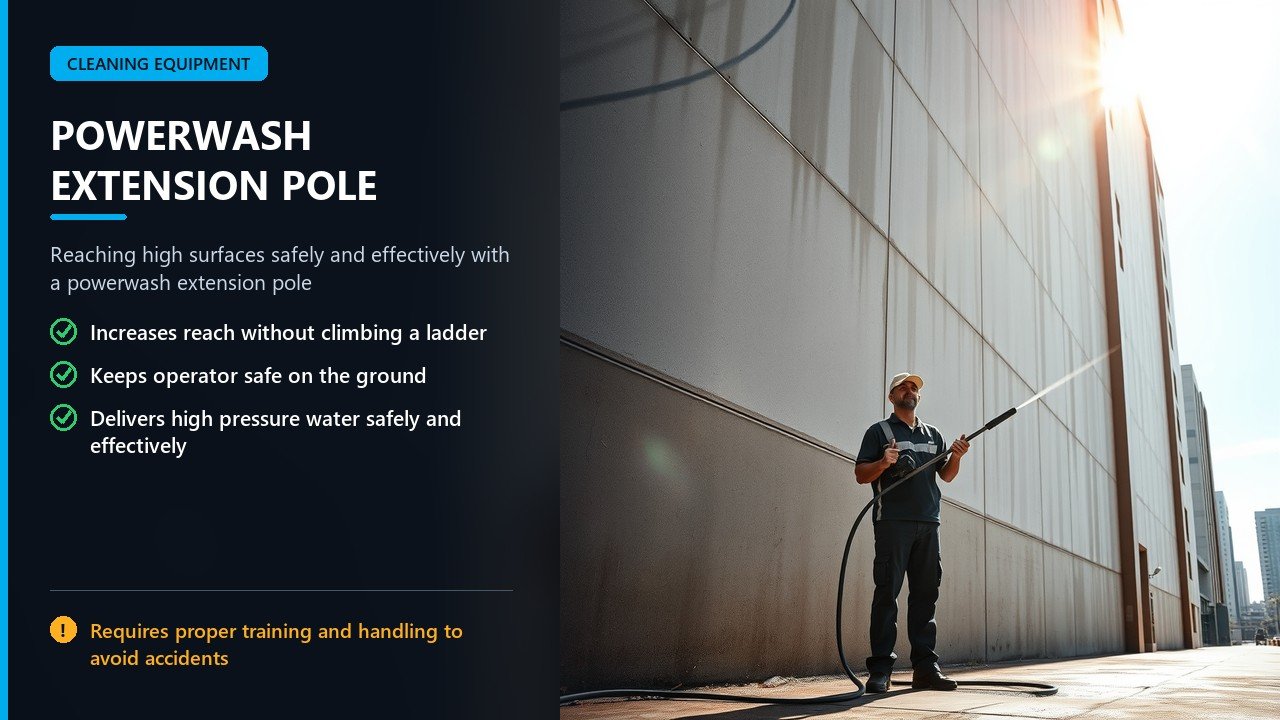
A powerwash extension pole lets an operator clean high walls, gutters, roofs, and glass without climbing a ladder. It reaches places a standard wand cannot, keeps both feet on the ground, and turns a difficult job into a safe one. This guide explains how these poles work, what to look for when buying one, and how to use an extension pole safely and effectively.
What a Powerwash Extension Pole Is
An extension pole is a simple idea with a large effect on the way a cleaning job is done. It extends the reach of the spray gun so the operator can work from a safe position on the ground.
The basic idea. A powerwash extension pole is a rigid or telescopic tube that fits between the spray gun and the nozzle, moving the point of cleaning several feet from the operator’s hands. The water still travels through the same high pressure line, but it is delivered far from the body, which means the operator no longer has to lean, stretch, or climb to reach a high surface. The pole is usually made from lightweight metal or composite material so that the extra length does not make the tool impossible to hold. Many poles telescope, sliding out to the required length and locking in place, while others are supplied as a set of fixed sections that screw together. Either way, the principle is the same. By adding distance between the operator and the surface, the pole transforms a task that would otherwise need a ladder or scaffolding into one that can be completed comfortably from the ground.
Why reach matters. Height is such a challenge because much of the dirt on a building sits well above head height. Gutters, fascia boards, soffits, upper walls, second storey windows, and rooflines all collect dirt, moss, and grime that a standard wand cannot touch. Cleaning them without an extension pole usually means a ladder, and ladders bring their own risks, especially on wet, slippery ground. An extension pole removes that risk almost entirely, because the operator stays on solid ground while the cleaning head reaches up high. It also saves the time and effort of moving a ladder repeatedly along a wall. For anyone who cleans houses, commercial buildings, or vehicles, the reach an extension pole provides is not a luxury but a practical necessity that makes otherwise awkward work quick, safe, and thorough. It also keeps the operator away from splashes and drift, so less cleaning solution ends up on the person doing the work.
Why an Extension Pole Helps
The benefits of an extension pole go beyond simple reach, and they show up on almost every job that involves a height. Understanding them helps an operator decide when the tool is worth using.
Cleaning high surfaces safely. The greatest benefit of an extension pole is safety. Working at height from a ladder while holding a pressure washer is genuinely dangerous, because the spray can knock the operator off balance and the ground below is often wet. An extension pole removes that danger completely by keeping the operator on the ground. The cleaning head reaches the high surface while the person stays stable and in control. This matters even more on windy days or on uneven ground, where a ladder is most likely to shift. For commercial operators, working from the ground also removes the need for fall protection equipment, which saves time on every job. Safety alone justifies the cost of a good pole, and the improved results that come with it are a welcome bonus. The safety gain alone often pays for the pole, and everything else is a welcome extra. It does all of this without adding much to the cost of the setup.
Reaching awkward areas. Some surfaces are simply difficult to reach even from a ladder, and these are exactly where an extension pole earns its keep. Second storey windows, high fascia and soffits, guttering packed with leaves, and the tops of walls all sit in places that are awkward to clean from close range. The angled head of an extension pole can be turned to face upward or sideways, so the spray reaches deeply into gutters or across a fascia without the operator stretching. Awkward areas that would otherwise be skipped or only partly cleaned become quick and easy with the right pole, and that makes the finished result far more consistent. A job that looks even from top to bottom always reflects well on the operator, and it takes less time to check because nothing is left half done, and that consistency is what customers notice most. A tidy finish from top to bottom often wins the next job.
Reaching windows and glass. Extension poles are especially useful for glass, because they allow water and cleaning solution to be delivered to upper windows in a controlled stream. Used with a water fed brush or a suitable nozzle, a pole can rinse and clean tall windows without a ladder, leaving a streak free finish. This makes the tool valuable for window cleaners as well as pressure washing operators, and it explains why the combination of pole and brush is so popular for high reach glasswork. The same reach that helps with windows also helps with solar panels, conservatory roofs, and other large glazed surfaces that must be cleaned without scratches. For delicate glass, a soft brush and clean water do the work while the pole provides the height. High glass can be cleaned and rinsed in one pass, so the finish is as clear at the top as at the bottom.
Why extension poles are worth the money. The biggest benefit of an extension pole is safety. Working from a ladder while holding a pressure washer is one of the most dangerous ways to clean a high surface, because a sudden kick of the spray or a slip on a wet rung can lead to a serious fall. An extension pole removes that risk by keeping the operator firmly on the ground. It also speeds up the work, because there is no ladder to move and no climb to make for every section of wall. Over a full day, that saved time adds up to real money for a professional, and to far less effort for a home user. Because the cleaning head can be angled, the pole also reaches into gutters and under eaves where a ladder would not help at all. For the price of a good pole, an operator gains safety, speed, and much greater reach on every job.
Types of Extension Pole
Extension poles come in a few broad designs, and each suits a different kind of work. Knowing the differences helps an operator choose the right tool for the tasks ahead.
Telescopic poles. This is the most popular design, because they collapse for storage and extend to the length a job requires. A typical pole has two, three, or four sections that slide inside one another and lock in place with clamps or collars. This makes the pole compact enough to carry in a van yet long enough to reach a second storey. Good telescopic poles lock firmly without slipping and stay rigid when fully extended, while cheaper models can wobble or collapse under pressure. The locks are the most important part to inspect, because a pole that will not hold its length is worse than no pole at all. A well made telescopic pole is versatile, easy to store, and suitable for a very wide range of cleaning tasks, which is why it is the design most owners choose first. Collapsing the pole also makes it easy to carry, and the locks match the length to each surface in seconds.
Fixed length poles. These are made in a single, rigid piece, usually with a threaded fitting at each end. They do not collapse, so they take up more space, but they are usually stronger and more rigid than a telescopic design of the same weight. Because there are no joints or locks, there is nothing to slip or wear, and the pole feels solid throughout the working range. Fixed poles are often favoured for frequent, repetitive jobs at a consistent height, such as cleaning a run of windows on the same building. The lack of moving parts makes them very durable, and the rigid feel helps with accuracy on glass and delicate surfaces. An operator who cleans the same height every day may prefer a fixed pole, while a general purpose user usually prefers the flexibility of a telescopic one. A fixed pole suits regular tasks at a known height, while a telescopic pole suits a varied workload.
Complete extension kits. Many manufacturers sell complete kits that bundle a pole with the fittings, nozzles, and sometimes a brush that are needed to get started. These kits are convenient for a first purchase, because everything matches and nothing has to be tracked down separately. A typical kit includes a pole, a suitable adapter for the spray gun, one or more nozzles, and often a pivoting head or brush. Buying a kit can be cheaper than assembling the parts separately, and it removes the risk of ordering a fitting that does not connect. The trade off is that a kit may not match an operator’s exact needs, so it is worth checking that the pole length, pressure rating, and fittings all suit the machine in use before buying. A kit saves both research and money, but it is still worth checking the pressure rating and flow first, so a quick look at the manual saves trouble later.
Materials and Build Quality
| Material | Strengths | Best for |
|---|---|---|
| Aluminium | Light, strong, and rust resistant | General cleaning and most tasks |
| Fibreglass or composite | Non conductive, rust proof, comfortable to hold | Work near electrical equipment |
The material a pole is made from affects its weight, strength, and durability, and those qualities decide how pleasant the tool is to use for long periods.
Aluminium and lightweight metals. Aluminium is the most common material for pressure washing extension poles, because it is light, strong, and resistant to corrosion. A good aluminium pole adds little weight to the setup, which matters when the pole is held overhead for long stretches. Anodised aluminium resists the rust that plain steel would quickly develop in wet conditions. The wall thickness and the quality of the joints decide whether a pole feels solid or flimsy, so two aluminium poles of similar size can perform very differently. Welded or riveted joints are usually stronger than pressed ones, and machined locks grip better than plastic substitutes. When choosing an aluminium pole, look for clean, even finishes and firm, positive locks, because those details are the clearest sign of quality. Thicker walls, machined locks, and neat joints point to a pole that stays rigid rather than one that flexes and fails. Thicker walls and machined locks are the clearest signs of a pole built to last.
Composite and fibreglass. These poles are valued for being light and for not conducting electricity, which makes them a sensible choice near overhead power lines or when cleaning around electrical equipment. They do not rust, they resist many chemicals, and they feel comfortable in the hand even when wet. On the other hand, fibreglass can fray or splinter if the surface is damaged, and it is more expensive than aluminium. Some poles combine materials, using aluminium sections with composite handles or vice grips for the best balance of strength and safety. For most general cleaning, aluminium is the practical choice, while fibreglass earns its place in situations where electrical safety is a real concern. Either material will last for years with basic care and sensible storage. Fibreglass also stays comfortable to hold in cold weather, which is a real advantage on winter jobs when bare metal can feel icy to hold.
Choosing the Right Length
Buying the right length is the single most important decision, because a pole that is too short leaves height out of reach and one that is too long becomes awkward and tiring.
Matching pole to job. The right length depends on the highest surface to be cleaned and the height the operator can comfortably hold the pole. Measure the tallest wall or the height of a typical guttering, then allow some margin. A pole that reaches the top of a single storey wall is different from one that reaches a second storey roof, so it pays to think about the range of tasks in advance rather than only the next job. Buying a slightly longer telescopic pole than the minimum gives flexibility, because it can be extended part way for smaller tasks. Buying one that is far too long makes the tool heavy and hard to control, especially fully extended. A measured decision at the point of sale saves the frustration of discovering the pole cannot quite reach the surface that matters most. Buying a pole that reaches just beyond the tallest job keeps the tool light and easy to handle. A pole that reaches a little beyond the tallest job gives room to work without constantly moving a ladder.
Weight and control. A longer pole is not automatically better, because every extra section adds weight and leverage that the operator has to manage overhead. A heavy pole that is fully extended becomes a lever that strains the wrists and shoulders, especially in wind. Weight matters most when cleaning high walls, where the pole is held up for long periods, so a lighter pole of adequate strength is usually easier to live with than a heavy one with a higher rating. Control is closely linked to rigidity, because a whippy pole transfers every movement to the cleaning head and makes accuracy difficult. Choosing a pole that balances length against weight and stiffness is the key to comfortable, controlled work over a full day. A balanced pole in the middle of its range is far easier to control than one fully extended in the wind, so choose a length you can manage comfortably.
Number of sections. The number of sections affects both the collapsed size and the rigidity of a pole. More sections make a pole more compact when folded, which is useful for storage in a small van, but each joint introduces a little flex. A pole with two or three sections usually balances compactness against rigidity well, while a four section pole packs down smaller but can feel less firm when fully extended. The locks between sections should be easy to adjust yet firm enough to prevent slipping under load. Buying a pole with more sections than needed can add weight and wobble for no real benefit, while too few sections limits how compact the tool can be. Thinking about where the pole will be stored and how often it will be extended helps an operator get this balance right. Buying an extra section more than you need usually adds weight rather than usefulness.
Reach and stability in practice. A pole that reaches the surface is only useful if it can be held steady while it cleans. The most useful length is the shortest one that comfortably reaches the highest point, because a shorter pole is always easier to hold steady than a longer one. When a pole is fully extended, every shake at the base is amplified at the tip, so a steady stance and a relaxed grip matter as much as the tool itself. Choosing a pole with firm locks and a rigid outer section makes a noticeable difference to control when working at full reach. It also helps to plan the job so the pole is used at a comfortable extension for most surfaces, reserving the full extension only for the highest points. A pole chosen with these points in mind will always be easier and more accurate to use. Matching the number of sections to the work keeps the pole light and manageable.
Fittings and Compatibility
Getting the fittings right is what turns a good pole into a usable one. Check the thread and connector on the machine, buy the adapters you need, and the pole connects cleanly every time.
A pole is only useful if it connects properly to the gun and the nozzle, so the fittings deserve careful attention before any purchase.
Connecting to the gun. Extension poles attach to the spray gun through a threaded or quick connect fitting at the base. The most common setup uses a standard thread that mates with the end of the gun or wand, while some poles use a quick connect that snaps into place. Either can work well, but the connection must be secure, because it carries pressurised water and must not leak or detach. Some guns need an adapter to accept a pole, so it is worth checking the fitting on your machine before ordering. A secure connection keeps water pressure where it belongs and prevents the pole from becoming a hazard. When the connection is right, the pole feels like a natural extension of the gun rather than an awkward add on, and the whole setup works smoothly. A pole that connects firmly feels like part of the machine rather than an extra to wrestle with.
Matching threads and fittings. Thread standards vary between manufacturers, and a mismatch is the most common reason a new pole cannot be used. Common thread standards exist for pressure washing, but not every maker follows the same one, and quick connect sizes can also differ. Before buying, identify the thread and connector type on your gun and wand, and confirm that the pole, or the adapters supplied with it, will fit. Buying a small set of adapters is a cheap way to bridge most gaps between brands. Getting the fittings right means the pole can be used immediately, without a frustrating delay or a wasted purchase, and it gives confidence that the tool will work with the rest of the equipment the first time it is used, with no frustrating delay. A pole that connects firmly is a pleasure to work with. Check the connection once, and the rest of the job runs without interruption.
Pressure Ratings and Flow
A pole must be able to handle the pressure and flow the machine produces. Ignoring these figures risks a burst, poor performance, or both.
Rated pressure and flow. Every extension pole has a maximum pressure rating, and the machine should operate within it with a comfortable margin. A pole rated below the machine’s working pressure may fail under load, and a burst under pressure is dangerous. Flow also matters, because a narrow bore restricts water and reduces cleaning power at the nozzle. Check both the pressure and the flow figures against the machine before buying, and choose a pole with a margin of safety. A pole that comfortably exceeds the machine’s ratings will last longer and perform better, while one that is only just adequate may struggle on a powerful unit. Matching the ratings is a simple check that prevents an expensive and potentially dangerous mistake. A pole with a comfortable safety margin lasts far longer and gives peace of mind on a powerful machine that runs at high pressure all day. Leave a clear margin and the pole will handle the pressure with ease.
Effect on cleaning power. Adding a long pole inevitably has some effect on cleaning power, because water loses pressure as it travels through a narrow passage. A well designed pole keeps this loss small, but a long, thin, or poorly made one can noticeably weaken the spray. The nozzle at the end also influences performance, so a suitable nozzle matched to the pole helps maintain strength at the surface. Flow through the pole should be smooth and unrestricted, which is why a bore that is wide enough for the machine matters. In practice, a good pole with the right nozzle delivers almost the same cleaning power as working directly, and the reach it provides more than offsets the small loss. Choosing quality here keeps results strong even at full extension, so reach costs almost nothing in cleaning power, and the reach it adds is well worth the tiny loss. A matched nozzle recovers most of what the extra length takes away.
Nozzles for Extension Poles
The nozzle at the end of the pole decides how the water behaves when it reaches the surface, so it deserves as much attention as the pole itself.
Choosing nozzles. The right nozzle depends on the surface being cleaned. A wider angle is gentler and suits paint, render, and glass, while a narrower angle delivers more force for concrete and paving. Because an extension pole keeps the operator at a distance, it is easy to use too aggressive a nozzle without seeing the damage it causes up close, so choosing a sensible angle matters even more than usual. Nozzles should be rated for the machine’s pressure and should fit the pole’s connection cleanly. Keeping a small selection on the pole, or close at hand, allows the operator to change the spray to suit each surface. The nozzle is a small, inexpensive part that has a large influence on the finished result, so change the nozzle to suit the surface rather than the other way round. A small set of nozzles lets the operator change the spray to suit the surface without leaving the ground, which keeps the work safe and steady.
Angle and spray pattern. Spray angle and pattern affect both cleaning and safety at height. A narrow, high pressure jet can damage render, strip paint, or break seals around windows, and the risk is greater when the operator cannot see the surface clearly from below. A wider fan is safer and often just as effective at lifting dirt from a surface, especially with a little detergent. Adjustable or pivoting heads allow the angle of the spray to be turned to face upward into gutters or across a fascia, which is far more effective than trying to aim a fixed head. Matching the spray pattern to the surface keeps the cleaning gentle enough to avoid damage yet strong enough to be effective, and it makes the results at height as good as those achieved at ground level. A pole also makes short work of tall conservatories and solar panels.A gentle, wide spray is usually enough at height, because the water has time to work before it runs off.
Using an Extension Pole Safely
An extension pole improves safety, but it also introduces new things to think about. A few sensible precautions keep the operator out of trouble.
Ladders and reach. The whole point of an extension pole is to avoid ladders, so it should be used from the ground wherever possible. If a ladder is genuinely needed, keep the pole clear of the ladder and never overreach from the rungs, because a pressure washer can push an operator off balance. Position the ladder on firm, level ground, and keep the pole’s spray away from anything that could fall or become unstable. Water running down a wall can make footing slippery, so keep the feet planted and the ladder secure. When the pole can reach the surface from the ground, use it that way, because the safest place to pressure wash from is standing on solid, level ground with both hands on the pole, which is always safer than balancing on a ladder with a pressurised gun, which is a risk no operator needs to take. A stable stance on firm ground is always the better choice.
Water and electrical hazards. Water and electricity are a dangerous combination, and an extension pole can bring water into contact with fittings that would otherwise stay dry. Keep the spray away from overhead power lines, exterior sockets, lights, and other electrical fittings, and never direct water upward toward cables. If the pole is fibreglass, it offers some protection against shock, but no pole makes contact with live electricity safe, so distance is the real protection. Check the area above and around the work for cables, lights, and fittings before starting, and plan the spray direction to avoid them. A moment spent checking for hazards before the first spray is time well spent when working at height with water and electricity nearby, so a careful look for hazards before starting is always worthwhile, because a moment of care prevents a serious accident. Treat every cable and socket as a hazard before the job begins. A few seconds of scanning can prevent a dangerous mistake.
Techniques for Even Cleaning
Good technique makes an extension pole far easier to use and produces a more even finish. A few habits separate a tidy job from a patchy one.
Keeping the pole steady. A steady pole comes from a stable stance and a light grip, not from fighting the recoil. Stand with feet apart, hold the pole toward the body rather than at arm’s length, and let the machine supply the pressure while the operator guides the head. Resting the pole against the wall in a controlled way can help with balance, provided it does not scratch the surface. Working in manageable strokes rather than wide sweeps keeps the spray where it is wanted. With practice, the pole feels like an extension of the arm, and the operator can move it smoothly across large surfaces. A steady approach also reduces fatigue, which keeps the quality of the work high from the first section to the last, and the steady rhythm keeps the operator comfortable throughout and the finish even from top to bottom. An easy rhythm also keeps fatigue away on long jobs.
Working in sections. Cleaning in sections keeps track of what has been done and prevents missed patches. Divide a large wall or roof into manageable bands, and work each band from one side to the other before moving on. Overlap the edges of each band slightly so no strips of dirt are left behind. Pre-soaking and rinsing in the same order helps the finish look even, because every section is treated the same way. Working methodically also means the operator can keep the pole at a comfortable height and angle for each band, rather than reaching awkwardly. A section by section approach is slower only in theory; in practice it is faster, because nothing has to be cleaned twice and the result is consistent from top to bottom, and nothing has to be cleaned twice, which saves both water and time. Working in bands also makes the whole surface easy to check at the end. Method beats speed when working at height every time.
Care and Storage
Looking after an extension pole is easy, and it protects the parts that matter most. The locks and joints do the hard work, so keeping them clean and dry keeps the pole working smoothly for years.
An extension pole is built to last, and a little basic care keeps it working smoothly for years. Protecting the locks and joints is the main concern.
Cleaning and drying. After use, wipe the pole down and dry it before storage, especially the locking mechanisms and joints. Grit trapped in the locks can make them stick or slip, so a quick clean keeps them working smoothly. Water left inside a pole can cause corrosion over time, so draining and drying it helps the metal last. Check the joints and locks for wear now and then, and lubricate them lightly if the manufacturer recommends it. A pole that is cleaned and dried after each job looks better, stores more easily, and performs consistently. These few minutes of care add up to a longer working life and avoid the small frustrations that come from a neglected tool, so a quick wipe and dry after every job is time well spent, because a clean pole is a smooth pole. Wipe the joints and locks, then dry the sections before putting the pole away.
Storing and transporting. Store the pole collapsed and in a dry place where it will not be crushed or bent. A wall bracket or a simple strap in the van keeps it out of the way and prevents it from being damaged by other equipment. When transporting, avoid laying heavy items on top of the pole, because a bent section will never slide or lock properly again. Keep the pole away from extreme heat, which can distort plastic parts and seals. A little order in storage pays off, because a pole that is looked after is ready to work the moment it is needed, and it retains its value far better than one thrown into a corner between jobs, and it keeps its value far better than one treated carelessly. A little order in storage means the pole is always ready and lasts for many seasons with no fuss at all.
Best Uses Around the Home and Trade
Extension poles prove their worth across a wide range of tasks, both around the home and in professional work. A few examples show where they help most.
Gutters, soffits, and roofs. Gutters, soffits, and low roofs are among the most common uses for an extension pole, because they sit high and collect a great deal of dirt. An angled head can flush leaves and debris from guttering and clean the fascia and soffit beneath, all from the ground. This removes the need to climb and makes a dirty job far safer and quicker. Conservatory roofs and low-pitched roofs can also be cleaned with a suitable pole and nozzle, especially when combined with a soft brush for gentler surfaces. These are the jobs where an extension pole turns an awkward, risky task into a straightforward one, and they are the reason so many owners buy a pole in the first place, because it removes the need to climb just to clear a gutter, and it keeps the operator on solid ground. Leaves and debris flush away quickly from below with an angled head.
Fleet and commercial use. Commercial operators and fleet owners use extension poles for vehicles as well as buildings. A pole helps reach the roofs of vans, trucks, and buses, and the upper sides of large vehicles, without a platform or steps. For building maintenance, an extension pole cleans high walls, signage, and cladding quickly, and it allows one operator to cover ground that would otherwise need scaffolding. The time saved on these jobs is significant, and it makes the pole a genuine productivity tool rather than a simple accessory. In any commercial setting where height is involved, an extension pole pays for itself through faster work, safer working practices, and a more consistent finish on every high surface a business has to clean, which adds up to a real saving over a season. That saved time is the clearest reason a commercial operator invests in a quality pole without question.
Frequently Asked Questions
Buyers often have the same questions about extension poles. These answers cover the most common ones clearly and briefly.
How long should an extension pole be? The right length depends on the highest surface you need to reach and how much weight you can comfortably hold overhead. A pole that reaches slightly higher than your tallest regular job gives useful flexibility without becoming too heavy or hard to control. Match the pole to the work, and it stays easy to handle from the first job to the last. As a guide, a pole of roughly four to six metres suits most single storey work, while two storey buildings need a longer pole. A telescopic pole is the most flexible choice, because it can be shortened for low work and extended when height is required. Buying a pole just long enough for the tallest job, and no longer, keeps the weight and the leverage manageable all day. A shorter pole used well will always beat a longer one that tires the operator before the job is half done.
Can I use an extension pole with any pressure washer? Most machines can use a pole, provided the fittings connect and the pole is rated for the machine’s pressure and flow. Check the thread and connector type on the gun, and use adapters if needed to bridge any difference between brands, and these cost very little. It also matters that the pole is rated for the machine’s pressure and flow, because a pole that is not strong enough could fail under load. Checking the fitting and the rating before you buy means the pole will work the first time it is used, with no frustrating surprises or returns. Some poles suit a specific machine, so always check before buying and keep a small set of adapters to hand in case the threads differ. With the right fitting and rating, the pole will work the first time it is used reliably.
Is a water fed brush better than a nozzle on a pole? It depends on the job. A water fed brush is excellent for windows and gentle surfaces, while a nozzle delivers more force for concrete and paving. Many operators keep both, so they can match the attachment to the task at hand. A brush for glass and a nozzle for hard surfaces cover nearly everything. For upper windows and delicate surfaces, a soft brush fed with clean water often gives the best result, because it scrubs gently as it rinses. For paving, concrete, or render, a suitable nozzle may be needed to shift stubborn dirt. Many operators carry both and switch between them as the job demands, which protects the finish and gives a cleaner result from the ground. For upper windows, a soft brush with clean water usually gives the best finish, while paving and render may need a suitable nozzle to shift stubborn dirt. Many operators carry both and switch as the job demands, so the pole stays useful whatever the surface.
Final Thoughts on Powerwash Extension Poles
A powerwash extension pole is one of the most practical additions any pressure washing setup can have. It reaches high surfaces, keeps the operator on the ground, and turns risky ladder work into a safe, controlled job. With the right length, fittings, and nozzle, it delivers results at height that match those achieved at ground level, and it saves time on every task that involves a wall, a roof, or a large vehicle.
When choosing a pole, match it to the work, check the pressure and flow ratings, and confirm the fittings will connect. Then look after it with a quick clean and careful storage, and it will serve for years. For a wide range of pressure washing equipment and accessories, see this supplier of pressure washer trailers and equipment.
In the end, an extension pole is a tool that rewards a little planning. Choose a length that matches your tallest regular job, check that the fittings and ratings suit your machine, and pair it with a nozzle or brush that suits the surface. Set up that way, the pole reaches high walls, gutters, and glass safely and cleanly, and it turns jobs that once needed a ladder into work that can be done comfortably from the ground.
Look after the pole with a quick clean, check the locks before each use, and store it somewhere dry and free from damage. It will then serve for years, saving time on every high job and keeping the operator safe in the process. Few pressure washing accessories offer so much practical value for such a modest cost, and few make such a difference to the way a professional works.
The pole also gives confidence, because working from the ground removes much of the risk that makes cleaning at height unpleasant. A pole that reaches far, locks firmly, and handles well quickly becomes one of the most used tools in the van, and it earns its place on job after job throughout the year. For the money, few accessories come close. That is value few other accessories can match.