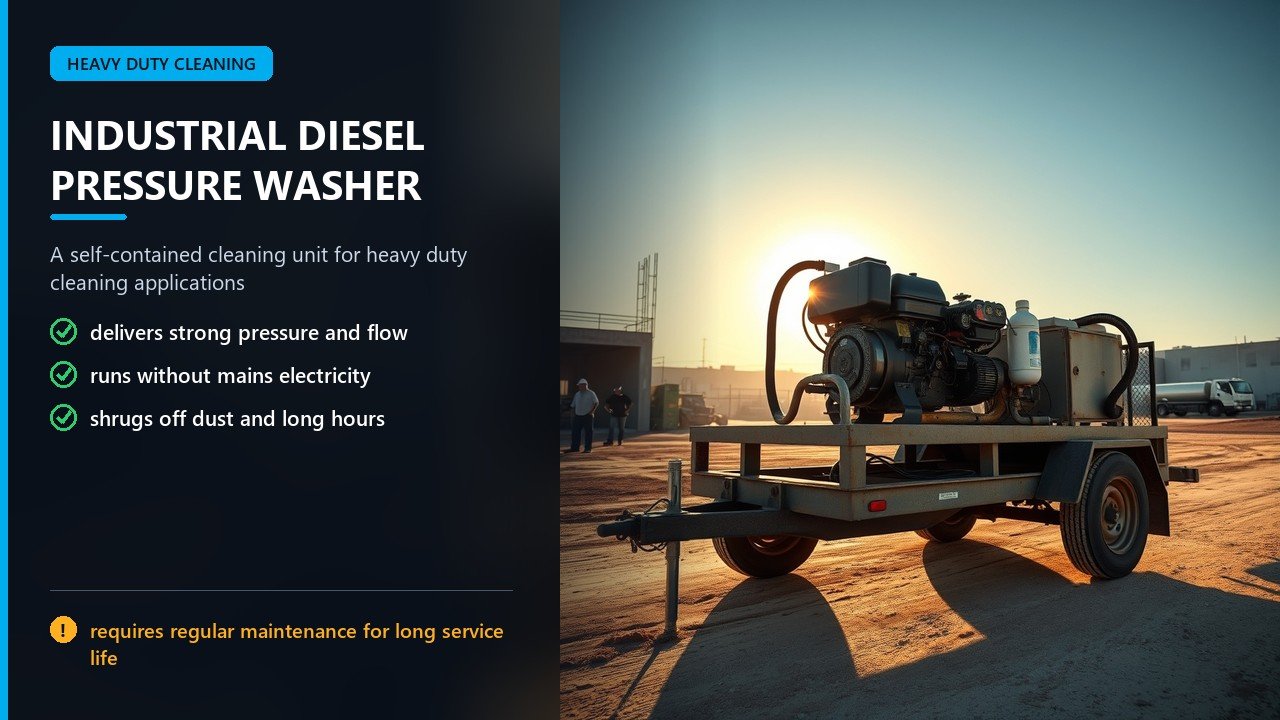
An industrial diesel pressure washer is a heavy duty cleaning machine built to run long shifts on the toughest jobs, pairing a rugged diesel engine with a high pressure pump and, on many models, a burner that heats the water. These machines are the workhorses of the cleaning trade, found on construction sites, in factories, at transport depots, and on farms, where ordinary pressure washers simply cannot keep up. They deliver strong pressure and flow, run without mains electricity, and shrug off the dust, vibration, and long hours that come with industrial work. This guide explains what an industrial diesel pressure washer is, how its engine, pump, and drive system work together, how to match one to the job, and how to keep it running reliably for years of demanding service.
What an Industrial Diesel Pressure Washer Is
Before comparing models, it helps to be clear about what these machines are and who they are made for.
A machine built for continuous duty. An industrial diesel pressure washer is a self contained cleaning unit designed to run continuously under heavy load. A diesel engine turns a high pressure pump, which pressurises water and forces it through a nozzle to create a powerful cleaning jet. Many industrial models add a burner to heat the water, so the machine delivers hot water as well as pressure. Because the engine makes its own power, the machine needs only water and diesel fuel to work, which means it can run on a site with no power supply at all. The pump, the engine, and the frame are all built for professional work rather than occasional use around a home. That heavy construction is what allows an industrial diesel pressure washer to start easily on a cold morning, run flat out for a full shift, and still be ready for the next job the following day.
How it differs from light duty models. The difference between an industrial diesel pressure washer and a light duty electric or petrol washer comes down to stamina and construction. Light duty machines are built for short bursts of work and rely on a mains supply, so they overheat, wear quickly, or run out of reach when asked to work all day. An industrial machine uses a diesel engine that produces strong torque at low speed and runs happily under a constant load, allowing the pump to deliver pressure and flow for hours without fading. Its components, from the pump and drive to the frame and wheels, are chosen for a long working life. Where a domestic washer might manage a driveway on a weekend, an industrial diesel pressure washer is a tool a business can build a service around, because it keeps running when a lighter machine would have stopped. That reliability is the whole point of paying for the industrial grade in the first place.
Where these machines are used. Industrial diesel pressure washers turn up wherever cleaning is heavy and continuous. Construction and civil engineering crews use them to clean plant, machinery, and concrete forms that are caked with mud, cement, and grease. Factories and processing plants rely on them to keep production areas, floors, and equipment clean, often using hot water to strip oil and residue. Transport operators wash trucks, buses, and trailers, where hot water removes road film and oil far faster than cold. Farms and agricultural businesses clean tractors, implements, and buildings that collect mud, slurry, and feed. Municipal teams wash drains, street furniture, and public spaces. In every one of these settings, the work is frequent, the soil is heavy, and the site often lacks convenient power, which is exactly the environment where an industrial diesel pressure washer proves its worth every single day. For these users the machine is a daily tool rather than an occasional luxury, and its value is proven in every shift it completes without a hitch.
Why Diesel Power Suits Industrial Cleaning
Diesel is the natural power source for heavy cleaning equipment, and the reasons run deeper than fashion or tradition.
Torque and constant load. A pressure washer loads its engine hard and unrelentingly whenever the trigger is open, and diesel handles that better than most alternatives. Diesel engines produce strong torque at low engine speed, which means the machine can drive the pump at its working pressure without needing to rev hard or strain. Under a steady, heavy load, a diesel engine runs comfortably for hours, with good fuel economy and a long service life. This matters even more on hot water machines, where the engine also drives a burner and its fan, adding to the demand. A petrol engine of the same size would struggle with that combined load and would wear faster. The diesel engine simply absorbs the work, which is why it powers the toughest machines. The result is a cleaner that can run flat out all day without tiring, which is the defining quality of an industrial diesel pressure washer. A machine that produces this kind of smooth, unflagging power is one the operator can trust to keep going through a long shift, which is exactly what industrial schedules demand.
Fuel economy and off grid freedom. Diesel is efficient, and on a machine that runs long hours that economy adds up to real savings. Because the engine produces its own power, the machine is free of cables, sockets, and the limits of a mains supply, so it can work in the middle of a field, a quarry, a roadside, or a yard with no electricity in sight. An onboard or towed fuel tank lets the machine run for a full shift or longer before it needs refuelling, which keeps a crew working instead of stopping. Diesel fuel is also widely available and easy to store safely on a trailer or in a site tank. That combination of economy, range, and independence is why diesel remains the power source of choice for serious industrial cleaning, where the machine must go to the work rather than the work being brought to a power socket. In practice that means the machine can be refuelled and refilled on site and kept working, rather than being tethered to a building or limited by the length of a power lead.
Pressure, Flow, and Cleaning Power
The cleaning power of any pressure washer rests on two numbers working together, and industrial machines are chosen for how they balance the pair.
Reading pressure and flow together. Pressure, measured in bar or PSI, is the force of the water jet, the quality that drives dirt off a surface. Flow, measured in litres or gallons per minute, is the volume of water delivered, the quality that washes loosened soil away and covers ground quickly. An industrial diesel pressure washer is chosen because it delivers both at levels light duty machines cannot reach. A machine with high pressure but low flow cuts into dirt but clears it slowly, while one with high flow but low pressure rinses well but lacks the bite to shift stubborn soil. The best industrial machines combine strong pressure with strong flow, so the jet cuts and clears in one pass. When comparing machines, buyers should look at the two figures as a pair, because a high number in one alone tells only half the story and can hide a weakness in the machine overall.
Matching power to the work. Choosing the right level of pressure and flow is about matching the machine to the work it will do, rather than simply buying the biggest numbers available. Loose mud and general grime on hard surfaces need good flow more than extreme pressure, while grease, oil, and baked on residue respond best to a combination of strong pressure, good flow, and heat. Large areas such as yards, factory floors, and vehicle fleets reward a machine with plenty of flow, because it covers ground fast and keeps the operator moving. Delicate surfaces, by contrast, need controlled pressure and a wider nozzle to avoid damage. An industrial diesel pressure washer with enough adjustment to suit different jobs is more useful than one locked to a single setting. Buying more power than the work demands wastes fuel and risks damage, while buying too little leaves the operator fighting every task, so an honest assessment of the job is the best guide to the right machine.
The Engine, Pump, and Drive System
The heart of an industrial machine is the way its engine, pump, and drive are put together, and that combination decides its reliability.
Engine and pump pairing. A high pressure pump is only as good as the engine that drives it, and the two must be matched for pressure and flow. Industrial machines use robust pumps, often of the triplex plunger type, with ceramic or hardened plungers and quality seals that stand up to long hours at high pressure. The engine must supply enough power to run the pump at its rated output while still having capacity to drive a burner fan on hot water models. A well matched pair runs smoothly, holds its pressure, and avoids the strain that shortens the life of an underpowered machine. Buyers should look at the quality of both parts, because a famous pump driven by a weak engine, or a strong engine turning a cheap pump, will never deliver the dependable service that industrial work requires. The pairing is the foundation on which everything else in the machine depends. A quality industrial pressure washer pump, turned by a well matched engine, is what gives the machine its strength and its staying power.
Direct drive and belt drive. The way the engine turns the pump also matters, and industrial machines generally use one of two arrangements. Direct drive couples the pump straight to the engine shaft, making the machine compact, cheap to build, and simple to maintain, though the pump runs at engine speed and can be sensitive to heat and vibration. Belt drive uses pulleys and belts to connect engine and pump, which allows the pump to run at its own speed and isolates it from engine vibration, giving smoother operation and a longer pump life, at the cost of extra size and periodic belt checks. For heavy industrial use, many buyers prefer belt drive because it protects the pump and allows easier servicing. Whichever the machine uses, the quality of the drive components matters, and regular inspection keeps the whole system running quietly and reliably for a long working life. Checking these parts regularly, and replacing them before they fail, is the simple discipline that keeps an industrial machine on the job rather than in the workshop.
Hot Water and Steam for Heavy Soil
Many industrial diesel pressure washers can heat the water, and some reach steam temperatures, which widens the range of work they can handle.
What hot water adds. Hot water transforms the way a pressure washer cleans greasy and oily soil. Heat softens and dissolves fats, oils, and greases so that the pressure can lift them away with far less force and far less time, and it also makes cleaning chemicals work more effectively. On an industrial machine the burner sits between the pump and the nozzle, heating the water as it passes through a coil on its way to the gun, so the operator gets hot water at full working pressure. This means tough residues that cold water leaves behind come away cleanly, and delicate surfaces can sometimes be cleaned at lower pressure because the heat is doing more of the work. For factories, kitchens, vehicle washing, and machinery cleaning, hot water is often the difference between a job that is slow and frustrating and one that is quick and thorough, which is why so many industrial buyers insist on it. On the greasiest work, the difference hot water makes is obvious to both the operator and the customer.
The steam option and its uses. Some industrial hot water machines can push water temperatures high enough to produce steam, and this opens up still more cleaning tasks. Steam is excellent for removing heavy grease, stripping stubborn coatings, and cleaning areas where water volume must be kept low, such as certain indoor spaces or machinery that should not be flooded. It can also be used to sanitise surfaces, because high temperatures kill many of the organisms that ordinary washing leaves behind. Steam requires a machine designed for it, with a burner and coil capable of reaching the higher temperatures and controls that keep the output safe and steady. For businesses facing the very heaviest soils, or needing a sanitising step in their cleaning routine, a machine with a steam capability is a significant advantage, and it is one of the reasons industrial buyers choose diesel powered hot water units over simpler cold water models. For businesses facing the heaviest soils, that extra capability is well worth having.
Fuel and Water Supply for Long Shifts
An industrial machine can only work as long as its supplies last, so fuel and water planning is part of choosing the right setup.
Fuel capacity and refuelling. Diesel capacity decides how long the machine can run before it must be refuelled, and industrial users are usually more worried about a clean that stops halfway than about the cost of the fuel itself. An onboard tank that lasts a full shift keeps the operator working without interruption, while a small tank forces frequent stops that ruin productivity. Many machines run both the engine and the burner from the same diesel supply, so the tank must be sized to feed both, and owners should watch consumption on hot water jobs where the burner adds to demand. Having a fuel source nearby, or a spare can, removes the risk of an empty tank in the middle of a paid job. It is worth checking the real running time of a machine at full load, because the difference between finishing a job and having to stop for fuel can decide whether the day went well or badly, so good fuel planning is part of running the machine well.
Water supply choices. Industrial machines need a dependable water supply, and how that supply reaches the machine shapes the way it can be used. On a site with a good mains tap, a machine can be fed directly by hose, allowing it to run continuously for as long as the tap keeps flowing. Where no mains water is available, an onboard or trailer mounted tank supplies the machine instead, and the operator must plan how much water the job requires, because running dry can damage the pump. A break tank or float tank arrangement can buffer an uneven supply and protect the pump from running dry when a supply is interrupted. For the most independent setups, a large tank combined with the diesel engine lets a machine work almost anywhere. Understanding how much water the work consumes, and how to keep the pump fed throughout, is an important part of planning any industrial cleaning operation. Plan the supplies first and the cleaning follows without interruption.
Nozzles, Wands, and Surface Cleaners
The accessories on the end of the hose decide how the machine’s power is applied, and choosing them well makes the machine far more useful.
Nozzles and wands. Nozzles shape the water jet, and the right choice turns raw pressure into a controlled cleaning tool. A narrow, focused nozzle concentrates pressure into a powerful cutting stream, which is ideal for stripping stubborn soil from hard surfaces but can damage soft materials if used carelessly. A wider nozzle spreads the water over a larger area, giving gentler cleaning and faster coverage of big surfaces. Angled and rotating nozzles add variety, letting an operator reach awkward places and apply a scrubbing action to tough dirt. The wand, or lance, determines reach and control, and industrial users often favour a robust wand, sometimes with an extension, so they can work on machinery, walls, and floors without straining. Having a set of nozzles and the right wand on hand lets one machine tackle many different jobs, which is far more economical than buying a separate tool for each task.
Surface cleaners and attachments. Attachments expand what an industrial diesel pressure washer can do and make large jobs far faster. A rotary surface cleaner, which is a spinning bar housed under a dome, cleans flat surfaces such as concrete, tarmac, and paving quickly and evenly, without the streaks that a single jet can leave and without splashing the operator. Turbo or rotating nozzles add scrubbing power to a standard wand. Extension lances reach high walls and guttering, and drain cleaning hoses clear blocked pipes. Foam and detergent injectors mix cleaning chemicals into the water so that heat, pressure, and chemistry work together. Because industrial work covers so many surfaces and soils, building a small kit of attachments around the machine turns it into a flexible cleaning system rather than a single purpose tool, and it is usually a sound investment for any busy operation. A small, well chosen kit of attachments turns one machine into a flexible cleaning system that can take on almost any job the day brings.
Trailer and Skid Mounted Industrial Rigs
Industrial machines come in different formats, and the mount decides how easily the machine can be moved and where it can work.
| Mount Type | What It Offers | Best For |
|---|---|---|
| Skid mount | Compact frame with no wheels | Fitting into a vehicle or fixed bay |
| Trailer mount | Towable rig with tank and storage | Mobile cleaning on many sites |
| Onboard vehicle | Machine built into a van or truck | Service work covering a wide area |
| Static install | Permanent machine at one location | Fixed sites needing constant cleaning |
Skid mount and static machines. A skid mounted industrial diesel pressure washer sits on a compact frame with no wheels, designed to be lifted or bolted into place. This format is ideal when the machine will live in one spot, such as a wash bay, a factory, or the back of a vehicle, where it can be plumbed to a water supply and a drain and left to work. A static installation takes the same idea further, fixing the machine permanently at a site that needs constant cleaning, so operatives always have a machine ready and need not move equipment to use it. Because skid and static machines do not carry their own transport, more of the cost goes into the engine, pump, and burner, so buyers often get more cleaning power for their money. They suit businesses with a fixed base, and they are simple to service because everything is accessible in one place.
Trailer mounted mobility. For businesses that clean across many locations, a trailer mounted industrial diesel pressure washer is often the best answer. The machine, its engine, pump, burner, water tank, and hose are all built onto a road going trailer, so a single vehicle can deliver a complete cleaning setup to any site. This mobility lets a cleaning business serve customers scattered across a wide area without needing power or water at each location, because the trailer carries its own. Trailer rigs also make sense for large sites where the machine must move around, such as construction projects, farms, and transport depots. Quality trailers are built with proper axles, brakes, and lighting for safe towing, and they organize the machine so it is quick to set up and pack away. For a service based cleaning operation, the trailer mounted format turns a single machine into a flexible business asset. For a cleaning company that serves many customers, the ability to arrive ready to work is often what wins the contract in the first place.
Choosing the Right Industrial Machine
With so many machines on the market, choosing well comes down to matching the specification to the work and the budget.
Start with the job. The first step in choosing an industrial diesel pressure washer is to describe the work honestly. What will the machine clean most often, how large are the areas, how heavy is the soil, and is grease or oil involved? Jobs dominated by grease and oil point to a hot water machine, while work on large flat areas calls for strong flow and a surface cleaner. Sites without power demand a diesel engine, and remote work may need a trailer with its own water tank. The frequency of use matters just as much as the type of work, because a machine used every day needs heavier duty components than one used now and then. Writing down the answers before shopping keeps the choice grounded in reality, and it prevents the common mistake of buying either far more machine than the work needs or too little to do the job comfortably over the long run. Honest sizing is the foundation of a good purchase.
Read the specification carefully. Once the job is clear, the specification tells you whether a machine will suit. Look at pressure and flow together rather than one alone, and check whether the figure is measured at the nozzle, which is the one that counts. For hot water models, look at the temperature rise at working flow, not just the maximum number on the label. Check the make and type of the pump, the engine, and the drive, because these decide reliability and the cost of future repairs. Consider the size of the fuel and water tanks, the build quality of the frame and wheels, and whether the machine comes from a maker who supports it with parts and service. Finally, think about the attachments you will need and whether the machine works with them. A careful reading of the specification, matched against the job, is the surest way to buy a machine that earns its keep. Careful specification repays the time it takes many times over during the life of the machine.
Maintenance for Long Service Life
An industrial machine is a serious investment, and a simple maintenance routine protects it and keeps it working when you need it.
Routine checks and servicing. The most important maintenance for an industrial diesel pressure washer is a regular routine that catches small problems before they grow. Check the engine oil and top it up as needed, and change it at the intervals the maker specifies, since clean oil is the single best protection for a hard working engine. Inspect and clean the air and fuel filters so the engine breathes and burns fuel properly. Check the pump oil if the pump has its own reservoir, and watch for leaks around seals and fittings. Clean the water inlet filter to keep grit out of the pump, and on hot water models, check and descale the coil so the burner keeps working efficiently. Grease moving parts and inspect hoses, belts, and connections for wear. A short checklist followed every day or week turns maintenance into a habit, and that habit is what keeps the machine dependable. A written checklist makes the routine easy to repeat and hard to forget.
Protecting the machine between jobs. How the machine is treated between jobs matters as much as how it is serviced during them. Before storage, run clean water through the system to clear out chemicals and grit, and never leave the machine full of dirty or hard water, which can scale the coil and damage the pump. In freezing weather, drain the pump, coil, hose, and gun completely, because trapped water expands as it freezes and can crack expensive parts. Store the machine under cover where it is protected from rain, dust, and frost, and keep the fuel tank topped up to reduce condensation inside it. Check and protect the battery on electric start models. Treat the machine as the valuable tool it is, handle it carefully, and it will reward you with many years of reliable service, which is exactly what an industrial grade machine is built to deliver. Treat it well and it will keep answering the call, job after job, season after season, without complaint. That durability is the whole reason to invest in the industrial grade.
Cost, Fuel, and Return on Investment
An industrial diesel pressure washer costs more than a light duty machine, so it is worth understanding how that cost is repaid over the years.
What the machine costs to run. The running cost of an industrial diesel machine has several parts. Fuel for the engine, and for the burner on hot water jobs, is the most obvious, and diesel is economical for the work it does. Oils, filters, and other service items add a modest, regular cost that is easy to predict if you keep a maintenance log. Wear parts such as seals, nozzles, and belts need replacing from time to time, and their cost depends on how hard the machine works. Cleaning chemicals add to the total, though hot water often lets you use less of them. Set against this is the value of the machine’s productivity, because an industrial machine that cleans faster and runs all day finishes more jobs and wins more work than a machine that keeps stopping. Judged purely on running cost, the industrial machine is efficient, and it is the productivity it unlocks that makes the investment worthwhile.
Judging the return over the years. The real test of an industrial diesel pressure washer is the return it produces over its working life, not its price on the day of purchase. A well built machine, looked after properly, will serve for many years, spreading its purchase cost across a long period of steady work. Because it runs without interruption and handles the heaviest soils, it lets a business take on jobs that cheaper machines must turn down, and it finishes the jobs it has more quickly, so it generates more income per hour of work. A machine that breaks down, by contrast, costs money in repairs, lost jobs, and damaged reputation, and those hidden costs often exceed the original saving on a cheap purchase. For a business that cleans for a living, the industrial machine that keeps running is nearly always the better investment, because it earns money rather than costing it.
Common Mistakes to Avoid
Most disappointments with industrial cleaning equipment can be traced back to a handful of avoidable mistakes, and knowing them in advance saves money and frustration.
Under sizing the machine. The most common and most expensive mistake is buying a machine that is too small for the work it will face. It is tempting to save money by choosing a lighter specification, but a machine that struggles with the soil it meets runs near its limit every day, which wears it out quickly and leaves the operator frustrated. A machine chosen to handle typical jobs with capacity to spare runs more comfortably, cleans faster, and lasts longer, so the extra spent up front is repaid many times over. Buyers should resist the pull of the cheapest option and instead match pressure, flow, and heat to the heaviest work they expect to do regularly. A machine that looks adequate on paper but is overwhelmed in practice will soon have the owner shopping for a replacement, which costs far more than choosing the right size to begin with, so it pays to be honest about the job from the outset. A realistic view of the work saves money and inconvenience, and it keeps the operator working at a comfortable pace instead of fighting the equipment every day.
Ignoring service and support. Another common mistake is treating the purchase as the end of the process rather than the beginning. An industrial diesel pressure washer is a machine that needs fuel, water, oil, filters, and periodic service, and buyers who overlook the availability of parts and support can find themselves with a capable machine standing idle for want of a simple seal or filter. Choosing a maker with a reputation for backup, and keeping a small stock of common wear parts, keeps the machine working when it matters most. It is equally important to follow a maintenance routine rather than waiting for something to break, because preventive care costs far less than emergency repairs and lost jobs. A machine is only valuable while it works, and the support behind it, together with the habits of its owner, decides how often that proves to be true. Support is not an afterthought; it is part of what makes an industrial machine a sound long term purchase.
Frequently Asked Questions
These are the questions buyers ask most often when they are considering an industrial diesel pressure washer.
Is an industrial diesel pressure washer worth the cost? For any business that cleans regularly or faces heavy, greasy soil, an industrial diesel pressure washer is usually worth the cost because it runs longer, cleans faster, and lasts far longer than a light duty machine. The price is higher, but the machine pays that difference back through productivity and reliability, and it allows the business to accept work that lighter machines cannot handle. Where cleaning is occasional and light, a cheaper machine may be enough, so the decision should rest on how often and how hard the machine will work, and on the value of the jobs it makes possible. For a busy cleaning business, that capability usually turns into more work won and more hours billed, which is where the real return is found. Over a busy season, a machine that keeps working can earn back its purchase price many times over.
Can it run without mains electricity? Yes. An industrial diesel pressure washer makes its own power with its diesel engine, so it can run on any site where fuel and water can be supplied. This is one of its greatest advantages, because it frees the business to work in fields, on roadsides, at construction sites, and in any other location without a power supply. The only requirements are diesel fuel and a source of water, which can come from a tap or from an onboard tank, so the machine can operate almost anywhere the work takes it. That freedom can change how a business plans its day, because it removes the need to find power before a job can even begin. That flexibility lets a business accept jobs in locations others must turn down. For a growing business, that reach is a genuine competitive edge that wins more work and keeps the schedule full.
How often does it need servicing? The servicing schedule for an industrial diesel pressure washer depends on how hard it works, but a daily check of oil and water levels and a regular programme of oil and filter changes, pump checks, and coil descaling will keep it reliable. Manufacturers give service intervals based on hours of use, and following them closely is the best way to avoid breakdowns. Keeping a simple log of everything that is done makes the schedule easy to follow and helps a technician trace any fault quickly, which keeps downtime to a minimum. A machine that is serviced on time rarely fails at the worst moment, and that reliability is what a business is really paying for. A machine that never lets you down protects both your schedule and your reputation, and those are the things a customer remembers. Reliable service and good backup are what keep a working machine in the field.
What size do I need? The right size depends on the work, so a machine should be chosen to suit the most common jobs rather than the most extreme one. Look at pressure and flow together, add heat if grease is routine, and consider tank sizes and mobility for the sites you visit. A machine that is too small will struggle and wear out early, while one that is too large wastes fuel and money. Where possible, describe your typical jobs to a reputable dealer and let them match a machine to your needs. Getting the size right is one of the most important decisions a buyer will make, because it decides how comfortable the work will be. A machine that fits the job lets the operator work steadily instead of struggling against the equipment, and steady work produces better results with far less fatigue. Comfortable, efficient working is always the sign of a machine that has been matched properly to the job.
Is hot water always necessary? No, hot water is not always necessary, but it makes a large difference on greasy and oily work. Cold water relies on pressure alone and struggles with fats and oils, while hot water dissolves those soils, speeds up chemicals, and cleans more gently at lower pressure. If your work is mostly dirt, mud, and general grime, a cold water machine may be sufficient, but if grease and oil are common, the extra cost of a hot water industrial diesel pressure washer is usually repaid quickly in time saved and better results. Where grease is frequent, the extra heat repays itself quickly in faster jobs and cleaner finishes. For heavy commercial work, that advantage alone is usually enough to justify the higher price of a hot water machine. Where grease is a regular part of the work, that extra capability is worth every penny, because time saved is money earned in this trade.
Final Thoughts on Industrial Diesel Pressure Washers
An industrial diesel pressure washer is the machine a serious cleaning business turns to when the work is heavy, frequent, and unforgiving. It combines a rugged diesel engine with a high pressure pump, and often a burner, to deliver power, stamina, and the freedom to work without mains electricity. Its construction is built for continuous duty, so it survives the long hours and rough conditions that wear out lighter machines, and it repays its higher price through productivity and reliability year after year.
Choosing well means matching the machine to the job. Pressure and flow should be read together, heat added where grease and oil are routine, and the mount chosen to suit the sites you visit, whether that is a compact skid, a permanent installation, or a fully equipped trailer that travels with you. Fuel and water supplies must be planned so the machine can finish a shift without stopping, and the machine should come from a maker who supports it with parts and service. Read the specification with care, and buy a machine that suits the work you actually do.
Looked after properly, an industrial diesel pressure washer becomes one of the most dependable tools a business owns. Regular servicing, clean fuel and water, protection from frost, and careful storage all add to its life and keep it ready for every job. For anyone who cleans for a living, that dependability is worth more than any single figure in a specification, because a machine that keeps running is a machine that keeps earning. Choose it carefully, fuel it, water it, service it, and store it well, and it will stand beside a cleaning business for many seasons of hard, profitable work without ever becoming the weak link. That is the quiet promise of an industrial diesel pressure washer, and it is one that a well kept machine keeps for years. A well specified industrial diesel pressure washer is a durable business asset rather than a disposable tool.
To explore machines, tanks, and towable rigs that suit this kind of work, see pressure washer trailers and equipment.