Hot water diesel pressure washers sit at the top of the cleaning trade, combining a powerful diesel engine with a burner that heats the water, so that grease, oil, and heavy grime come away far faster than they ever could under cold water alone. They are built to work hard, to run for hours without mains electricity, and to clean the kind of industrial and commercial mess that stops lesser machines in their tracks. For a contractor, a fleet operator, or any business that cleans for a living, they are often the tool that decides how quickly a job is finished and how well the result holds up. This guide explains how these machines work, what makes the heat and the diesel engine so useful together, how to match one to your work, and how to keep it running reliably for years of demanding service.
What Hot Water Diesel Pressure Washers Are
Before comparing models, it helps to understand what these machines are and what sets them apart from simpler pressure washers.
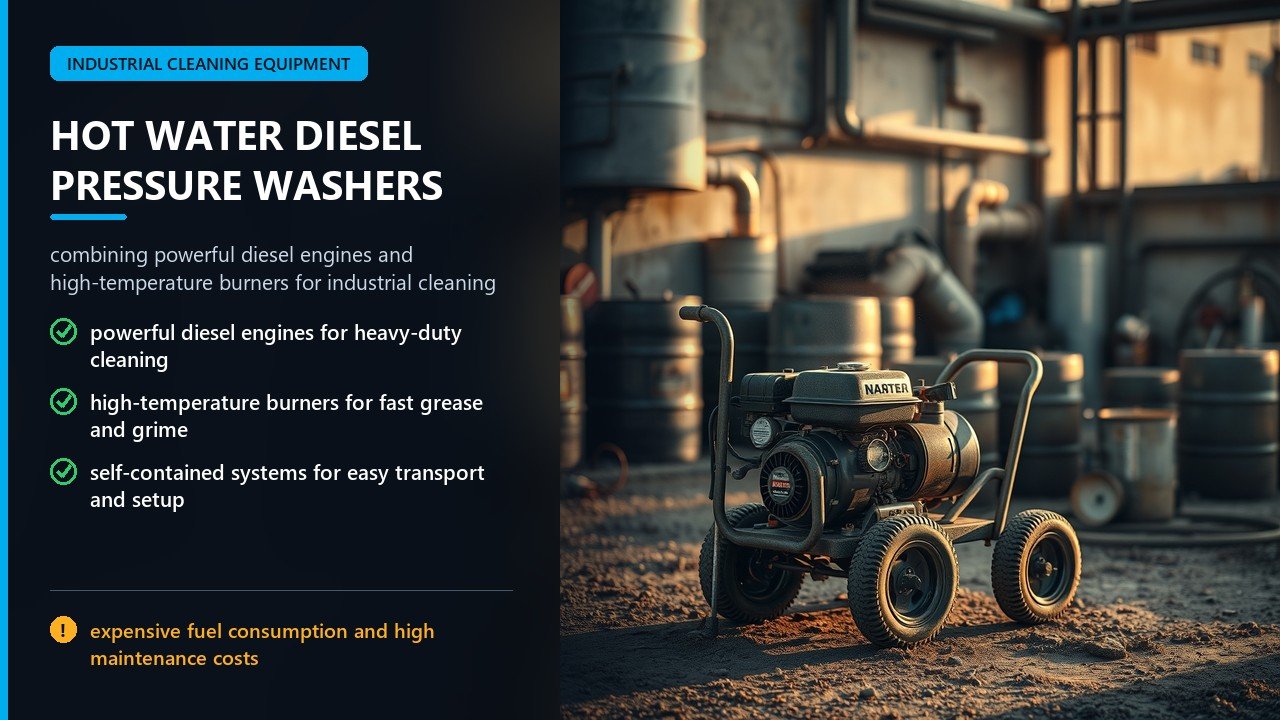
Engine, pump, and burner together. Hot water diesel pressure washers are self contained cleaning machines built around three core systems working as one. A diesel engine provides the power, driving a high pressure pump that pressurises water, and, on most models, also driving the fan and fuel pump of a burner. The burner heats the water as it passes through a coil on its way to the gun, so the operator gets hot water at full pressure. Because the engine supplies its own power, the machine needs only water and diesel fuel to run, which makes it ideal for sites with no mains electricity. This integration of engine, pump, and burner is the defining feature of the design, and it is what allows these machines to deliver both serious pressure and serious heat, in one mobile, self sufficient package built for professional use. The three systems are matched so the machine can work hard for hours without losing performance, and that stamina is exactly what professional cleaning demands.
How they differ from cold water machines. The difference between a hot water diesel machine and a cold water pressure washer is more than a few degrees. Cold water relies almost entirely on pressure to break dirt away, which works on loose material but struggles badly with grease, oil, and baked on residue. Hot water softens and dissolves those clinging soils so the pressure can lift them away far more easily, often at lower pressure, which is gentler on the surfaces being cleaned. Heat also makes many cleaning chemicals far more effective. On top of this, the diesel engine gives the machine the stamina to run all day and the independence to work away from any power supply. Taken together, heat and independence are what lift a hot water diesel machine from a pressure washer into a genuine professional cleaning tool. Taken together, heat and independence are what lift a hot water diesel machine above an ordinary pressure washer and make it a tool that a working business can rely on.
Where these machines earn their keep. These machines are found wherever grease, oil, and heavy soil must be removed quickly and thoroughly. Fleet operators use them to wash trucks, buses, and heavy equipment, where hot water cuts through road film and oil far faster than cold. Commercial kitchens, food factories, and restaurants rely on them to strip baked on grease from floors, hoods, and equipment. Workshops, industrial plants, and agricultural buildings use them for machinery, floors, and plant that everyday cleaning cannot touch. Many of these jobs happen on sites with no convenient power or water, which is exactly where the diesel engine and an onboard tank come into their own. For any business whose reputation rests on how clean it can make things, hot water diesel pressure washers are the machines that make difficult jobs routine. For a business whose livelihood depends on cleanliness, the machine is not a luxury but a necessity, and it earns its place on job after job.
Why Hot Water and Diesel Work Together
The pairing of a diesel engine and a hot water burner is not a coincidence; each part makes the other more useful on a working job.
Diesel torque for constant load. A pressure washer works its engine hard and constantly whenever the trigger is open, and a diesel engine is well suited to exactly that kind of duty. Diesel produces strong torque at low speed and runs comfortably under a heavy, steady load for hours, with better fuel economy and longer life than a petrol engine doing the same work. This matters because hot water machines carry an extra load, the burner and its fan, on top of the pump, so the engine needs to be robust. A diesel engine handles the combined demand without strain, which is why it is the power source of choice for the heaviest professional machines. The result is a cleaner that can run all day, day after day, without the engine feeling overworked. That stamina is the difference between a machine that can be depended on for a full shift and one that has to be rested, and it is why diesel is the standard for the heaviest professional cleaning work.
Heat for grease and soil. The burner turns water into a powerful cleaning medium by raising its temperature before it reaches the nozzle. Hot water dissolves fats, oils, and greases, and it speeds up the action of cleaning chemicals, so soils that would resist cold water come away with far less force and less time. This means the operator can often use a gentler nozzle and lower pressure on delicate surfaces while still getting a brilliant result, protecting paintwork, aluminium, and seals that high pressure alone might damage. Put simply, the diesel engine provides the muscle and the burner provides the chemistry, and together they clean faster, more thoroughly, and with less effort than either pressure or heat could achieve alone. That is why the two are paired in the machines that serious cleaning businesses depend on. When a crew must finish a greasy job before a site opens or a fleet leaves, heat and power working together are what make the deadline possible, and that is why these machines are the backbone of so many cleaning operations.
Burner Types and Heat Output
Not every hot water machine heats the same way, and the burner’s type and output decide how much heat the machine can deliver.
| Heat Feature | What It Means | Why It Matters |
|---|---|---|
| Diesel burner | Strong, independent heat source | Works off grid, high heat output |
| Temperature rise | Heat gained from inlet to outlet | Shows real heat at working flow |
| Coil type and size | Tubes that water passes through | Determines heat at full flow |
| Bypass control | Protects against overheating | Keeps the burner safe and steady |
Diesel burners and temperature rise. Most hot water diesel pressure washers use a diesel fired burner, which burns cleanly and delivers strong heat without needing any external power or gas supply. What matters most, though, is not the maximum temperature on the label but the temperature rise the burner can achieve at the flow the machine produces. Water passes through a coil inside the burner, where the flame heats it, and the size and design of that coil, together with the burner’s output, decide how hot the water can get while the machine is working at full pressure. A machine with a strong burner and a well designed coil can hold high temperatures even at full flow, while a weaker machine may only get hot when the pressure is turned down. Understanding temperature rise lets buyers compare machines honestly. A machine that claims a high temperature but cannot hold it at full flow will disappoint, so it is worth asking what temperature rise the machine achieves at its rated flow before you buy it.
Coil design and heat control. The coil is central to how well any hot water machine performs, and it is worth understanding what it does. Water flows through a long tube coiled inside the burner, where it absorbs heat from the flame over a large surface area, and the material, wall thickness, and length of that coil determine how efficiently the heat is transferred. A coil made from good material survives years of hot, pressurised water, while a cheap one corrodes from the inside and eventually fails. Burner controls, including a thermostat and a bypass, keep the temperature steady and prevent the water from overheating when the trigger is closed and the flow stops. Together, a sound coil and good controls give the operator dependable heat, whatever the job, and protect the machine from the damage that overheating can cause. Keeping the coil clean and the controls working is therefore not just about performance but about protecting an expensive part of the machine from the harm that trapped heat can do.
Pressure, Flow, and Temperature
The performance of a hot water diesel machine rests on three numbers, and together they decide how well it cleans.
Reading the three numbers together. Pressure, measured in bar or PSI, is the force of the jet, the quality that breaks dirt away from a surface. Flow, measured in litres or gallons per minute, is the volume of water delivered, the quality that washes soil away and covers ground quickly. Temperature is the heat of the water, the quality that dissolves grease and speeds up chemicals. A machine with high pressure but low flow cuts into dirt but struggles to clear it, while one with good flow but low pressure rinses well but lacks the force to shift stubborn soil, and a machine with neither pressure nor flow but plenty of heat will only be useful on light, greasy work. The best machines balance all three, and buyers should compare them together rather than being swayed by a single headline figure, because a balanced machine cleans far better than a lopsided one.
Matching the machine to the soil. Different jobs need different combinations of pressure, flow, and heat, so matching the machine to the soil is the key to efficient cleaning. Loose dirt, mud, and general grime come away with moderate pressure and good flow, while grease, oil, and baked on residues demand heat as much as force. Hard surfaces such as concrete and machinery tolerate high pressure and full heat, while paintwork, timber, seals, and soft metals need gentler treatment, lower heat, and a wider nozzle. A hot water diesel machine with adjustable heat, a choice of nozzles, and enough pressure and flow to be flexible gives the operator the tools to suit each task. Buying more power than the work requires wastes fuel and risks damage, while buying too little leaves the operator fighting every job, so a realistic assessment of the soil you face is the soundest guide. When pressure, flow, and heat are all chosen to suit the soil, the machine cleans efficiently without being pushed to its limit, which protects the equipment and the surfaces alike.
The Diesel Engine and Pump
The engine and pump are the heart of the machine, and how well they are matched and connected affects both performance and service life.
Engine and pump matching. A hot water diesel machine is only as good as the match between its engine and pump. The engine must produce enough power to drive the pump at its rated pressure and flow, with headroom to spare, because a pump driven by an engine that is always at full stretch will be unreliable and short lived. The pump itself is usually a triplex plunger type, with three pistons and a robust head, because this design delivers a smooth, powerful flow and lasts far longer under constant pressure than the simpler axial pumps found on cheap machines. Materials such as ceramic plungers and stainless valves resist wear and corrosion, and, on hot water machines, the pump and its seals must be rated for the temperature involved. A well matched engine and a quality pump are the foundation of a machine that keeps working, job after job. The best way to judge that match is to look at the machine as a whole rather than at any single component, because a strong engine with a weak pump, or a good pump with an underpowered engine, will never deliver the reliability that professional work demands.
Drive systems and pump speed. How the engine drives the pump affects both performance and longevity. Direct drive couples the pump straight to the engine, which is compact and efficient but spins the pump quickly and passes engine heat and vibration through to it. Belt drive isolates the pump, allowing it to run at a slower, gentler speed and making it easier to service or replace, which is why many heavy duty hot water machines use it. Belt reduction lowers the pump speed further still, extending pump life at the cost of a larger assembly. The best choice depends on the duty the machine will see, but for a hot water diesel machine expected to run long hours day after day, a drive that protects the pump and eases maintenance is usually worth the extra cost, because pump life is what keeps the machine earning. For a machine that runs long hours, a drive that protects the pump and simplifies maintenance is a sound investment, because the pump is the part most likely to wear out first and the most expensive to replace.
Fuel and Water Supplies
Because these machines run on diesel and often work away from a tap, their fuel and water supplies are central to how long they can work.
Diesel fuel and tank size. A hot water diesel machine consumes fuel to run its engine and to fire its burner, so the tank and the consumption rate together set its runtime. Larger machines with high flow and strong heat use more fuel per hour, while smaller ones sip it, and the burner adds its own consumption on top of the engine’s. Tank capacity should be matched to the length of a typical working day, so the machine can complete a job without running dry. Many machines have a generous fuel tank or separate tanks for engine and burner, and some let the burner draw from the same supply for simple refuelling. Estimating fuel use from the engine’s rated consumption plus the burner’s burn rate lets an operator plan refuelling and avoid the downtime that a dry tank causes in the middle of a paid job. A machine that can complete a full shift without refuelling keeps the operator productive and the customer happy, while one that needs constant attention interrupts the schedule and wastes time that should be spent cleaning.
Water tanks and water quality. These machines are frequently paired with a water tank on a trailer or skid, so they can work where no mains supply exists. Water from the tank reaches the pump by gravity or through a booster pump, and a float valve keeps the feed steady as the tank drains. The tank size decides how long the machine can run between refills, so it should be matched to the job and to the machine’s flow, and a strainer on the outlet keeps debris out of the pump. Water quality matters too, because sediment wears the pump and hard water scales the burner coil, so filtering and, where needed, softening protect the machine and keep it working at full efficiency, adding years to its service life. Filtering the water and descaling the coil on a routine basis are small jobs that protect the machine from the slow damage that dirty and hard water cause, and they cost far less than the repairs they prevent.
Heat, Chemicals, and Cleaning Speed
One of the greatest benefits of hot water is how it transforms the speed of cleaning, especially when combined with the right chemicals.
How heat speeds up cleaning. Heat works on soil in ways that pressure alone cannot. Grease and oil soften and dissolve as the water temperature rises, so the jet can lift them away with far less force, and the operator can often complete a job in a fraction of the time cold water would take. Heat also speeds up the chemical reactions that detergents rely on, so cleaning agents attack soil faster and more thoroughly in hot water than in cold. On greasy jobs this combination can mean the difference between scrubbing a surface for minutes and simply washing it clean. For a business that is paid by the job, that speed is money, and it is the main reason hot water machines earn their keep on commercial work despite costing more to buy and run than cold machines. On greasy, heavy work the time saved more than pays for the heat, but on light jobs it may not, so the value of hot water depends entirely on how often grease and oil feature in the work you do.
Choosing and using chemicals. The right chemical, used with hot water, makes cleaning faster and gentler on surfaces. Alkaline detergents suit grease and oil, while acidic products tackle scale and mineral deposits, and specialised agents handle particular soils. The chemical should be matched to the soil and the surface, applied at the right dilution, and given time to work before the jet washes it away. A downstream injector or a foam cannon makes applying detergent easy and even. It is important, though, to use chemicals responsibly, following their instructions, protecting plants and surfaces, and managing runoff, and to choose products compatible with the machine’s seals and materials. Used well, heat and chemistry together turn a difficult cleaning job into a quick and satisfying one. Using the right chemical at the right strength, and giving it time to work before rinsing, allows heat and pressure to do the hard part, which is what turns a slow, laborious job into a fast and pleasant one.
Mobile Setups and Trailers
Mobility is a major reason to choose these machines, and the way they are mounted shapes how well they work.
Trailer and skid mounting. Hot water diesel pressure washers are often mounted on a trailer or a skid so they can travel to the work. A trailer setup can carry the machine, a water tank, hose reels, and supplies of fuel and chemicals, making the whole cleaning rig self contained and ready to go. A skid mount sits on a truck bed or a flat surface and can be lifted or moved as a unit, which suits operators who already have a vehicle to carry it. Either way, the machine should be secured against movement and vibration, protected from the weather, and arranged so the burner exhaust, fuel filler, and controls are easy to reach. Good mounting means the operator can get to the gun, hose, and nozzles quickly, which speeds up every job and keeps the rig tidy. A well ordered rig, with the hose coiled, the nozzles stored, and the fuel and chemicals secure, is also safer to move and quicker to put into service when the operator arrives at the next site.
Towing safety and weight. When the machine travels on a trailer, road safety becomes part of the job. The towing vehicle must be able to handle the combined weight of the trailer, the machine, the water, and the fuel, and to control the tongue weight safely. Brakes, lights, tyres, and the coupling must be in good order, and the driver should know any licensing or registration rules that apply locally. Water is heavy, so a full tank adds significant weight, and routes and refuelling points are worth planning with that in mind. Distributing the load correctly keeps the trailer stable, and treating it as a serious vehicle rather than a box on wheels keeps a mobile hot water diesel machine working safely. A well organised rig is safer, quicker to set up, and easier to work from. Checking the trailer before every trip, from the coupling to the lights and tyres, takes only minutes and prevents the kind of breakdown or accident that can turn a simple journey into a costly delay.
Choosing the Right Machine
With so many sizes and configurations, matching the machine to the work is the single most important decision.
Matching to your work. Start by identifying what you will clean and how often, because these facts drive the specification. Light, occasional work may suit a smaller machine, while fleet cleaning, industrial plant, and heavy grease demand high flow, strong pressure, and ample heat. Consider the surfaces, since delicate paintwork needs controllable pressure and gentle nozzles while concrete and machinery tolerate full power. Think about the sites you visit, because remote locations favour a machine with its own water tank and generous fuel capacity, while sites with water and power allow a simpler setup. The right balance of pressure, flow, heat, and tank capacity, matched to the jobs you actually do, will serve you far better than an oversized machine that wastes money or an undersized one that struggles. Describing your typical jobs honestly to a dealer, rather than your most demanding one, helps ensure the machine suits the bulk of your work, which is what really decides whether it earns its keep over its life.
Build quality and support. Beyond the specification, judge the machine by its build and the support behind it. Look at the engine, the pump, the burner, and the frame, and favour well known components that can be serviced locally. Check the quality of the hose, gun, and nozzles, because weak accessories let down good machines. Most importantly, consider the availability of spare parts and service, because a machine that cannot be repaired quickly is a liability to a business that depends on it. Warranty terms, dealer support, and the reputation of the brand all matter, and reading reviews and speaking to other operators reveals how a machine behaves in real use rather than on a specification sheet. A well built, well supported hot water diesel machine is an investment that pays back over years of reliable work. A machine that starts first time, holds its temperature, and keeps running through a long shift is worth far more in the field than one that looks good on paper but costs time and reputation when it lets you down.
Maintenance and Longevity
Like any hard working machine, a hot water diesel pressure washer rewards regular care with a long and dependable life.
Routine service tasks. Keeping the machine in good order means following a simple routine. Change the engine oil and filters on schedule, and keep the air filter clean so the engine breathes freely. Change the pump oil at the intervals the maker specifies, using the correct grade, and check the pump for leaks or unusual noise. Clean or replace the fuel filter to protect the injection system, and service the burner, cleaning the fuel nozzle and checking the electrodes. Descale the burner coil on schedule, especially in hard water areas, because scale reduces heat transfer and forces the burner to work harder. Check the hose, gun, and nozzles for wear, and keep the water filter and tank clean. Staying on top of these tasks prevents the small faults that grow into expensive repairs or a breakdown in the middle of a paid job. Keeping a simple log of oil changes, filter renewals, burner services, and coil descaling makes the schedule easy to follow and reveals any change in how the machine runs before it becomes a problem.
Winterizing and storage. Cold weather is the greatest threat to a machine left standing, because water trapped in the pump, coil, hose, and gun can freeze and crack components. Before winter, or whenever freezing temperatures are expected, the machine should be drained or protected with a suitable antifreeze, and the hoses emptied. Fuel left standing for long periods can degrade, so keeping the tank full or adding a treatment helps, and water traps should be drained. The machine should be stored under cover where possible, with the battery protected and the burner and controls shielded from the weather. Before returning it to service, check the oils, filters, and connections, and run it briefly to confirm all is well. These habits guard against the frost damage that ruins machines left out in the cold. Draining the pump, coil, hose, and gun, protecting them from frost, and storing the machine under cover are simple habits that add years to its working life at almost no cost.
Cost, Fuel, and Return
These machines are a significant investment, so it is worth understanding both the cost and the value they deliver.
Upfront and running costs. A hot water diesel pressure washer costs more to buy than a cold water machine, reflecting its engine, pump, burner, and heavier build. Running costs include diesel for the engine and the burner, pump oil, filters, coil descaling, and periodic service, and these should be weighed against the work the machine makes possible. Fuel consumption rises with flow and heat, so a larger machine costs more per hour to run, though it also completes jobs faster. For a business, the relevant question is not the price alone but the cost per job and the value of the time saved, because a machine that cleans faster and more thoroughly, and reaches sites others cannot, often justifies its running cost many times over through higher productivity and better results. A machine that cleans faster, reaches remote sites, and handles grease that cold water cannot touch will usually win more work than a cheaper machine that cannot, so running cost is best judged against the value of the jobs it makes possible.
Return on a working machine. For a cleaning contractor, the return on a hot water diesel machine comes from the work it wins and the speed at which it finishes it. Hot water cleans grease and heavy soil that cold water cannot touch, opening up kitchen, industrial, and fleet cleaning that would otherwise be impossible or far slower. Being independent of mains power and water lets the machine reach remote sites, expanding the work that can be quoted for. Faster cleaning per job means more jobs per day, and a well maintained machine holds its value and serves for many years. Weighed this way, the machine is not simply an expense but a tool that earns its keep, and the operators who invest in a good one are usually the ones who build the busiest, most profitable cleaning businesses. A good machine, looked after well, becomes the dependable centre of a cleaning operation, and its cost is repaid not once but over many seasons of steady, profitable work.
Safety and Safe Operation
Hot water under pressure demands care and respect, and safe habits are essential to using these machines well.
Handling the jet and the heat. A hot water jet can scald and injure, so the operator should never point the gun at a person, an animal, or any part of the body, and should treat the machine as live whenever it is running. The trigger should be released when the gun is set down, the safety catch used, and fingers kept clear of the nozzle, and a blockage should never be cleared by looking into or touching the outlet. Protective clothing, gloves, and eye protection are wise, because hot spray splashes back off surfaces. The burner exhaust is also hot and must be kept clear of people and flammable material, and the engine and burner should never be run indoors or in an enclosed space without proper ventilation, because they produce dangerous exhaust gases. Understanding the temperature range, the burner controls, and the ventilation requirements is basic to operating any hot water diesel machine safely, and it protects both the operator and anyone nearby.
Protecting surfaces and surroundings. Safe operation also means protecting what is being cleaned and what surrounds it. Hot water and high pressure together can strip paint, etch soft metals, damage timber, and force water into places it should not go, so temperature and pressure should be matched to each surface and the jet kept a sensible distance from delicate material. Windows, vents, and electrical fittings should be avoided or protected, and the direction of the spray planned so that dirty water and splashback cause no damage or nuisance. Working methodically, moving steadily rather than dwelling on one spot, prevents stripes and gouges and gives a more even finish. With heat and pressure under control, the machine cleans thoroughly without harming the surfaces it is meant to restore. The aim is always to clean thoroughly while protecting the surface, and that balance comes from controlling heat, pressure, and distance with the same care throughout the job. Practising on a scrap panel until the settings feel natural is time well spent, because steady hands and good judgement protect both the operator and the surface on every job.
Frequently Asked Questions
These common questions help round out the picture for anyone considering hot water diesel pressure washers.
What are hot water diesel pressure washers used for? They are used for heavy cleaning where grease, oil, and stubborn soil must be removed quickly, and where a power supply may not be available. Typical work includes washing vehicle fleets, machinery, and heavy equipment, degreasing commercial kitchens and food plants, and cleaning industrial floors and plant. Because they carry their own diesel engine, they can work on remote sites with an onboard water tank, and the burner adds the heat that dissolves greasy soils far faster than cold water ever could. They are the machines of choice for professional cleaning that demands both power and heat. For a contractor, the machine is the tool that decides how quickly a greasy job can be finished, and that speed is where the profit lies, because time saved on every job adds up over a busy week of work. Over a season, that saving can be measured in whole working days.
Is hot water really better than cold water? For greasy and oily soils, yes, and often by a wide margin. Hot water dissolves grease and oil so the jet can lift them away with less force and less time, and it makes many cleaning chemicals work faster and more effectively. On loose dirt and mud, the difference is smaller, and cold water may be perfectly adequate. The value of heat depends on the soil you face, and if grease and oil are part of your regular work, the speed and quality hot water brings will quickly justify the extra cost of the machine. If you rarely face grease, a cold water machine with good pressure and flow may be the more economical choice, so weigh how often greasy soil appears in your work before deciding, and remember that heat can be used selectively to save fuel. Fuel is a real running cost, so using heat only when the soil demands it keeps the machine economical.
Do they need mains power? No. The diesel engine drives both the pump and, on most models, the burner, so the machine needs only diesel fuel and water to run. That independence is one of their main advantages, because it lets them work on remote sites, in fields, at roadside, and anywhere a cable could never reach. Some machines may have a small electrical requirement for controls or a battery for starting, but the cleaning power itself comes from the engine, so there is no reliance on a mains supply for the work. Some machines use a small battery for starting and controls, but the cleaning itself is powered entirely by the engine, which is why these machines are the standard choice for work in fields, on roadsides, and at remote sites where no supply exists. That independence is the biggest single reason contractors choose diesel over electric models for outdoor and off grid work.
How much maintenance do they need? They need regular attention, including engine oil and filter changes, pump oil changes, fuel filter care, burner servicing, and coil descaling, plus general checks of the hose, gun, and nozzles. Most of this is straightforward and can be done by the operator, with occasional professional service to keep the engine and burner in peak condition. Following the manufacturer’s schedule, keeping fuel and water clean, and winterizing the machine properly will keep it reliable for thousands of hours, and this modest care is far cheaper than the cost of a breakdown during a paid job. Keeping fuel and water clean, changing oils and filters on schedule, and servicing the burner are the key tasks, and they are simple enough for most operators to manage with occasional professional help, especially when a log is kept. A recorded history also helps a technician diagnose faults quickly, which shortens downtime and saves money.
What should I look for when buying? Look at the pressure, flow, and temperature together, and match them to the work you do, because a balanced machine cleans better than one with a single impressive figure. Check the quality of the engine, pump, and burner, and favour well known components that can be serviced locally. Consider the fuel and water capacity against your typical working day, and think about the mounting, whether trailer or skid, that suits how you operate. Finally, weigh the dealer support and parts availability, because a machine that cannot be repaired quickly is a liability, so support matters as much as specification. A well specified machine from a maker with good support will serve for many years, so it is worth paying a little more for quality and backup, because the cheapest machine is rarely the best value once it has to work for a living.
Final Thoughts
Hot water diesel pressure washers are among the most capable cleaning tools a professional can own, combining the muscle of a diesel engine with the cleaning chemistry of hot water under pressure. They reach sites that have no power, run for hours without complaint, and strip the grease and heavy soil that stop lesser machines, which is why they sit at the heart of so many serious cleaning operations. The keys to getting the most from one are to understand the engine, pump, and burner at its core, to match pressure, flow, and heat to the work you actually do, and to plan the fuel and water supplies so it can finish a job without interruption. Choose a well built machine from a maker who supports it with parts and service, and look after it with clean fuel, clean water, and regular care. Treated this way, a hot water diesel pressure washer becomes a dependable partner that improves every job and repays its cost many times over. For more on the equipment that surrounds these machines, see this guide to pressure washer trailers and equipment.
Whether you are buying your first hot water machine or upgrading an existing rig, the same principles apply. Understand what the machine is, match its pressure, flow, and heat to the work you do, and plan the fuel and water supplies so it can complete a full job without interruption. Choose quality components from a maker who stands behind them with parts and service, and look after the machine with clean fuel, clean water, correct oils, and regular service. A hot water diesel pressure washer built and maintained this way is far more than a piece of equipment; it is the tool that lets a cleaning business work faster, reach further, and take on the greasy, heavy jobs that lesser machines cannot handle, and it rewards that care with dependable service season after season. Start with a machine that suits your work, learn its controls, care for it properly, and it will keep earning for years, turning a well chosen machine into the dependable heart of a growing cleaning business.