A homeowner named Renee bought a Craftsman electric pressure washer to keep her car and concrete patio clean. She loved the machine but was confused about soap. The box mentioned a soap applicator, the manual talked about a detergent bottle, and the store shelf held everything from Craftsman-branded detergent to generic car wash. She wasted money on a thick bucket soap that clogged the applicator before she learned which products actually work with a Craftsman pressure washer. Once she understood the soap system, the machine became far more useful.
Craftsman pressure washer soap is more than a bottle of detergent. It refers to the soap delivery system Craftsman builds into its machines, the high-pressure soap applicator accessory, and the type of soap that works safely in both. This guide explains how Craftsman soap delivery works, which soaps to use, how to dilute them, and how to keep the system from clogging.
Craftsman’s Soap Delivery System
Craftsman approaches soap differently across its models.
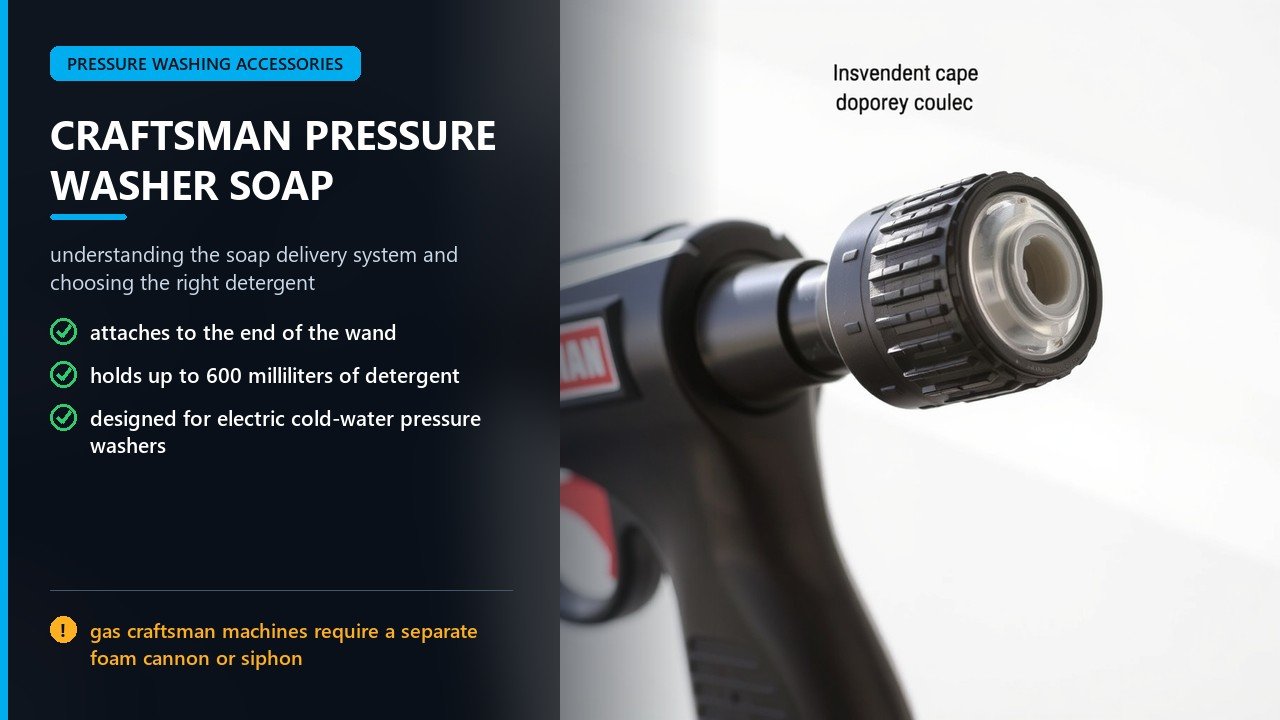
High-pressure soap applicator. Craftsman’s signature soap accessory is the High Pressure Soap Applicator, part CMZPWHPSB200. It attaches to the end of the wand with a quarter-inch quick connect and holds up to 600 milliliters of detergent in a bottle.
Clinging foam at pressure. Unlike a low-pressure siphon that dribbles soap, the Craftsman applicator applies detergent at high pressure to create a clinging foam, which stays on the surface and lifts dirt. It works on car paint, patios, siding, and more.
Machines with built-in soap. Many Craftsman electric models, such as the CMEPW1700 and CMEPW1800, include a high-pressure foam cannon or soap applicator bottle as part of the package, so soap delivery is ready out of the box.
Sold separately too. The applicator is also sold on its own as an accessory, letting owners of most Craftsman electric washers add foam capability without buying a new machine.
Compatibility limits. The applicator is rated for electric cold-water pressure washers up to 3000 PSI and about 1.2 GPM. It is not intended for gas machines, which is an important detail the packaging does not always make clear.
The Craftsman Soap Applicator in Detail
Understanding the accessory helps you use it well.
| Feature | Detail |
|---|---|
| Part number | CMZPWHPSB200 |
| Connection | 1/4 in quick connect |
| Bottle capacity | 600 ml |
| Pressure rating | Up to 3000 PSI |
| Compatibility | Electric cold-water washers |
Quick connect convenience. The quarter-inch quick connect is the same fitting used by Craftsman spray nozzles, so the applicator snaps on and off the wand in seconds. It is interchangeable with the machine’s other tips.
Bottle capacity. At 600 milliliters, the bottle holds enough diluted soap for a car or a patio job. Some users note it empties quickly at higher pressure settings, so a refill or a second bottle helps on big jobs.
Spray pattern. The applicator can be adjusted between horizontal and vertical spray patterns, letting you match the fan to the surface, which is useful for vertical siding versus flat ground.
Foam consistency. Results depend on soap type and dilution. A thin, low-foam pressure washer soap produces a consistent clinging foam, while a thick bucket soap can clog or foam unevenly at the nozzle.
What Soap to Use in a Craftsman Pressure Washer
The right soap keeps the system flowing and the surfaces safe.
Craftsman-branded detergent. The safest choice is pressure washer soap made or recommended for these machines. It is formulated to flow through the applicator and rinse clean.
pH-neutral car soap. For vehicles, a dedicated pH-neutral car wash soap protects wax, sealant, and ceramic coatings. Craftsman packages are sometimes paired with premium detailing soaps for exactly this reason.
Pressure-washer-safe cleaners. For siding, decks, and concrete, use cleaners labeled for pressure washers and the specific surface, such as deck cleaner or house wash.
Thin, low-foam liquids. Whatever the purpose, the soap should be thin and low-foam so it draws through the system without clogging the injector or applicator screen.
What to avoid. Dish soap, thick gel soaps, granular powders, and harsh degreasers. Dish soap strips wax and foams excessively, and thick or granular products clog the applicator.
| Surface | Recommended Soap |
|---|---|
| Car paint | pH-neutral car wash soap |
| Concrete and patios | Pressure washer concrete cleaner |
| Siding | House wash or siding cleaner |
| Decks | Deck cleaner (surface-safe) |
| Degreasing | Pressure washer degreaser |
How to Dilute Soap for a Craftsman
Dilution decides whether soap flows or clogs.
Follow the soap label. The manufacturer’s ratio, often around 1 part concentrate to 10 parts water, is the intended starting point. Some products specify different ratios for foam cannons.
Do not over-concentrate. Too much soap causes clogging, excessive foam, slow rinsing, and residue. Thicker is not cleaner.
Mix before filling. Dilute the soap and water first, then pour the mix into the applicator bottle or detergent tank. Never pour undiluted concentrate straight in unless the label says to.
Adjust to the job. Use a standard ratio for general cleaning and a slightly stronger mix only for heavy soil, staying within the label range.
Test first. Apply to a small hidden area to check for residue or streaking before treating the whole surface.
How to Use the Craftsman Soap Applicator
The steps are quick once you know them.
Step one: pre-rinse. Rinse the surface with a high-pressure nozzle to remove loose dirt and grit. Never soap a dusty car or patio.
Step two: fill the bottle. Pour diluted soap into the 600 ml applicator bottle and attach it to the quick connect on the wand.
Step three: apply the foam. Spray the surface with the applicator, working bottom to top on vertical surfaces so the foam does not dry before you reach the top.
Step four: let it dwell. Give the foam one to three minutes to lift dirt. Do not let it dry, especially in the sun.
Step five: agitate if needed. For dirty surfaces, use a soft brush or wash mitt on the foam-covered area, then rinse the tool often.
Step six: rinse. Remove the applicator and switch to a 25 or 40-degree nozzle. Rinse top down with overlapping passes.
Step seven: clean the applicator. Flush the bottle and nozzle with clean water after use so dried soap does not clog the screen.
Common Craftsman Soap Problems and Fixes
Most issues are easy to solve.
Soap not coming out. Check that the applicator is fully seated on the quick connect, the bottle has soap, and the nozzle screen is not clogged with dried soap.
Applicator clogs. Thick or granular soap is the usual culprit. Switch to a thin, pressure-washer-safe soap and flush the screen after every use.
Watery or weak foam. The mix is too dilute, or the soap is not formulated for foam. Adjust within the label range or choose a foam-oriented soap.
Foam too thin at pressure. Some soap types foam poorly at high pressure. A dedicated pressure washer or foam cannon soap produces a thicker, more clinging foam.
Applicator will not fit. It uses a quarter-inch quick connect. If your wand uses a different fitting, an adaptor bridges the gap. Our guide to pressure washer adaptors explains the common conversions.
Streaks after rinsing. Soap dried on the surface or was over-concentrated. Rinse sooner, work in the shade, and dilute more.
Craftsman Pressure Washer Models and Soap Features
The machine you own shapes how soap is delivered.
CMEPW1700. A compact 1700 PSI electric model that ships with a soap applicator bottle and a turbo nozzle. It is aimed at light-duty homeowners cleaning cars, patios, and furniture, and the included applicator makes soap work out of the box.
CMEPW1800. An 1800 PSI electric cold-water washer with a 13-amp motor and a high-pressure foam cannon included, plus a 20-foot kink-resistant hose and a 35-foot cord. The built-in foam cannon delivers clinging soap without an extra purchase.
Accessory applicator. The CMZPWHPSB200 soap applicator adds foam capability to most Craftsman electric, cold-water machines rated up to 3000 PSI, even if the machine did not include a foam cannon.
Quick-connect ecosystem. Craftsman uses a quarter-inch quick connect across its nozzles and the soap applicator, so tips and accessories interchange freely. That shared standard is a small but useful convenience.
Turbo nozzle. Many Craftsman kits include a turbo nozzle, which is not a soap accessory but pairs well with soap. Apply soap first, rinse, then use the turbo nozzle on hard surfaces like concrete. The nozzle colors are covered in our guide to power washer spray nozzles.
Choosing Soap by Surface
Matching soap to the surface protects it and cleans better.
Car paint and glass. A pH-neutral car wash soap is the only safe choice for vehicle paint and clear coat. It cleans without stripping wax or coatings and rinses residue-free.
Concrete and driveways. Use a pressure washer concrete cleaner for embedded dirt and stains. Concrete tolerates stronger cleaners than paint, and the turbo nozzle speeds the rinse.
Siding and house exteriors. A house wash or siding cleaner removes mildew and grime. Match the cleaner to vinyl, brick, or painted wood, and work top to bottom.
Decks and fences. Deck cleaners are formulated for wood and composite. Use a wide nozzle and moderate pressure to avoid raising the grain, and let the cleaner do the work.
Outdoor furniture and grills. Mild soap and low pressure suit furniture and grills. Degreasers help on grill surfaces, but keep them off painted or plastic parts that could stain.
Degreasing jobs. Engine bays, tools, and driveways with oil stains call for a pressure washer degreaser. Apply it, let it dwell, and agitate where needed before rinsing.
Maintaining the Soap System
A little care prevents clogs and keeps foam consistent.
Flush after every use. Run clean water through the applicator bottle and nozzle to clear soap before it dries. Dried soap is the number-one cause of clogged screens and weak foam.
Clean the bottle. Rinse the 600 ml bottle thoroughly, since leftover concentrate can thicken and block the pickup.
Inspect the screen. The applicator and injector contain a small mesh screen. Rinse it and clear any debris or dried soap that restricts flow.
Check the quick connect. Clean and lightly lubricate the O-ring on the quick connect so the applicator seats properly and does not leak.
Store soap properly. Keep detergent sealed and out of freezing temperatures, since freezing can separate some formulas and reduce performance.
Store the applicator dry. Let the bottle and nozzle dry before storage to prevent mildew and residue buildup.
Foam Cannon Versus Soap Applicator
Craftsman offers both styles, and the choice matters.
Soap applicator. Attaches at the wand tip with a quick connect. It is simple, compact, and easy to move between machines. It delivers clinging foam at the point of use.
Foam cannon. Mounts at the pump outlet or gun inlet and draws soap from a larger reservoir, producing thick, dense foam and covering large surfaces faster. It costs more and takes more setup.
Foam thickness. Cannons generally produce thicker, more stable foam than wand-tip applicators because they aerate the mix differently. For heavy detailing, a cannon has the edge.
Convenience. The applicator wins on simplicity and quick changes. For a homeowner cleaning a car and a patio, it is often all that is needed.
Which to buy. If your Craftsman machine already has an applicator bottle, start there. Upgrade to a foam cannon if you want maximum foam and faster coverage on large vehicles.
Craftsman Soap Versus Other Systems
Comparing helps you set expectations.
Downstream injectors. Many gas machines use a downstream injector that draws soap into the stream at low pressure. It is effective but applies soap at lower pressure and with less foam than a cannon or the Craftsman applicator.
Onboard detergent tanks. Some washers have a built-in tank that siphons soap through the pump. Convenient, but dilution control is limited and the tank needs cleaning.
Siphon tubes. A tube placed in a soap container draws detergent by vacuum. Simple, but it can siphon air when the container runs low.
Third-party foam cannons. Universal cannons work with Craftsman machines when fittings match, often producing excellent foam. They are a popular upgrade for detailers.
The Craftsman approach. Craftsman leans on a quick-connect applicator that balances simplicity with decent foam, which suits its homeowner audience well.
Getting the Best Foam
Small changes make a big difference in foam quality.
Use the right soap. Foam-oriented, pressure-washer-safe soap produces thicker foam than a generic liquid. Watery foam usually means the wrong soap or too much water.
Dial in the dilution. Slightly stronger mixes foam more, but over-concentrating causes clogging and residue. Find the balance within the label range.
Keep the nozzle clean. A partially clogged screen restricts flow and thins the foam. Rinse the screen often.
Work in sections. Foam dries fast in the sun. Work one section at a time, apply, dwell briefly, and rinse before moving on.
Use warm water if allowed. Some soaps foam better with warmer water, though you must stay within the machine’s temperature limits, which for many Craftsman electric units is cold to lukewarm water only.
Safety and Surface Care
Soap is only half the equation, technique is the other half.
Pre-rinse everything. Loosen dirt with water before applying soap, so you are not grinding grit into paint or pushing mud deeper into concrete pores.
Keep the wand moving. A stationary wand, especially at close range, etches paint and strips coatings. Continuous motion spreads both pressure and soap evenly.
Mind the distance. At the soap setting, keep the applicator a comfortable distance from the surface. At high pressure, back off further to protect delicate materials.
Protect trim and seals. Avoid driving high-pressure water into window seals, panel gaps, and trim edges, where it forces moisture behind the surface.
Watch the sun. Direct sunlight dries soap quickly and leaves streaks. Wash in the shade or during cooler hours and work in sections.
Rinse thoroughly. Leftover soap attracts dirt and dulls finishes. A clean-water rinse after the foam pass protects the surfaces you just cleaned.
Where to Buy Craftsman Soap and Accessories
Sourcing is straightforward.
Craftsman direct. Craftsman sells the soap applicator and related accessories directly and through its retail partners, often with the part number CMZPWHPSB200 for the applicator.
Major retailers. Large home improvement and hardware retailers stock Craftsman pressure washers, accessories, and cleaning detergents, so replacement parts and soap are easy to find.
Third-party soaps. You are not limited to Craftsman-branded soap. Any thin, pressure-washer-safe detergent works, including dedicated car wash and surface cleaner brands.
Foam cannons. Universal foam cannons are sold widely and work with Craftsman electric machines when the quick connect matching is correct.
Buy the adaptor if needed. If a third-party accessory uses a different fitting, a quarter-inch quick-connect adaptor makes it compatible.
Frequently Asked Questions
What soap do you use in a Craftsman pressure washer? Use pressure-washer-safe soap, such as Craftsman detergent or a pH-neutral car wash soap, chosen for the surface. Avoid dish soap and thick or granular products.
Does the Craftsman soap applicator work with gas pressure washers? No. The CMZPWHPSB200 applicator is designed for electric cold-water pressure washers up to 3000 PSI. For gas machines, use a separate foam cannon or siphon setup.
How much soap does the Craftsman applicator hold? The bottle holds up to 600 milliliters of detergent, which covers a car or a patio but may need a refill on large jobs.
Can I use dish soap in a Craftsman pressure washer? No. Dish soap strips wax and coatings and foams excessively. Use a dedicated pressure washer or car wash soap instead.
How do I dilute soap for a Craftsman pressure washer? Follow the soap label, commonly around 1 part concentrate to 10 parts water. Mix before filling and do not over-concentrate, which causes clogging and residue.
Why is my Craftsman soap applicator not foaming? The soap may be too thick or not foam-formulated, or the mix may be too dilute. Use a thin foam-oriented soap and check the dilution.
Is the Craftsman soap applicator the same as a foam cannon? It produces a similar clinging foam, but it attaches at the wand tip with a quick connect, whereas a foam cannon mounts higher in the system. Both apply thick soap.
What pressure rating does the Craftsman soap applicator support? The applicator is rated for electric cold-water pressure washers up to 3000 PSI and about 1.2 GPM, so it suits Craftsman’s homeowner electric models.
Can I use the Craftsman soap applicator on any pressure washer brand? It works on machines that use a quarter-inch quick connect and are electric cold-water units within the pressure rating. Adapters help if the fitting differs.
How much soap should I put in the Craftsman applicator bottle? Fill the 600 ml bottle with properly diluted soap, mixing per the product label, usually around 1 part concentrate to 10 parts water.
Why does my Craftsman soap bottle empty so fast? Higher pressure settings draw soap more quickly, and some mixes foam and flow faster than others. For large jobs, pre-mix a second bottle or work in sections.
Do I need a foam cannon for a Craftsman pressure washer? No, the included or optional soap applicator handles most homeowner jobs. A foam cannon is a worthwhile upgrade for thick foam and faster coverage on large vehicles.
Can I put car wash soap in a Craftsman pressure washer? Yes, a pH-neutral car wash soap is ideal for vehicles. Use it in the applicator or foam cannon and follow the dilution instructions, and rinse thoroughly afterward to avoid residue.
Does Craftsman make its own pressure washer soap? Craftsman focuses on the applicator and foam delivery and pairs its machines with quality detergents. You can use Craftsman-branded cleaner or any thin, pressure-washer-safe soap that suits the surface.
Quick Start Checklist
A fast reference for the next time you wash.
Before you start. Confirm the applicator fits your wand’s quick connect, mix the soap to the label ratio, and pre-rinse the surface.
During the wash. Apply foam from the bottom up, keep the nozzle moving at a safe distance, dwell one to three minutes, and never let soap dry in the sun.
After the wash. Rinse top down with a 25 or 40-degree nozzle, dry vehicles with a microfiber towel, and flush the applicator with clean water.
Storage. Store soap sealed and above freezing, and store the applicator dry so the screen does not clog before the next use.
Remember the limits. The Craftsman applicator is for electric cold-water machines up to 3000 PSI, so on a gas washer, switch to a foam cannon or siphon instead. Using the wrong delivery method on the wrong machine is a common source of frustration and poor foam.
Final Thoughts on Craftsman Pressure Washer Soap
Craftsman pressure washer soap is a system, not just a bottle. The brand’s High Pressure Soap Applicator delivers clinging foam through a simple quarter-inch quick connect, and it works best with thin, pressure-washer-safe soaps chosen for the surface you are cleaning. Match the soap to the job, dilute it per the label, apply it at the right angle, and flush the applicator after every use to keep the foam flowing.
Renee’s clogged applicator came down to using the wrong soap, and it is a mistake you can avoid entirely. Buy a thin, foam-friendly detergent, keep the mix correct, and understand that the applicator is for electric machines only. Do that, and the Craftsman soap system becomes one of the easiest ways to get a clean car or patio without scrubbing every square inch by hand.
The takeaway is refreshingly simple. Craftsman built an easy, quick-connect soap system around a large-bottle applicator, and it rewards owners who use the right detergent and keep the screen clean. Choose soap by surface, dilute it by the label, apply foam from the bottom up, dwell briefly, and rinse top down. Flush the applicator, store it dry, and the next wash will be faster and cleaner than the last, whether you are detailing a car or refreshing a concrete patio.