Of all the nozzle options for a pressure washer, the turbo nozzle is the one that changes the game on hard surfaces. It cleans faster and harder than a standard tip, cutting through grime that would otherwise demand a much more powerful machine. But not every turbo nozzle is the same, and the wrong one can underperform or even damage a surface or a pump. Finding the best pressure washer turbo nozzle means understanding how they work and matching one to your machine and your work.
A turbo nozzle, sometimes called a rotating or rotor nozzle, spins a zero-degree stream in a tight circle. The result is the cleaning force of a pencil jet spread over a small area, which removes dirt far faster than a fixed nozzle of the same pressure. It is a favorite for concrete, masonry, and heavy-duty cleaning, and for good reason.
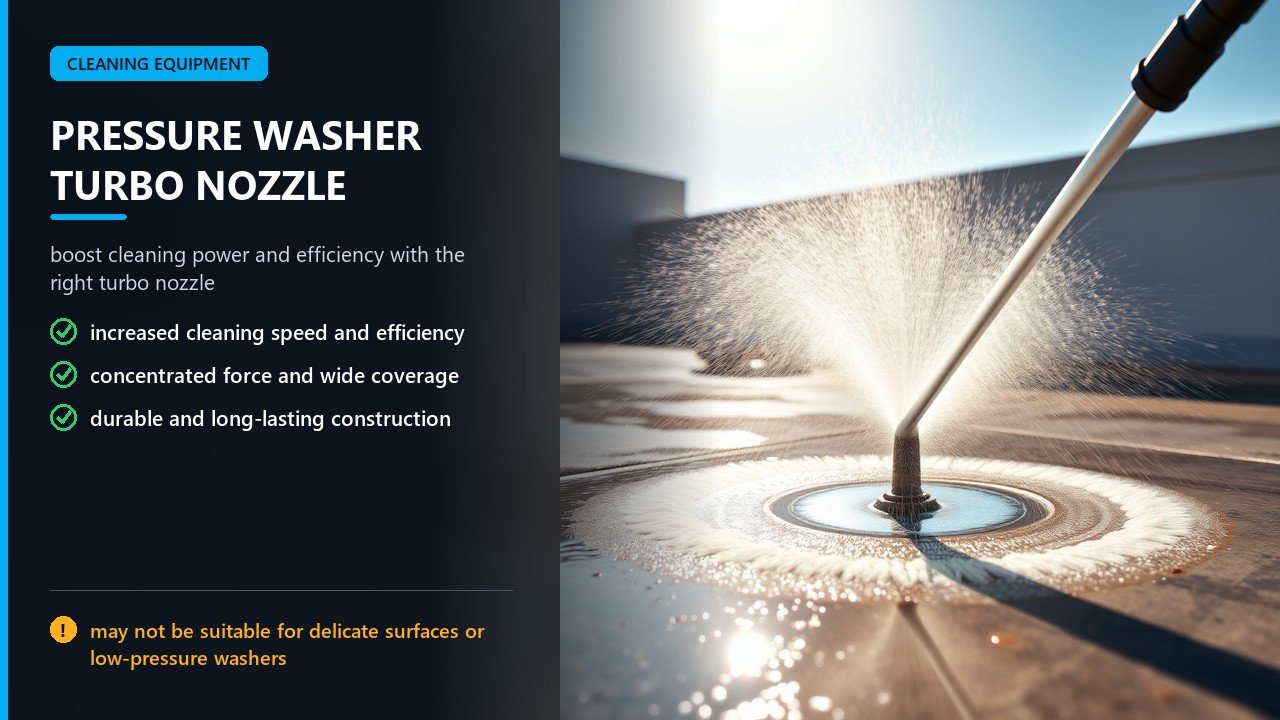
What a Turbo Nozzle Is
A turbo nozzle is a specialty tip that rotates a high-pressure stream to multiply cleaning power.
Rotating jet. Inside the nozzle, a small rotor spins a zero-degree jet, sweeping the spray in a circle.
Effective pattern. The result is like a 25-degree spray with the force of a 0-degree jet, combining coverage with impact.
Higher cleaning power. The rotating stream delivers more concentrated force than a standard tip at the same pressure.
Physical form. Turbo nozzles are larger than standard tips, often with a colored collar, and they snap into the wand with the machine’s quick connect.
How a Turbo Nozzle Works
Understanding the mechanism explains both its power and its limitations.
The rotor. A small internal rotor turns the stream as water passes through, creating the circular sweep.
Centrifugal action. The spinning motion is driven by the water flow itself, so the nozzle needs adequate flow to spin properly.
Flow dependence. If the machine’s GPM is too low, the rotor spins slowly or stalls, and cleaning performance suffers.
Pressure and flow together. The best turbo nozzle performance comes from matching the nozzle to both the pressure and the flow of the machine.
No moving maintenance. Because the rotor is driven by flow, there is little to service, though debris can clog the small orifice.
Benefits Over Standard Nozzles
The turbo nozzle’s advantages are practical and measurable.
Speed. It cleans flat surfaces significantly faster than a fixed nozzle, saving time on large jobs.
Power. It removes stubborn grime, like tire marks and embedded dirt, more effectively.
Fewer passes. Because it covers ground quickly and with force, fewer passes are needed.
Effectiveness on concrete. On driveways, sidewalks, and patios, it produces a striking before-and-after result.
Efficiency. Less time cleaning means less water and fuel used overall.
For hard-surface cleaning, a good turbo nozzle can make a modest machine perform like a stronger one, which is why it is such a popular upgrade.
When to Use a Turbo Nozzle
Turbo nozzles suit hard, durable surfaces where extra power helps.
Concrete driveways. A classic use, where the rotating jet lifts dirt and stains quickly.
Sidewalks and patios. Concrete and stone flatwork clean fast and evenly with a turbo tip.
Brick and masonry. Brick walls and stone benefit from the added cleaning force.
Heavy grime. Areas with embedded dirt, moss, or algae clean more easily.
Fences and hard landscaping. Durable materials clean well, with care around softer wood.
When Not to Use a Turbo Nozzle
Just as important is knowing when to reach for a gentler tip.
Car paint. The concentrated force can strip paint, clear coat, and decals. Never use a turbo nozzle on a vehicle’s body.
Wood surfaces. Decks and siding can be gouged and etched, and the surface raised. Use a wide nozzle instead.
Soft or delicate materials. Vinyl, soft plastics, and thin panels can be damaged.
Windows and glass. High pressure can crack glass or force water past seals.
Loose paint or finishes. The force can strip coatings you meant to keep.
Direct spray near people. The concentrated jet is dangerous, so never aim it toward people or animals.
Sizes, Flow, and Ratings
Turbo nozzles are sized by flow and rated for pressure, and matching both is essential.
Flow size (orifice). Turbo nozzles come in sizes matched to a machine’s GPM, such as 2.5, 3.0, 3.5, 4.0, and higher. The wrong size either fails to spin or restricts flow.
Pressure rating. Every turbo nozzle has a maximum pressure. Choose one rated at or above your machine’s PSI.
Too small. An undersized nozzle restricts flow, reduces performance, and can overpressure the pump.
Too large. An oversized nozzle reduces pressure and may not spin, cleaning poorly.
Match to GPM. The most important match is the nozzle size to the machine’s GPM, since flow drives the rotor.
| Machine GPM | Turbo Nozzle Size |
|---|---|
| 1.5-2.0 | 2.0-2.5 |
| 2.5-3.0 | 3.0-3.5 |
| 3.5-4.0 | 4.0-4.5 |
| 4.5+ | 5.0 and up |
Materials and Build Quality
The best turbo nozzles use quality materials and precise construction.
Stainless steel. The orifice and rotor are often stainless, resisting wear and corrosion for longer life.
Ceramic orifice. Some premium nozzles use ceramic orifices, which resist wear even better and hold their spray pattern longer.
Brass or metal body. Metal bodies withstand high pressure and heat without cracking, unlike cheaper plastic parts.
Sealed rotor. A well-sealed rotor keeps debris out and spins reliably, while cheap designs clog or seize.
Quality control. Precise manufacturing ensures the rotor spins smoothly and the pattern stays consistent.
For heavy or frequent use, a stainless or ceramic-orifice nozzle with a metal body is worth the higher price, as it lasts far longer and performs more consistently.
Compatibility
Before buying, confirm the nozzle fits your machine.
Quick connect size. Most turbo nozzles use a 1/4-inch quick connect, the common size for wands and guns, but confirm your machine’s size.
Adapters. If sizes differ, adapters can bridge them, though they should be rated for the pressure.
Pressure and flow. As always, match the nozzle’s pressure rating and flow size to your machine.
Wand compatibility. Ensure the nozzle fits your wand or gun without a leak, and that the connection is secure under pressure.
How to Choose the Best Turbo Nozzle
The right choice balances machine, job, and build quality.
Match the flow. Choose the nozzle size for your machine’s GPM. This is the single most important factor.
Match the pressure. Ensure the nozzle is rated for at least your machine’s PSI.
Check the connection. Confirm the quick connect size matches your equipment.
Prioritize materials. Favor stainless or ceramic orifices and metal bodies for durability.
Consider the job. For occasional home use, a mid-range nozzle suffices; for frequent or commercial work, invest in a premium one.
Read reviews. Other users’ experiences reveal which nozzles spin reliably and last.
Turbo Nozzles for Different Machines
Different machines call for different turbo nozzle considerations.
Small electric machines (1.2-1.6 GPM). Choose small nozzles sized to the lower flow, and expect moderate performance, since the rotor needs flow to spin.
Larger electric and light gas (2.0-2.8 GPM). Mid-size nozzles deliver strong turbo cleaning on concrete and patio surfaces.
Heavy gas machines (3.0 GPM+). Larger nozzles harness high flow for fast, powerful cleaning, ideal for commercial flatwork.
Hot water machines. Choose a turbo nozzle rated for heat, with materials that resist high temperatures.
Low-flow machines. If flow is very low, a turbo nozzle may not spin well, and a standard nozzle might serve better.
| Machine | Nozzle Focus |
|---|---|
| Small electric | Small size, modest expectations |
| Mid electric/gas | Mid-size, strong flatwork |
| Heavy gas | Large size, commercial power |
| Hot water | Heat-rated, durable materials |
Safety With a Turbo Nozzle
The turbo nozzle’s concentrated force demands caution.
Never aim at people or animals. The rotating jet can cause serious injury at close range.
Keep a safe distance. Even on concrete, get too close and the nozzle can etch or gouge the surface.
Test first. On an unfamiliar surface, test in a hidden area to confirm it will not damage it.
Wear protection. Use eye protection, and beware of splash and debris kicked up by the force.
Maintain a firm grip. The recoil and rotating pattern can be harder to control than a standard nozzle.
Respect surfaces. Never use a turbo nozzle on paint, wood, or delicate materials.
Maintenance and Troubleshooting
Turbo nozzles need little care, but a few habits keep them spinning.
Keep it clean. Debris clogs the small orifice and stops the rotor. Rinse and clear the nozzle after use.
Check for spin. If the pattern stops rotating, the rotor may be clogged or worn.
Replace when worn. An enlarged or worn orifice weakens the spray and reduces performance, a sign to replace the nozzle.
Filter the water. A clean inlet filter keeps debris out of the nozzle and pump.
Store carefully. Protect the nozzle from impact that could damage the rotor or orifice.
Winterize. Drain nozzles before freezing weather to prevent cracking.
Understanding Orifice Sizes
The orifice is the opening that determines flow, and it is the key to matching a nozzle.
What it controls. The orifice size sets how much water the nozzle passes at a given pressure, so it directly affects whether the machine performs at its rated flow.
Numbering. Nozzle sizes are numbered to correspond with flow at a standard pressure, so a size 3.0 passes roughly 3 GPM at that pressure.
Why it matters for turbos. A turbo nozzle needs adequate flow to spin the rotor. An orifice that is too small starves the rotor, and one that is too large drops pressure and spin speed.
Overpressure risk. Using a nozzle smaller than the machine’s rating restricts flow, which can raise pressure and stress the pump.
The rule. Match the orifice number to the machine’s GPM as closely as possible, then confirm the nozzle’s pressure rating.
Getting the orifice right is the difference between a turbo nozzle that spins powerfully and one that sputters, and it protects the pump from unnecessary stress.
Turbo Nozzle vs Surface Cleaner
Both clean flatwork, but they suit different jobs.
Speed and evenness. A surface cleaner covers ground faster and more evenly, enclosed in a skirt that contains splash and prevents stripes.
Precision and access. A turbo nozzle reaches edges, corners, and irregular surfaces a surface cleaner cannot, and it works on walls and vertical faces.
Splash. A turbo nozzle throws more splash and mist, while a surface cleaner contains it.
Flow needs. Surface cleaners need higher flow to work well, while a turbo nozzle functions on a wider range of machines.
Best practice. Use a surface cleaner for large, open, flat areas and a turbo nozzle for edges, tough spots, and vertical or irregular surfaces.
Many operators keep both, using the surface cleaner for the bulk of flatwork and the turbo nozzle for the details and stubborn spots.
Cleaning Concrete With a Turbo Nozzle
A simple routine gets the best from a turbo nozzle on concrete.
Step 1: Clear and pre-treat. Sweep the surface and apply detergent to loosen grime, especially in oil-stained areas.
Step 2: Test an area. Try a small, hidden patch to confirm the pressure will not etch the concrete.
Step 3: Work in sections. Move in overlapping passes, keeping an even distance and consistent speed.
Step 4: Watch for striping. Uneven passes leave visible marks, so keep the motion steady and overlap generously.
Step 5: Rinse and inspect. Rinse away loosened dirt and check for missed spots, giving stubborn areas another pass.
Done well, turbo cleaning leaves concrete visibly brighter and removes marks that a standard nozzle would labor to touch.
Real-World Examples
Practical scenarios show where a well-chosen turbo nozzle earns its place.
A homeowner with a concrete driveway. A turbo nozzle sized to the machine removes years of grime in a fraction of the time a standard tip would take.
A contractor cleaning patios. On hard stone and concrete, the turbo nozzle speeds up large jobs, with a surface cleaner for the broad areas.
A farm cleaning concrete pads. Muddy, stained pads around barns and equipment clean quickly with a turbo nozzle matched to a higher-flow machine.
A vehicle owner. Knowing a turbo nozzle is unsafe on paint, the owner uses it only on the concrete pad and chooses a gentle nozzle for the vehicle.
In each case, matching the nozzle to the machine and the surface delivers fast, safe, effective cleaning.
Common Mistakes to Avoid
Wrong size for the flow. The most common mistake. A nozzle mismatched to GPM spins poorly or restricts flow. Match the size.
Ignoring the pressure rating. Using a nozzle rated below your machine’s pressure risks failure. Match or exceed it.
Using it on delicate surfaces. Turbo nozzles damage car paint, wood, glass, and soft materials. Reserve them for hard surfaces.
Buying the cheapest option. Cheap turbo nozzles clog, spin poorly, and fail quickly. Quality materials last far longer.
Wrong quick connect size. A mismatch leaks or will not fit. Confirm your machine’s size.
Getting too close. Even on concrete, close-range spray etches and gouges. Keep a steady distance.
Ignoring the rotor. A clogged rotor cleans poorly. Clean the nozzle and check that it spins.
Buying Checklist
A quick checklist helps you buy the right turbo nozzle the first time.
Know your machine’s GPM. This determines the correct nozzle size, and it is the most important number.
Know your machine’s PSI. Choose a nozzle rated at or above this pressure.
Confirm the connection. Most use 1/4-inch quick connect, but verify your equipment’s size.
Choose quality materials. Stainless or ceramic orifice and a metal body last longer and perform better.
Check reviews. Reliable spinning and durability show up in user feedback.
Consider a kit. Some sellers offer turbo nozzles with multiple sizes, helpful if you own more than one machine.
With these details in hand, selecting a turbo nozzle becomes straightforward, and the payoff, faster, easier cleaning of hard surfaces, is immediate.
Frequently Asked Questions
What is the best turbo nozzle for a pressure washer? The best one is sized to your machine’s GPM and rated for its pressure, with a stainless or ceramic orifice and metal body for durability.
Are turbo nozzles worth it? For hard-surface cleaning like concrete and masonry, yes. They clean faster and more powerfully than standard nozzles, saving significant time.
What size turbo nozzle do I need? Match the nozzle size to your machine’s GPM. Using the wrong size causes poor spinning or restricted flow, so check your machine’s flow rating.
Can I use a turbo nozzle on a car? No. Turbo nozzles can strip paint and damage finishes. Use a wider, gentler nozzle for vehicles.
Why is my turbo nozzle not spinning? Low flow, an undersized nozzle, or debris in the rotor can stop the spin. Check the machine’s GPM, the nozzle size, and clean the nozzle.
Do turbo nozzles work on low-GPM machines? They can, but performance is limited because the rotor needs flow. Very low-flow machines may clean better with a standard nozzle.
How long does a turbo nozzle last? With quality materials and good care, a turbo nozzle lasts a long time. Worn orifices that lose their pattern should be replaced.
What is the difference between a turbo nozzle and a rotating nozzle? They are the same thing. Turbo, rotating, and rotor are different names for the nozzle that spins a zero-degree jet.
Can I use a turbo nozzle for cleaning a deck? No, its concentrated force can gouge and etch wood. Use a wider nozzle for decks and other soft surfaces.
Do turbo nozzles use more water? No, they use the machine’s flow, but they clean faster, so total water used on a job is often lower.
Will a turbo nozzle clean paint off concrete? It can strip loose or poorly bonded paint along with dirt, which is sometimes desirable but must be intended. Test first.
Can I use a turbo nozzle with hot water? Yes, if the nozzle is rated for heat and made from materials that withstand high temperatures.
How do I know my turbo nozzle is working properly? It should spin continuously under use, producing a fast rotating pattern. If it stalls or sprays unevenly, clean it or check the flow.
Final Thoughts
The best pressure washer turbo nozzle is the one that matches your machine’s flow and pressure and holds up under use. Sized correctly and built from quality materials, it unlocks far faster and more powerful cleaning on concrete, masonry, and other hard surfaces, turning a modest machine into a serious cleaner.
Match the nozzle to your GPM first, confirm the pressure rating and connection, and invest in durable materials. Then use it wisely, reserving its concentrated force for hard surfaces and keeping a safe distance. Chosen and used well, a turbo nozzle becomes one of the most valuable accessories a pressure washer owner can own.