There is a small feature on most pressure washers that gets used incorrectly more often than almost any other, and it is the soap dispenser. People pour in dish soap, crank the dial, and expect a thick blanket of foam, then wonder why nothing happens. The soap dispenser, sometimes called the detergent tank or soap nozzle system, is one of the simplest parts of a pressure washer, but it only works well when you understand how it draws soap, which nozzle to use, and how to avoid the mistakes that leave you rinsing with plain water. Learning how to use soap dispenser on pressure washer properly is a quick win that makes every cleaning job faster and more effective, especially on siding, vehicles, and grimy surfaces.
This guide explains how the soap dispenser works and how to use it correctly. We will cover the types of soap systems, which nozzle to use, how to mix and load soap, how to apply and rinse, the role of the downstream injector, common mistakes, and safety. By the end, you will know exactly how to get soap out of your pressure washer and onto the surface where it can do its job.
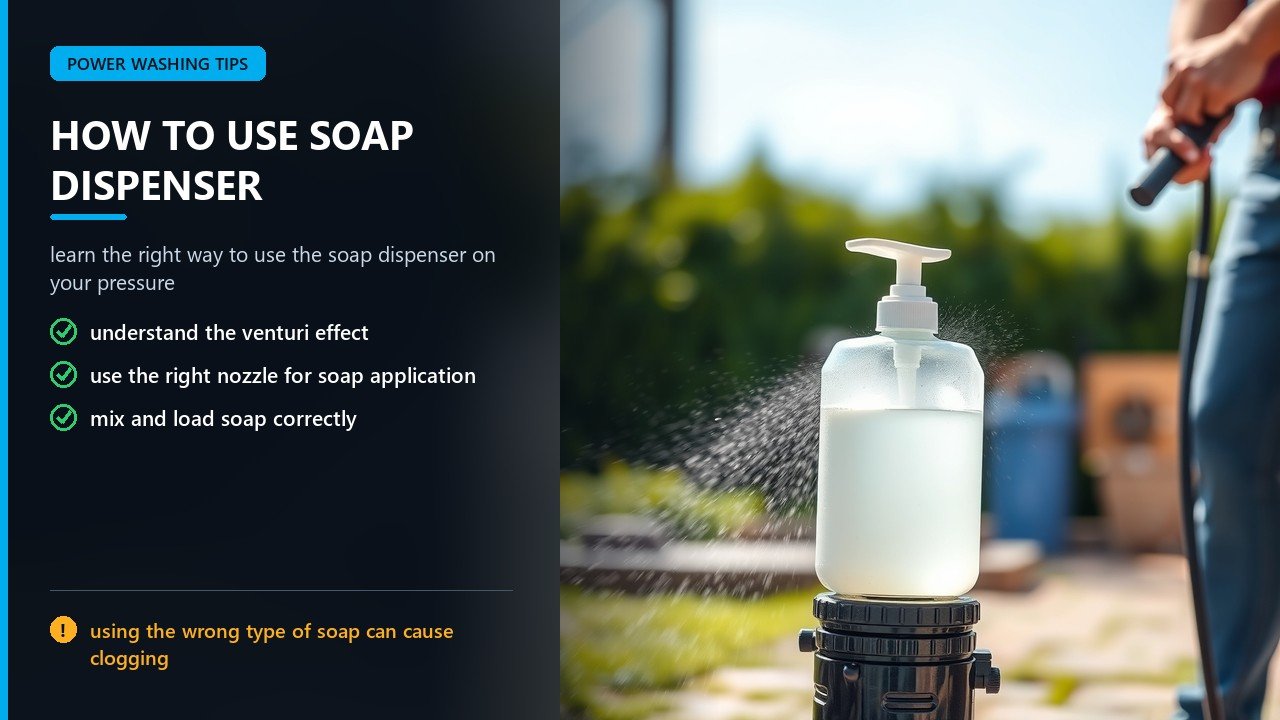
How the Soap Dispenser Works
Most pressure washer soap systems use a venturi effect, a drop in pressure that draws soap into the water stream.
- Low-pressure flow: Soap is drawn in when the water is at low pressure.
- The soap nozzle: A wide-angle nozzle, often black, that enables the draw.
- The tank or bottle: Holds the soap mixture.
- The injector or pickup tube: Draws soap into the stream.
The key is that soap only draws at low pressure. On high pressure, the system does not siphon soap, which is why using the wrong nozzle defeats the whole thing.
Types of Soap Systems
| System | How It Works | Typical On |
|---|---|---|
| Onboard detergent tank | Built-in tank feeds the injector | Many gas and larger electric machines |
| Detergent bottle | A bottle attached to the gun or wand | Compact electric machines |
| Downstream injector | Injects soap into the low-pressure stream | Machines with a soap setting |
| Foam cannon | Uses pressure and air to make thick foam | Car washing and detailing |
Whatever the type, the principle is the same: soap draws at low pressure and is applied before rinsing at higher pressure.
Which Nozzle to Use
| Nozzle | Purpose |
|---|---|
| Black (soap) | Wide, low-pressure spray for applying soap |
| White (40 degrees) | Gentle rinsing |
| Green (25 degrees) | General cleaning and rinsing |
The black soap nozzle is the key. It lowers pressure and opens the spray so soap can be drawn and applied evenly.
How to Mix and Load Soap
- Choose the right soap for the surface and your machine.
- Dilute per the product instructions, since concentrate can be too strong.
- Fill the tank or bottle with the mixture.
- Attach the pickup tube or secure the bottle.
- Prime the system by running at low pressure until soap appears.
- Check the ratio and adjust as needed.
Applying and Rinsing
- Pre-rinse the surface to remove loose dirt.
- Install the soap nozzle and select low pressure.
- Apply soap from the bottom up for even coverage.
- Let it dwell per the product instructions, without letting it dry.
- Switch to a rinse nozzle and higher pressure.
- Rinse top to bottom to avoid re-soiling cleaned areas.
- Flush the system with clean water when done.
The Downstream Injector
- Draws soap into the stream after the pump, at low pressure.
- Requires low pressure to function, like other soap systems.
- Often adjustable, letting you control the soap ratio.
- Common on machines with a soap or chemical setting.
Common Mistakes
- Using high pressure with soap. Soap will not draw.
- Skipping the soap nozzle. The system will not siphon.
- Using too much soap. Residue attracts dirt and is hard to rinse.
- Letting soap dry. It leaves streaks and is difficult to remove.
- Using the wrong soap. Harsh chemicals can damage surfaces or the machine.
- Forgetting to flush. Leftover soap clogs the injector and lines.
Safety
- Handle soap and chemicals with care.
- Protect eyes and skin.
- Never mix chemicals that can react dangerously, such as bleach and ammonia.
- Keep soap out of storm drains where required.
- Ventilate when using strong solutions.
- Rinse plants before and after applying soap near landscaping.
Frequently Asked Questions
How do I make the soap dispenser work on my pressure washer?
Install the black soap nozzle or select the soap setting, run at low pressure, and make sure the tank or bottle has soap and the pickup tube is in the liquid. Soap draws only at low pressure.
Why is my pressure washer not drawing soap?
Most often because the machine is at high pressure with a narrow nozzle. Switch to the soap nozzle or low-pressure setting, check the pickup tube, and prime the system.
What soap should I use in a pressure washer?
Use soap made for pressure washers and suited to the surface. Dilute per the instructions, and avoid harsh chemicals that can damage surfaces or the machine.
Can I use dish soap in a pressure washer?
Use pressure washer soap for best results. Dish soap can create too much foam and leave residue, and some users prefer it only in small amounts for light jobs.
Why do I need a soap nozzle?
The soap nozzle lowers pressure and widens the spray so soap can be drawn into the stream and applied evenly. Without it, the dispenser will not work.
Final Thoughts
Using the soap dispenser on a pressure washer is simple once you know the rule that governs every system: soap draws at low pressure. Install the soap nozzle or select the soap setting, load the right mixture, apply from the bottom up, let it dwell, and rinse top to bottom.
Flush the system after every use, use the right soap, and plan where runoff goes. Master these basics, and your soap dispenser becomes one of the most useful parts of the machine, making cleaning faster, easier, and far more effective.