Trailer mounted pressure cleaners are the practical answer for anyone who needs serious cleaning power at many different places. Instead of dragging a machine and a separate bucket to each job, you tow the whole operation behind a vehicle: the pressure washer, the water supply, the hose, the fuel, and every accessory, all arranged on a purpose built trailer. For a growing cleaning business, grounds team, farm, or contractor, this changes the way work is done, because the equipment is always ready to go and everything needed is already in one place. This guide explains what trailer mounted pressure cleaners are, why teams choose them, how the components work together, and what to consider before you buy, so you can decide whether a trailer setup is the right move for your work.
What Trailer Mounted Pressure Cleaners Are
Before comparing models, it helps to understand exactly what a trailer mounted setup includes and how the parts fit together into a single working system.
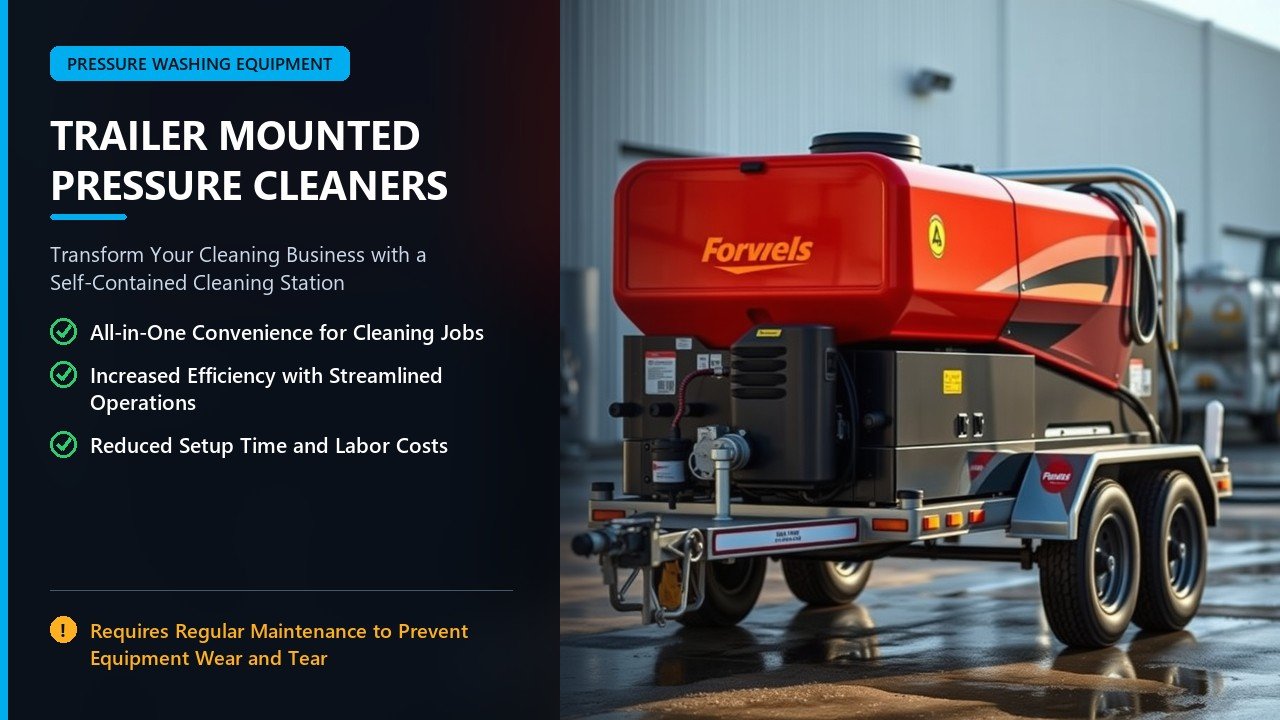
The basic layout of a trailer setup. A trailer mounted pressure cleaner is a pressure washing system built permanently onto a road trailer. At its heart is a pressure washer, either a single powerful machine or a pair running together, chosen to suit the pressure and flow the work demands. Around it are arranged the supporting systems that make the machine usable in the field: a water tank, or the plumbing to connect to a mains supply, a fuel tank for a petrol or diesel engine, batteries for electric start and controls, a hose reel with high pressure hose, and storage for wands, nozzles, and cleaning chemicals. All of this sits within a robust trailer frame, often with its own canopy or weather cover, so the whole unit can be towed to a site, parked, and put to work within minutes. The result is a complete mobile clean station rather than a machine that must be unpacked and assembled every time it is used.
How it differs from a portable pressure washer. The difference between a trailer mounted pressure cleaner and a portable machine is not just size, it is a different way of working. A portable unit has to be lifted, carried, set up, connected, and packed away for every job, which limits how much you can carry and how quickly you can move. A trailer, by contrast, stays loaded and ready, so starting a job is a matter of unhitching, connecting, and switching on. It carries far more water, fuel, and equipment than any portable rig, and it keeps everything organised and protected in transit. That means more cleaning time and less preparation time, which is exactly what a busy operator values. The trade off is that a trailer needs a vehicle capable of towing it, somewhere to store it, and a slightly higher level of care, but for regular professional work the time and effort saved quickly outweigh these considerations.
Why Teams Choose a Trailer Setup
Understanding the advantages of a trailer explains why so many cleaning businesses build their operation around one and rarely go back to carrying equipment by hand.
Time saved on every job. The clearest benefit of trailer mounted pressure cleaners is the time they return to the operator. When everything is already loaded, protected, and connected on the trailer, arriving at a site means unhitching, checking the setup, and beginning work within minutes, rather than unloading a heavy machine, finding a water supply, and hunting for the right nozzle. At the end of the job the reverse process is just as quick, so more of the working day is spent cleaning and less on preparation. Across a week of jobs, that saved time adds up to hours, and across a season it can amount to many extra paid jobs. For a business that charges by the day or by the job, being able to start and finish faster is a direct and obvious gain, and it is often the single strongest reason owners choose a trailer over any other arrangement.
Independence from on site water and power. A second major advantage is that a trailer frees you from relying on a customer’s water tap and electrical supply, both of which can be awkward, unavailable, or unsuitable. With your own water tank and fuel, you can work anywhere your vehicle and trailer can reach, including remote sites, building plots, fields, and car parks with no services at all. This independence removes the need to negotiate access to a tap, to run hoses through a building, or to worry about a supply that cannot keep up with the machine. It also means you can control the quality and pressure of your water supply, avoiding the flow problems and contamination that a poor mains feed can cause. For commercial and remote work, this self sufficiency is invaluable, and it is what allows a professional cleaner to take on jobs that others simply cannot manage with a hand carried machine and a borrowed tap.
Machine Types and Power Options
The pressure washer at the centre of the trailer determines what the whole setup can do, so choosing the right machine matters more than any other decision.
Cold water, hot water, and engine types. Trailer mounted pressure cleaners are built around cold water machines, hot water machines, or both. Cold water units are simpler, cheaper, and lighter, and they handle most general exterior cleaning well. Hot water machines add a burner and a fuel system to heat the water, which greatly improves results on grease, oil, and stubborn grime, making them the standard choice for commercial kitchen, industrial, and fleet cleaning. The engine or motor that drives the pump also varies: petrol engines suit lower cost and lighter weight, diesel engines offer durability, fuel economy, and long life for heavy daily use, and electric motors suit quiet, emission free work where power is available. The right combination depends on the work you do, and it is worth matching the machine to the job rather than buying more or less than you need. A machine slightly more capable than today’s tasks is usually the wiser long term choice.
Matching pressure and flow to the job. Beyond the type of machine, the pressure and flow it delivers decide what tasks it can handle. Pressure, measured in bar or psi, is what drives dirt off a surface, while flow, measured in litres or gallons per minute, decides how quickly an area can be cleaned and how well the machine rinses. A balance of both is what makes a machine productive, and a trailer often benefits from a machine with high flow, since large exterior areas are cleaned more quickly with volume than with extreme pressure alone. It is also wise to allow headroom for the work you expect to take on next year, not just today. Choosing a machine that suits your typical work, with a little extra capacity for growth, gives a trailer setup that stays useful as your business develops rather than needing replacement within a season or two, which is why a little extra capability is rarely money wasted.
Water Tanks and Supply
Water supply is the part of a trailer setup that most often limits performance, so it deserves careful thought.
Sizing the water tank. The size of the water tank determines how long you can work before needing to refill, and it must be matched to the machine’s flow rate. A simple calculation helps: divide the tank capacity by the machine’s rated flow to find the running time in minutes, then compare that with how long you need to work between refills. A machine using twenty litres a minute on a five hundred litre tank gives about twenty five minutes of continuous work, which is fine for smaller jobs but too short for a full day. Many professionals choose a tank large enough to cover their typical job, or they plan to refill on site or top up from a mains supply when available. Working out this maths before buying prevents the frustration of running dry halfway through a job and having to stop to refill. Planning the tank around your longest typical job avoids that frustration entirely.
Feed systems, tanks, and buffer tanks. How the water reaches the pump matters as much as how much you carry. Mains fed trailers connect directly to a tap through a float tank or a break tank, which acts as a buffer so the machine always draws from a steady reservoir rather than from an uncertain supply. Tank fed systems draw from an onboard tank, often through a filter, and may use a booster pump or a float valve to maintain a steady feed. Whatever the arrangement, the rule is that the supply must always exceed the machine’s demand, or the pump will cavitate and be damaged. Quality tanks are fitted with baffles to stop water surging during towing, and with secure lids and vents. Getting the water system right, from tank size to feed method, is what keeps a trailer mounted pressure cleaner working reliably all day, every day, in every season of the year, from the first job of spring to the last of autumn, making it a genuinely year round tool.
Hose Reels, Wands, and Accessories
The accessories fitted to a trailer shape how convenient it is in daily use, and they deserve as much thought as the machine itself.
Hose reels and pressure hose. A good hose reel is one of the most valuable accessories on any trailer, because it stores a long length of high pressure hose neatly and lets it be paid out and rewound quickly. Long hose, often thirty to fifty metres or more, gives the operator the freedom to move around a large site without repositioning the trailer, and a swivel reel makes deployment effortless. The hose itself should be rated comfortably above the machine’s working pressure, with quality fittings that resist wear, and it should be protected from abrasion where it crosses rough ground. A second, separate hose for water supply, and a reel to manage it, also improves efficiency. Taken together, generous, well stored hose is what turns a trailer from a fixed point into a flexible system that can reach every part of a job without moving the trailer again. It gives the operator real freedom on a large site.
Wands, nozzles, foam, and extras. The working end of the system matters just as much as the machine. Telescoping wands extend reach for high surfaces, surface cleaners speed up flat work and give a more even finish, and a range of nozzles lets the operator match the jet to each task. A foam or detergent system, plumbed into the trailer with its own tank and injector, makes surface cleaning and vehicle washing far more effective and lets one operator apply and rinse with ease. Other useful additions include water filters, chemical-resistant gloves, spare O-rings, and a small tool kit for adjustments on site. Choosing accessories that support the work you actually do, rather than adding every gadget available, keeps the trailer focused, uncluttered, and genuinely more productive in daily use, which is exactly what a busy operator needs. It is the small conveniences that make a trailer a pleasure to work from.
Trailer Design, Weight, and Towing
A trailer is a vehicle as well as a workstation, so its design, weight, and towing behaviour matter as much as the cleaning equipment it carries.
Weight, balance, and axle choice. A loaded trailer can be surprisingly heavy once you add the machine, a full water tank, fuel, and accessories, so weight and balance are critical. Water alone is heavy, and a full tank positioned badly can unbalance a trailer and make it unsafe to tow. Good designs place heavy components over or near the axle, keeping the centre of gravity low and the nose weight within the towing limit. The choice of single or twin axle depends on the load: a single axle is lighter and easier to manoeuvre by hand, while a twin axle carries more weight, tows more stably at speed, and is more forgiving of uneven loading. Always check the trailer’s gross weight and the towing limit of your vehicle, and never exceed either, since overloading is both illegal and dangerous, so learn the limits of your trailer and respect them on every single load.
Towing, brakes, and stability. Safe towing depends on the trailer, the vehicle, and the way they are matched. A trailer should be loaded to give a positive but modest nose weight, so it tracks properly without pushing the rear of the vehicle down. Larger trailers benefit from brakes and, for heavier loads, from stabilisers, which reduce snaking and make towing far less stressful on long journeys. The vehicle must be rated to tow the laden weight and have the right hitch, electrics, and mirrors. Tyres should be correctly inflated and in good condition, and the coupling, safety chain, and lights must be checked before every trip. Treating the trailer as a serious vehicle, rather than a box on wheels, is what keeps a mobile cleaning setup safe and usable over the years, on the road as well as on the job itself. Treating the trailer as a serious vehicle, rather than a box on wheels, is what keeps it safe and usable for years, on every trip you make.
Setting Up and Operating Safely
Once on site, safe and efficient operation comes down to a routine that becomes second nature with practice.
Positioning and setup on site. Where you park the trailer is the first important decision, because it affects safety, access, and how much hose you need. Choose level ground where possible, so the machine and the water in the tank sit correctly and the trailer is stable. Chock the wheels and apply any parking brake or stabiliser feet before working, and lower any jacks designed for the purpose. Think about where the exhaust and any heat will go, and keep the trailer clear of buildings, vehicles, and people in a way that allows safe access to the controls. Plan the route of the hose so it does not become a trip hazard or run across a busy area, and consider the fall of water and runoff, especially on paving and near drains. A careful setup takes only minutes but prevents most of the problems that can spoil a job or cause an accident.
Working routines and shutdown. During operation, work methodically and keep an eye on the machine, the tank level, and the fuel. Check the water level regularly so the pump is never starved, listen for changes in the sound that might indicate a problem, and keep the working area tidy as debris builds up. Never leave the machine running unattended, and never leave a hot machine where people or animals could touch it. At the end of the job, shut down in the correct order, allowing the burner and engine to cool as the manual advises, then release pressure from the wand and hose before disconnecting anything. Rinse the equipment, secure the hose, and secure the trailer properly before moving. A consistent start and finish routine keeps both the operator and the equipment safe and ready for the next job, which is how a professional outfit works day in and day out. A calm, repeatable routine also keeps the operator safe and the work consistent, and it is the foundation of a professional service that customers come back to.
Fuel, Battery, and Power Considerations
The supporting systems that power and support the machine are easy to overlook, yet they decide how smoothly a trailer operates day to day.
Fuel storage and handling. Trailers that use petrol or diesel engines, and hot water machines with burners, need on board fuel, and handling it safely is essential. Fuel tanks should be properly mounted, sealed, and vented, with a shut off valve and a filler designed to prevent spills and overfilling. Do not allow fuel to sit for long periods where it can degrade, and always store it away from heat and ignition sources. When refuelling, switch off the machine and any burners, avoid smoking, and clean up spills immediately. On hot water machines the burner consumes fuel steadily, so plan the quantity you carry against the length of the jobs you take on. Respectful, careful fuel handling keeps a trailer legal, safe, and reliable, and it protects the operator from the very real hazards of working with flammable liquids in a mobile setup, where a moment of carelessness can have serious consequences for everyone nearby.
Batteries, charging, and electrical safety. Many trailer mounted machines use a battery to start the engine and to run controls, lights, and safety systems, so the electrical side deserves attention too. Keep the battery charged and the terminals clean and tight, and check the charging system regularly so the machine starts reliably in the morning. Inspect wiring for chafing and corrosion, since a trailer flexes and vibrates in use, and protect connections from water and road spray. If the trailer carries electric motors or a generator, ensure all wiring is properly rated, earthed, and protected against damp and damage, and never use electrical equipment in wet conditions without proper protection. A sound electrical system, with a healthy battery and sound wiring, quietly prevents most of the frustrating breakdowns that can ruin a working day and cost you a customer, so a few minutes of electrical care each week is well worth the effort, and one of the cheapest forms of insurance you can buy for a working machine.
Workspace and Business Benefits
A trailer mounted setup changes not only how the equipment is carried but also how the business operates and what jobs it can win.
Organisation, appearance, and professionalism. A well organised trailer presents a clean, professional image that customers notice immediately. When every tool has its place, hoses are neatly stored, and the machine looks well maintained, clients gain confidence in the operator, and that impression often helps win repeat and referral work. A tidy, branded trailer is effectively a moving advertisement, seen at every job and wherever it is parked. Beyond image, an organised setup saves time every day, because nothing has to be hunted for and nothing is left behind. Order, cleanliness, and reliability are the traits that separate a professional operation from an improvised one, and a well designed trailer makes all three easier to maintain because it gives every item a natural home, and that visible order quietly earns the trust of every client who sees it, and trust is what turns a one off job into a repeat contract.
Taking on bigger and better jobs. A trailer also expands the range of work a business can accept and the price it can charge. With its own water and power, the setup can handle large commercial sites, fleets, industrial equipment, and remote locations that a hand carried machine cannot serve. It can support hot water cleaning, surface cleaners, and multiple operators working from one station, which makes bigger contracts achievable with a small team. Larger, well equipped jobs tend to pay better and come with repeat contracts, so the trailer can raise both turnover and margin over time. Looked at this way, the trailer is not just a piece of equipment but an investment in the kind of work the business can win, and many owners find it pays for itself through the opportunities it opens up. A well chosen pressure cleaning trailer is more than equipment; it is a platform for steady growth, and few investments return as much for a small cleaning business, repaying the outlay many times over.
Maintenance and Winter Care
Like any mobile equipment, a trailer benefits from regular care, and looking after it well protects both its value and its reliability.
| Task | Frequency | Why It Matters |
|---|---|---|
| Flush the machine and pump | After each use | Prevents scale, chemical and frost damage |
| Check oils, filters, and belts | Per the service schedule | Keeps the engine and pump running well |
| Inspect hose, reels, and fittings | Weekly | Spots leaks and wear before they fail |
| Check tyre pressures and lights | Before every trip | Keeps the trailer legal and safe to tow |
| Wash and protect the trailer | Regularly | Prevents rust and preserves resale value |
| Drain water and fuel for storage | Before long idle periods | Avoids frost damage and stale fuel |
Routine servicing and inspection. Routine maintenance keeps a trailer mounted pressure cleaner working when you need it most. Flush the pump and machine after use, especially if chemicals or hard water have been used, and follow the manufacturer’s schedule for oil, filters, and belts. Inspect the hose, reels, seals, and fittings regularly, since small leaks and worn parts are easier and cheaper to fix before they cause a breakdown on site. Check that the trailer itself, its brakes, tyres, lights, and couplings, remain in good order, because the trailer must be roadworthy as well as the machine clean. Keep a simple log of service and repairs, and act on small faults promptly. This steady routine keeps the whole setup dependable and is far less costly than dealing with breakdowns and emergency repairs during busy periods, when a breakdown costs the most in lost work and lost goodwill, so routine care is never wasted time.
Winter storage and frost protection. Cold weather is a particular threat to pressure washing equipment, so winter care matters. Water left in pumps, hoses, and heaters can freeze and expand, cracking pumps, valves, and pipes, so drain the system thoroughly before any period of frost. If the machine will be idle for a while, drain the water tank, blow out or siphon the machine, and add antifreeze protection where the manufacturer recommends it. Drain and stabilise fuel systems if the engine will not run for some time, and charge or remove the battery. Store the trailer under cover where possible, or use a quality cover, and protect the machine from the worst of the weather. Taking these steps before the cold sets in prevents the expensive frost damage that catches out so many owners every winter, and they are always far easier to prevent than to repair, so winter preparation is time well spent in autumn.
Legal, Insurance, and Road Rules
A trailer used on the road brings legal responsibilities, and understanding them keeps a business compliant and safe.
Towing rules and weight limits. Driving with a trailer means obeying rules about towing, load, and equipment that vary by country and can change over time. The vehicle must be rated to tow the laden weight of the trailer, and the combined weight must stay within the relevant limits. Trailers over a certain weight need brakes and may have lighting and marking requirements, and all trailers need correct number plates, lights, tyres, and a properly secured load. Speed limits are often lower when towing, and some routes restrict trailers altogether. Because these rules are specific to your location and licence, it is essential to check the current requirements before you tow, and to renew your knowledge if they change. A few minutes of research protects a business from fines, insurance problems, and, most importantly, accidents, so take the time to learn and follow the rules that apply where you work.
Insurance and business compliance. Beyond the road rules, a cleaning business needs the right insurance and paperwork. Trailers and the expensive equipment they carry should be covered against theft, damage, and liability, and any public liability policy should reflect the fact that you work at customers’ premises with water, heat, and electricity. If you employ staff, workplace safety obligations apply to both the trailer and the cleaning work, and risk assessments may be expected. Some commercial clients require evidence of insurance before they will award a contract, so keeping cover in place can be commercially necessary as well as prudent. Checking insurance and compliance is not the most exciting part of running a cleaning business, but it protects the investment, the operators, and the reputation that took so long to build, which is why good insurance and sound paperwork are worth every penny. Compliance protects the investment, the people who operate it, and the business itself. Sound cover and clear paperwork are part of running a professional operation, and they give both the owner and the operator peace of mind on every job.
Buying Guide and Budget
Buying a trailer mounted pressure cleaner is a significant investment, so it is worth approaching the decision methodically and with clear priorities.
What to look for and match. Start by defining the work you do and the jobs you want to win, and let that set your requirements for pressure, flow, water and hot water capability, and machine type. Then choose a trailer built to carry that equipment safely, with the right axle configuration, sufficient tank size, good hose and reel capacity, and room for the accessories you need. Check the build quality of the trailer itself, the quality of the machine and pump, and the quality of the fittings, because these decide how long the setup lasts and how much it costs to run. Make sure the whole package is matched to your towing vehicle’s limits, and confirm that spares and service are readily available for the machine you choose. Buying the machine you need, rather than the cheapest or the largest one, is the surest route to satisfaction, and to a trailer that earns its keep for years to come.
New versus used, and lifetime cost. You can buy a trailer setup new, built to your specification, or look for a good used one that is already assembled. New offers the latest equipment, a warranty, and a setup tailored to your needs, while used can offer better value if the machine and trailer have been well maintained and the specification suits you. Whichever route you take, look beyond the purchase price to the whole cost of ownership: fuel, servicing, consumables, insurance, and the time the equipment saves. A cheaper trailer that breaks down and limits the work you can take on is a false economy, while a well chosen setup that runs reliably and handles bigger jobs is a genuine asset that earns its keep. Judge the purchase by the work it enables over its life, not by the sticker price alone, but by the work it reliably makes possible over the months and years ahead. That is the right way to judge any major purchase.
Frequently Asked Questions
What are trailer mounted pressure cleaners? They are pressure washing systems built onto a road trailer, combining a pressure washer with a water tank, fuel supply, hose reel, and accessories in one mobile unit. Because everything travels together and is ready to use, they let a cleaner arrive at a site and begin work within minutes. They are widely used by cleaning businesses, grounds teams, farms, and contractors who need powerful cleaning at many different locations. Many cleaning businesses, grounds teams, farms, and contractors rely on them because a single trailer replaces a whole van load of separate equipment, moves between jobs without unloading and reloading, and keeps the machine and its accessories protected while on the road. For a growing business they are a natural next step once hand carried equipment starts to hold the work back. They also present a professional image that helps win larger contracts, and over time that image and efficiency add up.
How much water should a trailer tank hold? It depends on your machine’s flow rate and the length of your jobs. Work out how long the tank will last by dividing its capacity by the machine’s flow, and choose a size that covers your typical work with some spare. Many professionals carry enough for a full job and top up on site when possible, or choose a larger tank for remote work where no water supply is available. As a rough guide, divide the tank capacity by the machine’s flow rate to see how many minutes of cleaning it holds, then choose a tank that covers your longest normal job with a little to spare so you are never caught short midway through. A slightly larger tank is usually worth the small extra weight, because running out of water in the middle of a job is one of the most avoidable frustrations in mobile cleaning.
Do trailer mounted pressure cleaners need a water supply? No. One of their main advantages is that they carry their own water, so they can work where no tap is available. Some setups can also connect to a mains supply when convenient, filling the tank or feeding the machine directly. That flexibility lets a trailer work equally well on remote sites and in places where a mains tap is available but slow. This flexibility is one of the strongest reasons professionals choose a trailer, because it means a job never has to wait on a customer’s plumbing, and the operator controls the quality and reliability of the water going into the machine. It also means a job can go ahead even where there is no mains supply at all, which widens the range of sites a cleaner can serve. That independence is a genuine competitive edge for many operators and it is what makes a trailer so useful on remote work.
Can I tow a pressure washer trailer with a normal car? Often yes, provided the vehicle is rated to tow the laden weight of the trailer and the combined weight stays within the legal limits for the vehicle and licence. Larger or heavily loaded trailers may require a more capable vehicle, and trailers above certain weights need brakes and specific equipment. Always check the towing capacity of your vehicle and the relevant local rules before towing. If you are unsure, ask a trailer specialist or your licensing authority, and keep your knowledge current, since towing rules and weight limits are periodically reviewed and can change over time. When in doubt, ask a specialist or the relevant authority, and keep a note of the limits that apply to your vehicle and licence so you always stay on the right side of the law. A little preparation avoids a great deal of trouble.
Are trailer mounted pressure cleaners worth the cost? For anyone doing regular professional cleaning, they usually are, because they save time on every job, remove dependence on on site water and power, and let a business take on larger and better paying work. The purchase price is significant, but a well chosen setup that runs reliably and expands the range of jobs you can accept often pays for itself and becomes a valuable long term asset. A trailer that starts quickly, runs reliably, and handles larger contracts will repay its cost many times over, which is why seasoned owners judge the purchase by the work it enables rather than the price alone. For a business that turns down jobs for lack of equipment, a good trailer can quickly pay back its cost in new contracts and steadier work through the year. That is value in the truest sense. A trailer that earns more than it costs is a genuine asset.
Final Thoughts
Trailer mounted pressure cleaners change more than the way equipment is carried. They turn cleaning into a mobile, self sufficient operation that can start work anywhere and take on jobs a hand carried machine could never manage. With your own water, power, and accessories always ready, the trailer removes the delays and limitations that hold back so many cleaning businesses, and it lets one or two operators work as productively as a much larger team.
Choosing the right setup comes down to matching the machine, tank, and accessories to the work you do, towing it safely, and looking after it with regular care. Get those things right and a pressure washer trailer becomes one of the most valuable pieces of equipment a cleaning business can own, quietly earning its keep on every job while opening the door to bigger contracts and steadier, more profitable work.
To explore machines and accessories that pair well with a mobile setup, see our guide to pressure washer trailers and equipment.
The advantages of trailer mounted pressure cleaners are easy to see once you have worked with a proper setup. Everything travels together, the water and power are your own, and the machine is always ready the moment you arrive. That combination saves time on every job, opens the door to larger and more profitable contracts, and gives a small team the reach and independence of a much bigger operation. Choose the machine, tank, and accessories to match the work you do, keep the trailer legal and well maintained, and it will quietly become the backbone of a growing cleaning business for many years. If you are weighing up the move from hand carried equipment to a proper trailer setup, start by listing the jobs you would like to win but currently cannot manage, then choose a machine, tank, and trailer that make those jobs straightforward. Look after the trailer as carefully as the machine it carries, and it will serve you reliably in every season, quietly raising the standard and the scale of everything your business does. That is the quiet return on a well chosen trailer mounted pressure cleaning setup.