A few years ago, a friend called me frustrated about a pressure washer she had just bought. The box shouted “1,600 PSI” in bold letters, but the machine felt weak, and cleaning her driveway took forever. She wondered if she had bought a dud. The machine was fine. The problem was on a line of the spec sheet she had never noticed: 1.2 GPM. She had focused entirely on pressure and ignored flow, and that oversight explained everything.
So, is 1.2 GPM good for a pressure washer? The honest answer depends on what you are cleaning, because flow rate and pressure do different jobs. Understanding the difference between GPM and PSI is one of the most valuable pieces of knowledge any pressure washer owner can have, and it will change how you shop and how you judge the machine you already own.
The Short Answer
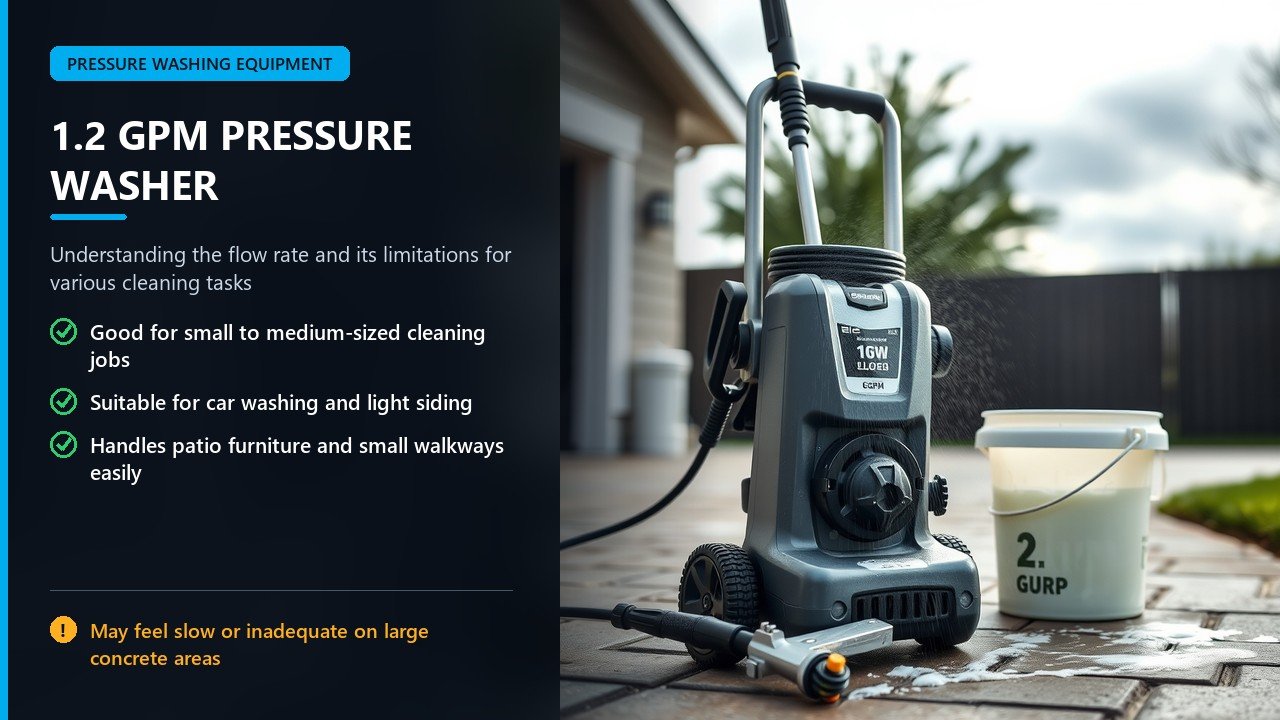
Yes, 1.2 GPM is a perfectly good flow rate for the right kinds of jobs. It is common on compact electric pressure washers, and it handles car washing, patio furniture, grills, small walkways, and light siding cleaning very well. It is not, however, a high-flow rate, and it will feel slow or inadequate on large concrete areas, heavy staining, or any task where you are measuring success in square feet per hour.
So the better question is not “is 1.2 GPM good,” but “is 1.2 GPM good for what I need to clean?” That is the question we are going to answer precisely.
What GPM Actually Means
GPM stands for gallons per minute. It measures how much water flows out of the nozzle every minute. PSI measures how hard that water hits the surface. Think of it like a fire hose versus a garden hose. Both might have similar pressure at the source, but the fire hose moves far more water, which is why it can knock down a wall of flame while a garden hose cannot.
In pressure washing, this matters because:
- Pressure (PSI) breaks the bond between dirt and surface.
- Flow (GPM) washes the dirt away and covers more area in less time.
- Together they define cleaning speed, often called “cleaning units” or simply PSI times GPM.
A machine with high pressure but low flow can break grime loose, but it takes longer to rinse the loosened dirt away. A machine with high flow but low pressure rinses beautifully but struggles to remove stubborn, bonded grime. The best results come from a healthy balance of both.
GPM vs PSI: The Balance That Matters
The single most useful number for comparing machines is cleaning units: PSI multiplied by GPM. It estimates overall cleaning power better than either spec alone.
| Machine | PSI | GPM | Approx. Cleaning Units |
|---|---|---|---|
| Compact electric | 1,600 | 1.2 | About 1,920 |
| Mid electric | 2,000 | 1.4 | About 2,800 |
| Entry gas | 2,800 | 2.3 | About 6,440 |
| Mid gas | 3,200 | 2.8 | About 8,960 |
| Large gas / commercial | 4,000 | 4.0 | About 16,000 |
Notice how the jump from 1.2 GPM to, say, 2.5 GPM, combined with a bump in pressure, more than quadruples the cleaning units. That is why big gas machines cut through large jobs so much faster. It is not just the pressure. It is the volume.
What 1.2 GPM Can Handle Well
At 1.2 GPM with typical residential pressure, you can comfortably clean:
- Cars and trucks. Even the best hand wash benefits from a proper pre-rinse, and 1.2 GPM is ideal for vehicle paint and wheels.
- Patio furniture and grills. These small, detailed items suit a light-duty machine.
- Bikes, garden tools, and equipment. Quick, targeted cleaning is a great fit.
- Small walkways and steps. Manageable if you are patient and methodical.
- Fences and railings. A pass over vertical surfaces works well.
- Vinyl siding (with care). Low flow plus moderate pressure cleans siding without flooding behind it.
For these tasks, 1.2 GPM is not a limitation. It is actually an advantage, because lower flow is gentler and easier to control, which reduces the risk of damage to paint, wood, and garden plants.
Where 1.2 GPM Falls Short
On certain jobs, the same low flow becomes a real weakness:
- Large driveways and parking areas. Coverage is slow, and you will spend a long time for modest results.
- Heavy concrete staining. Oil, rust, and deep tire marks often need more pressure and flow than a compact unit provides.
- Commercial or repetitive work. If you are cleaning for hours to earn money, low GPM means low hourly output.
- Two-story or large siding jobs. The volume of surface to cover makes it tedious.
- Deck stripping or paint removal. These demand far more power than a 1.2 GPM machine offers.
For these tasks, you want more flow and pressure, which usually means a gas machine or a much larger electric unit.
Typical GPM by Machine Type
To put 1.2 GPM in context, here is how flow rates scale across the market.
| Machine Type | Typical GPM Range | Best Suited For |
|---|---|---|
| Compact electric | 1.0 – 1.5 | Cars, furniture, light tasks |
| Full-size electric | 1.4 – 1.8 | Patios, siding, moderate cleaning |
| Entry gas | 2.0 – 2.5 | Driveways, fences, home exteriors |
| Mid gas | 2.5 – 3.5 | Large homes, frequent cleaning |
| Commercial | 3.5 – 5.0+ | Professional and industrial work |
As you can see, 1.2 GPM sits at the lower end, firmly in the homeowner and light-duty category. That is not a flaw. It is a product category, chosen for portability, quiet operation, and low cost.
Matching GPM to Your Real Tasks
Rather than chasing a number, start with the biggest job you will realistically do.
- Cars and small items only? 1.2 GPM is plenty.
- One patio and some furniture? 1.2 to 1.5 GPM works fine.
- A full driveway and home exterior? Aim for 2.0 GPM or more.
- Regular, large, or commercial work? Step up to 2.5 to 4.0 GPM and beyond.
Buy for the hardest job you expect, not the easiest. A machine that breezes through a car wash but stalls on the driveway is a common source of buyer regret.
Why Flow Matters More Than Many People Think
Marketing has trained shoppers to stare at the PSI number, because big pressure figures are easy to advertise. But flow quietly determines how pleasant the whole experience is. Higher GPM means:
- Faster rinsing, so you spend less time chasing suds and loosened dirt.
- Better coverage, so each pass cleans more square footage.
- More consistent results, because the surface is flushed clean rather than spot-washed.
- Less frustration on jobs that drag on with a thin stream of water.
If your machine feels weak despite a decent PSI rating, low GPM is very often the reason.
Getting More Out of a 1.2 GPM Machine
If you already own a low-flow washer, you can still get the most from it:
- Pre-soak with a foam cannon or detergent to loosen dirt before rinsing.
- Work methodically in overlapping passes so each area is cleaned once, thoroughly.
- Use the right nozzle for the surface to maximize the pressure you have.
- Keep the inlet filter and nozzle clean so flow is never restricted.
- Stay close to the machine with short hoses to avoid pressure loss over distance.
- Pick a surface cleaner attachment for flat areas where it is compatible, for more even coverage.
Frequently Asked Questions
Is 1.2 GPM enough to wash a car?
Yes, comfortably. Vehicle washing is one of the best uses for a 1.2 GPM machine. It provides ample flow for rinsing and foam without risking paint damage.
Is 1.2 GPM good for a driveway?
For a small area, it can work, but it will be slow. For a large or heavily stained driveway, you will want more flow and pressure, typically a gas machine.
What is a good GPM for a pressure washer?
For general home cleaning, about 1.4 to 2.0 GPM is a good target. For driveway and exterior work, 2.0 to 2.5 GPM is better. Commercial work needs 3.0 GPM and up.
Does higher GPM mean more pressure?
No. GPM is flow and PSI is pressure. They are different specs. Cleaning speed depends on both. A machine can have high pressure and low flow, or the reverse.
Should I prioritize GPM or PSI?
Prioritize the balance. Multiply the two to estimate cleaning power, and match the combination to your tasks. Ignoring either one leads to the wrong machine.
Final Thoughts
So, is 1.2 GPM good for a pressure washer? For cars, furniture, small patios, and light home tasks, yes, it is perfectly good, and it comes with real benefits like gentle cleaning and lower water use. For large driveways, heavy staining, and professional work, it is too little flow, and you will want a higher-GPM machine.
The lesson is to stop judging pressure washers by a single number. Pressure breaks dirt loose, but flow washes it away and covers ground fast. Understand both, match them to your actual jobs, and you will choose a machine that feels strong and capable from the very first use.