The gutters were the reason Dave bought his first long power washer wand. He had been cleaning the single-story eaves with the machine’s stock wand, on a stepladder, one dangerous lean at a time, and the second story of the townhouse simply refused to be reached at all without dragging the ladder around the whole building. A neighbor handed him a telescoping wand, four feet of extra reach that collapsed to a manageable length, and within an hour the entire second story was washed from the ground. The ladder went back to the garage and stayed there. That is the promise of the long wand: not more pressure, but the reach to use the pressure where the machine was always meant to go, without a ladder, a scaffold, or a new respect for gravity.
A long power washer wand is the simplest upgrade in the pressure washing world and one of the most misunderstood. Longer is not automatically better, because every inch of length changes the wand’s balance, amplifies the force at the grip, and forces the operator to hold the stream at a distance that can underdeliver on stubborn grime. The right wand is the one matched to the job and the operator’s reach, not the longest tube in the catalog. This guide explains what long and extension wands are, the jobs they solve, how length trades against control, the materials and fittings that matter, and the safety habits that keep a reach tool from becoming a hazard.
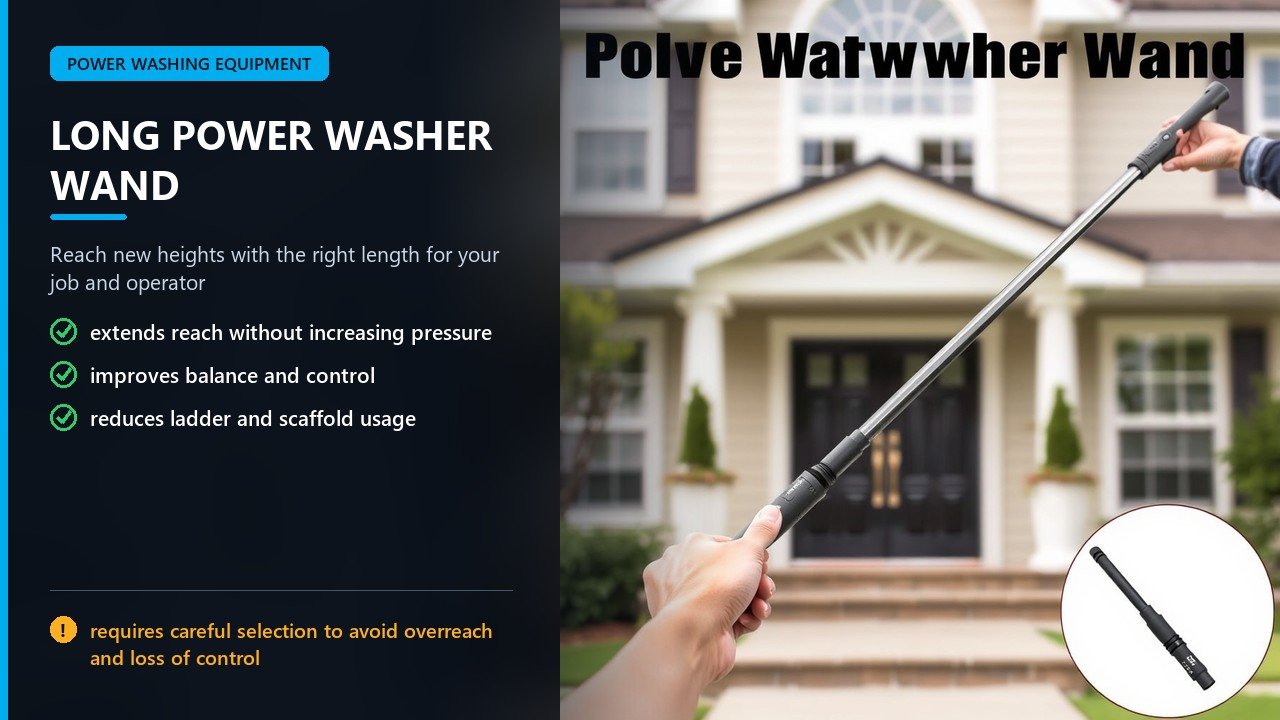
What Counts as a Long Wand
Wands come in three broad lengths, and each has a clear home on the job list.
Standard wand. The wand most machines ship with, roughly 18 to 24 inches, held at an arm’s length. It is balanced, responsive, and the right tool for close work: cars, patio furniture, fences, and anything the operator can comfortably reach on flat ground.
Intermediate wands. The 30 to 48-inch range, often sold as an “extension wand” or a single long tube. This is the office of reach without drama: lower gutters, single-story eaves, the tops of tall fences, the far side of a patio, and the big flat surfaces of trucks and trailers. It is the most useful upgrade for most homeowners and rarely forces the operator into a compromised stance.
Long and telescoping wands. From about four feet up to the eight-foot-plus telescoping models. These are the ladder-avoiders, made to reach second stories, high fascia, tall soffits, roofs, and any surface that would otherwise require climbing. They collapse for storage and extend for work, and they demand the most care because their length magnifies every force. Our guide to the telescoping wand and when extra length pays off explores that top end in detail.
The Jobs a Long Wand Solves
The right length is the one that reaches your actual work, so start from the job list and work back.
Gutters and fascia. The classic use. A long or telescoping wand cleans the gutter face, the fascia, and the soffit from the ground, which removes the ladder from the most dangerous part of home exterior cleaning. Wet gutters over wet concrete are a fall waiting to happen, and the wand simply deletes the risk.
Second-story siding and windows. A long wand washes upper-story walls and window frames from a safe stance at ground level. The technique changes, since the operator aims more by feel and geometry than by proximity, but the result is a clean upper wall without a single rung.
Roof edges and soft-wash work. Extended wands reach roof overhangs and the edges of low-slope roofs for the rinse and pre-treatment stages of a soft wash, and they are standard tools on soft-wash rigs for exactly that reason.
Trucks, trailers, and equipment. On a trailer, a fleet, or a farm, a mid-to-long wand reaches across the top of a vehicle or implement without walking around it. Upline, flatwork crews keep an extended wand for the windward edges a surface cleaner cannot quite hug.
Fences and hard-to-reach walls. Tall privacy fences, retaining walls, and the far sides of landscaping features all yield to a longer wand without the operator crouching or reaching across obstacles. The reach alone makes the job possible from a sane position.
Fixed Length Versus Telescoping
The two families of long wands behave differently, and the choice is between simplicity and flexibility.
Fixed-length wands. A single tube of a set length, threaded or fitted to the machine. Fixed wands are stiffer, hold their balance predictably, resist flexing under pressure, and have no joints to leak or slip. Their drawback is storage and one-size-fits-most: a six-foot tube is awkward to stow and equally awkward when the job only needs two feet. A fixed wand is the right choice when you need one consistent reach and value rigidity.
Telescoping wands. Adjustable tubes that collapse for storage and extend for reach. They are the practical choice for general use, because one tool covers many jobs and stores in the same space as a short wand. The trade is complexity: telescoping wands have a slip joint and a lock collar that must hold reliably under pressure, and a cheap or worn lock is a wand that collapses or leaks when it matters. Buy a well-made telescoping wand or a fixed wand; avoid the flimsy ones, which are the source of most “telescoping wands are junk” complaints. Our article on extension wands and when the extra length pays off weighs the two.
| Factor | Fixed Long Wand | Telescoping Wand |
|---|---|---|
| Rigidity | High | Moderate |
| Storage | Awkward | Compact |
| Adjustability | None | Wide range |
| Failure points | Few | Lock and slip joint |
| Best for | One steady reach | Mixed jobs |
Materials and Fittings
A long wand is only as good as its tube and its connection to the machine.
Stainless steel. The premium tube: strong, corrosion-resistant, and smooth, it resists the mineral and chemical exposure of hard use. Stainless wands hold pressure well and last for years, which is why commercial operators favor them.
Aluminum. Lighter and cheaper, easy to handle at length, and fine for most home wands. Aluminum is softer and dents more easily, and it is more prone to corroded threads if neglected. For a homeowner’s use, aluminum is a sensible, light choice; for hard daily work, stainless lasts longer.
Brass fittings and the connection. The fitting that joins the wand to the gun or hose carries the whole load. Brass is the durable standard; cheap plated fittings corrode and seize. Match the thread to your machine (M22 and quick connect are common) and use quick connect at the wand so tips and extension pieces swap without a wrench. Our fitting guide identifies what your machine needs at a glance.
The quick-connect end. A long wand that terminates in a quick connect plug lets you swap nozzles, add an extension, or drop to a short wand for close work in seconds. That single feature makes one long wand double as a system, and it is the feature to insist on.
How Length Changes Pressure and Control
This is the physics most buyers miss, and it decides whether a long wand feels like an upgrade or a disappointment.
Reach does not add pressure. The pump’s pressure is set at the nozzle, and a longer wand does not concentrate it. What changes is the distance and angle between the nozzle and the surface, which spreads the stream and softens the effective cleaning impact if the operator holds the wand wrong. A long wand frees you to clean from farther back; it does not make the machine stronger.
Angles get steeper. At the base of a tall wall, a long wand forces the stream upward at a shallow angle, which glances off the surface rather than driving into it. Good operators step back and use the angle to their advantage, but the geometry explains why very long reach and very precise cleaning rarely coexist at the same spot.
The grip force grows. A longer wand is a longer lever, so the trigger force and any kickback are felt more at the handle. On a strong machine, a rigid long wand can transmit a firm jolt back to the operator’s wrist and shoulder. A two-handed grip, a steady stance, and quality fittings that do not leak or whip make the length manageable.
Balance matters more than length. A wand that is front-heavy pulls the operator forward and tires the arms by midday. Handle weight and balance at length, and prefer a wand whose weight sits near the grip. Our guide to pressure washer wand attachments covers the ball valves and grips that improve control.
Safety With a Long Wand
The whole reason to own a long wand is to avoid ladders, so the safety section starts there and stays practical.
The ground beats the ladder. The OSHA falls guidance is explicit that falls are among the leading causes of serious workplace injury, and ladders on wet ground are a fall waiting to happen. A long wand’s entire value is removing you from the fall equation, so resist the temptation to climb anyway for the last stubborn spot. The wand can be extended; your balance cannot.
Never over-extend your stance. Chasing reach with a long wand from a twisting, leaning position puts strain on the back and invites the stream to wander. Move your feet, reset your stance, and keep the wand’s weight over your base. A reach tool used from an over-reached body is a back injury in slow motion.
Watch the kickback. Longer levers amplify force, and a sudden pressure surge or a clogged nozzle can jolt a long wand harder than a short one. Keep the trigger hand firm, keep the tip clear of your own body, and never point a long wand where a slip could send the stream at a person or a pet.
Mind overhead wires and glass. Reach wands get long enough to approach power lines, soffit lights, and second-story windows. Before extending, scan the area above and around for hazards a ground-level wand would never have threatened.
Keep a safe tip distance from the surface. A long wand encourages the operator to get close to compensate for the reach, which is exactly when a tight tip etches wood or strips paint. Hold the correct tip distance and let the machine work. Our guide to avoiding cutting concrete and wood applies at any wand length.
Maintaining a Long Wand
Long wands are durable and simple, and a little care keeps the joints and threads working.
Dry and store the tube. A tube left full of water corrodes and can grow scale inside, especially the aluminum ones. Blow or drain the wand after use and store it collapsed and dry. The annual storage routine includes the wand for good reason.
Service the telescoping lock. On a telescoping wand, the lock collar is the part that fails first. Keep it clean, check that it holds firmly at every usable length, and replace worn seals or collars rather than forcing a slipping lock. A lock that lets go mid-job drops the wand and can swing the tip unpredictably.
Protect the threads and o-rings. Thread protection and fresh o-rings keep the wand’s connections drip-free. A wrap of PTFE tape on threaded ends and a light wipe of the o-rings before reconnecting prevent the slow seep that ruins an otherwise good wand.
Check for cracks and dents. A dented or cracked aluminum tube is a weak point under pressure. Retire a damaged wand rather than trusting it under load, and inspect the quick-connect collar for wear each season.
Long Wands by Job and Location
Matching the wand to the job is easier when the jobs are grouped by where the surface sits and how far the operator has to stand.
Overhead work: gutters, fascia, soffits, eaves. This is the flagship. A telescoping or long fixed wand reaches gutter faces and soffits from below, and the cleaning motion is a controlled vertical sweep along the line. The operator stands clear of the runoff and works along the length of the building rather than across it. Choose six to eight feet of reach here; the extra length directly removes ladder risk. Our guide to cleaning gutters without a ladder builds the routine around this exact tool.
Vertical walls: siding, stucco, and brick exteriors. An intermediate to long wand washes upper-story walls from a comfortable distance at ground level. The key is walking the wall slowly with a wide tip rather than trying to clean a whole elevation from one spot, because the reach lets you stand back but the cleaning still comes from consistent distance and overlap.
Wide flanks: trucks, trailers, and implements. A medium-long wand lets one operator clean the whole side of a vehicle or implement without circling it, and on a large trailer or a loader, that reach is the difference between a one-sided and a both-sides job. Fleet washes budget a step-up wand per bay for exactly this reason.
Horizontal spans: roofs, awnings, and overhangs. Extended wands handle roof edges and low-slope awnings for the rinse and pre-treatment stages, and they are standard gear on rigs that do soft-wash work. The wand reaches across the span while the operator moves along the perimeter, staying on solid ground throughout.
The far side: fences, retaining walls, and tight lots. Where a literal wall or a fence line blocks the machine, a long wand lets the operator spray across or around the obstacle instead of dragging the whole rig to the other side. It is less about height here and more about geometry, and it saves relocating the machine a dozen times a day.
Buying Checklist for a Long Wand
Standing in the aisle with three wands in reach, the deciding factors are fewer than the packaging suggests.
Confirm the connection to your machine. The wand’s base must thread or quick-connect to your gun or hose without a stack of adapters. Note whether your machine uses M22 threads or a quick connect, and whether the wand expects a plug or a socket. Getting this wrong is the first and most common return. Our fitting identification guide settles it before buying.
Check the pressure rating with margin. The wand’s working rating should exceed your machine’s PSI. A wand rated below the pump is a burst risk at the joint, and at extended length the failure is more dangerous than a short-wand leak, because the tube swings. Buy above your machine, always.
Weigh the tube and test the balance. A long wand’s real-world usability is the balance in your hand, not the length in the spec. A balanced aluminum wand is easier to run all day than a front-heavy stainless one that outlasts it. If you can, hold it before buying.
Inspect the lock on a telescoping model. Give the collar a test extend and collapse in the store. A lock that slips, sticks, or wobbles now will slip under pressure later. The lock is the telescoping wand’s whole reliability story.
Insist on quality fittings and a quick-connect end. Brass at the base, a solid quick-connect at the tip, and replaceable o-rings make the wand a system you can service rather than a disposable tube. Cheap plated fittings seize within a season. Our article on how far a long wand should reach ties length back to the fitting and tip choices.
Match the wand to the machine’s power. A long wand on a weak machine cleans little, because the reach spreads a weak stream. A long wand on a strong machine is a joy, because the power still arrives at the far surface. If your machine is modest, favor an intermediate length and aim for the jobs it can actually finish at distance.
Weigh these six lines against the price and the job list, and the decision becomes obvious. The wand that matches your machine’s connection and pressure, balances in your hand, and locks firmly is the one that earns its spot in the tool kit, length be damned.
Common Long Wand Mistakes
Buying the longest wand available. Length beyond your needs only adds weight, awkwardness, and force at the grip. Match the wand to the job.
Extending to chase the last spot while on a ladder. The wand exists to keep you off the ladder. Do not cancel its best benefit to win one stubborn stain.
Cheaping out on the telescoping lock. A weak lock is the wand’s Achilles heel. Buy a good one or use a fixed length instead.
Using a tight tip at full extension on soft surfaces. Reach plus a narrow tip plus a weak stance equals damage. Choose the wide tip and hold distance.
Ignoring the balance and grip. A front-heavy wand tires you and compromises aim. Add a grip or a ball valve and keep the weight near the handle.
Storing it wet. Water left in the tube corrodes and scales it. Drain, collapse, and store dry.
Frequently Asked Questions
How long can a power washer wand be? Common home wands run up to about four feet, with telescoping wands reaching six to eight feet or more. Longer than that begins to sacrifice control and balance.
Does a longer wand reduce pressure? It does not change the machine’s pressure, but it spreads the stream over distance and changes the angle, which can soften the cleaning impact if aimed poorly. Aim and distance still matter.
Are telescoping wands worth it? Yes, for mixed reach jobs, when the lock and joints are quality. Cheap telescoping wands are the ones that fail; a good one is a versatile tool.
Can a long wand clean a second story? Yes, the telescoping and long fixed wands reach second-story siding, fascia, and soffits from the ground, letting you avoid ladders for the majority of tasks.
What is the best material for a pressure washer wand? Stainless steel for durability and premium use; aluminum for light, affordable home use. Both work well when cared for.
Do I need a quick connect on the wand? It is strongly recommended. It lets you swap nozzles and extensions in seconds and is the feature that makes a long wand a flexible system.
Final Thoughts on the Long Power Washer Wand
A long power washer wand is the most direct way to expand what a pressure washer can safely clean, because it solves the two things a short wand forces on its owner: the ladder and the stretch. Reach up to the second story, out across the trailer, down the gutter line, all from the ground, with both feet planted and the machine doing exactly what it always did. It adds no pressure and no horsepower, and it makes whole categories of jobs possible anyway.
Choose length by the job, not by the catalog’s maximum. Balance matters more than inches, and a well-made fixed or telescoping wand with brass fittings and a quick-connect end will outwork a longer, flimsier one every season. Respect the lever, keep the tip clear of your body, use the correct tip distance, and refuse to climb for the last spot when the wand can reach it from below. Store it collapsed, drained, and dry, and service the lock and fittings like the working parts they are. Do that, and the ladder stays in the garage where it belongs while the long wand quietly turns the tallest, most awkward cleaning work into ground-level routine, which is the entire point of owning one.