When you start looking at pressure washer hose connections, one term shows up again and again: M22. It appears on hoses, guns, wands, and pumps, and it confuses many owners because there is more than one type of M22, and not all of them fit each other. Getting the right M22 pressure washer hose fittings is essential for a leak-free, working setup, and mixing them up is one of the most common causes of connection problems. This guide explains what M22 fittings are, the differences between the M22 varieties, where they are used, how to match and adapt them, and how to avoid the mistakes that lead to leaks and frustration.
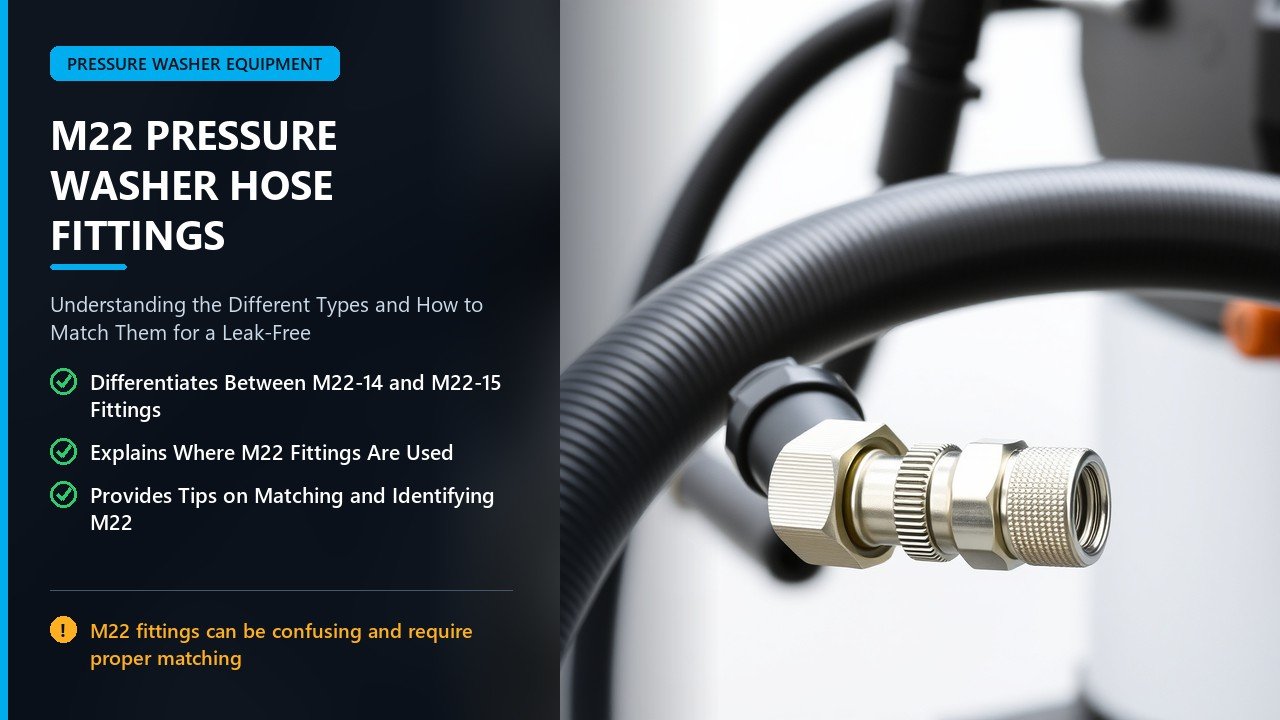
What M22 Fittings Are
M22 refers to a specific metric thread size used widely in pressure washers.
M22 indicates a metric thread with a nominal diameter of 22 millimeters, and it is one of the standard connection types on pressure washers, especially on the hose and the connections to the gun, wand, and pump. An M22 fitting has a male or female thread and a sealing face, usually a flat face with an O-ring or a conical seat, and it is designed to handle high pressure when properly matched. Because M22 is common, many pressure washer hoses and accessories use it, and adapters convert it to other connection types.
The challenge is that “M22” is not a single, universal fitting. There are variations in thread pitch and bore size, and the most significant are the M22-14 and M22-15 types. These share the M22 thread but differ in the bore, and the difference means that a male M22-14 and a female M22-15, or vice versa, may thread together but leak or not seal properly, because the sealing surfaces and internal dimensions differ. This subtlety is why M22 fittings cause so much confusion.
Understanding that M22 is a family, not a single fitting, is the key. When you buy or replace a hose or adapter, you must know which M22 variant and gender you need, and match it to the mating part. Getting this right ensures a proper seal; getting it wrong leads to leaks that no amount of tightening fixes. With this in mind, the rest of the details make sense, and you can approach M22 connections with confidence. Our guide to a pressure washer hose connector covers connectors in general.
M22-14 Versus M22-15
The two main M22 variants differ in a way that matters.
M22-14 and M22-15 both use the M22 thread, so they can appear to fit together, but they differ in the bore and sealing dimensions. The number refers to the bore size in millimeters, 14 or 15, and this affects how the fitting seats and seals. A male M22-14 fitting matched with a female M22-15, or the reverse, may thread on but not seal correctly, resulting in leaks, or may not seat fully. This mismatch is a frequent source of mystery leaks on pressure washers.
To complicate matters, the sealing method differs: some M22 fittings seal on a flat face with an O-ring, while others use a conical or tapered seat, and the two types do not always seal against each other even when the thread matches. So two fittings can share the M22 thread and the same nominal size yet still not seal if their sealing styles differ. This is why simply checking that the threads mesh is not enough; the sealing geometry must also match.
Matching both the variant and the seal type is essential for a leak-free connection. When replacing a hose or fitting, identify the existing one’s type precisely, or replace a matched pair together, so the male and female components are compatible. Buying a hose and adapter that are known to match, or replacing both sides of a connection together, avoids the guesswork. Understanding the M22-14 and M22-15 difference, and the seal-type difference, is what lets you get this right. Our guide to pressure cleaner hose fittings covers fitting types and matching.
Where M22 Fittings Are Used
M22 connections appear at several points on a pressure washer.
Pump outlet. The high-pressure outlet of the pump often uses an M22 connection, where the high-pressure hose attaches to the machine. This is a common M22 point and one where the correct fitting and seal are critical for pressure.
Hose ends. Pressure washer hoses frequently come with M22 fittings on one or both ends, either to connect to the machine and gun or to accept adapters. Some hoses have a different fitting on each end, such as M22 on one end and a quick connect or a machine-specific fitting on the other.
Gun and wand connections. The inlet of the spray gun and the connection between the gun and wand often involve M22 or a compatible thread, with some using quick connects or other standards. Many guns accept an M22 inlet and use quick connects at the wand.
Adapters and accessories. M22 adapters convert between M22 and other types, such as M22 to quick connect, M22 to garden hose, or M22 male to female, and are common accessories for matching components or upgrading to quick connects.
Because M22 appears at multiple connection points, understanding it helps with almost any pressure washer setup task, from replacing a hose to adding a quick-connect system. Identifying the fittings at each point, and matching them correctly, ensures a working, leak-free machine. When in doubt, examine the connections, note the type and gender, and match accordingly, or replace matched pairs together. Our guide to pressure washer components places these connections in the machine’s overall system.
Matching and Identifying M22 Fittings
Getting the right fitting starts with identification.
To match an M22 fitting, determine three things: the type (M22-14 or M22-15), the gender (male or female), and the seal type (flat face with O-ring or conical seat). Examine the existing fitting, and if possible, compare it to the replacement or to reference information from the manufacturer. Many pressure washer hoses and parts list their fitting type, so the manual or product details often specify M22 and the variant. If the information is unavailable, measuring or testing may be needed, and matching the seal type by sight helps.
When replacing a hose or fitting, a reliable approach is to replace a matched pair together, so the male and female components are known compatible, or to buy a hose and adapters from the same source with known types. For upgrades, such as converting to quick connects, an M22 adapter kit matched to the existing fittings simplifies the task, and choosing a kit designed for the machine or thread avoids mismatches. Keeping track of the fittings you use helps for future replacements.
Identification and matching prevent the leaks and frustration of incompatible fittings. Because M22 has variants that look similar, careful checking is worthwhile, and when uncertain, replacing both sides of a connection or using a matched kit removes the risk. This attention saves the effort of trial and error and the annoyance of a leaking connection. With the right information and approach, matching M22 fittings is straightforward, and the result is a properly sealed, working pressure washer. Our guide to a pressure washer hose connector types covers the range of connection types and how they compare.
Adapters and Conversions
Adapters let you connect different types and upgrade to quicker systems.
M22 adapters convert between M22 and other connections. Common examples include M22 to quick connect, which lets you add quick-connect fittings for fast hose attachment; M22 to garden hose, useful for certain setups; M22 male to M22 female, for gender changes; and M22 to machine-specific fittings. These adapters make it possible to match components that would otherwise be incompatible and to modernize a machine with quick connects.
The most popular upgrade is converting M22 connections to quick connects, which allows fast, tool-free attachment of hoses and accessories and is a significant convenience improvement. A quick-connect conversion kit typically includes M22 adapters for the pump outlet, hose, and gun, plus the quick-connect fittings, and installing it lets you snap hoses on and off instead of threading them every time. This upgrade is common and worthwhile for frequent users.
| Adapter / Conversion | Purpose |
|---|---|
| M22 to quick connect | Add quick connects for fast hose attachment |
| M22 male to female | Change gender to match a connection |
| M22 to garden hose | Connect to garden hose fittings |
| M22 to machine-specific | Match a machine’s particular fitting |
Adapters must match the M22 variant and seal type to work, so choose ones known to be compatible, ideally designed for your machine or a standard fit. When installing adapters, use appropriate sealing, such as the correct O-rings, and check for leaks. With the right adapters, you can match any components and upgrade to quick connects, making the setup more convenient and versatile. Our guide to pressure washer o ring kit covers the seals that keep these connections leak free.
Common M22 Mistakes
Avoiding these mistakes saves time and leaks.
A frequent error is assuming all M22 fittings match, then discovering a leak because the M22-14 and M22-15, or different seal types, were mixed. Another is over-tightening to stop a leak, which can damage the threads or seal without fixing the underlying mismatch, since the problem is incompatibility, not tightness. Using the wrong or a missing O-ring, or the wrong seal type, causes leaks that tightening cannot cure. And forgetting which fittings you have leads to repeated mismatches when replacing parts.
To avoid these, identify your fittings precisely, match both variant and seal type, replace matched pairs when unsure, use the correct O-rings and seals, and do not rely on force to stop leaks. Keep a record or spare set of your fittings, and choose adapters and hoses known to be compatible. When a leak persists, suspect a mismatch rather than insufficient tightening, and address the compatibility. These habits prevent the most common M22 problems.
Mistakes with M22 fittings are preventable with care and information. Because the fittings look similar, precise identification and matching are the cure, and understanding that leaks often indicate a mismatch rather than loose threads points to the right solution. With the correct fittings, seals, and gentle tightening, connections seal reliably, and the machine runs as it should. Keeping the right fittings on hand and knowing your setup makes future work easy and leak free. Our guide to a pressure washer repair kit is a reminder that having the right parts prevents downtime.
Why Pressure Washer Threads Are So Confusing
The confusion around M22 is part of a broader fitting puzzle.
Pressure washers use a mix of connection standards, including M22 metric threads, garden hose threads (GHT), quick connects, and various machine- and brand-specific fittings. There is no single universal standard across all machines, so different brands may use different fittings, and a hose that fits one machine may not fit another. This variety means owners must often identify and match fittings or use adapters, and it is why the same task, connecting a hose, can require different solutions on different machines.
M22 sits in this mix as a common standard, especially for high-pressure connections, but its variants add a layer of complexity. So a buyer faces both the question of whether a fitting is M22 or something else, and, if M22, which variant and seal type. Add the fact that many hoses come with different fittings on each end, and the puzzle deepens. This is why understanding the standards, and matching carefully, is so important.
Recognizing that pressure washer fittings are not standardized explains the need for care and adapters. Because no single standard applies, matching your specific machine and its components is essential, and adapters bridge the gaps. This also explains why kits and hoses specify their fitting types and why replacing matched pairs is a safe approach. Once you understand the landscape, the confusion becomes manageable, and you can navigate fittings and connections methodically rather than by trial and error. Our guide to a 100 ft pressure washer hose shows how hoses are specified with their fittings.
Choosing a Replacement Hose
Hose selection depends on matching the fittings to your machine.
When choosing a replacement pressure washer hose, first determine the fittings you need. Many hoses come with M22 fittings, but you must confirm the variant and gender, and whether the machine or gun uses M22 or another type. Some hoses have an M22 fitting on one end and a machine-specific fitting on the other, designed for particular brands, while others are M22 on both ends for use with adapters. Choose a hose whose fittings match, or buy adapters to bridge differences.
Beyond fittings, consider the hose’s pressure rating, diameter, length, and material, ensuring it suits your machine and tasks. A hose rated below your machine’s pressure is a failure risk, while a larger diameter reduces pressure loss over distance, and length should match your reach needs. Material affects flexibility, durability, and weight. The fittings and these performance factors together determine whether the hose works for your setup.
Choosing the right hose means matching both the connection and the performance to your needs. Because fittings are the point of connection, getting them right is essential, and adapters can help where standards differ. Pairing correct fittings with an appropriate rating and length yields a hose that connects and performs reliably. When in doubt, buy from a source with clear fitting specifications and matched adapters, and keep your machine’s fitting types documented for future purchases. Our guide to a 100ft pressure washer hose covers hose options and specifications.
Sealing and Preventing Leaks
Proper sealing keeps M22 connections leak free.
Most M22 connections seal with an O-ring on a flat face, and some use a conical seat, so the correct seal is essential. Inspect and replace O-rings regularly, since a worn, missing, or wrong O-ring is a common cause of leaks. When connecting, hand-tighten and then snug with a wrench, avoiding over-tightening, which can damage threads and seals. Ensure the sealing surfaces are clean and free of debris, and check for leaks when pressurizing, tightening only as needed. Use the right seal type for your fittings.
If a connection leaks despite correct tightening, suspect a mismatch in variant or seal type rather than insufficient tightness, and address the compatibility. Sometimes a small amount of thread sealant is appropriate on certain fittings, but many M22 connections rely on the O-ring or seat, so follow the manufacturer’s guidance. Keeping spare O-rings and seals on hand prevents interruptions and lets you fix leaks quickly.
Good sealing practice prevents the leaks that plague mismatched or worn connections. Because most M22 leaks trace to seal issues or mismatches rather than tightness, correct seals and compatibility are the cure. Inspecting and replacing O-rings, matching seal types, and refraining from over-tightening keep connections dry and the machine performing. These simple practices save the frustration of drips and pressure loss and extend the life of your fittings and hoses. Our guide to pressure washer o rings covers the seals that make these connections work.
Frequently Asked Questions About M22 Pressure Washer Hose Fittings
What is an M22 pressure washer fitting? A metric thread connection with a nominal 22 mm diameter, common on pressure washers at the pump outlet, hose ends, and gun inlet, with variants like M22-14 and M22-15.
What is the difference between M22-14 and M22-15? They share the M22 thread but differ in bore size and sealing dimensions, so they can appear to fit yet leak. Match the correct variant for a proper seal.
Will M22-14 and M22-15 fit each other? They may thread together but often will not seal correctly, causing leaks. Always match the same variant and seal type.
How do I identify my M22 fitting? Determine the variant (M22-14 or M22-15), the gender (male or female), and the seal type (flat face with O-ring or conical seat), and match the replacement accordingly.
Can I convert M22 to quick connect? Yes, M22 to quick-connect adapter kits are common and let you add quick connects for fast, tool-free hose attachment, a popular upgrade.
Why does my M22 connection leak? Often a mismatch in variant or seal type, or a missing or wrong O-ring, rather than insufficient tightening. Match the fittings and seals rather than over-tightening.
Final Verdict on M22 Pressure Washer Hose Fittings
M22 pressure washer hose fittings are a common but easily misunderstood connection standard. They appear at the pump outlet, hose ends, and gun inlet, and the key is that M22 is a family, not a single fitting, with variants like M22-14 and M22-15 and different seal types that must match to seal properly. Assuming all M22 fittings are the same leads to the leaks that frustrate so many owners.
Identify your fittings precisely, matching variant, gender, and seal type, replace matched pairs when unsure, use the correct O-rings, and choose compatible adapters, including quick-connect kits for convenience. Do not rely on over-tightening to stop a leak caused by a mismatch. Mastering M22 fittings makes any pressure washer setup task easier and keeps your machine leak free, and with the right understanding, this common connection becomes simple rather than confusing.