When a pressure washer hose fails, it rarely fails quietly. At thousands of pounds per square inch, a burst hose can whip, spray, and endanger anyone nearby. That is why serious operators look beyond the cheapest coil of tubing and invest in a proven industrial-grade hose. A Parker pressure washer hose falls squarely into that category — engineered for high pressure, harsh conditions, and long service life.
This guide explains what makes Parker hoses different, the types and series you may encounter, how to match a hose to your machine, what fittings you need, how to care for one, and how to decide whether a premium hose is worth the price for your work.
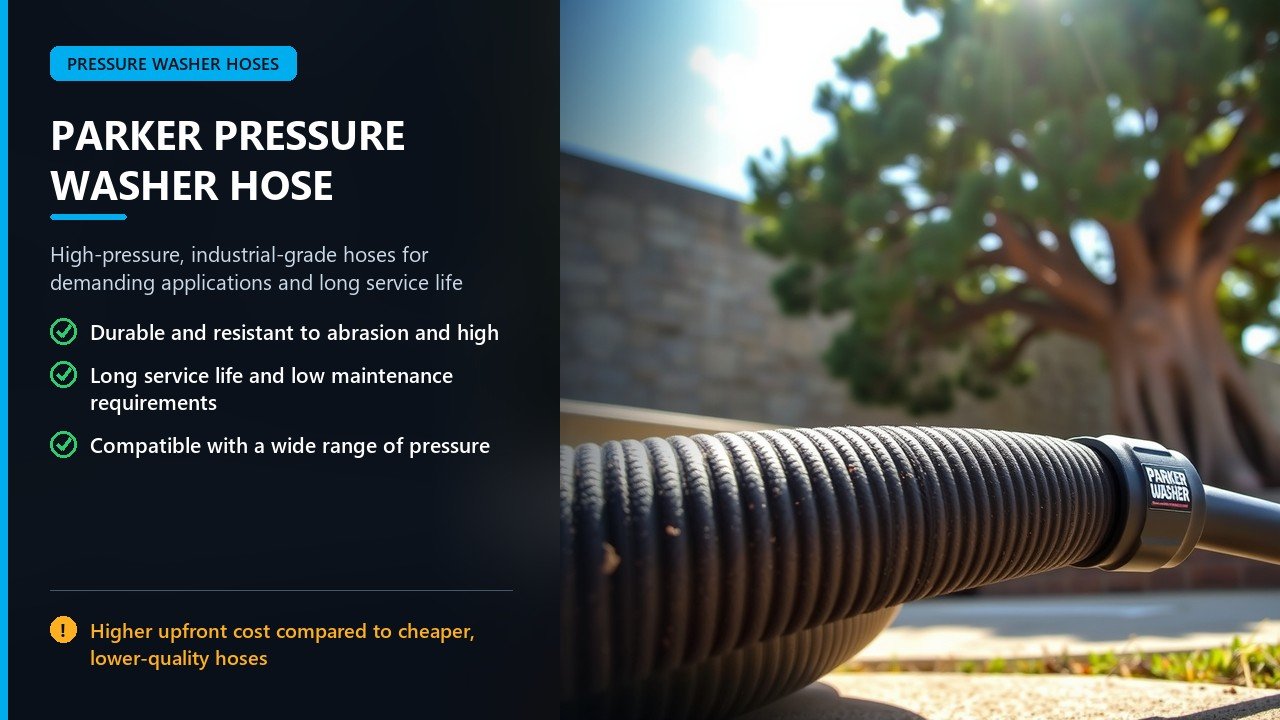
Who Is Parker?
Parker Hannifin is one of the world’s largest manufacturers of motion and control technologies, including hydraulic and industrial hoses. For decades, Parker hoses have been the standard in demanding fields — construction, agriculture, mining, manufacturing, and pressure washing — because they are engineered to survive extreme pressure, abrasion, and repeated bending.
When people search for a “Parker pressure washer hose,” they are usually looking for a rugged, professional-grade replacement or upgrade for the hose that came with their machine. Parker’s reputation rests on durability and consistency rather than bargain pricing.
Quick Note: A pressure washer hose is a safety-critical component. A cheap hose that bursts at 4,000 PSI can cause severe injury. Buying a name-brand, correctly rated hose is not an upgrade — it is basic safety.
Why the Hose Matters So Much
Many owners focus on the machine and neglect the hose, yet the hose directly affects both performance and safety.
- Pressure rating. The hose must exceed your machine’s working pressure with a safety margin.
- Flow capacity. An undersized hose restricts flow and reduces cleaning performance.
- Durability. The outer cover resists abrasion, UV, oil, and weather.
- Flexibility. A stiff hose is exhausting to use all day; a supple one saves fatigue.
- Safety. The hose and its couplings are the most common failure points on any pressure washer.
- Longevity. A quality hose outlasts several cheap ones, so total cost can be lower.
Short Note: The working pressure rating on a hose is what matters — not the “burst” pressure. Always choose a working rating comfortably above your machine’s output.
Types of Pressure Washer Hoses
| Type | Characteristics | Best For |
|---|---|---|
| Single-wire braid | Moderate pressure, flexible | Light and medium-duty |
| Two-wire braid | High pressure, robust | Professional gas machines |
| Thermoplastic | Lightweight, chemically resistant | General cleaning |
| Rubber-covered | Flexible, abrasion-resistant | All-day professional use |
| Non-marking | Won’t leave scuff marks | Marine, pools, autos |
Parker manufactures hoses across several of these categories, from general hydraulic and industrial lines to purpose-built pressure-washing hoses. The right choice depends on your machine’s pressure, your working environment, and how much you use it.
Key Specifications to Match
| Specification | What to Look For |
|---|---|
| Working pressure | Above your machine’s output, with margin |
| Inner diameter (ID) | 1/4-inch for light; 3/8-inch for high flow |
| Length | Reach without excessive pressure loss |
| End fittings | Match your gun and machine (often 3/8-inch quick-connect or M22) |
| Temperature rating | Important for hot-water machines |
| Cover material | Abrasion and weather resistance |
| Certification | Industry standards for your region |
The most common mismatch is diameter. A 1/4-inch hose is fine for lower-flow machines, but a high-flow 4 GPM machine needs a 3/8-inch hose to avoid throttling. Choose the inner diameter to match your flow rate.
Understanding Fittings and Couplings
The best hose fails if the fittings do not match your equipment — or if they are cheap. Pressure washer connections typically use a few standard types:
- M22 threads. Common on many machines and guns.
- Quick-connect (QC) plugs. Tool-free, common on hoses, guns, and nozzles.
- 3/8-inch fittings. Standard for professional high-flow equipment.
- Metric / proprietary fittings. Found on some brands; adapters exist.
When buying a Parker hose, check whether it comes with fittings installed and whether they match your gun and pump outlet. Steel and brass couplings with proper crimps are far safer than clamped-on hardware-store fittings.
Short Note: Never repair a high-pressure hose with a hose clamp and barbed fitting. Only properly crimped or factory fittings are safe at pressure-washer pressures.
Choosing the Right Hose for Your Machine
| Machine | Suggested Hose |
|---|---|
| Electric (1,500–2,000 PSI) | 1/4-inch, ~1,500–3,000 PSI working |
| Light gas (2,500–3,000 PSI) | 1/4-inch or 5/16-inch, 2,500+ PSI working |
| Heavy gas (3,500–4,000 PSI) | 3/8-inch, 4,000+ PSI working |
| Hot-water industrial | High-temp rated, heavy-duty |
Always select a working pressure comfortably above your machine’s rating. If your machine runs at 4,000 PSI, do not buy a hose rated for 4,000 PSI working with no margin — choose one rated higher.
Parker vs Other Brands
| Consideration | Premium (Parker-class) | Budget Hose |
|---|---|---|
| Durability | High; lasts many seasons | Lower; may fail in a season |
| Flexibility | Engineered for comfort | Often stiff and tiring |
| Safety margin | Consistent, verified ratings | Optimistic ratings common |
| Cost | Higher upfront | Lower upfront |
| Value over time | Often cheaper per year of use | More frequent replacement |
For occasional home use, a decent mid-range hose is usually enough. For professional or heavy use, a premium hose pays for itself through reliability and safety.
Common Applications
A quality Parker-class pressure washer hose suits a wide range of demanding jobs:
- Commercial and residential cleaning — driveways, patios, sidewalks, and building exteriors.
- Fleet and vehicle washing — cars, trucks, buses, and heavy equipment.
- Industrial and plant maintenance — machinery, tanks, and processing areas.
- Agriculture — tractors, implements, barns, and livestock facilities.
- Marine and boating — docks, hulls, and decks, where non-marking hoses are preferred.
- Construction — site cleanup and concrete work.
In each of these, the hose faces pressure, abrasion, and continuous flexing. That is exactly the environment a premium hose is built to survive.
When to Replace a Hose
| Warning Sign | Action |
|---|---|
| Bulging or bubbling | Replace immediately — internal failure |
| Cracked or worn cover | Replace; reinforcement may be exposed |
| Kinks that won’t relax | Restricts flow; consider replacement |
| Leaking or loose fittings | Repair professionally or replace |
| Bulging at the crimp | Replace — imminent blow-off risk |
| Loss of pressure | Check internal damage; replace if needed |
Short Note: Any hose with a bulge, blister, or damaged crimp should be retired immediately. These are warning signs of an impending burst at pressure.
Cost and Value
| Tier | Typical Price (3/8-inch, 50 ft) | Best For |
|---|---|---|
| Budget | $25–$50 | Occasional home use |
| Mid-range | $50–$100 | Regular home and light commercial |
| Premium (Parker-class) | $100+ | Professional and industrial duty |
Premium hoses cost more upfront but typically outlast several budget hoses, making the cost per year of service competitive — with the added benefit of far better safety.
Real-World Scenarios
Scenario 1: A cleaning contractor. Using a 3/8-inch premium hose on a 4 GPM machine, the crew gets full flow, smooth handling, and a hose that survives daily commercial use across seasons.
Scenario 2: A marina detailer. A non-marking premium hose cleans boat hulls and decks without leaving scuff marks — a detail that protects the customer’s finish and the detailer’s reputation.
Scenario 3: A farm operation. A rugged premium hose endures abrasion against equipment, gravel, and fences while cleaning tractors and barns in every weather condition.
Frequently Asked Questions
Is a Parker pressure washer hose worth it? For professional or heavy use, yes — durability and safety justify the cost. For occasional light home use, a decent mid-range hose is usually sufficient.
What size hose do I need? Match the inner diameter to your flow: 1/4-inch for lower-flow machines, 3/8-inch for high-flow (around 4 GPM) machines.
What pressure rating should I choose? Choose a working pressure comfortably above your machine’s output — never equal to it.
Can I use a Parker hydraulic hose for pressure washing? Only if it is correctly rated for the pressure, water, and temperature. Purpose-built pressure-washing hoses are the safest choice.
How long should a pressure washer hose last? With good care, a premium hose can last several seasons; budget hoses may fail within a year of heavy use.
Final Thoughts
A Parker pressure washer hose is a professional-grade component that delivers durable, safe, full-flow performance — exactly what a high-pressure machine needs to work properly. Whether you run a cleaning business or maintain a large property, the hose is not a place to cut corners: it carries the water, it takes the abuse, and it protects the operator.
Match the working pressure, inner diameter, and fittings to your machine, handle it with care, and store it well, and a premium hose will serve you for years. For related reading, see our guides on the 1/4 power washer hose and Gates pressure washer hose.
Compatibility and Adapters
One of the most common frustrations is a new hose that will not connect. Before ordering, identify three connection points:
- The pump outlet — where the hose attaches to the machine.
- The gun / wand inlet — where the hose attaches to the spray gun.
- Any inline accessories — surface cleaners, foam cannons, or extension wands.
If the hose’s fittings do not match, adapters and couplers are widely available — for example, M22 to quick-connect, or thread adapters between metric and imperial. Just make sure every adapter is rated for the same pressure as the hose and machine.
Short Note: Purchase adapters and fittings rated for your working pressure. A fitting rated far below the machine’s output is a burst hazard, even on a premium hose.
Using and Handling the Hose
- Uncoil fully before use. A kinked or coiled hose creates pressure spikes and premature failure.
- Avoid sharp edges and hot surfaces. Abrasion and heat shorten hose life.
- Don’t drag over concrete corners. Use hose guides or lift carefully.
- Don’t run over the hose with vehicles or equipment.
- Keep it out of standing water and chemicals when not in use.
- Never pull the machine by the hose. Pull the handle or frame.
- Bleed pressure before disconnecting any fitting.
Most pressure washer hose failures trace back to handling, not manufacturing. Treating a quality hose well can double its life.
Maintenance and Storage
| Task | Interval | Purpose |
|---|---|---|
| Inspect cover for cracks and cuts | Before use | Catch failures early |
| Check fittings and crimps | Before use | Prevent blow-offs |
| Rinse and dry | After use | Prevent chemical and mildew damage |
| Coil loosely for storage | After use | Avoid kinks and memory bends |
| Store indoors, above freezing | Off-season | Prevent UV and freeze damage |
UV exposure degrades rubber and many thermoplastics over time. Storing a hose out of direct sunlight and above freezing dramatically extends its life.
Safety Reminders
- Never touch a leaking hose or fitting with your hand while pressurized — high-pressure water can inject into skin.
- Shut off the machine before inspecting a suspected leak. Use a piece of cardboard to check.
- Replace, don’t patch, any compromised hose or fitting.
- Match pressure ratings across hose, gun, and machine.
- Wear eye protection during use.
Guidance from the Occupational Safety and Health Administration (OSHA) on high-pressure and powered-equipment hazards is relevant to any pressure-washing operation, especially for employees.