Every pressure washer eventually needs a part. It might be an O-ring that started leaking, a nozzle that got lost, a pump that lost pressure, or a carburetor that refuses to cooperate after a season of sitting. When that moment comes, the challenge is rarely the repair itself. It is figuring out which part you need, whether it is still available, and whether the fix is worth the effort. Owners of PowerStroke pressure washers, a brand sold through warehouse clubs, often face this exact question. Finding parts for powerstroke pressure washer units is very doable, but it helps to know where to look and what commonly fails.
This guide covers everything you need to keep a PowerStroke pressure washer running. We will look at the brand and its machines, the parts that wear out most, the difference between engine, pump, and accessory parts, the common failure points like pumps and unloader valves, nozzles, guns, hoses, O-rings, and carburetors, how to find the right parts using model numbers, how to decide between repairing and replacing, and the maintenance that prevents failures in the first place. By the end, you will be able to source parts and make smart repair decisions.
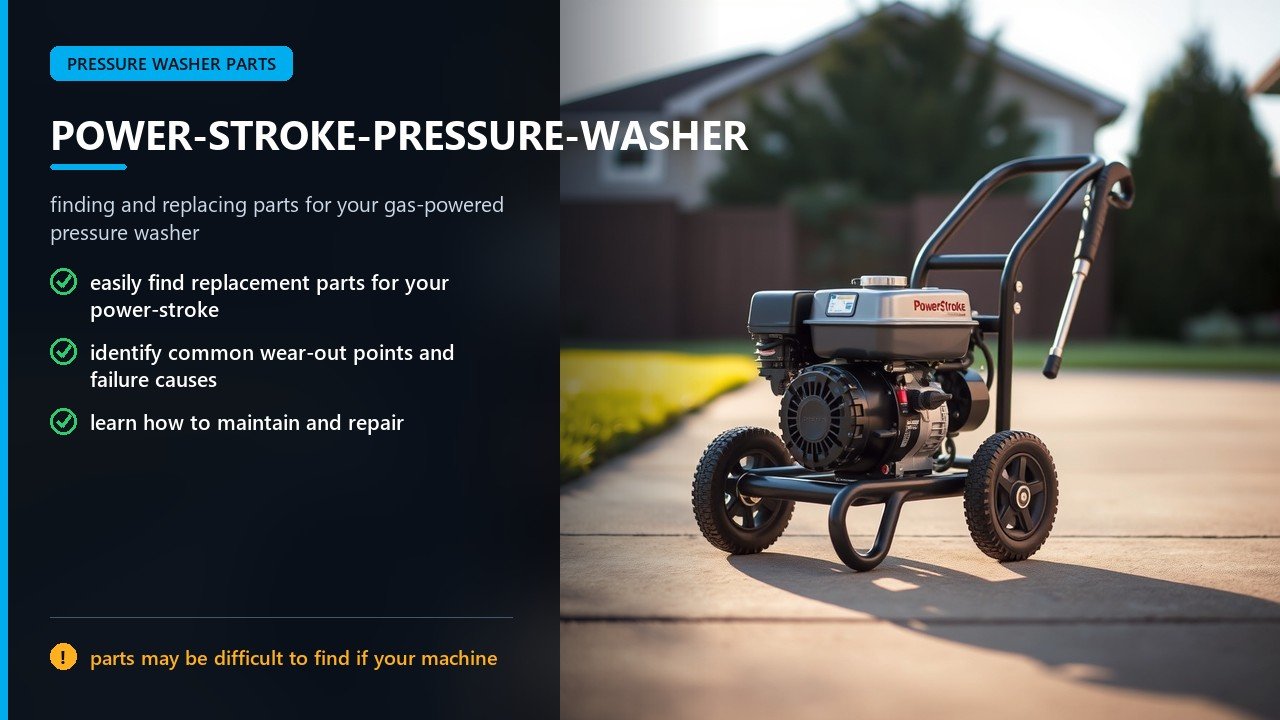
About PowerStroke Pressure Washers
PowerStroke is a brand of pressure washers and generators sold primarily through warehouse clubs. The machines are gas-powered units spanning various pressure and flow ratings, built by established manufacturers and branded for retail. Because of this, replacement parts are often shared with other machines built on the same platforms.
That is good news for owners. Even if you cannot find a part labeled specifically for PowerStroke, an equivalent part from the engine, pump, or accessory manufacturer often fits.
Parts That Wear Out Most
Pressure washers fail in predictable places. Knowing the usual suspects speeds up diagnosis.
- Pump seals and valves wear from use, chemicals, and dry running.
- Unloader valve controls pressure and is a common failure point.
- Nozzles clog, wear, and get lost.
- O-rings and seals dry out and leak over time.
- Hoses crack, kink, and burst.
- Guns and wands leak or fail at the trigger and connections.
- Carburetor and fuel system on gas engines clog from stale fuel.
- Spark plugs, air filters, and engine oil are routine wear items.
- Thermal relief valve can fail if the machine recirculates hot water too long.
Categories of Parts
| Category | Examples | Where to Source |
|---|---|---|
| Engine parts | Carburetor, spark plug, air filter, fuel lines | Engine manufacturer, retailers |
| Pump parts | Seals, valves, unloader, complete pump | Pump brand, pressure washer suppliers |
| Accessories | Nozzles, gun, wand, hose, O-rings | Retailers and suppliers, broadly compatible |
| Frame and hardware | Wheels, handles, fasteners | Retailers, generic fit |
Because PowerStroke machines use components from established makers, parts are often available even without PowerStroke branding.
The Pump
The pump is the heart of the pressure washer and the most expensive part to replace. Symptoms of a failing pump include lost pressure, pulsation, water leaking from the pump, and oil that looks milky, indicating water intrusion.
- Rebuild kits replace seals and valves for a fraction of a new pump’s cost.
- Replacement pumps are available when the old one is beyond repair.
- Match the pump to your engine’s shaft size, mounting, and specs.
The Unloader Valve
The unloader valve regulates pressure and diverts water when the trigger is released. When it fails, you may see no pressure, too much pressure, or the machine cycling on and off rapidly.
- Causes: debris, corrosion, and wear.
- Symptoms: pulsation, pressure loss, or the pump running against a closed flow.
- Fix: clean, adjust, or replace the valve.
An unloader failure is often mistaken for a pump failure, so check it before replacing the pump.
Nozzles, Gun, and Wand
- Nozzles are widely compatible and inexpensive. Buy a full set and replace lost or worn tips.
- Guns are available in various styles and connect through standard fittings.
- Wands extend reach and are inexpensive to replace.
These accessories rarely need brand-specific parts, which makes them easy to replace.
Hoses and O-Rings
- Hoses are broadly interchangeable if the diameter, pressure rating, and fittings match.
- O-rings are the most common cause of leaks and are cheap to replace in bulk.
- Fittings and adapters connect mismatched components.
Keep a supply of O-rings on hand; they solve a surprising share of pressure washer complaints.
Engine and Carburetor
On gas PowerStroke washers, engine parts follow the engine manufacturer’s specs. The carburetor is the most common trouble spot, usually from stale or ethanol fuel.
- Carburetor cleaning or replacement fixes hard starting and rough running.
- Spark plugs and air filters are routine replacements.
- Fuel lines and filters degrade over time and are easy to swap.
See a dedicated carburetor guide for detailed troubleshooting, since fuel problems are so common on stored gas machines.
Finding the Right Parts
- Locate the model and serial numbers on the machine, usually on a label on the frame or engine.
- Identify the engine brand and model, often separate from the PowerStroke branding.
- Identify the pump brand and model, usually stamped on the pump itself.
- Note specs such as PSI, GPM, and shaft size for replacements.
- Search by the component manufacturer, not just PowerStroke, since parts are shared.
- Contact the retailer or a Parts supplier with the model number if unsure.
- Confirm compatibility before ordering, especially for pumps.
Repair or Replace?
| Situation | Recommendation |
|---|---|
| Lost nozzle or O-ring | Replace, cheap and easy |
| Leaking gun or hose | Replace the part |
| Pump seals worn | Rebuild kit if pump is otherwise sound |
| Pump failed, engine healthy | Replace the pump |
| Engine seized or heavily damaged | Weigh replacement cost vs new machine |
| Multiple major failures | Often cheaper to replace the machine |
As a rule, replace parts when the machine is otherwise sound, and consider a new machine when the cost of repair approaches the price of a replacement.
Maintenance to Prevent Failures
- Never run the machine dry, which destroys pump seals.
- Flush after chemicals to protect the pump.
- Keep the inlet filter clean to prevent debris damage.
- Check and change pump oil if the model requires it.
- Use fresh fuel and stabilizer on gas engines.
- Winterize to prevent freeze damage.
- Replace worn O-rings and nozzles before they cause bigger problems.
- Inspect the hose and gun regularly for cracks and leaks.
The Occupational Safety and Health Administration stresses using components rated for system pressure and handling equipment safely. When replacing parts, always match or exceed the original ratings.
Frequently Asked Questions
Where can I buy parts for a PowerStroke pressure washer?
Start with the retailer that sold the machine, then look to the engine and pump manufacturers, since PowerStroke machines use components from established brands. Many parts are shared with other machines.
How do I find the right part for my PowerStroke pressure washer?
Locate the model and serial numbers, identify the engine and pump brands and models, note the specs, and search by those components rather than PowerStroke branding alone.
Is it worth repairing a PowerStroke pressure washer?
Often yes for pumps, seals, guns, hoses, and engine parts while the machine is otherwise sound. If repair costs approach the price of a new machine, replacement is usually smarter.
Why did my PowerStroke pressure washer lose pressure?
Common causes include a clogged or worn nozzle, a failed unloader valve, or worn pump seals. Check the nozzle and unloader first, then the pump.
How do I keep my PowerStroke pressure washer running longer?
Never run it dry, flush after chemicals, keep the inlet filter clean, maintain pump oil, use fresh fuel with stabilizer on gas models, winterize, and replace worn O-rings and nozzles promptly.
Final Thoughts
Finding parts for powerstroke pressure washer units is easier than it first appears, because these machines use engines, pumps, and accessories from established manufacturers. With the model and serial numbers and the component brands in hand, you can source most parts without trouble.
Diagnose before you buy: check the nozzle, unloader, and O-rings before assuming the pump is gone. Weigh repair against replacement sensibly, and protect your machine with good maintenance so fewer parts fail in the first place. With the right approach, a PowerStroke pressure washer can serve reliably for many seasons.