Two summers ago, a friend who runs a small mobile detailing service asked me to help him clean a fleet of delivery vans parked in a lot behind a warehouse. There was no spigot anywhere, no hose bib, no faucet within a hundred yards. A normal pressure washer would have been useless. Instead, he unloaded a portable power washer with water tank, filled the reservoir from his truck, and worked van after van without ever hunting for a water source. Watching that setup in action made the case for tank-fed machines better than any sales pitch could. When you cannot count on water being where the work is, you bring your own.
Portable pressure washers with water tanks solve a problem that trips up a lot of people: the machine needs water, and the water is not always convenient. Whether you are a mobile detailer, a landowner cleaning equipment in a far field, or someone who simply does not want to drag a hose across the yard, understanding these machines helps you choose the right one and run it without starving the pump. This guide covers the types, how they work, how to size them, and how to avoid the mistakes that frustrate new owners.
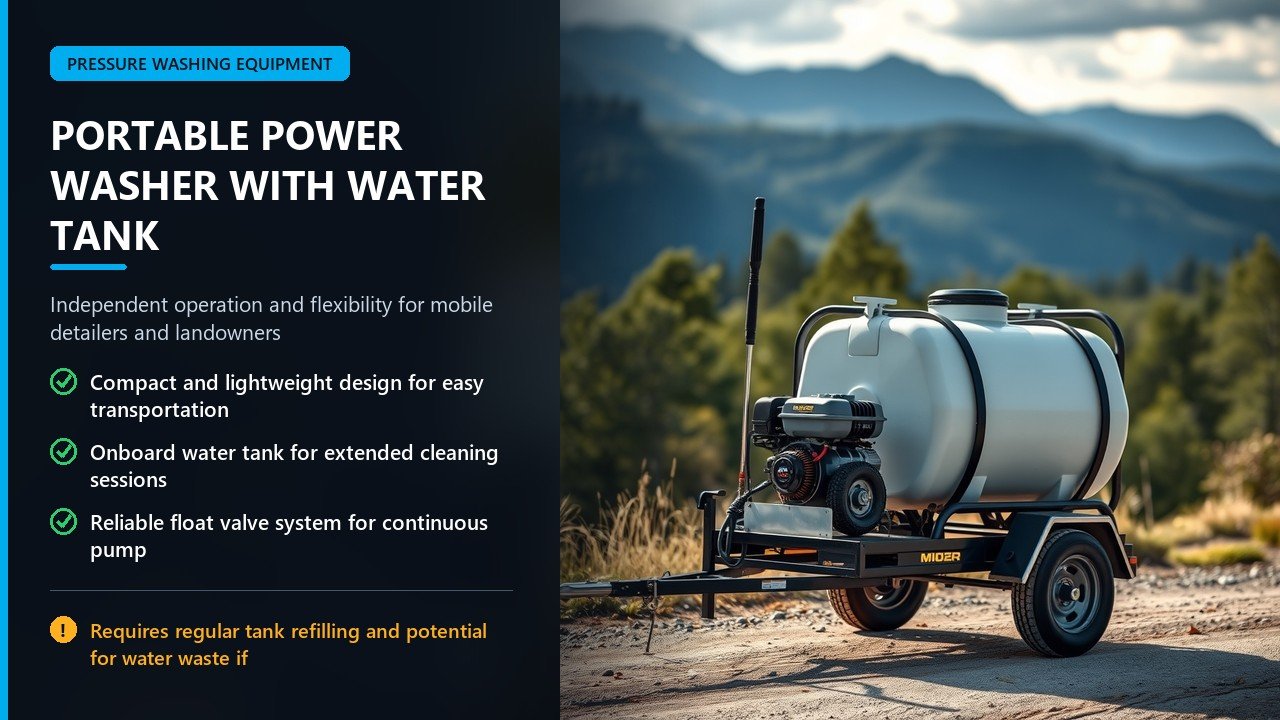
What Is a Portable Power Washer With Water Tank
At its core, this is a pressure washer paired with a water reservoir so it can operate independently of a plumbing supply. The tank holds a volume of water, and the pump draws from it. Depending on the design, the tank may be integrated into the machine, mounted on the same cart, or connected as a separate reservoir that you place nearby.
The reason this matters is simple. Pressure washer pumps must never run dry. They rely on water for lubrication and cooling, and running even briefly without water destroys seals and valves. When you depend on a faucet, a closed valve, a kinked hose, or a weak supply can starve the pump. A tank solves this by providing a known, controlled water source that keeps the pump fed.
Tank-fed machines are popular in mobile detailing, remote property maintenance, camping, equestrian facilities, and anywhere water access is unreliable. They let you work on your terms, not the plumbing’s terms.
The Three Common Configurations
When you shop, you will encounter three main setups, and each has a different feel.
All-in-one machines with an integrated tank. These combine the washer and tank on a single cart. They are compact, easy to move, and convenient because everything is in one unit. Tank size on these units tends to be modest, often enough for a car or a few small tasks before a refill. They are the simplest option for homeowners and light users.
Separate tank and machine on a cart or rig. These pair a pressure washer with a larger tank mounted on the same frame. This is the professional approach, offering more water capacity and flexibility. Mobile detailers and commercial cleaners favor this configuration because it can hold enough water to work a full vehicle or more between refills.
Suction or siphon setups. Some pressure washers can draw water directly from a tank or a body of water using a suction hose with a strainer, rather than relying on an onboard tank. This is flexible because you can use any available reservoir, but it works best when the reservoir is at or above the pump level, and it requires care to avoid drawing in air or debris.
| Configuration | Capacity | Best For | Convenience |
|---|---|---|---|
| Integrated tank cart | Small | Home, light tasks | High |
| Separate tank + machine | Medium to large | Detailing, commercial | Moderate |
| Suction/siphon | Depends on source | Flexible field work | Depends on setup |
How Tank-Fed Pressure Washing Works
Understanding the water path helps you set up and troubleshoot a tank-fed machine.
Water sits in the reservoir. A suction line with a strainer draws water from near the bottom of the tank to the pump inlet. The strainer keeps debris out, which is critical because grit destroys pump valves. The pump then pressurizes the water and sends it out to the gun and nozzle as usual.
In a well-designed rig, the tank refills from a supply line through a float valve that maintains a constant level. As the pump draws water, the float drops and the valve opens to refill, so the pump always has a steady supply even if the incoming flow is modest. This is how professional rigs turn a slow customer spigot into a steady, adequate flow for high-demand machines.
When there is no supply at all, you work from the tank alone, and your runtime is limited by capacity and flow. That is why sizing the tank to the job is so important on truly off-grid setups.
Sizing the Tank to Your Work
Here is the math that surprises a lot of new owners. A pressure washer’s flow rate, measured in GPM, tells you how many gallons it uses per minute. A tank’s capacity divided by the flow rate gives you roughly how many minutes you can run before the tank is empty, assuming no refill.
For example, a machine using 2 GPM with a 50-gallon tank lasts about 25 minutes of trigger time. A 100-gallon tank doubles that to 50 minutes. A machine using 4 GPM will drain a 50-gallon tank in about 12 minutes. This is why high-flow machines on small tanks run dry quickly, and why a refill method or a larger tank is essential for real work.
| Tank Size | At 2 GPM | At 3 GPM | At 4 GPM |
|---|---|---|---|
| 25 gallons | ~12 min | ~8 min | ~6 min |
| 50 gallons | ~25 min | ~16 min | ~12 min |
| 100 gallons | ~50 min | ~33 min | ~25 min |
| 200 gallons | ~100 min | ~66 min | ~50 min |
Keep in mind that trigger time is not the same as job time. You release the trigger often, so actual working time is usually longer than pure runtime. Still, the ratio matters. If your jobs involve a lot of continuous spraying, you need more capacity. If your work is detailed and trigger-modulated, the tank stretches further.
Electric vs Gas Tank-Fed Machines
The power source changes the character of the machine.
Electric tank-fed washers. Quiet, fume-free, and safe to run in enclosed or sensitive areas. They are ideal for car detailing, indoor work, and residential use. Their limitation is power: electric units generally produce less pressure and flow than gas machines, and they need a power source. For a mobile setup far from electricity, you need a battery and inverter or a generator, which adds cost and complexity.
Gas tank-fed washers. More powerful and fully independent of electricity, gas machines are the choice for heavy cleaning and remote work. They produce higher pressure and flow, which means they drain a tank faster, so they need larger tanks or a refill plan. They are louder and produce exhaust, so they must be run outdoors or with ventilation.
12V machines. There are small 12-volt pressure washers designed for light duty, often paired with a small tank and used for camping, rinsing, or gentle cleaning. These are convenient and portable but have modest power and are best for small, light tasks rather than serious cleaning. A 12v power washer is a different tool from a gas or full-size electric machine, and expectations should match.
Where Tank-Fed Washers Excel
These machines are built for situations where water access is the bottleneck.
Mobile detailing. This is the classic use. A detailer with a tank-fed rig can clean vehicles in office parking lots, apartment complexes, and car dealerships where no spigot exists. Hot water options and chemical injection make detailing rigs especially capable.
Remote property cleaning. Farms, ranches, and acreage often have equipment far from a water source. A tank-fed machine cleans tractors, trailers, and fences wherever they sit.
Commercial sites and events. Cleaning after events, at construction sites, or in industrial areas with no convenient water is far easier with a tank.
Camping and outdoor use. Small tank-fed units let campers rinse gear and vehicles without a hookup, within the water-use rules of the location.
Homeowners without convenient spigots. If your only faucet is on the far side of the house, or your water pressure is weak, a tank and pump combo gets the job done without fighting a long, pressure-killing hose.
Setting Up a Tank-Fed Washer Correctly
Good setup prevents most problems.
Position the tank for gravity feed where possible. Keeping the tank at or above the pump inlet helps water flow and reduces the risk of the pump sucking air.
Use a proper suction line and strainer. A sturdy, non-collapsing suction hose with a clean strainer prevents cavitation and keeps debris out of the pump.
Install a float valve for refill setups. When a supply is available, a float valve keeps the tank filled automatically and protects the pump from starving.
Add a low-water shutoff. This protects the pump by stopping it before the tank runs dry.
Clean the inlet filter. Grit ruins pumps. Filter the water at the inlet and clean the filter regularly.
Plan your refills. Know where the nearest water source is, or carry enough capacity, so you never run dry mid-job.
Water Sources and Refilling
Off-grid does not mean no water. It means bringing or finding it thoughtfully.
If you have access to a customer or site spigot, fill the tank and use the float valve to maintain the level while you work. If not, carry a full tank and plan where to refill. For professional work, a larger tank, or a truck-mounted supply, keeps you running longer. Always ask permission before using a water source, and be mindful of local rules about water use and runoff, since some areas restrict non-potable or external use.
For environmental and practical reasons, do not let contaminated wash water run into storm drains. Capture or redirect it where required, and follow local guidance. The EPA WaterSense program offers useful context on responsible water use, which is worth keeping in mind for any business that uses water as a core input.
Common Mistakes With Tank-Fed Washers
Running the pump dry. The number one killer. Watch the tank, use a low-water shutoff, and never keep spraying on an empty tank.
Ignoring the suction strainer. A missing or clogged strainer starves or contaminates the pump. Keep it clean.
Undersizing the tank. A tank that empties before the job is done is a constant interruption. Size up or plan refills.
Air leaks in the suction line. Loose fittings let air in and cause cavitation. Check connections regularly.
Running a gas machine in an enclosed space. Exhaust is dangerous. Operate outdoors or ventilate.
Expecting a 12v unit to do heavy work. Small low-voltage washers are for light tasks. Do not judge their performance against a gas machine.
Skipping winterization. Water left in the tank, lines, and pump freezes and cracks them. Drain and winterize.
Maintenance for Tank-Fed Machines
Maintain the tank and water path as carefully as the machine itself. Clean the tank periodically to prevent algae and sediment buildup. Inspect and clean the suction strainer and the inlet filter. Check the suction line for cracks that let air in. Test the float valve and low-water shutoff. Service the pump with correct oil and intervals. Flush the system after detergent use. Inspect hoses, fittings, and o-rings, and replace worn seals. Drain and winterize before freezing temperatures. And keep the trailer or cart components clean and secure.
Cart, Rig, or Truck-Mounted Setup
How you mount the tank and machine shapes how well the setup works for you.
Cart setups. A cart with an integrated tank and machine is compact and easy to move by hand. It suits homeowners and light users who clean a few vehicles or small areas. The limitation is capacity and power: cart rigs usually hold a modest amount of water and use lighter machines, so they are best for shorter jobs.
Trailer rigs. Mounting the machine and a larger tank on a trailer is the standard professional setup. It carries enough water for real work, holds fuel and reels, and can be towed to site. A mobile pressure washer trailer setup gives you the most complete, self-contained option, and it is the configuration most cleaning businesses rely on. The tradeoff is that you need a tow vehicle and space to store the trailer.
Truck or van mounted. Some detailers mount the tank and machine in a truck bed or van, using the vehicle itself as the platform. This keeps everything enclosed and secure and can be easier to maneuver in tight urban spaces than a trailer. The downside is that the vehicle is committed to the setup and carries the extra weight permanently.
Whichever you choose, prioritize the water path. The tank should feed the pump reliably, with gravity on your side where possible, a clean strainer, and a way to protect the pump from running dry. A great machine on a poorly designed water system is a constant frustration; a modest machine on a well-designed system works beautifully.
Detailing With a Tank-Fed Machine: A Walkthrough
Mobile detailing is the most common use case, so it is worth walking through how a job actually flows.
You arrive with a full tank. You assess the vehicle and decide on the plan: a pre-rinse, a foam stage, a hand wash, a rinse, and a protective spray. Because you control the water, you can work at a steady pace without worrying about supply.
You begin with the pre-rinse, keeping pressure reasonable and the nozzle at a safe distance. Then you apply foam through a cannon or an injector, letting it dwell and lift dirt. You wash with a mitt and two buckets, rinsing the mitt often. Then you rinse the vehicle clean. If you are applying a wax or sealant, you do it while the vehicle is wet, then rinse and dry.
Throughout, you watch your tank level. If you use roughly 2 GPM and you have 50 gallons, you have about 25 minutes of trigger time, but detailing is trigger-modulated, so the tank stretches across a full vehicle or even two, depending on the size and how much you spray. If you have a refill source on site, the float valve tops the tank up and you barely think about level at all.
The finish is the point. With a tank-fed rig, you delivered a professional clean in a parking lot with no water hookup, no mess left behind, and no compromises. That is the value proposition in a single job.
Side Note: If you detail frequently, the choice of nozzle and chemical matters as much as the tank. Our guide to car wash soap in a pressure washer pairs well with a tank-fed setup and helps you make the most of every gallon.
Water Conservation and Chemical Use
Because tank-fed setups give you direct control over water, they reward thoughtful use. Every gallon you save is a gallon you do not have to carry or refill.
Use trigger discipline. Do not hold the trigger continuously when you do not need water. Modulate the spray, and use a nozzle that matches the task so you are not compensating for the wrong tip with extra passes. Pre-soak tough soil with detergent so you spend less time blasting it. And consider using foam or soak stages to do the heavy lifting chemically, which reduces the water and pressure needed.
On chemicals, choose detergents suited to the job and dilute them to the label ratio. Over-concentration wastes product, can damage finishes, and leaves residue. When using a downstream injector, remember that it mixes after the pump, which protects the pump from harsh chemicals but limits concentration. For heavy cleaning, apply detergent separately and rinse with the machine. And always respect local rules on where wash water may go, since contaminated runoff is regulated in many areas.
Buying Tips for a Tank-Fed Washer
When you shop, weigh these factors.
Pump quality. Look for a durable pump, ideally a triplex pump with an oil bath on serious machines. The pump is what fails first if the water supply is handled poorly.
Tank capacity and refill method. Choose a tank that matches your jobs, and prefer setups with a float valve or an easy refill method.
Flow and pressure. Match these to your work. Higher flow cleans faster but drains the tank sooner, so balance capability against capacity.
Low-water protection. A low-water shutoff is a cheap insurance policy for your pump. Prefer machines that have it.
Filtration. A good inlet filter and clean suction strainer protect the pump from grit.
Power source. Electric for quiet, fume-free work near power; gas for maximum capability and independence; 12v for light duty only.
Portability and build. Consider weight, wheels, and how easy the unit is to move and store, especially if you work alone.
Quick Note: If you plan to grow into commercial work, buy a setup with room to expand. A machine and tank that can be moved onto a trailer later will save you from buying twice.
Portable Power Washer With Water Tank: Frequently Asked Questions
Can I use my pressure washer with a water tank instead of a hose? Yes, if your washer can draw from a tank, either through a gravity feed or a suction line with a strainer. Many machines can be fed from a tank with the right setup.
How long will a tank last? Divide the tank capacity by your machine’s GPM. A 50-gallon tank at 2 GPM lasts about 25 minutes of trigger time, and less at higher flow. Plan for margin.
Do I need a pump to draw from a tank? Your pressure washer’s own pump draws water from the tank as long as the feed is set up correctly and does not introduce air. Gravity feed from a tank at or above the pump helps.
Can I use a portable washer without any water source? You can work from the tank until it empties, but you must refill eventually. Plan water sources or bring enough capacity for the job.
Is a 12v pressure washer worth it? For light tasks like rinsing and small cleaning jobs, yes. For serious cleaning, a gas or full-size electric tank-fed machine is far more capable.
What tank size do I need for mobile detailing? Many detailers use 50 to 100 gallons or more, depending on flow and how many vehicles they clean between refills. A larger tank or a refill plan keeps the work flowing.
Final Verdict on Portable Tank-Fed Pressure Washers
A portable power washer with water tank is the answer to the age-old problem of water not being where the work is. It frees you from faucets and hoses, protects your pump with a controlled supply, and makes mobile cleaning possible in places a hose-bound machine cannot reach. For mobile detailers, remote properties, and anyone tired of fighting water access, a tank-fed setup is not a gimmick, it is a genuine capability upgrade.
Get the details right and these machines are reliable and productive. Size the tank to your real jobs, protect the pump with a strainer, a low-water shutoff, and careful monitoring, plan your refills, and winterize the tank and lines. Whether you choose a compact integrated cart or a full detailing rig with a large reservoir, the combination of a pressure washer and a water tank turns your cleaning power into something you can take anywhere.