Pressure is the headline number on every pressure washer box, but flow — measured in gallons per minute — is what actually determines how fast you clean. A power washer 4 gpm moves four gallons of water every minute, and that volume changes everything about productivity.
This guide explains what 4 GPM means, how flow and pressure work together, who needs a 4 GPM machine, how to match it to tasks and water supply, and how to maintain it.
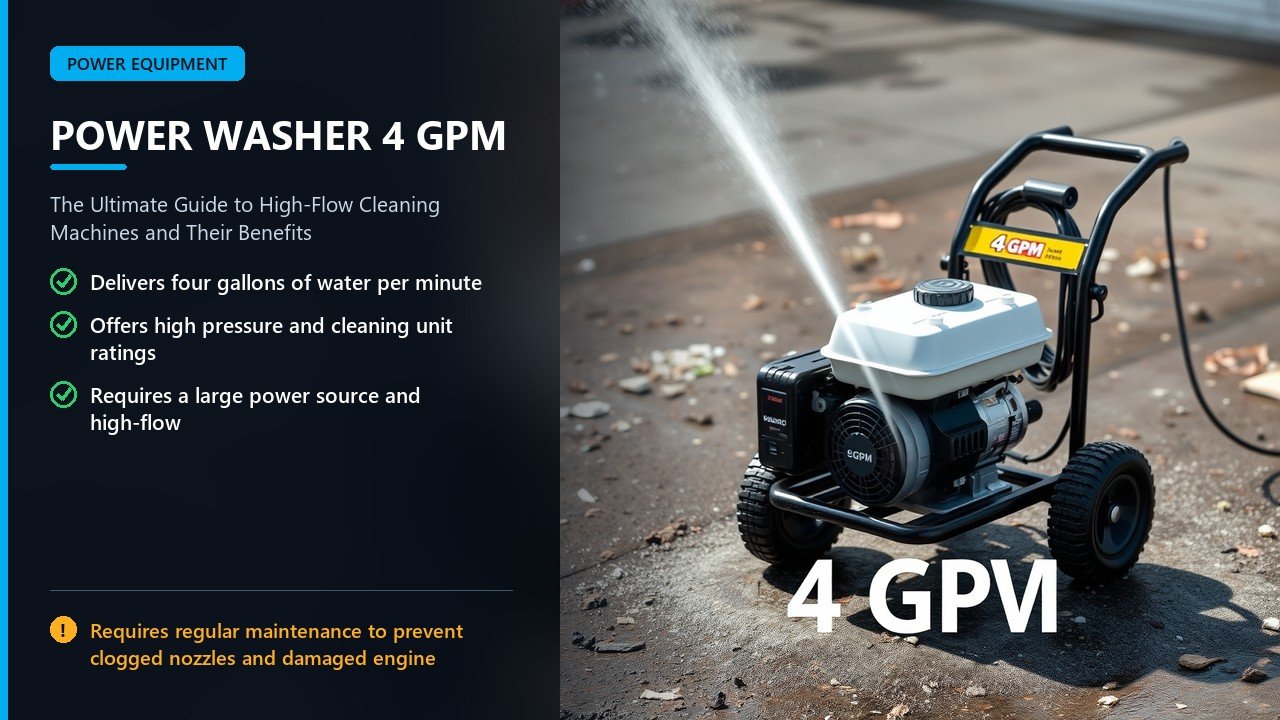
What 4 GPM Means
GPM stands for gallons per minute — the volume of water the machine pushes through the nozzle each minute. A 4 GPM washer delivers a substantial flow, well above the 1.5–2.5 GPM of typical consumer units.
A 4 GPM machine usually pairs that flow with high pressure, often 3,000–4,000 PSI. The combination gives it a very high “cleaning unit” rating, which is simply pressure multiplied by flow. Cleaning units are the best single measure of total cleaning power, because they account for both the force of the water and the volume delivered.
Because it moves so much water, a 4 GPM washer needs a power source that can keep up — usually a large gas engine or a heavy-duty electric motor. It also needs a water supply that exceeds 4 GPM at all times, and a nozzle that is sized exactly for that flow. Get any one of those wrong and the machine either underperforms or damages itself.
Why Flow Matters More Than You Think
Most buyers fixate on PSI, but flow is what determines how fast you actually clean. Pressure strips and cuts; flow rinses and covers ground. On a large, dirty surface, a machine with more GPM usually finishes first because it carries away loosened dirt faster and covers more area per pass.
Think of it this way: pressure is how hard you scrub, and flow is how much water you use to wash the dirt away. Two machines with identical PSI can clean very differently if their flow rates differ. The one with higher GPM rinses better, covers more surface per minute, and leaves fewer streaks.
This is why professional cleaners pay close attention to GPM, sometimes more than PSI. For big, dirty surfaces, flow is often the difference between a task taking one hour or three. A 4 GPM machine is, above all, a productivity tool.
4 GPM vs Lower-Flow Machines
To put 4 GPM in context, consider where it sits in the market. Compact electric washers typically deliver 1.2 to 1.6 GPM — fine for washing a car or a small patio. Standard gas washers often deliver 2.4 to 2.8 GPM, which suits most home cleaning. The professional class moves 3.5 to 4.0 GPM and often more, and that is where a 4 GPM machine lives: light commercial and heavy residential duty.
The step up in flow from a 2.5 GPM home machine to a 4 GPM unit is significant. Surfaces rinse faster, detergent clears sooner, and jobs that once took an afternoon finish in a fraction of the time. That is why contractors and property managers favor 4 GPM machines even when the pressure rating looks similar to a cheaper unit.
Who Needs 4 GPM
Not everyone needs 4 GPM. For occasional home use, a lower-flow machine is lighter, cheaper, and easier to handle. But certain users benefit immediately. Contractors and cleaning businesses gain faster job completion, which directly increases revenue. Property managers covering large areas reduce labor hours. Fleet washing operations rinse vehicles faster. Farm and ranch owners handle heavy, recurring dirt more effectively. And serious DIY users with long driveways or large properties save substantial time.
The common thread is scale and frequency. The more surface you clean and the more often you do it, the more a 4 GPM machine earns its place.
Flow, Pressure, and Cleaning Units
To choose the right machine, you need to understand how pressure and flow combine. Pressure, measured in PSI, is the force the water carries. Flow, measured in GPM, is the volume delivered. Cleaning units — pressure multiplied by flow — express the total cleaning power in a single number.
A 4 GPM machine at 3,500 PSI delivers 14,000 cleaning units. Compare that to a consumer washer at 2.5 GPM and 3,000 PSI, which delivers 7,500 cleaning units. The 4 GPM machine is roughly twice as powerful in practical terms, even though its pressure is only modestly higher. This is why flow deserves as much attention as pressure when you shop.
The nozzle is the final piece. It is the component that converts the pump’s pressure and flow into an actual spray pattern, and it must be sized to the machine’s GPM. Get the size right, and the machine runs efficiently and reaches its rated pressure. Get it wrong, and you either over-pressurize the pump or rob yourself of cleaning force.
Matching the Machine to the Task
A 4 GPM washer is versatile, but matching it to the job ensures you get the most from it. On concrete driveways and sidewalks, a 4 GPM machine paired with a rotary surface cleaner removes dirt and stains quickly and evenly, far faster than a lower-flow unit. On building exteriors and siding, the extra volume rinses soap and debris efficiently. For fleet and vehicle washing, the flow clears road grime and detergent in a fraction of the time.
On equipment and machinery, 4 GPM provides enough volume to flush grease and debris from complex surfaces. On decks and wood, you should still avoid maximum pressure, but the higher flow lets you rinse thoroughly without holding the nozzle in one place. In every case, the machine’s strength is speed and volume, not simply brute force.
Water Supply: The Hidden Requirement
The most common mistake with a high-flow machine is starving it. A 4 GPM pump needs a water supply that delivers more than 4 GPM — ideally well over it — at adequate inlet pressure. If the supply falls short, the pump cavitates, runs hot, and wears out prematurely.
Garden hoses and household spigots can often supply enough volume, but not always, and long or narrow hoses reduce flow further. In settings where the supply is limited, a break tank or buffer tank keeps a reserve of water so the pump never runs dry. When using a tank, the supply must still refill it faster than the pump empties it, or the tank will eventually run low.
Always test the available flow before buying or operating a 4 GPM machine. The bucket-and-timer test — filling a known volume and measuring the time — tells you real-world GPM at the spigot. If it falls short of 4 GPM, plan for a tank or a different supply.
Nozzle Sizing for 4 GPM
Nozzle size is calibrated to flow, and it is critical on a 4 GPM machine. Using a nozzle that is too small for the flow raises pressure above the machine’s rating and can damage the pump. Using one that is too large drops pressure and leaves you cleaning with a weak, wasteful spray.
The correct nozzle for a given pressure and GPM is found on standard nozzle charts, usually expressed by orifice number. Most manufacturers ship a matched set of colored tips — 0°, 15°, 25°, and 40° — sized for the machine’s flow. Replace them with the same rated size, not generic tips, and check them for wear, since a worn nozzle changes both pattern and pressure.
A worn or mismatched nozzle is one of the most common causes of poor performance on a 4 GPM machine. It is also one of the cheapest problems to fix, which is why a spare set of correctly sized nozzles should be part of any kit.
Getting the Most From a 4 GPM Machine
A 4 GPM washer rewards good technique. Because it moves so much water, small changes in how you use it produce large differences in results. Keep the nozzle at a consistent distance from the surface, typically 12 to 18 inches, and keep it moving. Holding the spray in one spot concentrates the force and can etch concrete or gouge wood.
Work in overlapping passes, the way you would paint a wall, so no strip of surface is missed or over-cleaned. Start at the top of a vertical surface and work downward, letting gravity help carry the dirt away. On flat surfaces, use a rotary surface cleaner, which contains the spray and delivers an even, streak-free finish far faster than a wand alone.
Match the nozzle to the job. A 0° tip is for stubborn spots only, a 15° tip for tough grime on hard surfaces, a 25° tip for general cleaning, and a 40° tip for rinsing and gentler work. On a 4 GPM machine, the difference in surface impact between tips is dramatic, so choose deliberately rather than defaulting to the most aggressive one.
Maintenance Schedule
A high-flow machine works hard, so it needs regular care. The good news is that the routine is simple, and skipping it is what shortens a machine’s life.
| Task | Interval |
|---|---|
| Check pump oil (if applicable) | Every use |
| Inspect hose, gun, and O-rings | Every use |
| Clean inlet filter | Every use |
| Change pump oil | First 50 hours, then per manual |
| Service engine oil and air filter | Per engine manual |
| Check unloader and relief valve | Seasonally |
| Winterize | Before freezing |
Clean oil, clean water, and protection from heat and freezing cover most of what a 4 GPM pump needs. The two failures that kill pumps fastest — running dry and deadheading — are entirely preventable. Always keep water flowing through the pump, and never hold the trigger closed for long periods, because the pump has nowhere to send the water and it overheats.
Accessories Worth Adding
Several accessories make a 4 GPM machine dramatically more useful. A rotary surface cleaner is the single best upgrade, turning slow wand work on driveways into a fast, even job. A turbo or rotating nozzle adds concentrated force for concrete and masonry. Heavy-duty hoses in longer lengths let you work farther from the machine, and a hose reel keeps a long hose organized and protected.
Chemical injectors and foam cannons let you apply detergent and pre-soak vehicles or siding, then rinse with the full flow of the machine. Quick-connect fittings make swapping nozzles, wands, and attachments fast. An inline inlet filter protects the pump from grit that would otherwise score the valves over time. Together, these accessories stretch what one 4 GPM machine can do.
Safety With a High-Flow Machine
A 4 GPM machine at 3,000–4,000 PSI combines high pressure with high volume, which makes it more dangerous than a consumer washer. Never point the nozzle at people or animals, wear eye protection and gloves, and use the trigger lock whenever the gun is set down. Keep both hands on the gun and brace for kickback, which is stronger on a high-flow machine.
Relieve all pressure before disconnecting hoses or fittings, and inspect the gun, hose, and connections before every job. Never use the washer to clean yourself, and keep bystanders at a safe distance with a defined work zone. For general safety guidance, see the Occupational Safety and Health Administration and the U.S. Consumer Product Safety Commission.
Troubleshooting a 4 GPM Machine
When a 4 GPM machine underperforms, the cause is usually one of a handful of issues. If pressure drops, check the nozzle first: a worn or wrong-sized tip changes everything, and a clogged nozzle restricts flow and raises or lowers pressure unpredictably. Next, check for air in the suction line, usually caused by a loose connection or a supply that cannot keep up with the pump. Both produce a pulsing spray and reduced performance.
A failing unloader valve can also cause pressure loss. It regulates the machine’s working pressure and bypasses water when the gun is closed, and when it sticks or wears out, pressure becomes inconsistent or disappears. Finally, worn pump valves or seals reduce pressure gradually as they wear. If the pump oil has turned milky, water has entered the crankcase through failed seals, and the pump needs a rebuild or replacement.
Before condemning the pump, check the easy things first: nozzle condition, air in the line, water supply, and the unloader. Many “bad pump” complaints turn out to be a worn nozzle or an air leak, both of which are cheap to fix.
Common Mistakes to Avoid
The fastest way to ruin a 4 GPM machine is to starve it of water or let it run dry. Both cause cavitation and overheating that destroy seals and valves. Feeding the pump more water than it needs is the simplest protection you can provide.
Equally damaging is deadheading — running the pump with the gun closed. Without an outlet, the water heats rapidly and the pump is damaged within minutes. Trigger the gun regularly and rely on a working unloader to bypass water when the spray stops. Using a nozzle that is too small for the flow is another common mistake: it raises pressure above the machine’s rating and stresses every component.
Other easy-to-avoid errors include using an undersized or kinked hose, ignoring O-ring wear, running the machine without an inlet filter, and leaving water in the pump over winter. Each of these is cheap to prevent and expensive to ignore.
Frequently Asked Questions
Is 4 GPM better than higher PSI? Neither is universally better. Flow speeds up rinsing and coverage, while pressure strips and cuts. For most large-surface cleaning, the combination — high GPM with adequate PSI — matters most.
Can my water supply handle a 4 GPM washer? Only if it delivers more than 4 GPM at the inlet. Test with a bucket and timer; if the supply falls short, use a buffer tank to protect the pump.
What PSI goes with a 4 GPM machine? Usually 3,000 to 4,000 PSI. Lower pressure with very high flow is used for some applications, but most 4 GPM machines pair high flow with high pressure.
Do I need a special nozzle for 4 GPM? Yes. Nozzles are sized to flow. Using the wrong size either over-pressurizes the pump or leaves you with weak pressure.
Is a 4 GPM washer too much for home use? It can be, but for large properties and heavy cleaning it is a worthwhile investment. Smaller jobs are handled fine by lower-flow machines.
How do I maintain a 4 GPM washer? Keep water flowing, never deadhead, change pump oil on schedule, clean the inlet filter, and winterize every year.
Final Thoughts
A power washer 4 gpm is a productivity tool. The high flow lets it rinse, cover, and finish large jobs far faster than a standard consumer machine, which is why contractors, property managers, and serious property owners favor it.
Choose one that matches your water supply, use correctly sized nozzles, keep the pump fed and protected, and add a surface cleaner to unlock its full potential. For related reading, see our guides on the pressure washer pump 3000 psi and the 4000 PSI pressure washer gun.