A 4000 PSI power washer sits at the top of what a portable, wheeled machine can do. Below it is the field of homeowner and light-commercial washers; above it, machines become mounted, trailed, or truly industrial. That makes 4000 PSI a useful line to understand: it is where a portable washer starts acting like commercial equipment, and where the choice between pressure and flow decides how the machine performs.
This guide explains the 4000 PSI class — what it can clean, how the specifications differ, and what to look for if you are buying one.
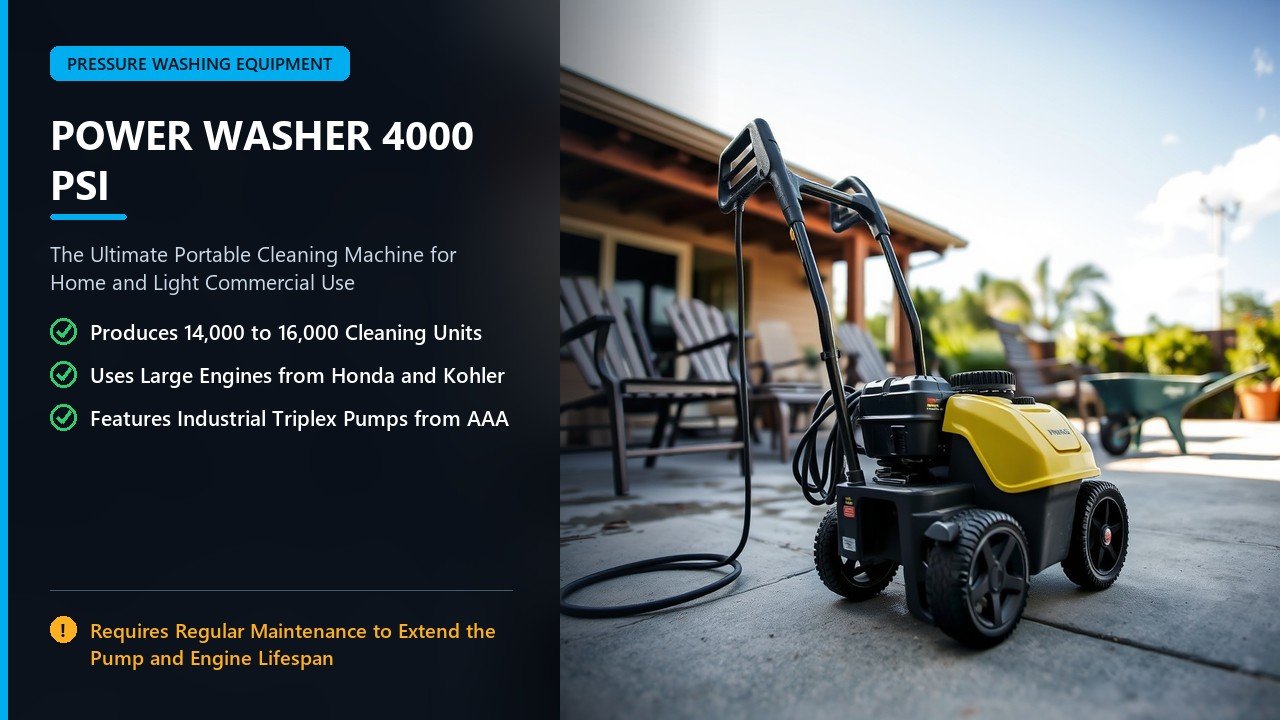
What 4000 PSI Represents
4000 PSI is a serious pressure rating, and paired with the flow these machines deliver, it produces a lot of cleaning power. Cleaning power is pressure multiplied by flow, so a 4000 PSI washer at 3.5 GPM outputs about 14,000 cleaning units, and at 4.0 GPM about 16,000. For comparison, a typical home machine produces a few thousand, and a light commercial machine around half of that.
The class is also the practical ceiling for portable gas washers. Above roughly 4000 PSI, machines tend to grow into industrial designs with larger engines, belt or hydraulic drives, or mounted configurations. So when you buy a 4000 PSI portable washer, you are buying close to the most powerful tool you can still move and store as a single unit.
Two things define the class: a large engine and an industrial triplex pump. These machines typically use engines around 270 cc to 390 cc from Honda, Kohler, or similar makers, driving triplex pumps from AAA, CAT, Comet, or Udor. That combination is what lets them hold 4000 PSI at a useful flow continuously, rather than only in short bursts.
The 3.5 vs 4.0 GPM Choice
Within the 4000 PSI class, the main decision is flow. Many machines are rated at 3.5 GPM with a mid-size engine such as a Honda GX270, while more powerful units reach 4.0 GPM with a larger engine like the Honda GX390. The higher-flow machine cleans faster because it moves more water at the same pressure.
The table below shows how the two common configurations compare.
| Spec | Mid | High |
|---|---|---|
| Pressure | 4000 PSI | 4000-4200 PSI |
| Flow | 3.5 GPM | 4.0 GPM |
| Engine | ~270 cc (e.g. GX270) | ~390 cc (e.g. GX390) |
| Cleaning units | ~14,000 | ~16,000 |
| Hose | 3/8″ x 50 ft | 3/8″ x 50 ft |
The pattern: both configurations sit at 4000 PSI, but the 4.0 GPM version with the larger engine cleans noticeably faster on large areas. If speed on big surfaces matters, the higher flow is worth it; if not, the 3.5 GPM machine is lighter and less expensive while still delivering professional pressure.
Engines, Pumps, and Drives
The engine is the first thing to check, because it decides how much flow the machine can sustain. Mid-range 4000 PSI units use engines around 270 cc; the higher-flow versions step up to roughly 390 cc. Brand matters too — Honda GX engines and Kohler units are common in this class because they start easily and hold up under long use. Look for features like low-oil shutdown that protect the engine from running dry.
The pump is the second key component. Machines in this class use industrial triplex pumps with ceramic plungers and stainless valves, made by brands such as AAA, CAT, Comet, or Udor. A triplex pump outlasts the cheaper axial pumps found on homeowner machines and is built to handle 4000 PSI continuously. A rebuildable pump with available parts is worth more than a sealed one, because it can be serviced rather than replaced.
The drive type — direct or belt — is the third choice. Direct drive connects the pump straight to the engine crankshaft: simple, compact, and common. Belt drive uses a belt to spin the pump more slowly and separately from the engine, which reduces heat and vibration and typically extends pump life. Belt-drive machines usually cost and weigh more, but they are the choice when the machine will run hard for long periods.
What a 4000 PSI Machine Can Do
At this level, the machine handles the toughest common cleaning jobs. It strips heavy grime from concrete driveways and parking areas, cleans large decks and restores weathered wood, removes graffiti in many cases, and prepares surfaces for paint by blasting away dirt, old coatings, and loose material. It is the kind of machine chosen for construction, rental fleets, and large-scale projects where a homeowner washer would simply be too slow.
Paired with a surface cleaner, a 4000 PSI washer becomes very productive on flat surfaces. A properly sized surface cleaner uses multiple rotating jets to clean a wide path evenly, cutting cleaning time dramatically and avoiding the stripes a wand leaves. Sizing the surface cleaner to the machine’s flow — not just its pressure — is what makes the pairing work.
With that capability comes responsibility. Used carelessly, 4000 PSI can etch concrete, gouge wood, strip paint, and force water behind siding or seals. These machines are powerful enough to cause real damage, so the operator needs the right nozzle, the right distance, and the right pressure for each surface. Power is the selling point; control is what makes it useful.
Choosing and Running a 4000 PSI Washer
Match the machine to the work first. If you clean large hard surfaces regularly, choose the 4.0 GPM version with the larger engine and consider belt drive for durability. If your jobs are smaller or less frequent, the 3.5 GPM direct-drive machine is easier to handle and costs less while still delivering 4000 PSI.
Check the details that affect daily use: a 50-foot 3/8-inch high-pressure hose, a quality trigger gun, a full nozzle set, and a rebuildable pump with available parts. Confirm the machine has a thermal relief valve to protect the pump when the gun is closed, and that the engine has low-oil shutdown. These features separate a machine that lasts from one that fails early.
Then treat it like the serious tool it is. Keep the pump oil at the correct level and change it on schedule, never run the pump dry, use the correct-size nozzle for the flow, and never modify or exceed the machine’s ratings. Service the engine as the manual directs, and winterize the machine completely before freezing weather. Run properly, a 4000 PSI washer earns its cost many times over; neglected, its pump is the first expensive part to go.
Safety at This Pressure
A 4000 PSI washer is not a toy, and its safety needs are real. The stream can cut skin, blast debris into the air, and damage surfaces in an instant if mishandled. Always wear eye protection, keep the nozzle away from people and animals, and never point the gun at yourself or anyone else — even briefly, and even with the machine off, because residual pressure can remain.
Handle the surfaces with the same respect. Never use the concentrated 0-degree tip on wood, and keep it away from anything that can be marked or gouged. Work at an angle, keep a suitable distance, and test an inconspicuous area first, because a powerful machine can leave permanent damage that appears only after the surface dries.
Watch the equipment as well. Never operate with damaged or missing hoses or parts, and always replace a high-pressure component with one rated at or above the machine’s rating rather than attempting to repair it. Check hoses, fittings, the wand, and the gun for cracks, wear, or leaks, and replace anything suspect — a failure at 4000 PSI is dangerous, not just inconvenient.
Where 4000 PSI Fits
Placing the class on a scale makes buying decisions easier. Homeowner washers generally run 2,000 to 3,200 PSI at a modest flow and are built for occasional use. Light commercial machines reach around 3,500 PSI, a step up in duty. The 4000 PSI class is where engines get large, pumps become industrial triplex, and the machine is genuinely built for repeated, demanding work.
Above 4000 PSI, machines tend to leave the portable category. Higher pressures come with bigger power plants, belt or hydraulic drives, and skid, trailer, or truck mounting, because the extra capability needs more infrastructure to supply and support. For a machine you can still wheel around and store as one unit, 4000 PSI is close to the summit.
That is why the class suits professionals and serious homeowners who clean large or tough surfaces often. It is overkill for occasional light cleaning, and it is the entry point for those doing real work. Knowing which side of that line you are on is the whole decision.
Maintaining the Pump and Engine
The pump is the heart of a 4000 PSI machine and the part most worth protecting. Check its oil before use, change it on schedule, and never let the machine run without water. Avoid long periods with the gun closed and the pump running, since dead-heading builds heat and pressure that shorten pump life; when you pause, release the trigger. Keep the inlet water clean and free of debris so grit never reaches the closely fitted pump parts.
The engine needs the same routine as any small gas engine. Check and change the oil, keep the air filter clean, replace the spark plug on schedule, and use fresh fuel. On machines with low-oil shutdown, do not rely on it as a substitute for checking the oil — it is a backup, not a maintenance plan. Store the machine with treated fuel or drain the fuel system for long storage.
Between jobs, inspect the high-pressure hose, gun, wand, and nozzle for wear, and keep spare O-rings and a nozzle or two on hand so small failures do not stop the work. Winterize fully before cold weather by draining the pump, hose, and any heater components, and store the machine dry and covered. Looked after this way, the engine and pump — the two most expensive parts — give long, reliable service.
Frequently Asked Questions
Is 4000 PSI good? Yes, it is a professional-level rating at the top of the portable gas class. Paired with a good flow rate, it produces high cleaning power for demanding jobs.
What flow rate should a 4000 PSI washer have? Common configurations are 3.5 GPM with a mid-size engine and 4.0 GPM with a larger engine. More flow cleans faster; 4.0 GPM units output about 16,000 cleaning units versus about 14,000 for 3.5 GPM.
What can a 4000 PSI washer clean? Heavy grime on concrete, large decks, wood restoration, graffiti removal, and paint preparation, as well as large-scale commercial cleaning with a surface cleaner.
Is 4000 PSI too much for cars? It is far more than a car needs. Use a lower-pressure tip, a wider angle, and greater distance, or step down to a gentler setting; high pressure can damage paint and trim.
What engine and pump should I look for? Engines around 270-390 cc from makers like Honda or Kohler, and industrial triplex pumps from AAA, CAT, Comet, or Udor. Prefer a rebuildable pump with available parts.
Direct or belt drive? Direct is simpler, lighter, and cheaper. Belt drive runs cooler and lasts longer, which helps under heavy, continuous use.
Can 4000 PSI damage surfaces? Yes. It can etch concrete, gouge wood, and strip paint. Use the correct nozzle, distance, and pressure for each surface, and test first.
How do I maintain it? Keep pump and engine oil at the right levels, change them on schedule, never run the pump dry, use the correct nozzle, avoid long dead-head periods, inspect hoses and fittings, and winterize fully.
Final Thoughts
A 4000 PSI power washer is the top of the portable class and the entry point to serious commercial cleaning. Its value comes from the combination of high pressure, useful flow, a large engine, and an industrial triplex pump — and the choice between 3.5 and 4.0 GPM often matters more than the pressure rating itself. Choose the flow to match your work, and the pressure to match your surfaces.
Respect the machine’s power, maintain its pump and engine carefully, and keep rated parts and spares on hand. Treated well, a 4000 PSI washer handles the toughest jobs for years and earns its keep; treated carelessly, it damages surfaces and eats pumps. For related reading, see our guides on 4 GPM pressure washers and a 4000 PSI pressure washer gun.