A first-time pressure washer owner named Devon decided to blast the mildew off his wooden deck with the red nozzle because it looked the most powerful. It was. It also carved deep gouges into the soft wood that no amount of sanding could hide. He learned the hard way what every experienced operator knows: the nozzle you choose matters as much as the machine, because it controls both the power and the safety of the spray. Understanding power washer spray nozzles is the single most valuable skill a pressure washer owner can develop.
A spray nozzle is the small component at the end of the wand, and it does far more than direct water. It shapes the spray, sets how concentrated the force is, and even affects the pressure your pump produces. Choosing the right nozzle for each surface protects the surface, extends the machine’s life, and produces a better result. This guide explains the color code, the spray angles, the critical orifice size, and how to match a nozzle to your machine and your job.
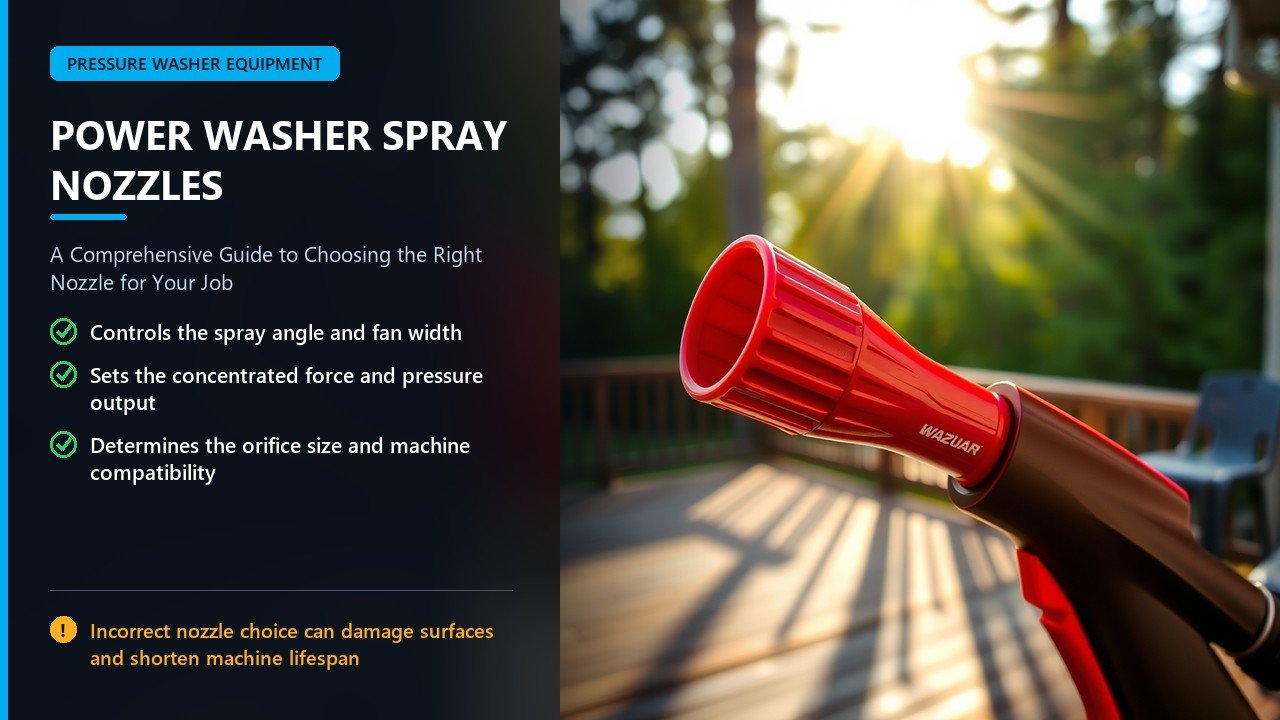
What a Spray Nozzle Really Does
To use nozzles well, it helps to understand the physics behind them.
The nozzle creates the pressure. A pressure washer pump moves a fixed volume of water. That water develops pressure only because the nozzle restricts its escape. A smaller opening restricts more and raises pressure, while a larger opening lets water flow freely at lower pressure. The nozzle, not just the pump, determines the machine’s working pressure.
The angle sets the concentration. A narrow fan concentrates the water into a small area for maximum impact, while a wide fan spreads it for gentle coverage. This is why the same machine can etch concrete with one tip and safely rinse a car with another.
The size sets the flow and pressure balance. The nozzle’s internal opening, called the orifice, is sized to the machine’s flow and target pressure. A tip that is too small spikes pressure and strains the pump, while one that is too large drops pressure and wastes the machine’s power. Matching the orifice is the part most people miss.
It is a safety device, too. Used correctly, the nozzle lets you tailor the spray to the surface, preventing the accidental damage that gives pressure washers a bad name. Used carelessly, it can strip paint, gouge wood, and injure. Respect the nozzle and it becomes a precision tool.
The Five Standard Color-Coded Nozzles
Almost every pressure washer comes with a set of color-coded tips, and each color has a specific purpose.
| Color | Angle | Best For | Caution |
|---|---|---|---|
| Red | 0 degrees | Concrete and metal, tough spots | Can gouge wood, strip paint, injure |
| Yellow | 15 degrees | Stripping paint, heavy grime on hard surfaces | Aggressive on soft materials |
| Green | 25 degrees | General cleaning: decks, siding, patios | Watch distance on wood |
| White | 40 degrees | Vehicles, windows, soft wood, siding | Lower impact, more rinsing |
| Black | 65 degrees | Applying soap and detergent | Not for cleaning or rinsing |
Red, the zero-degree tip. This is the most powerful and least forgiving nozzle. It fires a pinpoint stream for maximum impact, ideal for blasting rust, gum, and heavy stains from concrete and metal. It should never touch wood, siding, or automotive paint, and it should be aimed with care because a concentrated stream can cut flesh. Think of it as a precision tool for the toughest surfaces only.
Yellow, the 15-degree tip. This narrow fan offers strong impact with a bit more coverage than red. It is the go-to for stripping peeling paint, removing mildew, and cleaning hardened grease from hard surfaces like concrete, brick, and unpainted metal. It is aggressive, so use it at a distance on softer materials and hold the wand at an angle so it chisels under grime rather than hammering straight down.
Green, the 25-degree tip. The most versatile nozzle in the set, green balances power and coverage for general cleaning. It handles decks, fences, patios, siding, and vehicles well, delivering enough force to dislodge dirt without gouging most surfaces. When in doubt about which tip to start with, green is usually the answer.
White, the 40-degree tip. This wide, gentle fan spreads the water over a large area, making it ideal for delicate surfaces such as windows, painted finishes, soft wood, and vehicles. It is also the best choice for final rinsing, because its broad pattern avoids the harsh impact that can mark a surface. Our guide to the white pressure washer tip covers it in detail.
Black, the 65-degree soap tip. This tip is not a cleaning nozzle. It has a wide angle and a large orifice that drops pressure low enough to trigger the machine’s detergent injector, drawing soap from the tank or jug. Use black to apply detergent, then switch to a cleaning tip to wash and rinse. Using it for cleaning defeats its purpose.
What Are Higher and Lower Angle Nozzles?
Beyond the five standards, nozzles come in other angles for specialized work.
Narrow angles below 15 degrees. Some sets include a 15-degree tip only as the narrowest, but a 0-degree is the practical minimum. Anything narrower offers little real benefit for cleaning and increases the risk of damage, which is why the rotating turbo nozzle is a better answer for concentrated power.
Wider angles above 40 degrees. A 65-degree tip is the soap standard, and some chemical nozzles use even wider patterns to spread detergent quickly. These wide tips are for coverage and chemical application, not for the impact that removes heavy dirt.
The general rule of angles. The higher the angle, the wider and gentler the spray, and the lower the angle, the more concentrated and aggressive. Angle is a surface decision, while orifice size is a machine decision. Keep those two ideas separate and nozzle selection becomes simple.
The Orifice Size: The Number That Actually Matters
Color gets all the attention, but the orifice size determines how your machine performs.
What the orifice is. The orifice is the tiny internal opening the water passes through. Tips are stamped with a size number, such as 2.5, 3.0, or 4.0, which represents the flow the tip passes in gallons per minute at 4,000 PSI. That is why a 4.0 tip flows 4.0 GPM at 4,000 PSI.
Why it must match your machine. A nozzle that is too small forces the pump to work against excess pressure, overheating it and reducing flow. A nozzle that is too large lets water escape too easily, lowering pressure and cleaning poorly. Matching the orifice to your machine’s flow and target pressure is the key to peak performance.
The sizing formula. The standard formula is: nozzle size equals GPM times the square root of 4,000 divided by PSI. For example, a 4.0 GPM pump running at 3,500 PSI needs a size of about 4.3, which rounds to a 4.5 tip. This arithmetic takes the guesswork out of choosing.
A reference table. The following table offers a simple starting point for common machine classes.
| Machine Flow | Typical Pressure | Approximate Orifice Size |
|---|---|---|
| 2.0 GPM (electric) | 2,000 to 3,000 PSI | 2.5 to 3.0 |
| 2.5 GPM (entry gas) | 2,700 to 3,000 PSI | 3.0 |
| 3.0 GPM (mid gas) | 3,000 PSI | 3.5 |
| 3.5 GPM (pro direct drive) | 3,500 to 4,000 PSI | 3.5 to 4.0 |
| 4.0 GPM (commercial) | 3,500 to 4,000 PSI | 4.0 to 4.5 |
When in doubt, round up. If your calculation lands between two sizes, choose the larger tip rather than the smaller. A slightly oversized tip lowers pressure a touch, which is safer than an undersized tip that spikes pressure and strains the pump, as our guide to high-flow machines notes for demanding setups.
How to Read the Numbers on a Nozzle
The stamped code confuses many owners, but it follows a simple pattern.
A five-digit example. A tip stamped 25040 is a 25-degree nozzle with a 4.0 orifice. The first two digits give the angle, and the last three give the size, with an implied decimal. So 15035 is a 15-degree tip with a 3.5 orifice, and 40030 is a 40-degree tip with a 3.0 orifice.
Four-digit versions mean the same thing. Some manufacturers stamp 2504 instead of 25040, leaving off the trailing zero. Both mean a 25-degree tip with a 4.0 orifice. The difference is only formatting, and it trips up plenty of buyers.
Half sizes use a decimal. Sizes like 4.5 or 6.5 appear as 25045 or 25065, showing the decimal in the last digits. These half sizes let you dial in the match when your calculation falls between whole numbers.
Markings wear off. Because stamps and laser markings fade with use, it pays to note your machine’s required size and store an extra labeled set. A worn nozzle with an unknown size is a liability, and nozzles are cheap enough that replacing them when the marking fades is sensible.
Turbo and Rotary Nozzles
For concentrated cleaning power over a larger area, the turbo nozzle is a favorite upgrade.
How it works. A turbo nozzle, also called a rotary nozzle, spins a zero-degree pinpoint jet in a tight cone. The result is the impact of a concentrated stream with the coverage of a wider fan, which is why it feels several times more powerful than a standard tip.
Where it shines. Turbo nozzles excel on concrete, brick, and other hard surfaces, cleaning flatwork faster and more evenly than a fixed tip. They are the go-to for driveways and sidewalks where speed and impact both matter.
Where to avoid it. Because it concentrates force, a turbo nozzle can damage softer surfaces such as wood, siding, and vehicle paint. Reserve it for hard, durable materials, and keep it moving to avoid etching.
Size it like any nozzle. A turbo nozzle uses the same orifice sizing as a standard tip. Size it to your machine’s flow and pressure exactly as you would a fixed tip. A common mistake is assuming the turbo’s extra bite comes from a smaller hole, when in fact the mechanics create the power.
Threaded Versus Quick-Connect Nozzles
Nozzles attach in one of two ways, and the choice affects convenience.
Quick-connect nozzles. These have a built-in quarter-inch plug and snap into a matching coupler on the wand, allowing instant changes without tools. They are the standard on consumer and most prosumer machines, and their color-coded collars make them easy to identify. The one caution is to confirm the nozzle is fully locked before spraying, since a loose tip can be ejected under pressure.
Threaded nozzles. These screw into a threaded holder, usually with quarter-inch or other pipe threads. They are common on commercial machines and in fixed holders or dual lances. They seal by the thread and require a tighter, more deliberate change than a quick-connect.
Adapters bridge the two. If your machine uses threaded tips but you prefer quick-connects, an adapter converts the connection. Understanding your fittings is essential, and our guide to pressure washer connector types explains the common standards.
Fixed versus adjustable. Some wands use a single adjustable nozzle that twists to change the angle, trading precision for convenience. Fixed color-coded tips remain more accurate and are what professionals prefer, but an adjustable wand is handy for quick, minor jobs.
Using Nozzles Safely
Good technique prevents damage and injury.
Start wide and work narrower. Begin with a gentle, wider tip such as white or green, then move to a narrower angle only if the surface needs more force. It is far easier to add pressure than to repair a gouge.
Test in a hidden spot. Before cleaning a whole deck or wall, test your nozzle and distance on an inconspicuous area to confirm the surface can take it. This one habit prevents most accidents.
Keep the wand moving. Holding a narrow tip in one spot etches and streaks. Keep the nozzle in motion, work in overlapping passes, and maintain a consistent distance.
Mind the distance. The closer the nozzle, the more impact. For delicate surfaces, stand back and use a wider angle, letting the water carry dirt away rather than forcing it.
Never point a nozzle at people or animals. A zero-degree stream at close range can penetrate skin and cause serious injury. Treat the wand like the dangerous tool it is.
Nozzle Maintenance
Simple care keeps nozzles performing and lasting.
Clean clogged tips. Minerals and debris can block the orifice, causing a distorted spray. Most sets include a small cleaning needle, and a soak in vinegar or a descaling solution removes mineral buildup. Never poke a nozzle with a hard metal object that could enlarge or scratch the orifice.
Inspect O-rings. Quick-connect nozzles rely on O-rings to seal. A worn or missing O-ring causes leaks and pressure loss, and replacing it costs almost nothing. Keep a supply of spares on hand.
Replace worn or damaged tips. A nozzle that sprays unevenly, has an enlarged or scratched orifice, or has lost its markings should be replaced. A damaged tip wastes pressure and can mark surfaces.
Store them organized. Keep nozzles in a holder or a labeled bag so you always have the right one at hand and can tell them apart once the markings fade. This small habit saves time on every job.
Matching Nozzles to Common Surfaces
While every job is different, a few surface rules cover most cleaning tasks.
| Surface | Recommended Angle | Notes |
|---|---|---|
| Concrete driveway | 25 degrees, or turbo | Green for routine, 15 or turbo for stains |
| Wood deck | 40 degrees | White tip, keep distance to protect grain |
| Vinyl siding | 25 to 40 degrees | Spray downward, avoid forcing water behind panels |
| Car paint | 40 degrees | White tip only, never a narrow angle |
| Brick and masonry | 15 to 25 degrees | Widen near mortar joints to avoid erosion |
| Patio furniture | 25 to 40 degrees | Match to material, gentler on plastic and fabric |
Hard surfaces tolerate narrow angles. Concrete, brick, stone, and unpainted metal can take the force of green, yellow, or even a turbo nozzle. These materials benefit from the extra impact, and a narrow tip speeds up heavy cleaning without risking damage.
Soft surfaces need wide angles. Wood, siding, painted finishes, and vehicles should be cleaned with white or green tips at a distance. The goal is to lift dirt with the water’s flow rather than drive it with concentrated force, which is how surfaces get marked.
When a surface is uncertain, treat it as delicate. If you cannot identify the material or its finish, err on the side of gentleness. A pass with a wide tip that does not fully clean a stain is far better than a pass with a narrow tip that leaves a permanent scar.
Angle and distance work together. Moving the wand closer increases impact even with a wide tip, so treat distance as a second adjustment knob. Widening the angle and stepping back are two ways to soften the spray, and narrowing the angle and stepping in are two ways to intensify it.
Nozzles and Detergent Injection
Soap application depends on the right nozzle as much as the right chemical.
Why the soap tip is different. The black 65-degree soap tip has a large orifice and wide angle that drop the pressure low enough to create a venturi vacuum in a downstream injector, drawing detergent from a jug into the water stream. Without that pressure drop, the injector cannot siphon soap at all.
Applying soap. Attach the black tip, lower the pressure, and apply detergent from the bottom of the surface upward so it does not streak as it runs down. Let it dwell long enough to loosen dirt, but do not let it dry in the sun, which can leave residue.
Switching back to cleaning. After the soap dwells, switch to a green, yellow, or white tip and rinse and wash at full pressure. The change in pressure from the soap step to the wash step is what makes the sequence work.
Upstream versus downstream. Some machines inject detergent before the pump, called upstream, and some after, called downstream. Downstream injection relies on the soap nozzle’s pressure drop, while upstream systems meter chemical into the pump inlet. Either way, the low-pressure soap tip is central to how the detergent reaches the surface.
Nozzles for Surface Cleaners
Surface cleaners, the spinning attachments that clean flatwork, use their own nozzle math.
Why sizing changes. A surface cleaner turns on two or more nozzles that share the machine’s total flow. Each nozzle therefore receives only part of the flow, so each one needs a smaller orifice than a single wand tip would.
The split rule. For a two-nozzle cleaner, divide the machine’s flow by two and size each tip to that value. A 4.0 GPM machine with two nozzles needs two tips sized around 2.0 each. For a three-nozzle cleaner, divide by three, and so on.
Why the split matters. Using full-size tips on a multi-nozzle cleaner would demand more water than the pump produces, dropping pressure and slowing the spin. Sizing each nozzle to its share of the flow keeps the cleaner turning fast and cleaning evenly.
The right angle for flatwork. Surface cleaner nozzles usually come in the 15 to 25-degree range, chosen for even coverage without the harsh lines a narrower tip can leave. Because the cleaner maintains a fixed height, the risk of etching is lower than with a handheld wand, but speed still matters.
Common Nozzle Mistakes to Avoid
Most pressure washer damage traces back to a handful of avoidable errors.
Reaching for the red tip by default. The zero-degree tip is the most tempting and the most destructive. Save it for extreme spots on hard surfaces, and keep it away from anything soft.
Ignoring the orifice size. A mismatched nozzle changes the machine’s pressure without warning. Always confirm the stamped size matches your machine before trusting a tip, especially after buying a replacement set.
Standing too close with a narrow angle. Even a green tip can mark a surface at close range. Keep a consistent distance and let the angle do the work rather than crowding the surface.
Holding the spray in one spot. A stationary narrow tip etches, streaks, and can carve grooves in seconds. Keep the wand moving and overlap your passes.
Cleaning a nozzle with a hard tool. Poking an orifice with a screwdriver or stiff wire can scratch or enlarge it and ruin the spray pattern. Use a soft cleaning needle or a soak, and replace the tip if the pattern stays poor.
Using the soap tip to clean. The black tip is for applying detergent, not washing. Relying on it for cleaning leaves surfaces dirty and wastes pressure that a proper tip would deliver.
Frequently Asked Questions
What are the colors of pressure washer nozzles? Red is 0 degrees, yellow is 15 degrees, green is 25 degrees, white is 40 degrees, and black is 65 degrees for soap application. The color indicates the spray angle, not the size.
What is the most common pressure washer nozzle? The green 25-degree tip is the most versatile and most commonly used, balancing force and coverage for general cleaning such as decks, siding, patios, and vehicles.
What nozzle should I use for a car? Use the white 40-degree tip, which spreads the water gently to protect paint. Keep the nozzle at a safe distance and never use the red zero-degree tip on a vehicle.
What nozzle do I use for concrete? The green 25-degree tip works for routine concrete cleaning, while the yellow 15-degree tip or a turbo nozzle handles tougher stains and faster flatwork cleaning. Reserve the red tip for extreme spots.
What do the numbers on a pressure washer nozzle mean? The first digits indicate the spray angle, and the remaining digits indicate the orifice size. A 25040 is a 25-degree tip with a 4.0 orifice. The orifice is the flow the tip passes in gallons per minute at 4,000 PSI.
How do I know what size nozzle my pressure washer needs? Match the orifice to your machine’s flow and pressure using the formula: size equals GPM times the square root of 4,000 divided by PSI. Round up to the next half size if you are between sizes.
What is a turbo nozzle used for? A turbo or rotary nozzle spins a zero-degree jet in a cone, delivering concentrated cleaning power over a larger area. It is best for hard surfaces like concrete and brick, and it should be avoided on wood, siding, and vehicles.
Why is my pressure washer nozzle not spraying right? An uneven or weak spray usually means a clogged orifice from minerals or debris. Clean it with a needle or a descaling soak, check the O-ring, and replace the tip if the spray stays distorted.
Final Thoughts on Power Washer Spray Nozzles
Power washer spray nozzles are the interface between your machine and the surface you are cleaning, and mastering them transforms both your results and your safety. The color code tells you the angle, the stamped number tells you the size, and the two together let you match the right tip to the machine and the job. Get those right and the machine feels more powerful, the surfaces come out cleaner, and accidents become rare.
Devon repaired his deck, bought a proper set of nozzles, and never again reached for the red tip on wood. He learned that the goal is not maximum force but the right force for each surface, delivered by the right nozzle. Match your tip to your machine, start with the gentle angles, keep the spray moving, and your power washer spray nozzles will help you clean faster, safer, and better every time.