For years, Marcus cleaned his two-story house the same way most homeowners do: by dragging a ladder around the yard, climbing up, spraying one small section, climbing down, moving the ladder, and repeating. It took an entire weekend and scared his wife every time. Then a friend handed him a power washer wand extender, and he cleaned the same house in two hours with both feet planted on the ground. That single accessory changed the job from a chore and a hazard into a fast, safe task.
A power washer wand extender is a rigid or telescoping lance that attaches to the spray gun and moves the nozzle farther from the operator, letting you reach high siding, gutters, and second stories while staying safely on the ground. Choosing the right one comes down to reach, compatibility, and control. This guide explains the types, how to match an extender to your machine, and how to use one safely so you get the reach you need without the risk.
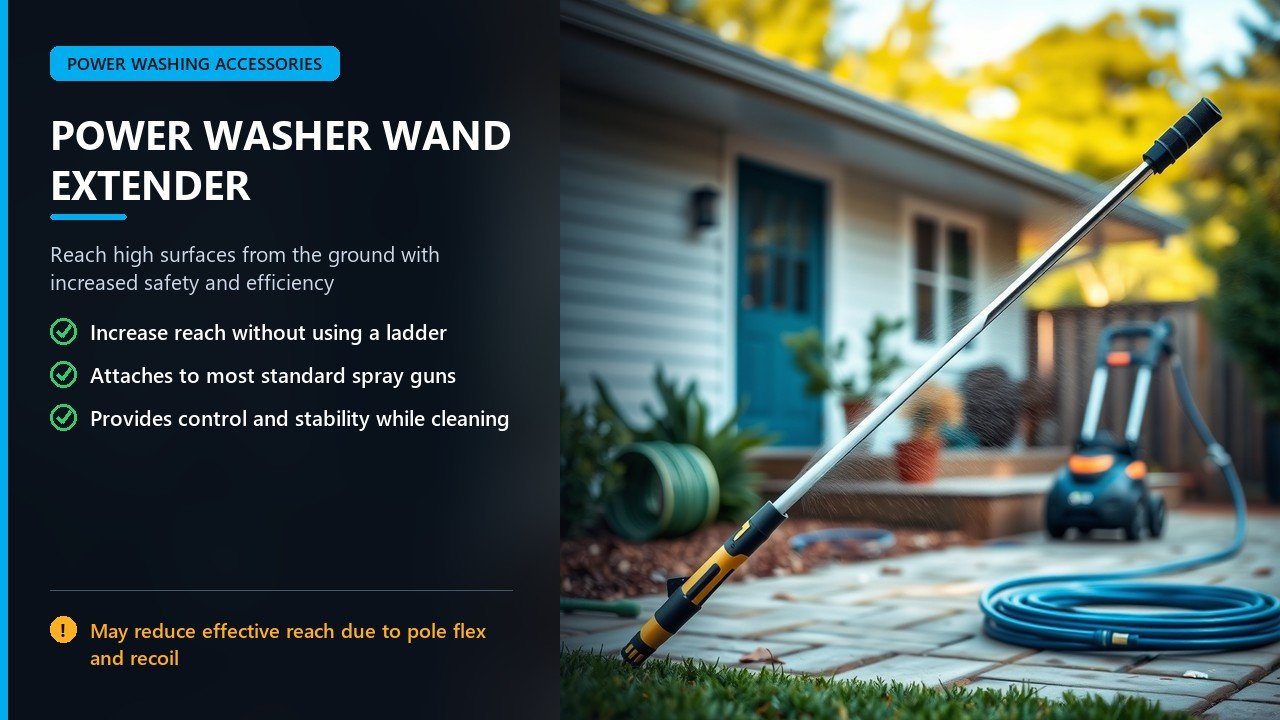
Why Use a Wand Extender
Extension wands solve a problem that ladders create but never really solve.
Safety first. The biggest reason to use an extender is to keep your feet on solid ground. Pressure washing from a ladder is dangerous, because the recoil of the spray, wet rungs, and the awkward stance combine into a serious fall risk. An extender removes the ladder from the equation entirely.
Reach. A good extender lets you clean one, two, or even three stories high, reaching siding, windows, soffits, fascia, and gutters that a standard wand cannot touch. For many homes, the difference between a clean second story and a streaked one is simply having the reach.
Speed. Moving a ladder for every section is slow. With an extender, you walk the perimeter of the house and clean continuously, which can cut the job time in half or better.
Versatility. Most extenders accept standard quick-connect nozzles and some support gutter-cleaning hooks, turning one accessory into a multi-purpose tool. Our guide to the extended power washer wand covers the gutter-cleaning use in detail.
Types of Wand Extenders
Extension wands come in a few distinct designs, and each suits different jobs.
| Type | Typical Reach | Best For | Trade-Off |
|---|---|---|---|
| Short rigid lance | 12 to 40 inches | Cars, decks, close work | Little added reach |
| Sectional pole | 3 to 9 feet | One-story siding, gutters | Assembly required |
| Telescoping pole | 6 to 24 feet | Two-story siding, fascia | Flexes when extended |
| Angled wand | Standard length | Undercarriage, hard angles | Not for height |
Short rigid lances. These add a foot or two of length and are handy for keeping your hands away from the spray on cars, wheels, and decks. They do not meaningfully increase height reach, but they improve control for close work.
Sectional poles. A sectional extender is made of separate pieces that screw or snap together, producing roughly three to nine feet of total length. They are simple and sturdy, though you must assemble them before use and cannot adjust length on the fly.
Telescoping poles. These use overlapping sections with locking collars, letting you set the length anywhere from fully retracted to fully extended, commonly six to twenty-four feet. They are the most convenient for height work, but the longer they extend, the more they flex and the harder they are to control accurately.
Angled wands. An angled wand bends the nozzle so you can spray under a car or into a tight corner. It is not an extender in the height sense, but it belongs in the same family of reach accessories and pairs well with the others.
How a Telescoping Wand Works
Understanding the mechanism helps you use it well.
The hose travels inside. On a telescoping wand, the high-pressure hose feeds through the inside of the pole and connects at the tip, so the water reaches the nozzle without dangling exposed hose. This internal routing is what allows the length to adjust smoothly.
A trigger gun stays on the pole. The gun is mounted at the base of the pole, and you keep one hand on it and one on a foam grip higher up. The gun should never be bypassed, disabled, or removed, because it is your main control and safety device.
Locking collars hold the length. Each section has a lock ring or lever that grips the pole at the chosen length. Grit inside a collar can prevent full engagement, so a dirty collar is a real hazard rather than a minor annoyance.
Flex is unavoidable. When pressure engages, the pole bows and springs. This reaction force grows with length, which is why the manufacturer warns that a fully extended pole tips from accurate at the point of cleaning and is harder to control.
Matching an Extender to Your Machine
Before buying, confirm that the extender will work with your pressure washer.
Check the pressure and flow rating. The extender must be rated at or above your machine’s maximum PSI and GPM. A typical heavy-duty telescoping wand is rated for around 4,000 PSI and 8 GPM, which covers most consumer and prosumer machines but can be exceeded by large commercial units.
Check the fittings. The wand’s inlet must match your hose end or trigger gun outlet. Many wands accept a quarter-inch quick-connect plug with an M22 male screw adapter, and some include an adapter for hoses that use a quick-connect coupler instead of threads. Matching fittings is essential, and our guide to pressure washer connector types explains the common standards.
Consider the hose diameter. Telescoping extenders typically require a three-eighths inch high-pressure hose to deliver enough flow to the nozzle at the top of the pole. A narrower hose may starve the nozzle and reduce performance.
Match the nozzle to the machine. Because the extender does not change your machine’s output, you still need a nozzle with the correct orifice for your PSI and GPM. Pair your wand with the right spray nozzles so pressure stays where it should.
Know the restrictions. Check the manual for limits such as cold-water only, no pivoting nozzles, or a maximum working length. Pivoting nozzles, for instance, increase the risk of kickback on a long pole and are often prohibited.
Choosing the Right Reach
The right length depends on what you are cleaning, not on buying the biggest number on the box.
| Task | Typical Length | Control Concern |
|---|---|---|
| Cars, wheels, decks | 1 to 4 feet | Keep nozzle 12 to 24 inches from surface |
| One-story siding | 4 to 8 feet | Avoid forcing water behind siding |
| Ground-level gutters | 6 to 10 feet | Use a downward angle and wide stance |
| Two-story siding | 12 to 18 feet | Flex and recoil increase fatigue |
| High gutters and fascia | 18 to 24 feet | Use a harness only if approved |
For most homeowners, six to ten feet is the sweet spot. That range reaches one-story siding and ground-level gutters comfortably without the handling difficulty of a very long pole. It is enough reach to matter and short enough to stay controllable.
For two-story work, twelve to eighteen feet is typical. A longer pole may be needed for high gables, but every extra foot adds flex and shoulder strain, so avoid overreaching for a job that a shorter pole handles.
Pick the shortest pole that reaches. This is the professional rule. A shorter pole is more accurate, less tiring, and safer. Advertised maximum length is a specification, not a recommended working position, and you should rarely extend a pole fully if flex prevents stable control.
How to Set Up and Use an Extender
Following the right sequence prevents leaks, damage, and injury.
Prepare safely. Turn the machine off, release the trigger, and relieve all pressure before attaching or adjusting the wand. Trapped pressure can make couplers difficult or dangerous to release.
Attach the wand. Connect the wand to the gun or hose with the correct fittings, threading any M22 fitting by hand or inserting the quick-connect plug until the collar locks. Never force a quick-connect with pliers.
Install the nozzle. Pull back the wand’s collar, insert the nozzle plug fully, and release the collar to lock it. Confirm there is a nozzle in place before starting, since running without one can damage the wand.
Extend at 50 percent first. Before approaching the work area, extend the pole to about half its length and test the spray on open ground. This lets you feel how the pole flexes and recoils before you are close to the house.
Grip with both hands. Keep one hand on the trigger gun and the other on the foam grip, with a braced stance and one foot slightly forward. A firm grip and a stiff arm help you absorb the kickback.
Start at a distance. Begin with the nozzle at least ten feet from the surface and move it in gradually. Work from the top down and from one side to the other so dirty water runs over already-cleaned areas rather than under them.
Stop spraying away from surfaces. Before you release the trigger, move the nozzle at least ten feet from the wall and make sure of your footing, because the pole will spring back when pressure is lost. Do not release the trigger close to the surface unless it is an emergency.
Never adjust under pressure. Extend, retract, or change nozzles only after stopping the machine and relieving pressure. Adjusting a live wand is one of the most dangerous mistakes an operator can make.
Reaching Safely Around Power Lines
Long poles and electricity are a deadly combination that deserves its own warning.
Keep your distance. Manufacturer manuals repeatedly require staying at least ten feet from overhead power lines, and some poles specify twenty-five feet. Contact with a transmission line through a wet pole can be fatal, and the pole can reach farther than it looks when it flexes.
Watch for service drops. The line from the utility pole to your house is often lower than the main lines and easy to overlook. Look up and map every wire before you raise the pole.
Never aim at electrical equipment. Do not spray toward meters, fixtures, or wiring. Water conducts, and a pressure stream can damage equipment or create a shock hazard.
Follow local rules. Clearance requirements vary by voltage and jurisdiction, so treat the ten-foot minimum as a floor, not a target, and follow any stricter local guidance for your area.
Accessories That Improve the Job
A few add-ons make extenders easier and safer to use.
Support harnesses. Some pole systems offer a belt or harness that carries part of the weight and steadies the pole. Use one only if the manufacturer approves it for your model, since an unapproved strap cannot remove recoil or snag hazards.
Gutter hooks. A curved hook attachment lets you pull debris toward you or flush gutters from the ground, turning the extender into a gutter tool without a ladder.
Angled nozzles. A fixed angled adapter lets you aim the spray around soffits and under garage doors, though pivoting nozzles are usually forbidden on long poles because they increase kickback.
A stable connection. Proper quick-connects rated for high pressure keep the wand secure. Our guide to quick connects for pressure washers explains how to choose fittings that will not fail under load.
Common Problems and Fixes
Most extender troubles trace back to a few causes.
Lost pressure at the nozzle. This usually means an oversized nozzle, a blocked tip, a restrictive adapter, or a damaged O-ring. Compare the spray with and without the wand and verify your nozzle against the machine’s GPM chart.
A collar that slips. Grit inside a locking collar prevents full grip. Clean the collar and check that the lock engages fully, and tighten the locking lever with the provided tool only if the manual allows it.
Excessive flex. The pole bows more the further it extends. The fix is almost always to shorten the pole and step closer, which restores accuracy and reduces fatigue.
A cracked fiberglass pole. Inspect fiberglass for cracks, splinters, and crushed ends before each use. A damaged pole can fail under pressure, so a worn extender should be replaced rather than repaired.
Leaks at the connection. A leaking joint often points to a worn O-ring or a partially locked coupler. Re-seat the fitting and replace the O-ring, working from the nozzle backward to find the source.
Materials and Weight
The material of an extender determines its weight, durability, and water compatibility.
Fiberglass. Fiberglass poles are lightweight and affordable, which makes them popular with homeowners. The downsides are that they are generally restricted to cold water and can crack, splinter, or crush at the ends if dropped or overstressed. Inspect them often and store them carefully.
Aluminum. Aluminum poles are heavier but far more durable, and professional-grade models are often rated for commercial hot water machines. For frequent or demanding use, aluminum is worth the extra weight because it survives the abuse that fiberglass cannot.
Weight versus reach. Longer poles are heavier and harder to hold aloft, and the higher the nozzle climbs, the more leverage the weight gains. A twenty-four foot pole can wear out your shoulders in minutes, while a twelve foot pole is manageable for a full cleaning session. This is another reason to choose the shortest pole that reaches.
Grip and balance. Look for a foam grip on the upper section and a firm, well-placed trigger gun at the base. Good balance matters more than raw lightness, because a balanced pole feels steadier and lets you work longer without fatigue.
Hot water compatibility. If you run a hot water machine, confirm the wand is rated for hot water before use. Cold-water wands can fail under heat, and the consequences of a burst fitting at pressure are serious. Match the accessory to your machine’s temperature rating, not just its pressure.
Extension Wand, Ladder, or Soft Wash
An extender is one of several ways to reach high surfaces, and each has trade-offs.
| Method | Advantages | Risks |
|---|---|---|
| Wand extender | Stays on the ground, fast, reusable | Recoil, flex, power-line contact |
| Ladder | Precise up-close work | Falls, wet rungs, unstable footing |
| Soft wash system | Gentle, safe for roofs | Lower pressure, separate equipment |
The extender keeps you grounded. Its greatest strength is removing the fall hazard of a ladder while still delivering pressure-washing force. For siding, gutters, and fascia, it is usually the safest and fastest option.
A ladder still has a place. For inspection, scraping, hand removal of heavy debris, or repairs, a ladder remains necessary. The point is not to ban ladders but to stop using them as a pressure-washing platform, which is where most accidents happen.
Soft wash for delicate surfaces. Roof shingles, old paint, and fragile materials may be damaged by pressure even from a distance. In those cases, a soft wash system that applies low-pressure detergent is safer than any pressure wand, extender or not. Know when the job calls for a different approach.
Combining methods. Many professionals use a soft wash for the roof, a wand extender for the siding and gutters, and a ladder only for inspection and detail work. Matching the method to the surface produces better results than forcing one tool to do everything.
Maintenance and Storage
Simple care keeps an extender reliable and safe.
Depressurize after every use. Squeeze the trigger until all water drains from the unit before putting it away. Trapped water and pressure stress seals and couplers over time.
Clean the locking collars. Grit is the enemy of a solid lock. Wipe or rinse the collars after each job so particles do not prevent full engagement and cause the pole to slip under pressure.
Inspect before each use. Check the pole for cracks, crushed ends, and worn O-rings, and confirm the fittings lock fully. A damaged extender should be replaced, not patched, because it can fail explosively under pressure.
Store indoors and dry. Store the extender indoors in a dry place, especially fiberglass, which can degrade with prolonged moisture and sunlight. A pole stored wet in a hot garage will not last as long as one dried and hung up.
Do not overtighten. Locking levers and couplers should be snug, not forced. Overtightening can strip threads or crack collars, and the manual usually warns against it.
Frequently Asked Questions
What is a power washer wand extender used for? It extends the reach of your spray, letting you clean high siding, windows, gutters, and fascia while standing safely on the ground. It reduces or eliminates the need for a ladder.
How long can an extension wand be? Short lances add 12 to 40 inches, sectional poles reach about 3 to 9 feet, and telescoping poles commonly reach 6 to 24 feet. Usable reach is less than advertised length once flex and nozzle angle are considered.
Can I use an extension wand with any pressure washer? Only if the ratings and fittings match. The wand must be rated at or above your machine’s PSI and GPM, and its inlet must fit your hose or gun. Check the manual before buying.
Do extension wands reduce pressure? A properly matched wand does not reduce pressure on its own, but an oversized nozzle, a blocked tip, or a restrictive adapter can lower it. Match the nozzle orifice to your machine’s PSI and GPM.
Can I use an extension wand on a hot water pressure washer? Only if the wand is rated for hot water. Fiberglass wands are generally for cold water, while professional aluminum wands are often approved for hot water. Verify the rating before use.
How far should I keep an extension wand from power lines? At least 10 feet at all times, and 25 feet for some models. Never contact or aim at electrical wiring, and follow any stricter local clearance rules.
Why does my extension wand flex so much? Pole flex grows with length and pressure. The reaction force of the spray bows the pole, especially when fully extended. Shorten the pole and step closer to regain control and accuracy.
Can I change nozzles while the wand is under pressure? No. Stop the machine, shut off the water supply, and release all pressure before changing nozzles or adjusting the wand. Doing so under pressure risks serious injury.
How much does a power washer wand extender cost? Short lances and simple sectional poles cost the least, while heavy-duty telescoping wands cost more. Price rises with length, material, and pressure rating, and a mid-priced aluminum telescoping wand is usually the best value for homeowners who clean twice a year or more.
Will an extension wand work with my existing nozzles? Most extenders accept standard quarter-inch quick-connect nozzles, so your existing color-coded tips usually fit. Confirm the connection style, and remember the nozzle orifice still has to match your machine’s PSI and GPM.
Is a longer extension wand always better? No. A longer wand reaches higher but flexes more, is heavier, and is harder to aim accurately. The best choice is the shortest wand that reaches your target with control, which is why most homeowners are best served by a six to ten foot or twelve foot model.
Can I use an extension wand to clean gutters? Yes, with a gutter hook attachment and the right nozzle. A downward angle and a wide stance keep you in control, and the extender lets you flush gutters from the ground instead of climbing a ladder. See our guide to the extended power washer wand for the full method.
What happens if I release the trigger next to the house? The pole springs back when pressure is lost, which can swing the nozzle into the surface and damage siding or glass. Always move the nozzle at least ten feet away from the surface before releasing the trigger, unless there is an emergency.
Final Thoughts on Power Washer Wand Extenders
A power washer wand extender turns a risky, slow job into a safe and efficient one by putting the reach where you need it while keeping your feet on the ground. Whether you choose a short lance, a sectional pole, or a telescoping wand, the keys are the same: match the ratings and fittings to your machine, choose the shortest length that reaches, and respect the recoil, flex, and power-line clearance rules that keep you safe.
Marcus never climbed a ladder to wash his house again. He bought an eighteen-foot telescoping wand rated for his machine, learned to extend it only as far as each section needed, and cleaned the whole exterior from the ground in a single afternoon. Treat your extender as the serious tool it is, set it up correctly, keep it clear of wires, and it will give you the reach to clean high surfaces safely for years.