A leaking or stubborn powerwash hose reel is one of the most needlessly replaced pieces of equipment in a pressure washing setup. Owners see a drip at the center or a drum that will not retract and assume the reel is finished. In most cases it is not — it is a worn seal, a tired spring, or a loose fitting, and each has a straightforward repair.
This guide covers the six failures that account for nearly every powerwash hose reel problem, how to diagnose each one, and how to decide between a rebuild kit and a replacement.
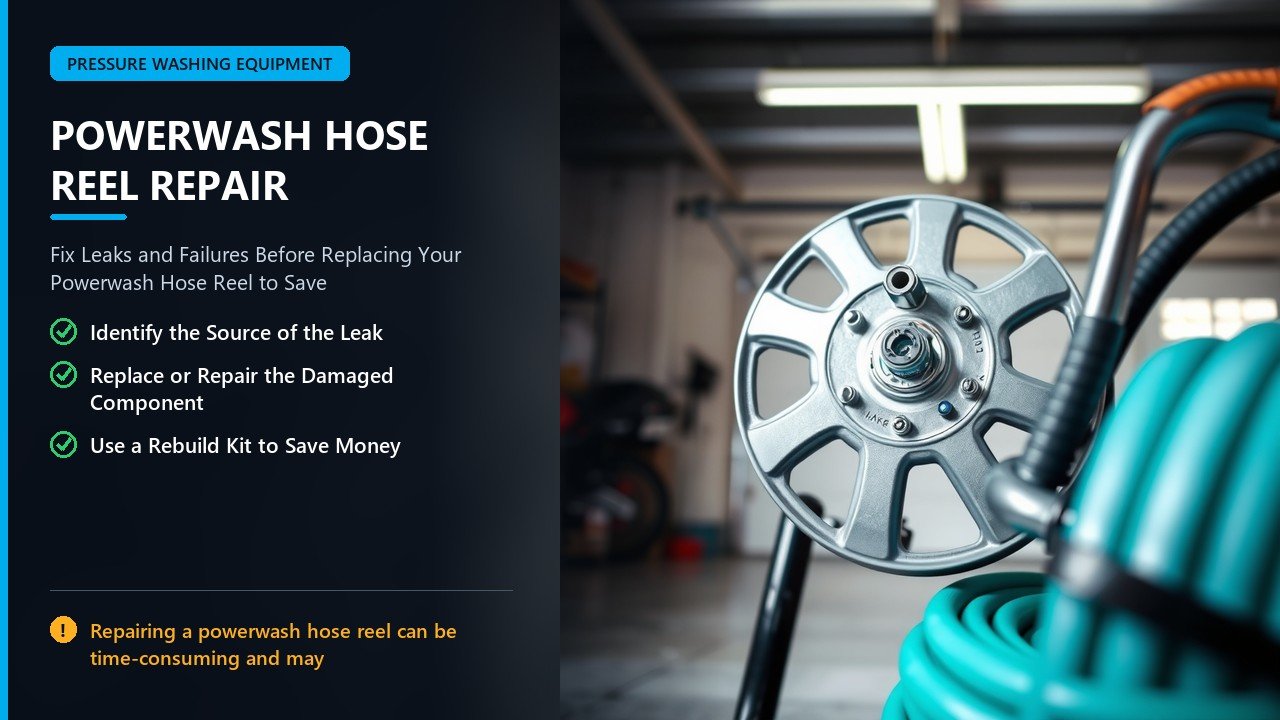
How a Hose Reel Is Built
To repair a reel, you need to know its four working parts. The swivel is the rotating joint at the center of the drum that lets water pass into the hose while the drum turns; it contains seals that wear out. The spring (on retractable reels) provides the pull that winds the hose back. The latch or ratchet holds the drum at the length you pull out. And the bearings or bushings let the drum spin smoothly on its axle.
Each failure you will encounter traces back to one of these parts. A drip at the center is a swivel seal. A reel that will not retract is a spring. A reel that will not hold position is a latch. A grinding crank is a bearing or debris. Identify which part is misbehaving and the repair is usually straightforward.
On reels that merely store the hose — the simple onboard reels on many electric washers — there is no swivel in the water path at all, so they rarely leak. The troubleshooting below applies mainly to reels that carry water through a swivel, which is the case for most commercial powerwash hose reels.
Failure One: The Swivel Leaks
A drip or spray at the center of the drum is the most common reel complaint. The cause is almost always worn or damaged swivel seals or O-rings, sometimes accelerated by exceeding the reel’s pressure rating or running chemicals the seals were not built for.
The fix is a swivel seal kit or a replacement swivel, matched to your reel model. Before blaming the swivel, though, be sure the leak is not simply at the hose fitting threading into the swivel. Tighten that fitting properly, using pipe sealant, and use a wrench to support the swivel so you do not twist the plumbing while tightening.
One subtle cause deserves a mention: a stiff, non-flexible inlet or leader hose can pull sideways on the swivel and cause it to leak or lock up. If a reel keeps leaking even after new seals, check whether the inlet hose is placing a side load on the swivel, and switch to a flexible leader hose.
Failure Two: The Reel Will Not Retract
If a spring-retractable reel will not pull its hose back, the power spring has lost tension or broken. A spring that is fatigued can sometimes be re-tensioned; a spring that has snapped must be replaced, usually as a complete spring canister.
Partial retraction is a clue. If the hose comes back most of the way but stops short, the spring may simply be under-tensioned, or the hose may be longer or heavier than the reel was designed for. Adding spring tension or fitting the specified hose length often solves it.
On many sealed consumer reels, the spring cannot be replaced at all — a design limitation rather than a repairable fault. On commercial reels, by contrast, the spring is a service part and can be adjusted or swapped, which is one more reason professional reels last longer.
Failure Three: The Reel Will Not Latch
A reel that will not hold position — where you pull out hose and it immediately winds back — has a latching problem. The latch, dog spring, or locking cam is worn or broken. On a manual reel, the ratchet pawl may be the culprit. Replacement of the small latch or cam is typically inexpensive.
Latching problems are often caused by incorrect operation rather than wear. To latch a spring reel, you pull the hose out and let it retract after hearing the first, second, or third click. To release it, you pull gently until the clicking stops, then control the retraction by hand. Using the reel carelessly stresses the latch and shortens its life.
If the latch mechanism is intact but the reel still will not hold, look at the drum’s rotation. A binding bearing or debris in the mechanism can prevent the pawl from engaging. Clean and lubricate before assuming the latch is broken.
Failure Four: The Crank Is Stiff or Grinding
A hand-crank reel that becomes hard to turn or grinds is usually suffering from debris, dried lubricant, or a worn bushing or bearing. Grit from job sites works into the axle and the crank pivot, and over time the friction builds.
The fix is cleaning and lubrication. Wipe out the grit, clear the pivot points, and apply a light lubricant to the crank and axle. If the drum still binds, the bushing or bearing may be worn and need replacement — a simple part on a serviceable reel.
A stiff crank can also mean the hose is wound unevenly and is rubbing against the drum or the frame. Rewind the hose flat and evenly, and make sure it is not overfilled beyond capacity, which loads the mechanism.
Symptom to Fix at a Glance
The table below maps the common symptoms of a powerwash hose reel to their causes and the usual remedy.
| Symptom | Likely cause | Fix |
|---|---|---|
| Leaking at the center | Worn swivel seals | Swivel seal kit or new swivel |
| Leaking at the inlet fitting | Loose threaded connection | Tighten with pipe sealant, support the swivel |
| Will not retract | Power spring fatigued or broken | Adjust or replace spring canister |
| Retracts only part way | Low spring tension or hose too long | Add tension or fit specified hose |
| Will not latch | Broken dog spring or locking cam | Replace latch or cam |
| Stiff or grinding crank | Debris, dried lube, worn bushing | Clean, lubricate, replace bushing |
| Swivel locks up | Stiff inlet hose side-loading it | Fit a flexible leader hose |
Notice how many of these are cheap, small parts. That is the recurring theme of reel repair: the failures are rarely catastrophic, and the parts are usually inexpensive compared to a new reel.
Repair or Replace?
The decision usually comes down to the reel’s construction. A commercial reel built with serviceable parts — a replaceable swivel, spring canister, latch, and bushings — can be repaired again and again, and rebuilding is nearly always cheaper than replacing. A cheap or sealed reel with no available parts is often a lost cause the first time it fails.
So before you repair, ask whether parts exist. If the manufacturer sells swivel kits, springs, and latches for your model, fix it. If the reel is a sealed consumer unit with no service parts, replacement is the realistic path — and a good reason to buy a serviceable reel next time.
The economics are stark. A swivel seal kit or latch might cost a fraction of a new reel, and an hour of your time. A quality reel repaired twice still costs less than two cheap reels replaced twice, and it performs better in between.
Preventing the Failures in the First Place
Most reel failures are wear or misuse, and both are manageable. Start by operating the reel correctly: pull hose out and control it during retraction rather than letting it snap back, which is both hard on the mechanism and dangerous. Never let a spring reel spin freely.
Keep the reel within its ratings. Exceeding the pressure rating damages the swivel seals, and running incompatible chemicals attacks them. Stay under the limits and the seals last far longer. Use a flexible leader hose at the inlet so the swivel is not side-loaded.
Maintain it like the machine part it is. Keep the drum, crank, and swivel clean and free of grit, lubricate the moving points lightly, wind the hose evenly, and inspect routinely for leaks and stiffness. In winter, drain the swivel and hose so freezing water does not crack them.
Safety Around Reel Repairs
Hose reels operate under high pressure, and high-pressure water can inject through skin and cause serious injury. Before any repair, shut off the machine, release all pressure by squeezing the gun, and disconnect the water supply. Never work on a pressurized reel.
Never put your hand over a pinhole leak or a fitting to stop a spray — the jet can pierce skin. Never let a spring-loaded reel spin uncontrolled; the whipping hose and spinning drum can injure. And after any repair, pressurize slowly and check every connection for leaks before returning to work.
If a reel’s spring canister or high-pressure plumbing is beyond your comfort, hand it to a qualified technician. A reel is a modest investment; a hand injury is not.
Knowing When to Stop Repairing
A leaking powerwash hose reel is rarely dead. Nine times out of ten it needs a swivel seal kit, a latch, a spring, or just a good cleaning — small parts and a little time. The reflex to replace the whole reel wastes money and throws away a serviceable unit.
Escalate only when it makes sense: a broken spring in a sealed, non-serviceable reel, or a swivel locked up by a stiff inlet hose you cannot fix. Otherwise, diagnose the part, order it, and repair. A reel treated this way can outlast the washer it feeds.
Frequently Asked Questions
Why is my hose reel leaking at the center? Worn swivel seals or O-rings. A swivel seal kit or a new swivel fixes it. First confirm the leak is not just a loose hose fitting.
Can I repair the swivel myself? Usually yes. Swivel seal kits are simple to install on serviceable reels. Follow the manufacturer’s instructions and support the swivel when tightening fittings.
Why won’t my hose reel retract? The power spring has lost tension or broken. Re-tension if possible; replace the spring canister if it has snapped. Some sealed reels cannot be repaired.
Why won’t my reel latch? A worn or broken latch, dog spring, or locking cam. Replace the small part, and operate the reel correctly to avoid stressing it.
Why is the crank stiff? Debris, dried lubricant, or a worn bushing. Clean and lubricate first; replace the bushing if it still binds.
Is it worth repairing a hose reel? Yes on commercial, serviceable reels — parts are cheap and rebuilding beats replacing. On sealed consumer reels with no parts, replacement may be the only option.
What causes a swivel to lock up? Often a stiff inlet hose applying side force to the swivel. Switching to a flexible leader hose solves it.
How do I avoid reel problems? Stay within the reel’s pressure and chemical limits, use a flexible leader hose, wind hose evenly, keep it clean and lubricated, and never let the reel spin freely.
Final Thoughts
A powerwash hose reel that leaks, sticks, or refuses to retract is almost always repairable, and the fault is nearly always a small, cheap part: a swivel seal, a latch, a spring, or a bushing. Diagnose which component failed, confirm that parts exist for your model, and repair before you replace.
The only real reasons to give up on a reel are a sealed, non-serviceable design or damage beyond the value of the parts. Otherwise, treat the reel as the serviceable machine part it is: operate it correctly, stay within its ratings, and maintain it. Do that and it will outlast several machines. For related reading, see our guides on pressure washer reel with hose and power washer with hose reel.