Buying a 4000 PSI pressure washer is only half the decision. The machine’s rating means nothing if the hose, gun, wand, fittings, or surface cleaner attached to it cannot hold that pressure. At 4000 PSI, every part in the chain becomes a pressure component, and one under-rated accessory is the weak link that leaks, bursts, or fails — potentially dangerously.
This guide explains why the whole system has to be rated for 4000 PSI, which parts matter most, and how to choose accessories that match the machine.
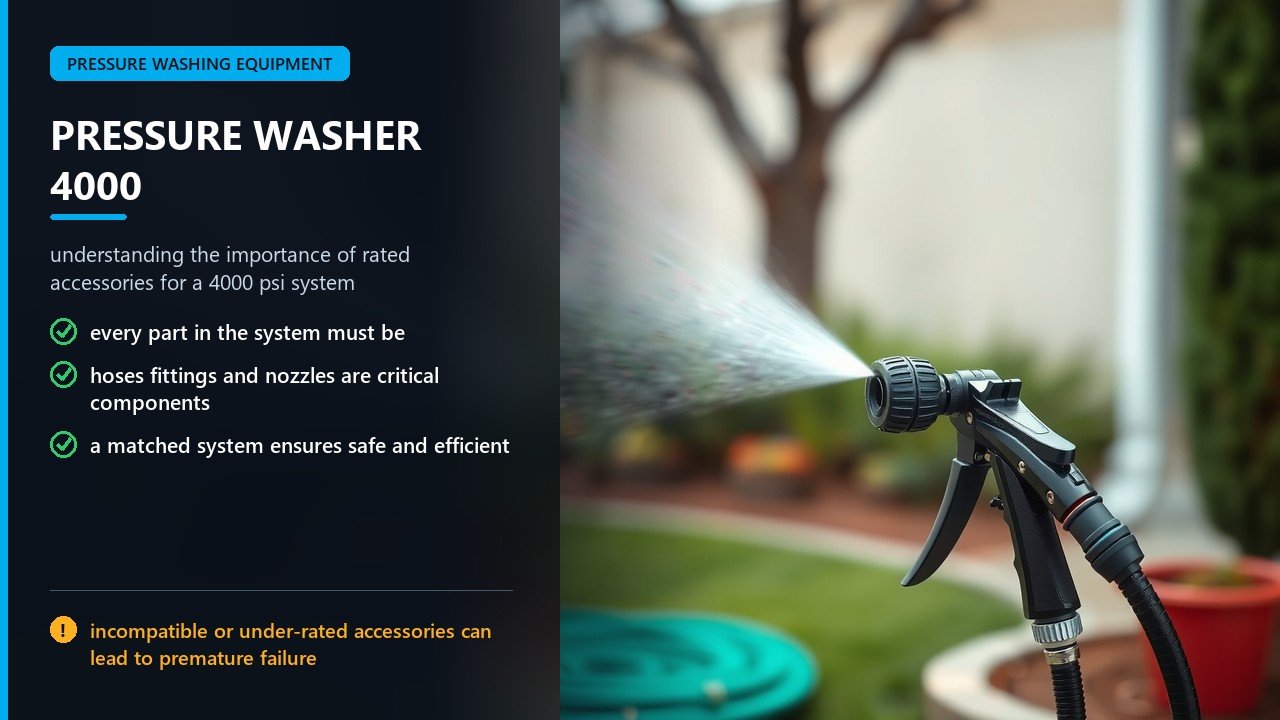
A System, Not Just a Machine
Water at 4000 PSI leaves the pump, travels through the high-pressure hose, into the spray gun, along the wand, and out the nozzle. Every one of those parts contains that pressure, so every one must be rated to withstand it. A machine at 4000 PSI connected to a hose rated for less is a failure waiting to happen, and the same is true of a bargain gun or a thin wand.
This is why manufacturers specify ratings on hoses and fittings and why cheap accessories carry low limits. The pressure rating of an accessory is its safe working maximum, not a suggestion. Matching the accessory to the machine’s output — or exceeding it — is what keeps the system intact.
The principle is simple: the system is only as strong as its weakest part. A premium 4000 PSI machine will leak at a cheap hose fitting and lose pressure through a worn nozzle, no matter how good the pump is. Buying the machine is the start; building a matched system around it is the rest.
The Parts That Must Be Rated
The table below lists the main pressure-carrying parts and what to check.
| Part | What to check |
|---|---|
| High-pressure hose | Rated at or above 4000 PSI; 3/8-inch for high flow; kink and abrasion resistant |
| Spray gun | Rated for the pressure; rebuildable valve; proper inlet connection |
| Wand | Rated steel or stainless wand; correct outlet for nozzles |
| Fittings and quick connects | Rated 4000 PSI or higher; brass, steel, or stainless as appropriate |
| Nozzles | Orifice matched to flow; rated for the pressure |
| Surface cleaner | Rated for the PSI and sized to the flow |
The pattern is that every part from the pump to the nozzle is under pressure, and each has its own rating. Some parts, like the hose and gun, see the full pressure continuously. Others, like a surface cleaner, must also be matched to the flow, not just the pressure, or they will not clean efficiently.
Rated Pressure vs Working Pressure
A term that confuses buyers is the difference between a fitting’s rated pressure and the working pressure it sees. The working pressure is the machine’s output — up to 4000 PSI. The rated pressure is the maximum the part is built to handle safely. A part is only safe to use if its rating meets or exceeds the working pressure.
Manufacturers also build in a margin, so a part rated at 4000 PSI is not at the edge of failure at exactly 4000 PSI. But that margin exists to absorb surges, water hammer, and temperature effects — not to let you connect a 2000 PSI hose to a 4000 PSI machine and hope. Using an accessory well below the machine’s rating removes the safety margin entirely and invites failure.
The same logic applies to temperature. A hose or seal rated for cold water at 4000 PSI may not hold the same rating when hot water is added, because heat softens materials and lowers their strength. If a machine runs hot water, both the pressure and the temperature ratings of every accessory matter, and O-ring material becomes important — Viton for heat, not standard Buna-N.
The Hose and Gun
The high-pressure hose is the most visible weak point. A 4000 PSI machine should use a hose rated at or above that pressure, and for high-flow machines a 3/8-inch hose is standard because it carries the volume without excess pressure loss. Steel-braided hose with a protective outer jacket resists kinks and abrasion, both of which weaken a hose and can lead to a burst.
The spray gun is next. Use a gun rated for the pressure with a proper inlet connection — often 3/8-inch for high-pressure hose. A rebuildable gun is worth choosing because its seals and valve can be serviced, rather than the whole gun being thrown away when it leaks. An under-rated or worn gun is both a performance problem and a safety risk at 4000 PSI.
Fittings and quick connects complete the chain. Use parts rated for the pressure — commercial quick connects commonly carry a 4000 PSI rating, and stainless steel reaches higher. The O-rings inside those fittings are the actual seals, so keep spares and replace them when they leak rather than overtightening the metal.
Nozzles and Surface Cleaners
Nozzles matter in two ways at 4000 PSI: the angle controls how aggressive the spray is, and the orifice controls how much water flows. The orifice must match the machine’s flow, or the machine will not deliver its rated performance — a too-small nozzle raises pressure beyond the rating, and a too-large nozzle drops it. For high-flow machines the orifice number is larger, and the tip should be rated for the pressure.
A surface cleaner is one of the best accessories for a 4000 PSI machine, but it must be matched to both the pressure and the flow. A cleaner rated below the machine’s PSI can be damaged, and one undersized for the flow will not clean at the machine’s full potential. Sized correctly, it cleans flat surfaces several times faster than a wand and leaves an even finish.
Keep a full nozzle set, a turbo or rotating nozzle for hard surfaces, and a spare of each wear item. These accessories are inexpensive, but using the wrong one at 4000 PSI can damage surfaces or the machine, so matching them properly is not optional.
Why Rated Parts Also Last Longer
Choosing rated accessories is not only about safety — it is also about cost over time. A part used far below its design intent is not a bargain; it is a part being pushed past its limit, and it will fail sooner. A cheap hose on a 4000 PSI machine may hold at first, but the constant pressure hastens wear, and a burst under load is both a repair bill and a hazard.
Properly rated parts, by contrast, run within their design envelope. They tolerate surges, temperature swings, and the ordinary strain of the job, so they last through far more hours of work. Over the life of a machine, a slightly more expensive rated hose, gun, or fitting usually costs less than replacing cheap ones repeatedly — and it removes the risk of a failure at a dangerous moment.
The same is true of rebuildable versus sealed components. A gun or pump that can be serviced lasts longer and costs less to keep running than a sealed part that must be replaced whole. When buying accessories for a 4000 PSI machine, favour parts that are rated correctly and can be maintained.
Building a Matched System
Building a matched system starts with the machine’s specs: its rated pressure, its flow in GPM, and — if it runs hot — its temperature. From those three numbers, every accessory can be chosen. The hose and gun must meet the pressure; the hose diameter and nozzle orifice must suit the flow; and all seals must handle the temperature.
Then standardise the connections. Converting every junction to a common quick-connect size makes swapping hoses, guns, wands, and nozzles fast and reliable, and it means fewer adapters and fewer potential leak points. Choose one size — often 3/8-inch for a machine at this level — and build around it.
Finally, keep spares. O-rings, a nozzle or two, and a spare hose are the parts most likely to fail, and having them on hand turns a stopped job into a quick fix. Because everything in the system is under pressure, replacing a worn part before it fails is both a maintenance habit and a safety one.
Protecting a 4000 PSI System
Once the system is matched and rated, protecting it is straightforward. Inspect the hose, gun, wand, and fittings regularly for cracks, bulges, leaks, and wear; a bulging hose or a weeping fitting should be replaced, not patched. Never attempt to repair a high-pressure component — always replace it with one rated at or above the machine’s pressure.
Use the correct nozzle for the flow, avoid long periods with the gun closed and the pump running, and never exceed the machine’s ratings by, for example, fitting a smaller nozzle to raise pressure. Keep the inlet water clean so grit does not damage fittings and seals, and flush the system after detergent so residue does not gum the gun and nozzle.
Store the hose, gun, and wand so they are not crushed or kinked, and winterize the whole system before freezing weather by draining the pump, hose, and any heater parts. A matched, rated, well-kept 4000 PSI system delivers its power safely and lasts for years; a mismatched one fails at the weakest part, usually sooner than expected.
Frequently Asked Questions
Do accessories need to be rated for 4000 PSI? Yes. Every part that carries the water — hose, gun, wand, fittings, nozzles, and surface cleaner — must be rated at or above the machine’s pressure, or it is the weak link that can fail.
What is the difference between rated and working pressure? Working pressure is what the machine produces (up to 4000 PSI). Rated pressure is the maximum a part is built to handle safely. The rating must meet or exceed the working pressure.
Can I use a cheaper hose on a 4000 PSI machine? No. A hose rated below the machine’s pressure removes the safety margin and can burst. Use a hose rated at or above 4000 PSI, ideally 3/8-inch for high flow.
Does temperature change the rating? Yes. Heat softens materials and lowers their strength, so both the pressure and temperature ratings matter on a hot water machine, and seals should be Viton rather than standard Buna-N.
How do I size a surface cleaner? Match it to both the machine’s pressure and its flow. One rated below the PSI can be damaged, and one undersized for the flow will not clean efficiently.
Why choose rebuildable accessories? A rebuildable gun or pump can be serviced with new seals rather than replaced, which costs less over time and keeps a good tool in service.
Can I repair a high-pressure hose or fitting? No. Never attempt to repair a high-pressure component. Always replace it with a part rated at or above the machine’s pressure.
How do I protect the system? Inspect parts for wear, replace rather than repair, use the correct nozzle, keep inlet water clean, flush after detergent, avoid dead-heading, and winterize fully.
Final Thoughts
A 4000 PSI pressure washer is a system, and its rating applies to every part in the water’s path. The hose, gun, wand, fittings, nozzles, and surface cleaner all have to be rated for the pressure — and, on a high-flow machine, matched to the flow as well. One under-rated accessory turns a capable machine into a failure waiting to happen.
Choose rated parts, standardise the connections, match the orifice and pressure to the flow, and keep spares on hand. Inspect and replace rather than repair, and protect the system with clean water, correct nozzles, and full winterizing. Built this way, a 4000 PSI setup delivers its power safely and lasts. For related reading, see our guides on a 4000 PSI pressure washer gun and a high pressure washer hose reel.