You buy a new foam cannon, or a surface cleaner, or a replacement gun, and you are sure it will fit your machine. Then you open the box, look at the connection, and realize it is completely different from what is on your wand. This happens constantly in pressure washing, because machines, guns, hoses, and accessories come from different makers using different standards. The fix is rarely a return and almost always a small, inexpensive part: an adapter. Knowing your way around pressure washer adapter fittings is what lets you connect mismatched components and build the setup you actually want.
This guide covers adapters in detail. We will explain why they exist, the common adapter types, the thread standards you will run into, how quick connect, hose, gun, and accessory adapters work, sizing, materials, how to prevent the leaks that adapters can introduce, and when to use one versus changing the component instead. By the end, you will be able to connect almost anything to almost anything, cleanly and without drips.
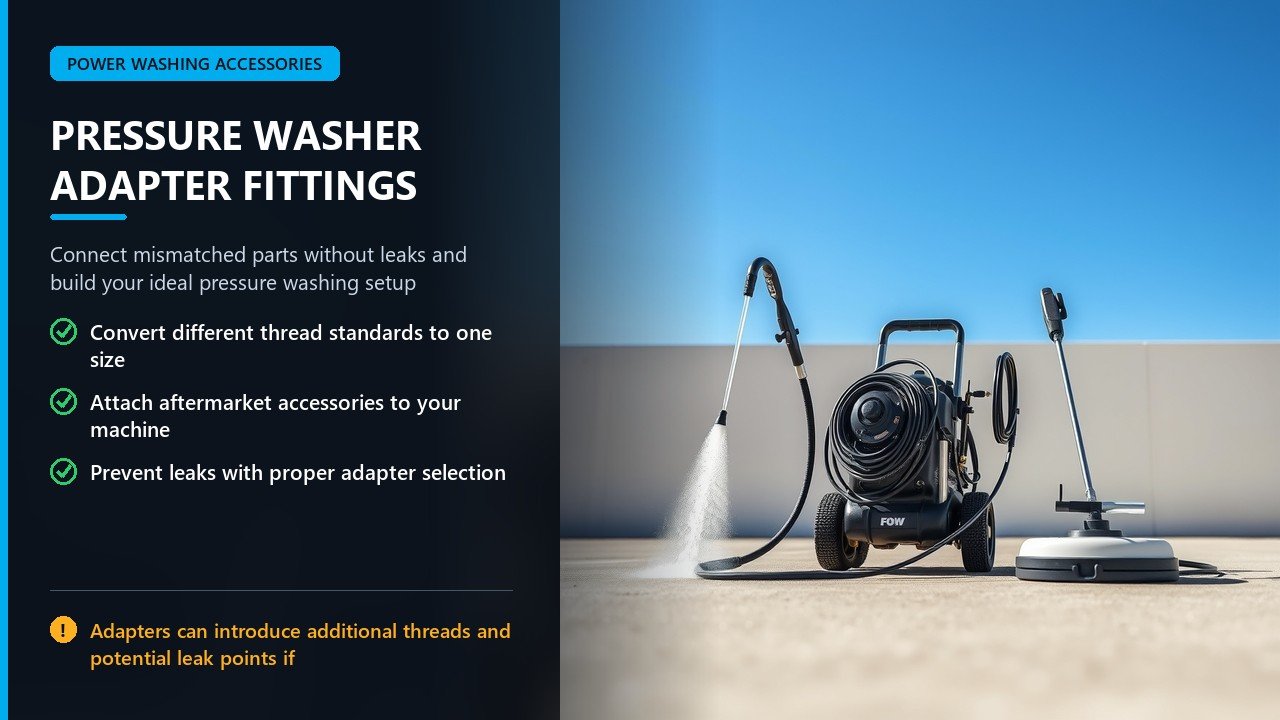
Why Adapters Exist
The pressure washing world never agreed on a single standard. Different manufacturers use different threads, sizes, and connection styles. On top of that, accessories are often made for the widest possible market, so they may not match your specific machine.
Adapters solve this by converting one connection type to another. They let you:
- Attach aftermarket accessories to your machine, gun, or wand.
- Connect hoses and guns from different brands together.
- Change sizes, such as stepping from 1/4 to 3/8 inch.
- Switch connection styles, such as M22 threaded to quick connect.
- Add comfort or function, through swivels and elbows.
Without adapters, you would be locked into a single brand’s ecosystem, which is exactly why they are so widely used.
Common Adapter Types
| Adapter Type | Converts | Typical Use |
|---|---|---|
| M22 to quick connect | Threaded pump/gun to quick connect | Attaching quick connect accessories |
| Quick connect to M22 | Quick connect to threaded | Connecting to threaded machines |
| Thread to thread | One thread standard to another | Metric to imperial conversions |
| Size reducers/bushings | Large to small (or reverse) | Matching diameters |
| Garden hose adapter | Garden thread to pump inlet | Connecting to a water supply |
| Swivel adapter | Adds rotation | Preventing hose twist |
| Elbow adapter | Changes direction | Relieving stress and kinks |
Most pressure washing setups end up using two or three adapters, usually where an aftermarket accessory meets the machine.
Thread Standards You Will Meet
Threads are where most confusion lives. The main standards in pressure washing are:
- M22 metric. Extremely common on pumps, hoses, and guns. M22 refers to the thread size, and the two common variants are M22-14 and M22-15, which differ slightly and are not always interchangeable.
- NPT (National Pipe Thread). A US standard seen on some machines and industrial equipment.
- BSP (British Standard Pipe). Common on imported equipment and accessories from certain markets.
- Garden hose thread (GHT). The standard for connecting to a home water supply.
Getting the thread standard right is essential. A metric adapter will not thread onto an NPT fitting, and forcing it cross-threads and ruins the connection.
Quick Connect Adapters
Quick connect fittings are the most common connection on the consumer side, and many adapters convert a threaded machine to accommodate them.
- M22 to 1/4 inch quick connect: Attaches quick connect guns, wands, and accessories to a threaded machine.
- 1/4 to 3/8 inch quick connect: Steps between the two common quick connect sizes.
- Quick connect to threaded: The reverse, for threaded accessories.
These are the workhorses of aftermarket compatibility. A single M22-to-quick-connect adapter can open your machine up to a huge range of accessories.
Hose and Gun Adapters
- Hose end adapters: Convert the hose connection to match a different gun or machine.
- Gun inlet adapters: Match a replacement gun to your existing hose.
- Swivels: Add rotation at the gun or hose to prevent twist and reduce strain.
- Elbows: Ease tight bends where the hose meets the gun.
Swivel adapters are especially valuable. They let the hose rotate freely, which prevents the stored twist that leads to kinks and premature hose failure.
Accessory Adapters
Aftermarket accessories are the most common reason people need adapters.
- Foam cannon adapters: Match a foam cannon to your gun, often M22 or quick connect.
- Surface cleaner adapters: Connect a surface cleaner to your wand or hose.
- Nozzle adapters: Change nozzle connection styles, such as threaded to quick connect.
- Water broom and undercarriage adapters: Attach specialty cleaning tools.
Because accessories are made for broad markets, a small adapter is frequently what makes them work with your specific machine.
Sizing at a Glance
| From | To | Common Adapter |
|---|---|---|
| M22 threaded | 1/4 inch quick connect | M22 to QC adapter |
| M22 threaded | 3/8 inch quick connect | M22 to 3/8 QC adapter |
| 1/4 inch QC | 3/8 inch QC | QC size adapter |
| Garden hose thread | Pump inlet | GHT to inlet adapter |
| Metric thread | NPT thread | Metric-to-NPT adapter |
Materials: What to Buy
| Material | Durability | Notes |
|---|---|---|
| Plastic | Low | Only for light use, cracks under pressure |
| Brass | High | The standard for quality adapters |
| Stainless steel | Very high | Best for hot water and demanding use |
| Zinc/coated | Moderate | Budget option, can corrode over time |
Brass is the go-to for adapters because it resists corrosion and holds up under pressure. Stainless steel is the best choice for hot water or the most demanding conditions.
Preventing Leaks With Adapters
Adapters can introduce leaks if chosen or installed carelessly. Avoid that with these practices:
- Match the thread standard and size exactly. This is the number one cause of leaks.
- Check the O-ring. Many adapters rely on an O-ring that can be missing or worn.
- Use sealing tape on threaded joints where specified.
- Do not overtighten. Excess force cracks metal and flattens seals.
- Clean the threads before assembly.
- Minimize the number of adapters. Each joint is a leak risk.
- Pressure test slowly and check every joint.
When to Use an Adapter vs Change the Component
- Use an adapter when the mismatch is minor and the running component is good, such as connecting an aftermarket foam cannon.
- Change the component when an adapter would add several joints in series, creating multiple leak points and restriction.
- Avoid stacking adapters. Two or three adapters chained together is a leak waiting to happen and can hurt flow.
Frequently Asked Questions
What are pressure washer adapter fittings used for?
They connect mismatched components, such as attaching an aftermarket accessory to your machine, joining hoses and guns from different brands, or converting between thread standards and sizes.
How do I know which adapter I need?
Identify the connection type and size on both ends you want to join, then choose an adapter that converts one to the other. Check the thread standard carefully, including M22 variants.
Are all M22 fittings the same?
No. M22-14 and M22-15 differ slightly and are not always interchangeable. Check which your machine uses before buying an adapter.
Can adapters cause pressure loss?
They can add minor restriction, and stacking several adapters compounds it. Keep adapters to a minimum and choose correctly sized brass or stainless parts.
What material are the best pressure washer adapters?
Brass is the standard for durability and corrosion resistance. Stainless steel is best for hot water and the most demanding conditions.
Final Thoughts
Pressure washer adapter fittings are the quiet enablers of a flexible setup. They let you attach the accessories you want, connect parts from different makers, and change sizes and standards without replacing good components.
Identify the exact connection type and size you are converting from and to, favor brass and stainless steel, mind the O-rings, and keep adapters to a minimum to avoid leaks and flow loss. Used wisely, adapters turn a rigid, single-brand machine into a system that fits your needs, no matter where the parts come from.