Every weekend, Tom dreaded cleaning his two-car concrete driveway. With just a wand and nozzle, it took nearly three hours of back-and-forth passes, and no matter how careful he was, he always ended up with faint streaks when he was done. One Saturday, a friend lent him a pressure washer attachments surface cleaner. In less than an hour, the same driveway looked perfectly even with no stripes at all. The only thing that changed was adding the right attachment.
The biggest time-saver for flat surfaces isn’t buying a bigger pressure washer — it’s buying the right attachment. A pressure washer attachments surface cleaner is the tool that turns slow, uneven wand work into fast, professional results. But a surface cleaner is just one of many useful attachments. This guide explains what a surface cleaner is, how it works, what other attachments are worth having, how to size them correctly, and how to get the most out of your pressure washer setup.
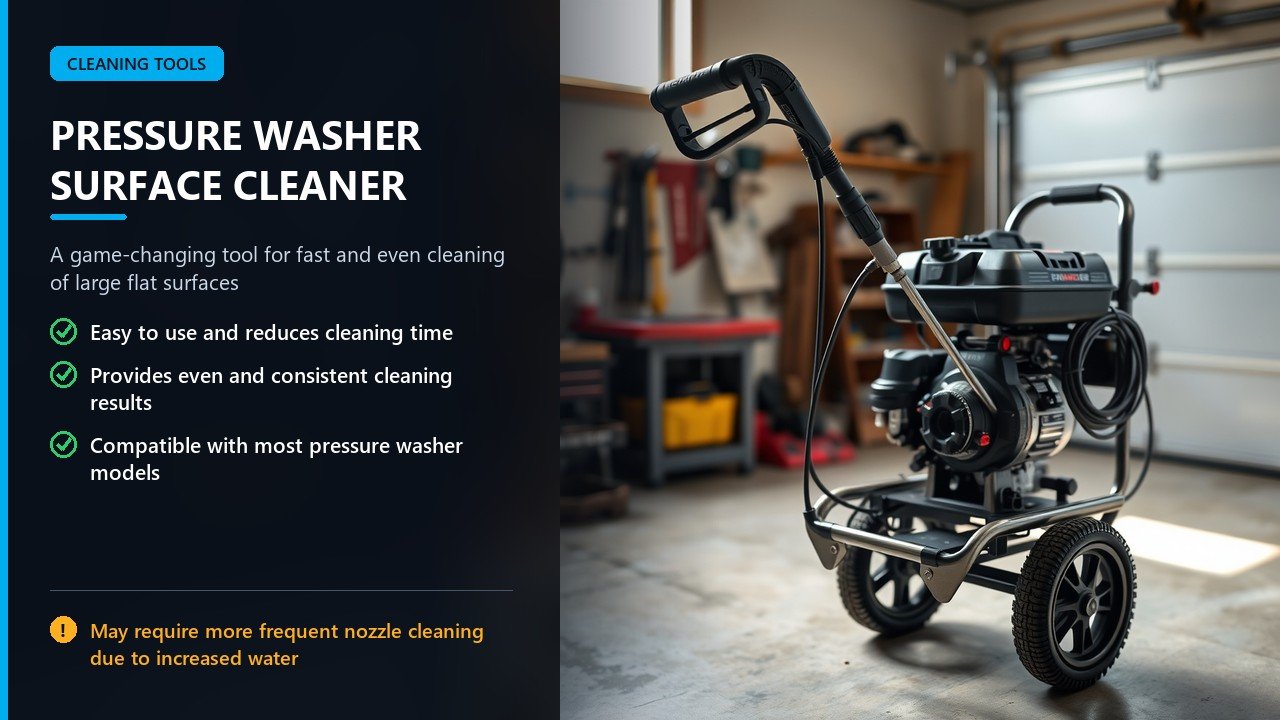
What Are Pressure Washer Attachments Surface Cleaner Tools?
The phrase “pressure washer attachments surface cleaner” refers to a round, deck-style attachment that connects to your spray gun or wand and cleans large, flat surfaces evenly. Instead of a single nozzle held by hand, the surface cleaner uses a rotating spray bar inside a sealed housing. As water pressure spins the bar, two or more nozzles sweep in a circle, covering a wide path with constant nozzle distance from the surface.
That constant distance is the key. With a wand, fatigue makes your height drift up and down, creating the zebra stripes everyone hates. A surface cleaner locks that height in place, so every pass blends evenly. It also contains overspray, keeps you drier, and moves water and debris across the slab instead of blasting it everywhere.
How a Surface Cleaner Works
Water enters the housing and spins a spray bar at high RPM. The bar holds two or more nozzles angled outward, so as they rotate they clean a circular path. The housing glides on wheels or floats slightly on water pressure, keeping the nozzles at the perfect standoff. You simply walk behind it in overlapping straight lines, and it cleans a much wider swath per pass than a wand ever could.
Because it covers more ground with consistent pressure, a surface cleaner cuts cleaning time dramatically on driveways, patios, sidewalks, and garage floors. For most homeowners, it is the single most valuable of all pressure washer attachments.
The Benefits of Adding a Surface Cleaner
The biggest benefit is speed. Most people report cutting flatwork time by 50% or more compared to a wand alone. You also get streak-free results, less operator fatigue, less overspray onto walls and plants, and more efficient water use since the housing keeps the spray focused on the surface. On large concrete slabs, the time savings alone usually pays for the attachment in just a few jobs.
Another benefit is safety and control. The housing keeps the high-pressure spray directed down at the slab, reducing the risk of accidentally spraying windows, siding, or people. It is simply a faster, cleaner, and easier way to handle big flat surfaces.
Other Must-Have Pressure Washer Attachments
A surface cleaner is the star for flatwork, but a few other attachments round out your setup. Quick-connect nozzle sets let you match spray angle to each job — 40° for delicate work, 25° for general, 15° for tough, 0° for spot work, and a soap tip for detergent. A turbo (rotary) nozzle is great for stubborn stains on hard, unpainted surfaces where a wand makes sense but you need extra bite. Extension wands help reach high siding or under vehicles without bending over constantly. A quality spray gun with a comfortable grip reduces fatigue on longer jobs. Surface cleaners are your main flatwork tool, but these other attachments cover everything else.
Matching Attachments to Your Pressure Washer
The most important rule with pressure washer attachments surface cleaner tools is matching to your machine’s GPM (gallons per minute) and PSI. Surface cleaners need enough flow to spin the spray bar at full speed. If your GPM is too low for the diameter, the bar spins slowly and leaves stripes. If it is matched correctly, it glides smoothly and cleans evenly.
As a general rule, plan for about 4 inches of cleaner diameter per 1 GPM of flow. For example, 3–4 GPM machines pair well with 12–16 inch cleaners, 4–6 GPM machines with 16–24 inch cleaners, and 6+ GPM with 24–30 inch cleaners. Always check the cleaner’s rated PSI and GPM range before buying to ensure it matches your pressure washer.
| Surface Cleaner Diameter | Minimum Recommended GPM | Best For |
|---|---|---|
| 8 – 10 inches | 1.5 – 2.0 GPM | Small patios, tight spaces |
| 12 – 16 inches | 3.0 – 4.0 GPM | Driveways, patios, walkways |
| 20 – 24 inches | 4.0 – 6.0 GPM | Large driveways, commercial |
| 28 – 30+ inches | 6.0+ GPM | High-volume commercial work |
What to Look For in a Surface Cleaner Attachment
Build quality matters. Look for a stainless steel or heavy-duty aluminum housing that can take years of use. The swivel is the most important moving part — choose one with quality bearings and seals that match your pressure and temperature. Non-marking casters make it glide easier and reduce fatigue on long jobs. A good brush skirt helps contain overspray and keeps debris contained under the deck. Also check that replacement parts (nozzles, swivel, spray bar) are easy to find, so you are not replacing the whole attachment when one part wears out.
For hot water pressure washers, make sure the swivel and seals are rated for hot water. For most homeowners with cold-water machines, standard seals are fine.
Surfaces to Use (and Avoid) With a Surface Cleaner
A pressure washer attachments surface cleaner works best on flat, hard, sound surfaces: concrete driveways, sidewalks, patios, garage floors, stamped concrete, and brick pavers. It gives the most value on large, open slabs where wand work is slow.
Avoid using a surface cleaner on vertical surfaces, very rough or crumbling concrete, softwood decks (unless you drastically lower pressure and test carefully), or delicate painted surfaces. For wood decks, most manufacturers recommend a wand with a wide fan tip at lower pressure instead. Always test in an inconspicuous spot first if you are unsure about a surface.
Tips For Getting The Best Results
Clear loose debris first with a broom or leaf blower. Pre-treat heavy stains or organic growth with an appropriate cleaner and let it dwell. Walk slowly and steadily, overlapping each pass by 2–3 inches. Work in straight, parallel lines from one end to the other. Do not rush — moving too fast is the most common reason for faint lines. Use your wand with a fan tip to clean edges, corners, and spots the round cleaner cannot reach. After cleaning, do a low-pressure rinse to push loosened debris off the slab.
Most importantly, match the surface cleaner diameter to your GPM. If the spray bar spins slowly or unevenly, your cleaner is likely oversized for your machine’s flow.
Maintenance For Your Attachments
Rinse your surface cleaner thoroughly after each use to flush grit out of the housing. Inspect nozzles for clogs or uneven wear — replace them as a matched set when worn. Grease the swivel if it has a fitting, or replace seals when you see leaks. Check casters, brush skirt, and fittings for damage. Store attachments in a dry place. A few minutes of maintenance will keep them spinning smoothly for many years.
Frequently Asked Questions
Are pressure washer attachments surface cleaner tools worth it? Yes, especially if you have a driveway, patio, or large concrete slab. They save hours of work and give streak-free results.
What size surface cleaner do I need? Match diameter to GPM: ~4 inches per 1 GPM. A 12–16 inch cleaner works well for most 3–4 GPM home pressure washers.
Can I use a surface cleaner on a wood deck? Usually not recommended. It can be too aggressive for softwood. Use a wide fan tip on a wand at lower pressure instead.
Will a surface cleaner work with my electric pressure washer? Yes, as long as the GPM/PSI ratings match the cleaner’s requirements. Electric washers in the 1.8–2.3 GPM range work best with smaller diameter cleaners (8–12 inches).
Do surface cleaners use more water? No, they use water more efficiently. The contained spray focuses water on the surface, so you usually use less total water and finish much faster than with a wand.
Final Thoughts
If you clean flat concrete more than once or twice a year, a pressure washer attachments surface cleaner is easily the best money you can spend on attachments. It eliminates striping, cuts your cleaning time in half, and makes the whole job far less tiring. Pair it with a few basics like the right nozzles and an extension wand, and you will have a complete setup that handles almost everything around your home with professional-looking results.