Soap and detergent are what turn a pressure washer from a water blaster into a proper cleaning system, and the bottle is where those chemicals live. Whether it is the small on-board detergent bottle, a foam cannon reservoir, or a refillable mixing bottle, choosing the right container makes cleaning easier, safer, and more effective. If you are looking for a pressure washer bottle, this guide explains the options.
We will cover the types of bottles, how detergent delivery works, dilution and mixing, compatibility with pressure washers, how to choose and clean bottles, and chemical safety.
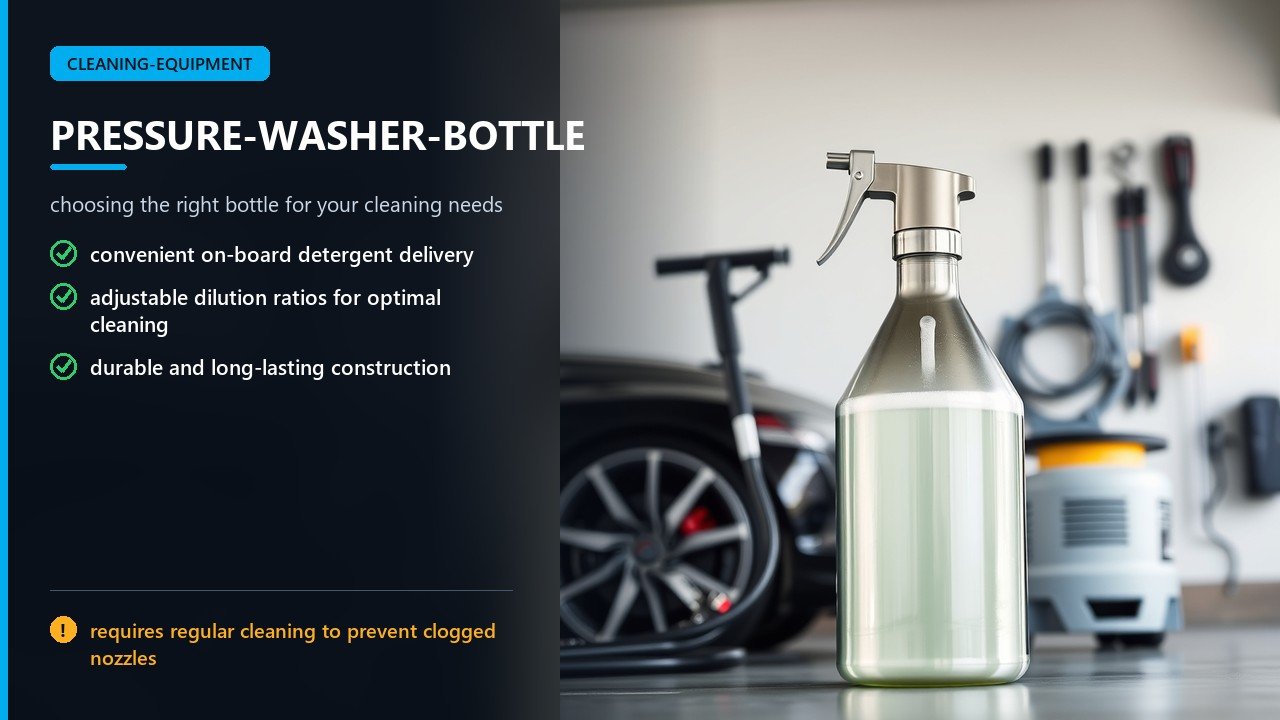
The Types of Pressure Washer Bottles
| Type | Purpose |
|---|---|
| On-board detergent bottle | Holds soap that is drawn into the stream |
| Foam cannon bottle | Holds soap for thick foam application |
| Downstream injector bottle | Feeds detergent into the stream at the gun |
| Mixing / dilution bottle | Used to pre-mix concentrate before filling |
| Spray bottle | For pre-treating spots by hand |
Quick Note: The right bottle depends on your method. On-board bottles are convenient for light jobs, while foam cannons deliver the thickest, most satisfying foam for vehicle cleaning.
On-Board Detergent Bottles
Many pressure washers include a small bottle or tank built into the frame. When a soap nozzle is fitted, the machine draws detergent and mixes it with the water stream.
- Convenient — soap is always on the machine.
- Limited capacity — often small, requiring refills.
- Fixed dilution — the machine sets the mix ratio.
- Best for light jobs — cars, furniture, and small areas.
On-board bottles use the pressure washer’s own flow to draw detergent, so no separate pump is needed. Dilution is set by the machine’s injector.
Foam Cannon Bottles
A foam cannon is a gun attachment with its own bottle and an adjustable mixing valve. It draws detergent and air into the stream to create thick foam.
| Feature | Details |
|---|---|
| Bottle capacity | Commonly 0.5–1 liter |
| Connection | 1/4-inch quick-connect |
| Foam control | Adjustable nozzle and air intake |
| Best for | Cars, trucks, and foam pre-soak |
Foam cannons are the most popular pressure washer bottles for vehicle cleaning, because thick foam clings to surfaces and lifts dirt before the rinse.
How Detergent Bottles Work
Most detergent bottles rely on a venturi effect. As water rushes past a narrow point, the pressure drops and draws soap up a tube from the bottle into the stream.
- Venturi draw — moving water pulls soap into the flow.
- Downstream method — soap is added after the pump, protecting the pump from chemicals.
- Upstream method — soap enters before the pump; less common and requires special pumps.
- Ratio control — set by the bottle’s metering or nozzle.
Note: Downstream injection is preferred because it keeps harsh chemicals out of the pump, where they can cause corrosion.
Compatibility and Materials
| Bottle Material | Notes |
|---|---|
| HDPE plastic | Common, chemical-resistant for many soaps |
| PET plastic | Clear, good for many detergents |
| Polypropylene | Good chemical resistance |
| Glass (rare) | Inert but breakable; not for field use |
Short Note: Match the bottle material to the chemical. Some aggressive solvents attack certain plastics, so always check the soap’s compatibility before filling an unfamiliar bottle.
Concentrates vs Ready-to-Use Soaps
Pressure washer soaps come as concentrates or ready-to-use liquids, and each suits a different user.
| Type | Pros | Cons |
|---|---|---|
| Concentrate | Economical; one bottle lasts long | Must be diluted correctly |
| Ready-to-use | Convenient, no mixing | Higher cost per wash |
| Powder | Compact storage | Allows mixing |
Note: Concentrates give the best value for frequent users, while ready-to-use soaps suit occasional users who value convenience over cost.
Filling and Using a Bottle
| Step | Action |
|---|---|
| 1. Read labels | Check dilution and safety guidance |
| 2. Pre-mix | Dilute concentrate with water if required |
| 3. Fill the bottle | Do not overfill |
| 4. Fit the tube and cap | Ensure the draw tube reaches the bottom |
| 5. Attach to the gun | Select the soap setting or nozzle |
| 6. Apply soap | Work bottom-up, then switch to rinse |
Apply soap at low pressure, let it dwell briefly, then rinse at high pressure. This sequence is the foundation of effective pressure-washer cleaning.
Cleaning and Storing Bottles
- Rinse after every use to prevent residue buildup.
- Flush the draw tube with clean water.
- Store bottles drained and dry.
- Label refill bottles so chemicals are never confused.
- Replace cracked or clouded bottles.
- Keep chemicals out of reach of children and pets.
- Store out of freezing temperatures if the liquid could expand.
A quick rinse after each use keeps bottles, tubes, and nozzles free of dried soap that would otherwise clog the system.
Choosing the Right Bottle
| Priority | What to Prefer |
|---|---|
| 1. Purpose | On-board, foam cannon, or mixing |
| 2. Fit and connection | Matches your gun or machine inlet |
| 3. Capacity | Enough for the job without frequent refills |
| 4. Chemical compatibility | Suits the soaps you use |
| 5. Adjustable ratio | Control over foam thickness and strength |
| 6. Durability | Thick plastic and good seals |
For most home users, a foam cannon bottle plus a simple mixing bottle covers nearly every need. Professionals may add larger on-board tanks and downstream injectors.
Detergent vs Sanitizer vs Degreaser
| Chemical | Use | Caution |
|---|---|---|
| Car wash soap | Vehicles and painted surfaces | Rinse before it dries |
| Heavy-duty degreaser | Engines, driveways, grease | Can damage paint and plants |
| Concrete cleaner | Flatwork and masonry | Follow dwell times |
| Sanitizer | Food-safe and high-touch areas | Use as directed; never mix chemicals |
| Mold / mildew cleaner | Siding and exterior surfaces | Protect skin, eyes, and plants |
Use a dedicated bottle for each type of chemical, label it clearly, and never combine different chemicals in the same container. Mixing can create dangerous fumes.
Common Mistakes to Avoid
- Using too much soap. Residue and streaks result.
- Letting soap dry on the surface. Causes stains and etching.
- Mixing chemicals in one bottle. Can create dangerous reactions.
- Using a bottle rated for the wrong chemical. Plastic may fail.
- Filling the bottle above the recommended line. Poor performance.
- Skipping the rinse and leaving soap to clog the tube.
- Leaving soap in over winter. Can freeze and crack the bottle.
Safety With Detergents
- Wear eye protection and gloves.
- Never mix chemicals. Especially never mix bleach with ammonia or acids.
- Work in ventilated areas.
- Protect plants and surfaces near runoff.
- Store bottles labeled and out of reach of children and pets.
- Dispose of rinse water responsibly.
Chemical safety guidance from the Centers for Disease Control and Prevention (CDC) and the Environmental Protection Agency (EPA) is worth reviewing before using unfamiliar products.
Routine Bottle Maintenance
- Rinse bottles and tubes after every use.
- Check the draw tube for cracks and residue.
- Clean the metering jet if flow drops.
- Store bottles upright and sealed when not in use.
- Replace caps and seals that leak.
- Keep spares of common bottle sizes for convenience.
Bottle maintenance is simple but easy to neglect. A few minutes of rinsing after each job prevents most problems.
Downstream Injectors Explained
A downstream injector is a device that draws detergent from a bottle or tank into the water stream after the pump. It is one of the safest ways to apply chemicals because the pump never touches them.
| Feature | Benefit |
|---|---|
| After-pump injection | Protects the pump from chemicals |
| Draw hose | Reaches into a bottle or tank |
| Metering tip | Sets the dilution ratio |
| Bypass trigger | Switches between soap and rinse |
Short Note: A downstream injector lets a single large reservoir replace a small bottle, which is handy for large jobs like siding or long driveways.
Foam Cannon Tuning
Getting thick, clingy foam from a foam cannon depends on a few settings.
- Soap concentration — a stronger mix yields thicker foam.
- Air intake — more air produces fluffier foam.
- Nozzle setting — controls spray pattern and fan width.
- Water hardness — hard water can reduce foaming; a water softener helps.
- Machine GPM and PSI — more flow generally means better foam.
Note: If foam is thin, increase soap concentration slightly before adjusting anything else. Small changes go a long way.
Bottle Cleaning Guide
| Part | Cleaning Method |
|---|---|
| Bottle body | Rinse with warm water |
| Draw tube | Flush and check for cracks |
| Cap and seals | Wipe clean; replace if stiff |
| Metering jet | Clear with a soft brush or pick |
| Nozzle | Rinse and clear any residue |
Residue buildup is the leading cause of poor soap draw. A short rinse after each use prevents nearly all of it.
Storing Chemicals Safely
- Keep original containers with intact labels where possible.
- Label any transfer bottles clearly.
- Store upright in a cool, dry place.
- Keep out of reach of children and pets.
- Never store near food or drink.
- Dispose of old chemicals properly per local rules.
- Avoid freezing where the container could crack.
Good chemical storage protects your family, your equipment, and the environment, and it keeps your soap ready for the next job.
Environmental Responsibility
- Direct runoff away from storm drains where possible.
- Use biodegradable soaps when cleaning outdoors.
- Avoid over-application. Use the mildest mix that works.
- Protect plants and waterways near the work area.
- Follow local regulations for wastewater.
Cleaning responsibly keeps the rinse water — and the chemicals in it — from harming lawns, gardens, and local water sources.
Real-World Scenarios
Scenario 1: A weekend car washer. A foam cannon bottle filled with a mild car soap transforms a basic wash into a thorough, swirl-free routine.
Scenario 2: A homeowner cleaning siding. An on-board bottle loaded with a mold and mildew cleaner makes short work of green algae on north-facing walls.
Scenario 3: A driveway detailer. A concrete cleaner in a mixing bottle, applied downstream and worked with a surface cleaner, lifts years of grime.
Bottle Sizes and Capacities
| Capacity | Typical Use |
|---|---|
| Small (under 0.5 L) | Spot treatments and small jobs |
| Medium (0.5–1 L) | Standard foam cannons and on-board bottles |
| Large (1–2 L+) | Bigger vehicles and surfaces |
| Tank systems | Commercial and high-volume work |
Choose a capacity that matches your typical job. Refilling often interrupts cleaning rhythm, but oversized bottles are awkward to handle.
DIY Soap Recipes vs Commercial Products
| Option | Pros | Cons |
|---|---|---|
| Commercial pressure-washer soap | Formulated for the job, safe and effective | Can cost more |
| Dish soap (diluted) | Cheap and available | Can strip wax; residue risk |
| Specialty cleaners | Targeted results | May harm some surfaces if misused |
Commercial products are formulated for pressure washers and surfaces. Homemade mixes can work but are riskier for paint and finishes.
Frequently Asked Questions
What is a pressure washer bottle? A container that holds detergent for application through the machine, a foam cannon, or a downstream injector.
Can I put any soap in the detergent bottle? Use pressure-washer-safe products, and never use bleach-based or corrosive cleaners unless the bottle and machine are rated for them.
How much soap should I use? Follow the product label and start mild. Too much soap leaves residue and streaks.
What is the difference between on-board and foam cannon bottles? On-board bottles feed the machine’s built-in injector; foam cannon bottles attach to the gun and produce thick foam.
Can I mix chemicals in one bottle? Never mix different chemicals. Some combinations are dangerous. Use separate, labeled bottles.
How do I clean the bottle? Rinse with clean water after each use, clear the draw tube, and let it dry before storage.
Final Thoughts
The pressure washer bottle is a small but important part of the cleaning system. The right bottle delivers soap reliably, protects your pump from chemicals, and makes every task faster and easier. Match the bottle to your method, dilute correctly, and rinse it after each use.
Never mix chemicals, always protect nearby surfaces and plants, and follow product labels. For related reading, see our guides on pressure washer water guns and attachments for power washers.