If you have ever looked at a set of pressure washer nozzle tips, you have seen a rainbow of colors, and that rainbow is not decoration. The pressure washer color code is a standard system that tells you, at a glance, the spray angle and how aggressive each nozzle is, which is essential for cleaning surfaces without damaging them. Knowing the color code lets you grab the right nozzle for the job, from tough concrete to a delicate car finish, without guessing or risking harm. While the colors are standard across most brands, there are details, variations, and safety rules worth understanding. This guide explains the pressure washer color code, what each color means, how to match colors to surfaces, and how to use them safely.
What the Color Code Is
The code maps color to spray angle.
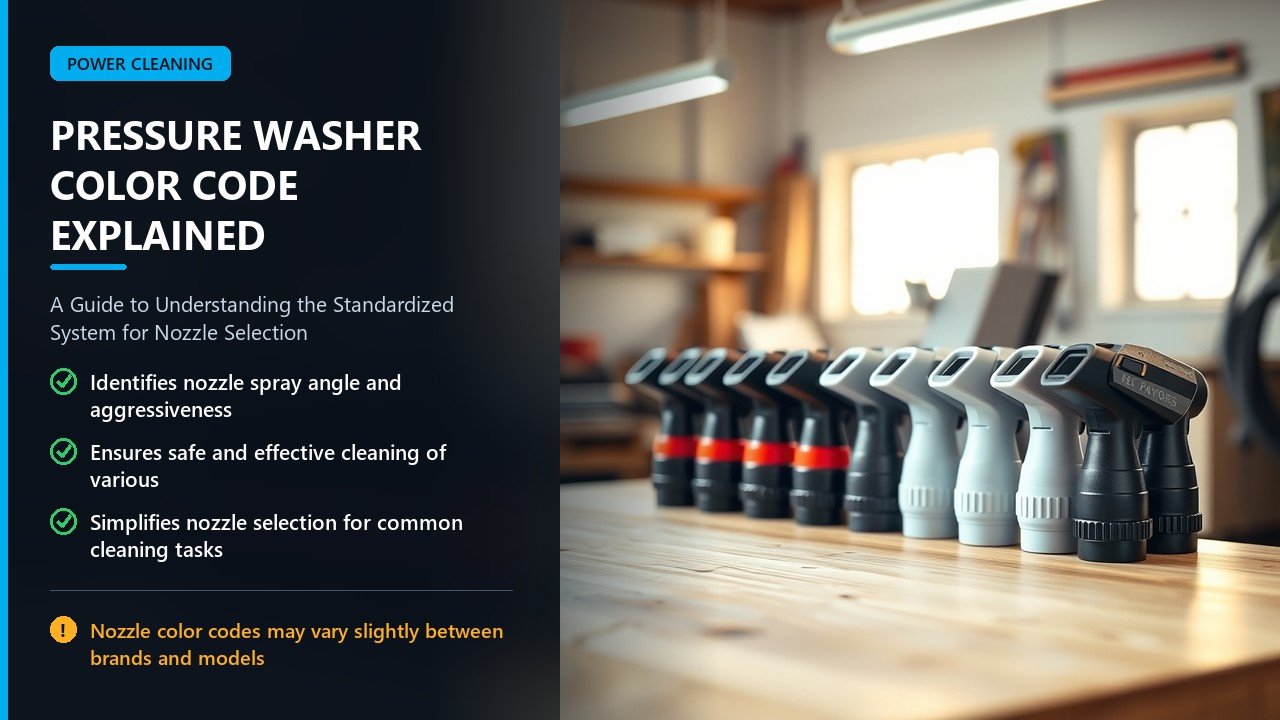
The pressure washer color code is a standardized system in which each nozzle tip is color-coded according to its spray angle, which determines how concentrated or spread the water is and, therefore, how aggressive the nozzle is. The angle is measured in degrees, ranging from 0 degrees, a tight, powerful stream, to wider angles that spread the water into a gentle fan, and the color tells you where each nozzle falls on that spectrum. Because the color directly indicates the angle, the code makes it easy to select the right nozzle for a surface without memorizing numbers.
The system is used by most pressure washer manufacturers, so a green nozzle from one brand generally corresponds to the same angle as a green nozzle from another, which makes the code a universal language for nozzle selection. This consistency is valuable, since it lets you understand any set of nozzles and choose appropriately. The code typically covers the five common nozzles, red, yellow, green, white, and black, though additional colors or specialty nozzles exist, and the core system is the foundation of safe, effective pressure washing.
Understanding the color code makes nozzle selection intuitive. Because each color corresponds to a spray angle and level of aggressiveness, and because the system is standardized, you can look at a nozzle’s color and know how to use it, which helps you clean each surface correctly and avoid damage. This is why the color code is worth learning, since it turns nozzle choice from guesswork into a quick visual decision. With the code in mind, the meaning of each color, and how to match it to a task, becomes clear. Our guide to nozzle washer covers the nozzle as a component.
The Five Standard Colors
Each color has a specific role.
Red (0 degrees). Red is the most aggressive nozzle, producing a tight, pencil-point stream that delivers the highest pressure at the surface. It is used for the toughest cleaning tasks on hard surfaces, such as stripping paint, removing stubborn stains, and cutting through heavy buildup, and it is also useful for clearing debris. Because it concentrates so much force, red can damage many surfaces and should be used with extreme caution, kept away from delicate materials and never aimed at people or pets.
Yellow (15 degrees). Yellow produces a narrow fan with strong pressure, more aggressive than green but less concentrated than red. It is used for heavy cleaning on durable surfaces, such as removing tough grime from concrete and stripping coatings, and it is a common choice when more force is needed. Like red, yellow is aggressive and should be kept away from delicate surfaces and used with care, since it can etch or damage materials that cannot handle high pressure.
Green (25 degrees). Green is the general-purpose nozzle, balancing pressure and coverage with a moderately narrow fan. It is the most commonly used nozzle, suited to everyday cleaning tasks like driveways, patios, decks, siding, and fences, where a mix of force and coverage works well. Green is a good default for most cleaning, though it is still powerful enough to damage delicate surfaces, so it should be used appropriately and not on cars or painted wood.
White (40 degrees). White produces a wide, gentle fan with lower effective pressure, making it the safest of the common nozzles for delicate surfaces. It is used for rinsing, cleaning cars and other finished surfaces, and any task where a soft touch is needed, and it is the nozzle to reach for when you are unsure or want to avoid damage. White spreads the water, reducing the pressure at the surface, which protects vulnerable materials while still cleaning effectively.
Black (soap). Black is the soap nozzle, a very wide, low-pressure spray used for applying detergent, often through the machine’s soap setting or a foam cannon. It spreads soap over a surface without pressure, allowing the detergent to dwell and loosen grime, and it is not used for rinsing or cleaning under pressure. Black is essential for the foaming and soap stages of a wash, and it pairs with the pressure nozzles for a complete cleaning routine.
| Color | Angle | Aggressiveness | Best Use |
|---|---|---|---|
| Red | 0 degrees | Most aggressive | Toughest spots on hard surfaces; extreme care |
| Yellow | 15 degrees | Strong | Heavy cleaning on durable surfaces |
| Green | 25 degrees | General-purpose | Everyday cleaning |
| White | 40 degrees | Gentle | Rinsing, delicate surfaces |
| Black | Soap | Low pressure | Applying detergent |
This table summarizes the five standard colors, their angles, and their roles, providing a quick reference for the pressure washer color code. Understanding each color lets you select the right nozzle for any surface, from the aggressive red for the toughest spots to the gentle white for delicate finishes and the black for soap. The code’s simplicity is its strength, and mastering it is the key to safe, effective pressure washing. Our guide to power washing nozzle tips covers the tips in more detail.
Matching Colors to Surfaces
The color guides safe cleaning.
Matching the color to the surface is what keeps pressure washing safe. For delicate surfaces, such as cars, painted wood, and anything finished or fragile, use the white (40-degree) nozzle, which is gentle, and keep the pressure low and the nozzle at a distance. For general cleaning of driveways, patios, decks, siding, and other moderately tough surfaces, the green (25-degree) nozzle is the everyday choice, offering a balance of cleaning power and coverage. For tough grime on durable surfaces, the yellow (15-degree) nozzle provides more force, and the red (0-degree) nozzle is reserved for the toughest spots on hard surfaces, used with great caution.
The soap stage uses the black nozzle to apply detergent before rinsing with a pressure nozzle, and the order of colors in a cleaning routine typically runs from soap to rinse to clean, using the appropriate angle for each surface. Beyond the color, distance and movement matter, since even a gentle nozzle held close can damage a surface, and keeping the nozzle moving prevents concentration. So the color is the starting point, and technique completes the safe approach, letting you clean each surface effectively without harm.
Matching colors to surfaces is the practical application of the code. Because each color corresponds to an aggressiveness suited to certain materials, choosing the right one for each surface cleans effectively and safely, and combining it with proper distance and movement prevents damage. This makes the color code a tool for both performance and protection. With the code and good technique, you can clean a wide range of surfaces with confidence. Our guide to nozzle size for pressure washer covers the orifice sizing that also matters.
Safety and the Color Code
Some colors demand respect.
The color code is also a safety guide, since the more aggressive colors carry more risk. The red (0-degree) nozzle is the most dangerous to surfaces and to people, capable of cutting skin and damaging materials, and it should never be aimed at a person, pet, or anything delicate. Yellow is also aggressive and can cause damage if misused. The general guidance is to use the widest nozzle that will do the job, reserving the aggressive colors for surfaces that can handle them, and to never point any pressure washer nozzle at a person or animal, since all pressure washer streams can cause injury.
Beyond surface damage, pressure washing poses injury risks, and the color code helps you manage them by indicating which nozzles are most forceful. Treating red and yellow with respect, wearing appropriate safety gear like eye protection, and never directing the stream at people or pets are essential practices. The color code, by signaling aggressiveness, thus serves both as a cleaning guide and a safety reminder, helping you choose nozzles that are appropriate and use them responsibly. Remembering that more aggressive colors mean more risk keeps the work safer.
Safety is integral to the color code. Because the aggressive colors carry more risk to surfaces and people, understanding that red and yellow demand caution, and always choosing the widest nozzle that works, keeps pressure washing safe. This connection between color and safety makes the code a valuable reference, reminding you to respect the powerful nozzles and to protect yourself and others. With this awareness, you use the code not just to clean well but to clean safely, which is essential. Our guide to rotary tip for pressure washer covers a specialized nozzle that is also aggressive.
Color Variations and Quick-Connects
Colors mean more than nozzles.
While the nozzle color code is standard, colors appear elsewhere on pressure washers, and understanding these helps avoid confusion. Quick-connect fittings and adapters are sometimes color-coded or marked to indicate size or type, though this varies, and the colors on the machine itself, such as on the casing or controls, often indicate functions rather than nozzle angles. Some brands also use additional or slightly different nozzle colors for specialty tips, such as a turbo or rotary nozzle, and the color conventions can vary in different regions, so it is worth checking your machine’s manual.
The safest practice is to rely on the standard color code for the common nozzles, which is widely consistent, and to consult the manual for any colors that do not match the standard, since a specialty or regional variation may apply. Keeping nozzles organized by color and knowing the standard meanings prevents mistakes, and being aware that colors also serve other purposes on the machine avoids confusion. So while the nozzle code is the primary use of color, knowing that colors appear elsewhere keeps you accurate.
Awareness of color variations completes the picture. Because colors are used for nozzles, fittings, and machine functions, and because regional and brand variations exist, relying on the standard code and checking the manual for anything unusual keeps you accurate. This prevents the mistakes that come from assuming every color means a nozzle angle. With this knowledge, you use the color code correctly in all its applications, and you avoid confusion. Our guide to high pressure washer nozzle covers nozzles for higher-pressure machines.
Why the Color Code Matters
The standard system has practical value.
The color code matters because it makes pressure washing safer and more effective. Without it, choosing a nozzle would mean remembering angles and their effects, and picking wrong could damage a surface or leave it dirty. The code reduces this to a glance, since the color tells you immediately whether a nozzle is gentle or aggressive, so you can match it to the surface without risk. This simplicity is why the code is universal, and it is a genuine aid to anyone using a pressure washer.
The code also matters because it is consistent across brands, so nozzles from different machines follow the same convention, and the knowledge transfers. This means you can buy a new machine or a replacement nozzle set and immediately understand the colors, which is convenient and reduces errors. For beginners, the code is especially helpful, providing a clear guide to safe nozzle selection, and for experienced users, it speeds up the work. The color code, in short, is a practical tool that improves the pressure washing experience.
Recognizing why the code matters encourages you to use it. Because it prevents damage and improves results, and because it is consistent and easy to learn, the code is worth mastering, and it makes nozzle selection intuitive. This applies to everyone, from first-time users to professionals, since the code saves time and protects surfaces. With an appreciation of its value, you use the code habitually, and your pressure washing is better for it. Our guide to pressure washer components places nozzles in the broader machine.
Choosing Nozzles for Common Jobs
Common tasks map to specific colors.
For common cleaning jobs, the color code provides a direct answer. Cleaning a concrete driveway or sidewalk, use a green (25-degree) nozzle for general cleaning and a yellow (15-degree) or a surface cleaner for tough stains, and consider a turbo nozzle for stubborn areas. Cleaning siding, use green and work carefully, keeping water out of seams, and use a wider nozzle for delicate siding materials. Cleaning a wood deck, use a white (40-degree) nozzle and low pressure to avoid damaging the wood, working with the grain.
Cleaning a car, use a white (40-degree) nozzle at low pressure, keep the nozzle at a distance, and use the black nozzle for soap, since cars demand gentleness. Cleaning patio furniture, grills, and outdoor items, a green or white nozzle depending on the material works well. Cleaning a roof, use low pressure only, since roofs are delicate and a soft-wash approach with detergent is preferred. For applying detergent on any surface, use the black soap nozzle before rinsing with the appropriate pressure nozzle. These mappings make the code practical for everyday cleaning.
Choosing nozzles for common jobs is where the code pays off. Because each task has a recommended color based on the surface and the aggressiveness needed, following the code cleans effectively and safely, from driveways to cars to decks. This makes the color code a practical guide rather than an abstract system, and it helps you approach any job with confidence. With the code and these mappings, you select the right nozzle quickly, and the results are consistently good. Our guide to surface cleaner washer covers the accessory that works with nozzles for large surfaces.
Caring for Color-Coded Nozzles
The nozzles need upkeep to work correctly.
Color-coded nozzles need care to maintain their performance, since a clogged or worn nozzle produces a poor spray regardless of its color. Keep nozzles clean by clearing the small orifice of debris with a nozzle cleaning tool or fine wire, and soak them in vinegar or a descaling solution to dissolve mineral buildup, which is common when the water supply is mineral-rich. Inspect them for wear and damage, since the orifice can erode over time, and replace worn or missing nozzles so the color still corresponds to a correct spray.
Store nozzles clean and organized, since they are small and easily lost or mixed up, and keeping them in a holder or case ensures you grab the right color and protects them from damage. Check that each nozzle is matched to the machine’s flow, since even the right color in the wrong size can affect performance and stress the pump. With this care, the nozzles keep their correct spray, and the color code remains a reliable guide, since a worn nozzle would otherwise no longer deliver the angle its color promises.
Caring for nozzles keeps the code trustworthy. Because a clogged or worn nozzle no longer sprays correctly, its color could mislead, so cleaning, inspecting, replacing, and storing nozzles properly maintains the relationship between color and performance. This care is simple but essential, and it ensures the color code works as intended. With well-maintained nozzles, every color delivers its expected spray, and the code remains a dependable tool for safe, effective cleaning. Our guide to nozzle washer covers cleaning and maintaining nozzles in detail.
Frequently Asked Questions About the Pressure Washer Color Code
What is the pressure washer color code? It is a standard system that assigns each nozzle color to a spray angle: red is 0 degrees, yellow 15, green 25, white 40, and black is for soap. The color tells you how aggressive the nozzle is.
What does each color mean? Red is the most aggressive, for the toughest spots on hard surfaces. Yellow is strong, for heavy cleaning. Green is general-purpose. White is gentle, for delicate surfaces and rinsing. Black is for applying soap.
Which color is safest for delicate surfaces? White (40 degrees) is the gentlest and safest for delicate surfaces like cars and painted wood. Always use the widest nozzle that will do the job to minimize the risk of damage.
Which nozzle color is the most dangerous? Red (0 degrees) is the most aggressive and dangerous to surfaces and people, capable of cutting skin. Use it only for the toughest spots on hard surfaces, with extreme care, and never aim it at people or pets.
Is the color code the same for all brands? For the common nozzles, yes, the standard is widely consistent, though some brands add specialty nozzles with other colors and regional variations may exist. Check the manual for anything unusual.
What is the black nozzle for? The black nozzle is the soap nozzle, a wide, low-pressure spray for applying detergent. It is used for the soap stage, not for cleaning under pressure or rinsing.
Final Verdict on the Pressure Washer Color Code
The pressure washer color code is a standard, color-based system that tells you the spray angle and aggressiveness of each nozzle, making it easy to select the right tip for any surface. Red is the most aggressive at 0 degrees, yellow is strong at 15, green is general-purpose at 25, white is gentle at 40, and black is for soap.
Match the color to the surface, using white for delicate surfaces, green for everyday cleaning, yellow for tough grime, and red only for the toughest spots with great care, and always use the widest nozzle that works to stay safe. Remember that the colors serve as a safety guide too, since the aggressive nozzles carry more risk. With the color code mastered, you choose nozzles quickly and confidently, cleaning effectively and safely with every color.