Every pressure washer is a chain of parts joined by fittings — the pump outlet, the high-pressure hose, the spray gun, the wand, and finally the nozzle. Each junction has to seal against thousands of pounds per square inch, and the wrong fitting there is the most common cause of leaks, spray failures, and damaged threads. Fittings look alike, but they are not interchangeable, and buying on looks alone is how a simple upgrade turns into a return.
This guide explains the fitting systems used on pressure washers, how to identify yours, and how to choose parts that actually connect and hold.
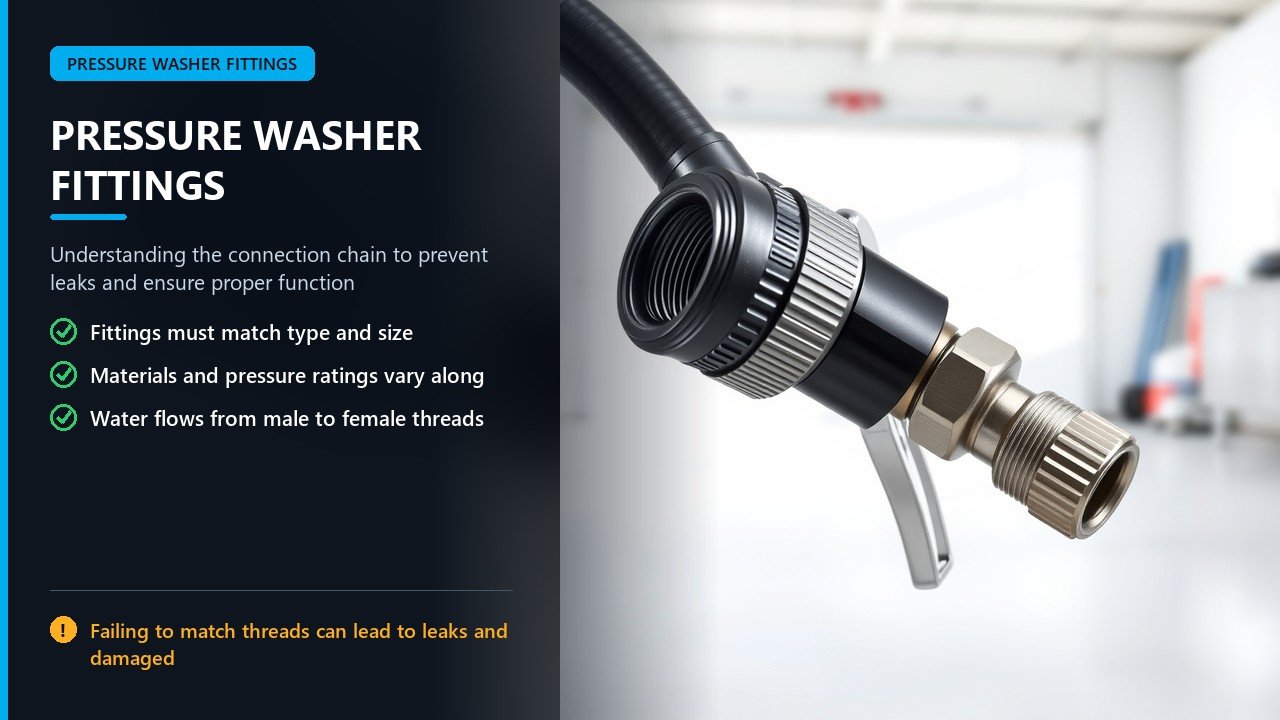
The Connection Chain
Water moves through the machine in a fixed direction: from the supply into the pump inlet, out the pump outlet, through the high-pressure hose, into the spray gun, through the wand, and out the nozzle. Each end of each part has a fitting, and they must match the part on either side in both type and size.
A useful rule is that water flows from male to female. Outlets are usually male and inlets female, so a pump outlet connects to a hose inlet, a hose outlet connects to a gun inlet, and so on. If a connection will not seal, the first thing to check is that you are joining a male thread to a matching female thread of the same standard.
The parts that join are not all under the same stress. The inlet side, fed by a garden hose, runs at low pressure, while everything from the pump outlet to the nozzle carries full working pressure. That difference in pressure is why fittings come in different materials and ratings along the chain.
The Fitting Systems You Will Meet
Pressure washers use a handful of connection systems, and mixing them is the source of most fitting problems. The table below covers the main ones.
| System | Where used | Notes |
|---|---|---|
| GHT | Pump inlet (supply) | 3/4″ garden hose thread; low pressure, seals with a rubber washer |
| M22 | Hoses, guns, wands | 22 mm metric; twist-on collar; 14 mm (gas/pro) or 15 mm (consumer electric) |
| NPT | Pumps, guns, ports | Tapered pipe thread; seals with tape or sealant; 1/4″ and 3/8″ |
| BSP | Imported/European gear | British thread; not compatible with NPT — never force together |
| Quick connect | Hose, gun, wand, nozzles | Push-and-click; 1/4″ light, 3/8″ heavy-duty, 1/2″ high flow |
The M22 system deserves special attention because of the 14 mm and 15 mm split. M22-14mm is the standard on most gas-powered machines and professional equipment, while M22-15mm is common on consumer electric machines. The two look similar but will not seal against each other — the connection will vibrate loose or leak badly. If your manual says M22 without a size, it is almost certainly 14 mm.
Quick Connects and O-Rings
Quick connects are the fittings that make a pressure washer convenient to use. They consist of a plug and a coupler, and they click together and release by pulling a collar. Unlike threaded fittings, they seal with an O-ring, so that small ring is the part doing the actual work — and the part that fails most often.
Quick connects are sized by their inner diameter, and the size must match the flow. The 1/4-inch size suits nozzles, light wands, and smaller machines. The 3/8-inch size is the heavy-duty standard, used to connect the high-pressure hose to the pump outlet and to the spray gun inlet. The 1/2-inch size is for large, high-flow commercial systems. Mixing sizes is no more possible than mixing threads.
The O-ring inside a quick connect is easily overlooked. Buna-N (nitrile) rubber is the standard and handles water and mild detergents well. For hot water or harsher chemicals, Viton is the better choice, and EPDM appears in some commercial fittings. A worn, cut, or missing O-ring is the usual cause of a quick connect that drips or pops apart under pressure, and replacing it is far cheaper than replacing the fitting.
Materials and Pressure Ratings
Fitting material decides how much pressure a connection can safely hold. Brass is common and corrosion-resistant, but standard brass fittings are typically used on the lower-pressure side of the machine — around 1,000 to 1,200 PSI — and are not meant for the full output of a high-pressure washer in every location. For the high-pressure side, steel and stainless steel are the safer choice.
Rated fittings in the M22 and quick-connect world commonly carry a 4,000 PSI rating, with stainless steel plugs and couplers reaching 5,000 PSI or more. A commercial-grade 3/8-inch stainless steel plug is the workhorse for high-pressure hose connections. Matching the rating to your machine’s output, not just the thread, is what keeps a connection safe.
Temperature matters too. Many standard fittings are rated to about 175°F, which is fine for cold water and most warm-water machines. A hot water pressure washer running at 200-250°F needs fittings and O-rings rated for that heat, which usually means stainless steel bodies and Viton seals.
Identifying and Matching Your Fittings
Before buying anything, identify what you have. Check the machine manual for the outlet thread, and look at the fitting on the part itself. Thread pitch, outer diameter, and whether the thread is tapered or parallel all matter. When in doubt, measure the fitting or search by your exact machine model and brand, because manufacturers vary more than the labels suggest.
Watch for proprietary connections. Consumer machines from some brands use bayonet-style or push-fit fittings that do not cross over to standard parts, and a few use proprietary quick-release systems with no standard adapter. For those machines, the only path is the brand’s own accessories or an adapter made specifically for that model.
Adapters solve most mismatches. If your pump outlet is M22-14mm male and you want a quick-connect system, an M22 female to 3/8-inch plug adapter converts it, and a matching coupler on the hose completes the change. Converting to quick connects at every junction — pump, hose, gun, wand, and nozzle — is the single best upgrade for convenience, because after that every part clicks on and off in seconds.
Common Fitting Mistakes
The first mistake is mixing thread standards. NPT and BSP threads are not compatible — NPT tapers and BSP is parallel — and forcing one onto the other strips the threads and guarantees a leak. The same applies to M22-14mm and M22-15mm, which will never seal together. Always confirm the standard, not just the size, before joining two parts.
The second is over-tightening. Threaded fittings that seal with an O-ring or a washer do not need to be cranked down; overtightening deforms the seal and cracks the fitting, especially brass. Conversely, NPT threads do need a sealant — pipe tape or paste — because they seal on the threads themselves, and skipping it produces a slow leak that worsens under pressure. Never put tape on a fitting that seals with a rubber washer or O-ring, as it only prevents the seal from seating.
The third is ignoring wear. O-rings harden, crack, and go missing, especially on quick connects that are clicked on and off constantly. A fitting that suddenly drips, spits, or disconnects under pressure is usually a worn O-ring, not a failed body. Keeping a small kit of spare O-rings — Buna-N for cold water, Viton for hot — prevents a job from stopping over a two-dollar part.
Preventing Leaks and Seized Threads
A few habits prevent most fitting trouble. Hand-tighten threaded connections, then snug them only slightly with a wrench; never overtighten brass. Clean the threads before assembly so grit does not damage them or defeat the seal, and use the correct sealant only where the fitting design calls for it. On garden hose inlets, check the rubber washer inside the female connection rather than adding tape.
Seized threads are another risk, especially where different metals meet, such as a steel hose end screwed into an aluminum wand. Moisture and pressure encourage galvanic corrosion that can weld the parts together. A wand saver — a small adapter fitted between the wand and the nozzle or gun — has a shoulder that protects the softer aluminum threads and gives you a sacrificial part to replace instead of the wand itself.
Keeping threads clean and covered, using matched materials where possible, and accepting that a cheap sacrificial adapter is cheaper than a ruined gun or wand will save money over the life of the machine. Most fitting damage is preventable with attention, not force.
What to Buy and Keep on Hand
A basic fitting kit pays for itself the first time something fails mid-job. Start with a set of quick-connect plugs and couplers in the size your machine uses — usually 3/8-inch for the high-pressure hose and 1/4-inch for nozzles and wands. Add adapters to convert your machine’s outlet and gun inlet to those quick connects if they are not already, and include a garden hose fitting with a screen for the pump inlet.
Carry spare O-rings in both Buna-N and Viton, a nozzle or two, and at least one wand saver. Choose rated parts — 4,000 PSI class brass, steel, or stainless steel — rather than bargain fittings that may fail at pressure. Match the material and rating to the side of the machine the fitting serves, and keep hot water parts specified for the higher temperature.
Buying fittings is less about guesswork than about reading what you have. Identify the thread standard and size at every junction, respect the pressure and temperature each one sees, and standardise on a quick-connect size you can reuse. Done once, that makes every future hose, gun, wand, or nozzle swap a five-second job.
Frequently Asked Questions
Are all pressure washer fittings the same? No. Systems include GHT, M22, NPT, BSP, and quick connects, and sizes have sub-types. Fittings must match in type and size or they will leak or fail to connect.
What is the difference between M22-14mm and M22-15mm? Both are 22 mm metric threads, but the internal post differs. M22-14mm suits most gas and professional machines; M22-15mm is common on consumer electric machines. They will not seal together.
Can I use NPT and BSP together? No. NPT is tapered and BSP is parallel, so they are not compatible. Forcing them damages the threads and causes leaks.
What is the difference between 1/4-inch and 3/8-inch quick connects? Size refers to the inner diameter. 1/4-inch suits nozzles and light wands; 3/8-inch is the heavy-duty standard for high-pressure hose connections; 1/2-inch is for high-flow commercial systems.
Why does my quick connect leak? Usually a worn, cut, or missing O-ring. Replace it with a Buna-N O-ring for cold water or Viton for hot water and harsh chemicals.
How much pressure can fittings hold? Rated M22 and quick-connect fittings commonly hold 4,000 PSI, with stainless steel reaching 5,000 PSI or more. Match the rating to your machine’s output.
Do I need sealant on fittings? Only on tapered threaded fittings like NPT. Do not use tape or sealant on quick connects or garden hose fittings, which seal with an O-ring or rubber washer.
How do I stop threads from seizing? A wand saver between the wand and the nozzle protects softer aluminum threads and gives you a cheap sacrificial part. Keep threads clean and avoid over-tightening.
Final Thoughts
Fittings are the small parts that decide whether a pressure washer runs smoothly or leaks at every joint. The key is to match the system, size, material, and rating at every connection along the chain — from the garden hose inlet through the pump, hose, gun, and wand to the nozzle. Most fitting trouble comes from mixing incompatible standards, using the wrong pressure or temperature rating, or neglecting the O-ring that does the real sealing.
Identify what your machine uses, buy rated parts for the side of the machine they serve, and standardise on a quick-connect size so everything clicks together. Keep spare O-rings and a wand saver on hand. With the right fittings, every accessory change becomes a seconds-long job instead of a fight. For related reading, see our guides on pressure washer gun attachments and the pressure washer spray wand.