Mobile car detailing is a business built on convenience. You bring the wash to the customer, whether that is a driveway, an office parking lot, or the side of a commercial building. That convenience depends entirely on the equipment you carry, and the pressure washer is the backbone of the setup. Choose the wrong machine and you either lack the power to clean properly or carry more than you need, wasting fuel, space, and time. A pressure washer for mobile car detailing has to balance power, water supply, portability, and safety for delicate paint, and that balance is what separates a smooth operation from a frustrating one.
This guide covers choosing and using a pressure washer for mobile detailing. We will cover what the work demands, electric versus gas, the specs that matter for cars, water supply on the road, the right nozzles and pressure, foam cannons and chemicals, safety for paint, setup and workflow, and buying tips. By the end, you will know how to build a detailing rig that delivers professional results anywhere.
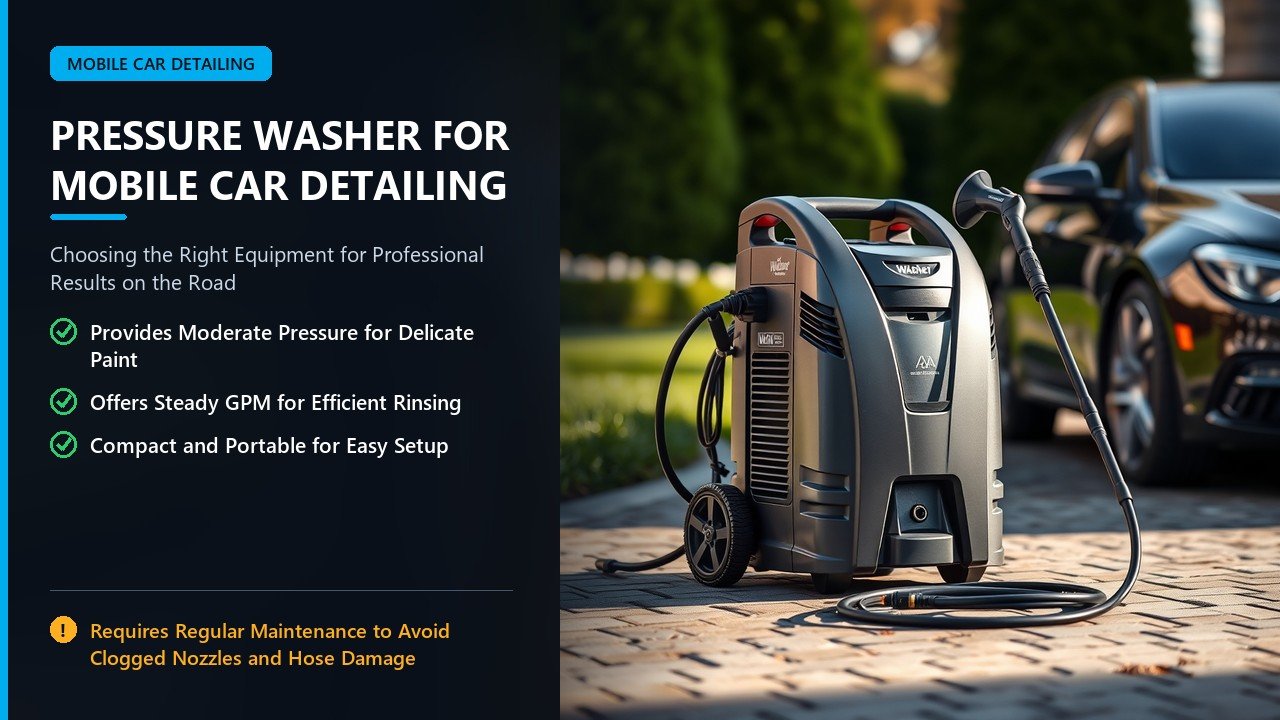
What Mobile Detailing Demands
Detailing cars is gentler work than stripping a driveway, but it has its own requirements.
- Control over pressure: Cars need moderate pressure and the right nozzles.
- Good flow: Rinsing and foam coverage benefit from steady GPM.
- Portability: Everything must fit and move efficiently.
- Water independence: Many sites lack a usable spigot.
- Chemical handling: Foam, soap, and rinse processes.
- Paint safety: Avoiding damage to clear coat and trim.
Electric vs. Gas
| Factor | Electric | Gas |
|---|---|---|
| Power | Moderate, plenty for cars | High, more than cars need |
| Noise | Quieter | Louder |
| Weight | Lighter | Heavier |
| Power source | Needs electricity | Fuel independent |
| Best For | Most mobile detailing | High-volume or multiple crews |
Many mobile detailers favor electric machines for cars because they are lighter, quieter, and powerful enough. Gas suits operations with heavy, continuous demand.
Specs That Matter for Cars
| Spec | Target for Detailing |
|---|---|
| PSI | Moderate, controlled by nozzle choice |
| GPM | Steady flow for rinsing and foam |
| Adjustability | Ability to reduce pressure |
| Portability | Light enough for mobile use |
| Nozzle variety | Wide angles for safe washing |
| Foam capability | Foam cannon compatibility |
Water and Power on the Road
- Water tank: For sites without a spigot, a tank makes you self-contained.
- Transfer pump: Ensures steady supply to the machine from the tank.
- Power: Electric machines need a power source or a generator.
- Battery options: Some electric machines offer battery or generator flexibility.
- Hose and reel: Compact, rated hose with a reel for quick setup.
Nozzles and Pressure for Paint Safety
- Use wider angles (white 40 degree and up) for general car washing.
- Avoid aggressive angles like red and yellow near paint and trim.
- Keep the nozzle at a distance to reduce impact.
- Never blast close to decals, badges, or damaged paint.
- Use a foam cannon to apply soap gently before washing.
Foam Cannons and Chemicals
- Foam cannon: Applies thick soap foam for a pre-wash that lifts dirt.
- Downstream injection: Draws soap into the stream through the machine.
- Proper soap: Use car-specific soaps, not harsh degreasers, on paint.
- Two-bucket method: Combine with hand washing for best results.
- Rinse thoroughly before and after contact washing.
Setup and Workflow
- Arrive and stage your equipment compactly.
- Pre-rinse the vehicle at low pressure to remove loose dirt.
- Apply foam and let it dwell.
- Wash gently using the two-bucket method.
- Rinse at moderate pressure with wide nozzles.
- Dry with proper towels or a blower to avoid water spots.
- Pack up and secure the rig for the next stop.
Common Mistakes
- Using too much pressure on paint and trim.
- Getting too close with the nozzle.
- Running out of water from an undersized tank.
- Using harsh chemicals not meant for car paint.
- Neglecting the machine between jobs.
- Ignoring water supply limits at the site.
Buying Tips
- Choose electric for most detailing, unless you need heavy continuous power.
- Prioritize adjustable pressure and good flow.
- Plan your water supply with a tank and transfer pump.
- Invest in nozzles and a foam cannon.
- Keep the rig compact and organized.
- Check parts availability and warranty.
- Consider total rig weight and setup time.
Frequently Asked Questions
What pressure washer is best for mobile car detailing?
An electric machine with adjustable pressure, steady flow, good portability, and nozzle variety suits most mobile detailing. Gas suits operations with heavy, continuous demand.
How much PSI do I need for car detailing?
Moderate pressure is plenty. Cars need control more than force, so choose a machine you can reduce and use wide-angle nozzles for safe, effective washing.
Can I detail cars without a water source?
Yes. A water tank with a transfer pump makes you self-contained, letting you work at sites without a spigot or with limited flow.
Will a pressure washer damage car paint?
It can if used too close or at high pressure. Use wide nozzles, keep a safe distance, keep the tip moving, and avoid damaged areas to protect paint and trim.
Do I need a foam cannon for mobile detailing?
A foam cannon is very useful for pre-washing, lifting dirt gently before contact washing. Pair it with car-specific soap and the two-bucket method for the best results.
Final Thoughts
A pressure washer for mobile car detailing has to balance power, portability, water independence, and paint safety. For most detailers, that means an electric machine with adjustable pressure, steady flow, a water tank, and the right nozzles and foam cannon.
Use wide angles and moderate pressure on paint, keep the tip moving, plan your water and power supply, and organize the rig for fast setup. Get the equipment right, and you can deliver professional results at any driveway or parking lot your customers send you to.