The spray gun is the command center of a pressure washer — the part your hands control and the place where every cleaning tool attaches. That is why pressure washer gun attachments can transform a basic machine. Swap a tip, add a turbo nozzle, clip on a surface cleaner, or mount a foam cannon, and the same gun suddenly handles jobs it never could before.
This guide covers the common gun-mounted attachments, how the connection systems work, which attachments suit which jobs, safety, and how to choose and maintain them.
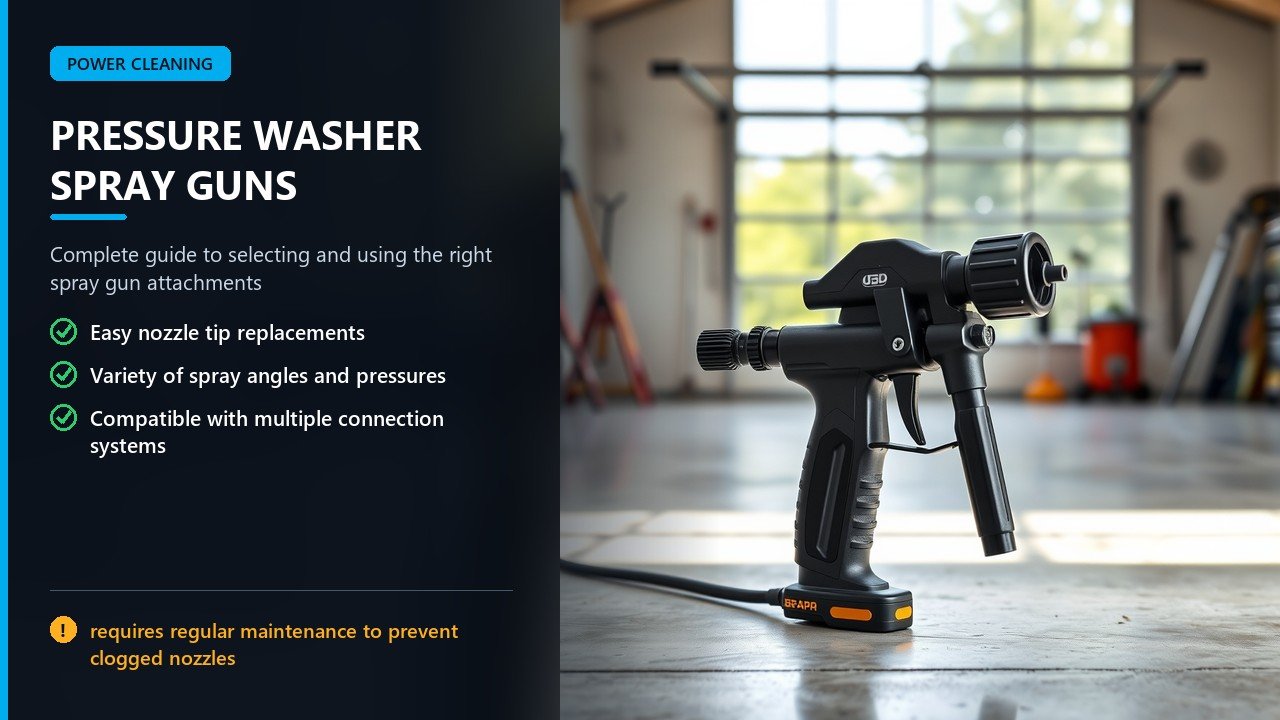
What Counts as a Gun Attachment
A gun attachment is anything that connects to the spray gun or its wand to change how water or detergent is delivered.
- Nozzle tips — set the spray angle and pressure.
- Turbo / rotary nozzles — spin the spray for extra force.
- Foam cannons — produce thick detergent foam.
- Surface cleaners — clean flatwork evenly.
- Brushes — scrub while spraying.
- Extension wands — add reach.
- Underbody / gutter cleaners — specialized tools.
Quick Note: Most attachments share one of a few connection types, so the first thing to learn is which system your gun uses.
Connection Systems
| Connection | Notes |
|---|---|
| Quick-connect (QC) | Most common; pop attachments on and off |
| M22 threaded | Common on hose-to-gun connections |
| Threaded (1/4-inch NPT) | Older wands and accessories |
| Bayonet / twist | Found on some brands |
Short Note: Quick-connect is the standard for accessories. If your gun lacks it, a 1/4-inch QC adapter converts it in seconds.
Nozzle Tips
| Nozzle | Spray Angle | Best Use |
|---|---|---|
| Red | 0° | Stubborn spots; high damage risk |
| Yellow | 15° | Tough grime on hard surfaces |
| Green | 25° | General cleaning |
| White | 40° | Rinsing and gentle work |
| Black / soap | Low pressure | Detergent application |
Nozzles are the cheapest, most useful gun attachments you can own. A full five-tip set covers almost every surface a home owner will face.
Turbo and Rotary Nozzles
| Feature | Detail |
|---|---|
| Action | Spinning jet patterns a tight circle |
| Effect | Feels like extra pressure without more PSI |
| Best for | Concrete, brick, and tough flatwork |
| Watch out for | Etching and striped marks if held still |
A turbo nozzle is a favorite upgrade because it makes a modest machine clean concrete like a much larger one, though it demands a steady hand.
Foam Cannons and Foam Guns
| Tool | Description |
|---|---|
| Foam cannon | Large reservoir; thick, clinging foam; best with higher flow |
| Foam gun | Smaller, attached to a garden hose; lighter foam |
Short Note: Foam cannons shine on higher-flow machines. On low-flow electric washers, a foam gun may actually produce better results.
Surface Cleaners
| Type | Best For |
|---|---|
| Water-broom / flat cleaner | Concrete driveways, patios, walkways |
| Rotary surface cleaner | Larger areas; spins on casters |
A surface cleaner is the single biggest upgrade for flatwork. It cleans faster and leaves fewer stripes than a wand alone.
Brushes, Wands, and Specialty Tools
| Attachment | Use |
|---|---|
| Fixed brush | Scrub and rinse in one pass |
| Rotary brush | Faster agitation on flat surfaces |
| Extension wand | Reach roofs, gutters, and high siding |
| Pivot / swivel joint | Easier under-vehicle and gutter angles |
| Underbody cleaner | Rinses the underside of vehicles |
| Gutter cleaner | Flushes gutters from the ground |
Specialty attachments turn one machine into a multi-purpose cleaning system, often for less than the cost of a second washer.
Matching Attachments to Jobs
| Job | Best Attachment |
|---|---|
| Driveway | Surface cleaner or turbo nozzle |
| Car wash | Foam cannon + 40° tip |
| Deck cleaning | Rotary brush + 40° tip |
| Siding | Extension wand + 40° tip |
| Gutters | Gutter cleaner attachment |
| Vehicle underbody | Underbody cleaner |
Because these tools share the same quick-connect system, you can switch jobs in seconds.
Adapters You May Need
- QC to M22 adapter for hose and gun ends.
- Threaded to QC adapter for older wands.
- Metric adapters for some imported machines.
- Swivel / pivot adapters for awkward angles.
- Wand extensions for extra reach.
- Nozzle holders to keep tips organized.
- O-ring kits to stop leaks at connections.
Note: Most “won’t fit” complaints come down to the wrong adapter. Identify your gun’s connection type first and buy accordingly.
Choosing Quality Attachments
| Sign of Quality | Why It Matters |
|---|---|
| Stainless steel nozzles | Hold a crisp spray pattern longer |
| Brass or stainless fittings | Resist corrosion and stripping |
| Proper pressure rating | Safe at the machine’s PSI |
| Good seals and O-rings | No leaks at joints |
| Compatible flow rating | Works with your GPM |
Cheap attachments often leak or lose their pattern quickly. Buying well-made versions saves frustration and water.
Safety With Gun Attachments
- Never point the gun at people or animals.
- Wear eye protection — debris ricochets.
- Use the trigger lock when not spraying.
- Check the pressure rating of each attachment.
- Beware of kickback with turbo nozzles and extensions.
- Keep both hands on the gun with long wands.
- Disconnect water before changing tips.
High-pressure spray causes serious injuries, and added reach or spin multiplies the risk. Follow the machine and attachment instructions, and for general context see the guidance from the Occupational Safety and Health Administration and the U.S. Consumer Product Safety Commission.
Maintenance and Troubleshooting
| Problem | Fix |
|---|---|
| Leaks at the connection | Replace or seat the O-ring |
| Weak, wobbly spray | Clear debris; replace the nozzle |
| Turbo nozzle stops spinning | Flush grit; often replaceable |
| Foam is thin | Adjust ratio; increase flow |
| Attachment won’t click on | Wrong connection type or debris |
Most attachment problems are small: a worn O-ring, grit in a nozzle, or the wrong adapter. Keeping spare O-rings and a nozzle cleaning tool solves most of them.
Common Mistakes to Avoid
- Using the wrong connection type. Buy the right adapter.
- Running below-rated attachments. They can burst.
- Holding a turbo nozzle still. Etches the surface.
- Forcing connections. Damages threads and O-rings.
- Ignoring O-ring wear. Causes constant leaks.
- Mixing brands blindly. Verify fit first.
- Using a 0° tip on soft surfaces. Causes instant damage.
Building a Starter Attachment Kit
| Priority | Attachment |
|---|---|
| 1 | Five-nozzle tip set |
| 2 | Turbo nozzle |
| 3 | Foam cannon or foam gun |
| 4 | Surface cleaner |
| 5 | Extension wand |
| 6 | O-ring and adapter kit |
Start with tips and a turbo nozzle, then add foam and flatwork tools as your jobs grow.
How Attachments Change Effective Pressure
The number on the machine is not the number at the surface. Nozzle angle, distance, and flow all reshape the cleaning force your gun delivers.
| Factor | Effect on Cleaning |
|---|---|
| Narrower nozzle angle | Concentrates force; more impact |
| Greater distance | Spreads and weakens the spray |
| Higher flow | Faster coverage and rinsing |
| Turbo nozzle | Adds perceived force without more PSI |
| Surface cleaner | Spreads force evenly; no streaks |
Short Note: Choosing the right attachment often matters more than upgrading the machine, because it changes how that pressure is applied.
Guns: Pistol Grip vs Rear-Entry vs Side-Entry
| Gun Type | Characteristic |
|---|---|
| Rear-entry | Hose enters the back; common on consumer units |
| Side-entry | Hose enters the side; easier wrist movement |
| Pistol / M22 | Standard threaded style; widely compatible |
A comfortable gun and a swivel connection reduce fatigue on long jobs, even before any attachment is added.
Thread and Adapter Reference
| Thread / System | Where You See It |
|---|---|
| M22 x 1.5 | Hose-to-gun and gun-to-wand on many machines |
| 1/4-inch NPT | Accessory threads on older equipment |
| Quick-connect (QC) | Tips, wands, and most attachments |
| M22 to QC plug | Adapter to use QC accessories |
Thread sealant tape is not usually needed on QC fittings but helps on threaded metal joints; check the manufacturer’s guidance before applying anything.
Using a Surface Cleaner Well
- Pre-treat the concrete with detergent.
- Keep an even, steady pace.
- Overlap passes by a few inches.
- Don’t tilt the unit. Keep it flat.
- Watch the flow rating. Too little GPM spins weakly.
- Work in sections and rinse as you go.
- Check the nozzles for even spray.
A surface cleaner is only as good as the flow behind it. On lower-GPM machines, expect slower progress and consider a smaller-diameter unit.
Detergent Delivery Through the Gun
| Method | How It Works |
|---|---|
| Built-in soap nozzle | Low-pressure tip draws soap |
| Downstream injector | Venturi draws soap after the pump |
| Foam cannon | Reservoir mixes soap and air |
| Foam gun | Garden-hose attachment; lighter foam |
Detergent plus dwell time often does more for a soiled surface than raw pressure, especially on vehicles and siding.
Caring for Quick-Connect Fittings
- Rinse the coupling before connecting to flush out grit.
- Push fully until it clicks — a partial seat leaks.
- Wipe the O-ring and inspect for nicks.
- Apply a little silicone grease to keep it smooth.
- Never force a mismatch. Get the right adapter.
- Cap exposed ends when stored.
- Replace couplings that no longer hold firmly.
Quick-connect fittings are what make gun attachments convenient, so a few seconds of care at each change keeps the whole system leak-free and reliable.
Real-World Scenarios
Scenario 1: A car detailer. A foam cannon plus a 40° tip turns a basic gun into a safe, effective washing setup, while a turbo nozzle handles the wheels.
Scenario 2: A homeowner facing a stained driveway. Adding a surface cleaner and turbo nozzle to the existing gun delivers even, streak-free results without buying a new machine.
Scenario 3: A two-story house owner. An extension wand and a pivot adapter let them reach siding and gutters from the ground, safely.
Attachment Compatibility Checklist
| Question | Why It Matters |
|---|---|
| What connection does my gun use? | Determines what fits directly |
| What is my machine’s PSI? | Attachments must be rated for it |
| What is my flow (GPM)? | Affects surface cleaner and foam performance |
| Do I need an adapter? | Most fit issues are solved with one |
| Is the wand removable? | Some tools attach to the wand, not the gun |
Answer these five questions and you will almost always buy the right attachment the first time.
Extending Attachment Life
- Flush attachments after use.
- Clean nozzles with a fine tool.
- Lubricate O-rings lightly with silicone grease.
- Store tools dry to prevent corrosion.
- Don’t overtighten threaded connections.
- Replace worn tips rather than forcing them.
- Keep a spare O-ring set.
Note: Attachments are cheap compared with the machine, but neglected ones leak, waste water, and clean poorly. A minute of care after each use keeps them working.
Frequently Asked Questions
What attachments fit my pressure washer gun? Anything matching your gun’s connection type — usually quick-connect — and rated for your machine’s pressure.
Are pressure washer guns universal? No. Connection types differ, but adapters let most attachments fit most guns.
What’s the single best gun attachment to buy first? A full nozzle tip set, followed closely by a turbo nozzle.
Can I use a foam cannon on any washer? Yes, but it performs best on machines with higher flow. Low-flow washers may do better with a foam gun.
Do surface cleaners fit all guns? Most use quick-connect and fit most guns, but a machine with good flow is needed for strong spin.
How do I stop leaks at the connection? Replace or reseat the O-ring, and make sure the fittings are clean and fully seated.
Final Thoughts
Pressure washer gun attachments are the fastest, cheapest way to expand what your machine can do. A tip set, a turbo nozzle, a foam cannon, and a surface cleaner cover the great majority of home and light commercial cleaning.
Know your connection type and flow, buy quality fittings, keep O-rings fresh, and respect the safety of high-pressure spray. For related reading, see our guides on the pressure washer water gun and attachments for pressure washers.